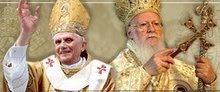
Saturday, December 1, 2007

"Christian roots aren't European"


Church's Roots Aren't European, Says Pope
Comments on Syriac Poet-Theologian

VATICAN CITY, NOV. 28, 2007 (Zenit.org).- Christianity didn't originate in Europe, but rather has its roots in the Middle Eastern world of the Old Testament, says Benedict XVI.
The Pope said this today during the general audience in Paul VI Hall, which he dedicated to the figure of St. Ephrem the Syrian, a fourth-century theologian, poet and musician.
He said the reflection continued along the lines of his commentary last week on the fourth-century Syriac Christian Aphraates, which also showed the cultural diversity of the early Christians.
"According to general opinion," said the Pontiff, "Christianity is a European religion that has exported the culture of this Continent to other countries. The reality, though, is a lot more complex, as the root of the Christian religion is found in the Old Testament, and therefore in Jerusalem and the Semitic world."
The Holy Father continued: "Its expansion during the first centuries was both westward -- toward the Greek-Latin world, where it then inspired the European culture -- and eastward to Persia and India, thus contributing to stimulate a specific culture, in Semitic languages, with its own identity."
St. Ephrem, said Benedict XIV, "was the most important representative of Syriac Christianity, and succeeded in a unique way to reconcile the vocation of the theologian with that of the poet."

Read Benedict's whole teaching on St. Ephrem here:
http://www.zenit.org/article-21138?l=english

An interesting new book


The following link has a nice excerpt from this new book offered by an exceptional publisher, Ignatius Press.

http://www.ignatiusinsight.com/features2007/areid_frwdgrkfathers_nov07.asp

Enjoy!

Wednesday, November 28, 2007

Christian dialogue with Islam...


Below are links to some really interesting articles by Sandro Magister, the author of a website out of Italy called "Chisea" (The Church). Article #3 is the most interesting, assuming you have some knowledge of the situation as a whole.

*You will have to copy and paste... sorry, I don't know how to work all this stuff yet!
#1: http://chiesa.espresso.repubblica.it/articolo/171166?eng=y
#2: http://chiesa.espresso.repubblica.it/articolo/173961?eng=y
#3: http://chiesa.espresso.repubblica.it/articolo/178461?eng=y

These articles are the most sensible dissection of what is going on in the dialogue between Christianity and Islam.

Remember that recently 138 Moslem (or Muslim, if you prefer) scholars sent a letter to leaders of Christian churches; this was primarily a response to the speech delivered at Regensburg University in Germany by Pope Benedict. This speech challenged both the modern, secular west and the radical east ('radical' Islam) to deal with the issue of faith and reason: can the two be compatible, and are they in fact essential for each others' existence? Benedict argues the latter, citing that God himself is Logos- the Word.

What Magister discusses is whether the latest ecumenical response from Christians to this letter is on topic: namely, faith and reason.

Monday, November 26, 2007

Pope Benedict's address on St. John Chrysostom


The Holy Father’s Letter on the occasion of the 16th Centenary of the death of St. John Chrysostom

The Holy Father Benedict XVI addressed bishops and all the faithful with a letter on the occasion of the 16th Centenary of the death of St. John Chrysostom, bishop and doctor of the Church. The Letter was released for the opening of the International Conference on St. John Chrysostom 1600th anniversary of his death, which took place at the Patristic Institute “Augustinianum” in Rome, from 8-10 November 2007.

Here's the entire text:
http://www.zenit.org/article-20599?l=english

Catholic - Orthodox dialogue snails along...


Here's the latest...

Catholic-Orthodox Dialogue Takes Important Step

Commission Recognizes Primacy of Bishop of Rome

VATICAN CITY, NOV. 18, 2007, (Zenit.org).- The Catholic-Orthodox theological commission's recognition of the primacy of the Bishop of Rome is an "important first step," says the director of the Vatican press office.

Jesuit Father Federico Lombardi said this in the latest edition of the weekly Vatican Television program "Octava Dies." He commented on the concluding document of the Oct. 8-14 plenary assembly of the Joint International Commission for Theological Dialogue Between the Catholic Church and the Orthodox Church, held in Ravenna, Italy.

The statement, titled "Ecclesiological and Canonical Consequences of the Sacramental Nature of the Church: Ecclesial Communion, Conciliarity and Authority," was published Nov. 15.

While the Vatican spokesman pointed out that the document also stipulated the need to study and understand the functions of the Bishop of Rome, how his primacy is to be exercised, and the scriptural and theological foundations of it, he added that this could be "an historical turn for the dialogue between Catholics and Orthodox."

"They delved into fundamental questions about the nature of the Church and they agreed that on every level -- local, regional and universal -- there is conciliarity, but also authority," said Father Lombardi.

He said that "the primacy at a universal level from ancient times of the Bishop of Rome was recognized. But there was no agreement on what his prerogatives are and on what theological and biblical bases these are founded."

Father Lombardi added that when the commission meets again in two years, it will study the theme of the primacy of the Bishop of Rome in the first millennium, "then there will be a need to study the second millennium and the councils that were held after the division between the Churches [...] to see what consensus can be reached."

Right direction

"It is a long and arduous road," said the spokesman, "but it is a road that is finally going in the direction that John Paul II wanted in 1995 with the encyclical 'Ut Unum Sint,' when he invited the separated brethren to dialogue on the theme of the Bishop of Rome's service to the universal Church."

"The historical problems of the division between the Catholics and the Orthodox have not been resolved," he added, "but a first step -- small but important -- in the right direction" has been taken.

Father Lombardi noted that, unfortunately, the representatives of the Patriarchate of Moscow were not present at the conclusion of the meeting, a reflection of old tensions between Moscow and Constantinople.

He said: "The road toward union does not regard only Catholics and Orthodox but also -- and sometimes more so -- it regards Orthodox and Orthodox, Catholics and Catholics.

"For all the pole of common attraction must be Jesus Christ, his mandate of love and his prayer 'that all be on.' Only if we all look first at Christ, can we hope that the long road will reach its goal."

Our latest selection...


Hey, fellas.

Our latest selection is proving to be very captivating read. It is interesting to see how similar Cyprian's criticisms of the Roman Empire are to what orthodox/traditional Christians would condemn in our own modern culture.

I have yet to read anything about the Church though... I guess I will have to keep reading.

Nota Bene: REMEMBER WE ARE ONLY READING UP TO PAGE 95. We will finish the book in December.

blessings,
Mike

Tuesday, August 28, 2007

Welcome to the site, gentlemen!


I intend for this to be a place where we can post comments, or begin a conversation before the actual meeting. We don't need to spend a lot of time here; it is simply meant to aid our discussion.

Thanks,
Mike