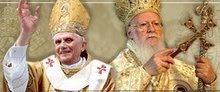
New York Bishops on Same-Sex "Marriage"
"We Stand Unified in Our Strong Opposition"
NEW YORK, JUNE 9, 2009 (Zenit.org).- Here is the statement the bishops of New York released June 1 on the proposed law that would legalize same-sex "marriage" in the state of New York.
* * *
We face today the prospect of a law in New York which would radically change the timeless institution of marriage. As pastors of citizens from every corner of our great state, we stand unified in our strong opposition to such a drastic measure.
Throughout history, different cultures have had different customs regarding marriage. But the one constant has been the conviction that marriage is the union of a man and a woman in an enduring bond, ordered for the procreation and stable rearing of children. Regrettably, the state Assembly has voted to redefine what nature and our common heritage long ago defined for us. We fervently pray that members of the state Senate will stand firm in opposition to this ill-advised legislation, and we call on Catholics and all New Yorkers to contact their Senators to make their voices heard.
Our opposition to this bill is based not only on Catholic teaching regarding human sexuality and the Sacrament of Marriage. Just as importantly, it is based on reason, sound public policy, and plain common sense, as we stated in our 2008 pastoral statement on same-sex “marriage.” To briefly reiterate, the state has a compelling legal interest in promoting marriage between men and women in order to create stable families and provide for the safety, health and well being of children. The state has no such compelling legal interest in recognizing a relationship between two people of the same sex.
If there are injustices against those in relationships other than marriage, those injustices can certainly be reformed and corrected in a way other than by drastically redefining marriage.
We close with a final point from our 2008 statement:
"(W)e want to make absolutely clear that our firm beliefs about marriage ... must not be misconstrued to be in any way a condemnation of homosexual people or an attack on their human dignity. Our Church teaches, and we affirm, that we must treat our homosexual sisters and brothers with dignity and love, as we would all God’s children. Indeed the Catechism of the Catholic Church warns that any form of prejudice or hatred – 'every sign of unjust discrimination' -- against homosexual people should be avoided" (CCC 2358).
Timothy M. Dolan
Archbishop of New York
Howard J. Hubbard
Bishop of Albany
Nicholas DiMarzio
Bishop of Brooklyn
Edward U. Kmiec
Bishop of Buffalo
Rev. Terry R. LaValley
Diocesan Administrator of Ogdensburg
Matthew H. Clark
Bishop of Rochester
William F. Murphy
Bishop of Rockville Centre
Robert J. Cunningham
Bishop of Syracuse
Showing posts with label liberalism/the left. Show all posts
Showing posts with label liberalism/the left. Show all posts
Wednesday, June 10, 2009

Sunday, April 26, 2009
The scandal of teacher unions...
From the Wall Street Journal:
"Teach for (Some of) America"
"Teach for (Some of) America"
Here's a quiz: Which of the following rejected more than 30,000 of the nation's top college seniors this month and put hundreds more on a waitlist? a) Harvard Law School; b) Goldman Sachs; or c) Teach for America.
If you've spent time on university campuses lately, you probably know the answer. Teach for America -- the privately funded program that sends college grads into America's poorest school districts for two years -- received 35,000 applications this year, up 42% from 2008. More than 11% of Ivy League seniors applied, including 35% of African-American seniors at Harvard. Teach for America has been gaining applicants since it was founded in 1990, but its popularity has exploded this year amid a tight job market.
So poor urban and rural school districts must be rejoicing, right? Hardly. Union and bureaucratic opposition is so strong that Teach for America is allotted a mere 3,800 teaching slots nationwide, or a little more than one in 10 of this year's applicants. Districts place a cap on the number of Teach for America teachers they will accept, typically between 10% and 30% of new hires. In the Washington area, that number is about 25% to 30%, but in Chicago, former home of Secretary of Education Arne Duncan, it is an embarrassing 10%.
This is a tragic lost opportunity. Teach for America picks up the $20,000 tab for the recruitment and training of each teacher, which saves public money. More important, the program feeds high-energy, high-IQ talent into a teaching profession that desperately needs it. Unions claim the recent grads lack the proper experience and commitment to a teaching career. But the Urban Institute has studied the program and found that "TFA status more than offsets any experience effects. Disadvantaged secondary students would be better off with TFA teachers, especially in math and science, than with fully licensed in-field teachers with three or more years of experience."
Read the rest here.
Saturday, April 25, 2009
Twittering church?

Trinity Church Wall Street...
After inventing the 'clown mass'; Trinity Church got another great idea...
As a follow-up to presenting the first-ever twittered Passion Play on Good Friday, Trinity Wall Street will now make its Sunday worship services at Trinity Church available via Twitter, the social networking site that allows users to update followers in short bursts of content. Beginning on Sunday, April 26, 2009, the historic church whose founding dates to 1697, will relay services in a series of "tweets" that capture the content of Sunday worship from opening procession and call to worship through scripture readings, the sermon, prayers of the people, and the Eucharist.
Designed to convey the depth and beauty of the liturgy and Holy Eucharist within Twitter's 140 character limit, Trinity's Twitter worship content will capture the essence of the service with truncated language from the Book of Common Prayer, the Bible, and the sermon.
Follow Twitter the Passion at twitter.com,twspassionplay and enable direct messages.
twspassionplayvia @_Peter_of_: is waiting in the courtyard of the High Priest Caiaphas. I ran scared when the officers came but I need to see how this ends.
8 minutes ago from GroupTweet
twspassionplay via @ServingGirl: Darkness and earthquake. I heard the curtain in the temple was torn in two. I wonder�
less than a minute ago from GroupTweet
twspassionplay via @Pontius_Pilate: They want this done by nightfall. I sent my soldiers to break the dead men�s legs. Are my hands clean of this?
less than a minute ago from GroupTweet
twspassionplayvia @ServingGirl: is so tired. Caiaphas and the priests have been up all night questioning a man who claims to be the Messiah. And I wait on them.
8 minutes ago from GroupTweet
twspassionplayvia @_JesusChrist: Let the scriptures be fulfilled. It is as the prophets wrote. I am who you say I am.
1 minute ago from GroupTweet
twspassionplayvia @_Peter_of_: is heartsick. I abandoned him. I denied him. I couldn�t believe it, even as the words came out of my mouth.
about 1 hour ago from GroupTweet
twspassionplay via @Pontius_Pilate: Bad feeling about this. The prisoner won�t talk. The priests accuse him of blasphemy and sedition, and he just stands there, waiting
about 1 hour ago from GroupTweet
twspassionplay via @Mary_Mother_Of: I have no peace, though I have talked with angels, and in my bones I know he is Emmanuel. It rips me to hear the crowds chant �Crucify him!�
about 1 hour ago from GroupTweet
twspassionplay via @Pontius_Pilate: What harm has this man done? Why does the crowd cheer on his murder? I wash my hands of this. They can do what they want
about 1 hour ago from GroupTweet
Friday, April 24, 2009
More 'global warming' shenanigans...
Washington, DC -- UK's Lord Christopher Monckton, a former science advisor to Prime Minister Margaret Thatcher, claimed House Democrats have refused to allow him to appear alongside former Vice President Al Gore at a high profile global warming hearing on Friday April 24, 2009 at 10am in Washington. Monckton told Climate Depot that the Democrats rescinded his scheduled joint appearance at the House Energy and Commerce hearing on Friday. Monckton said he was informed that he would not be allowed to testify alongside Gore when his plane landed from England Thursday afternoon.
“The House Democrats don't want Gore humiliated, so they slammed the door of the Capitol in my face,” Monckton told Climate Depot in an exclusive interview. “They are cowards.”
According to Monckton, Rep. Joe Barton (R-Texas), Ranking Member on the Energy & Commerce Committee, had invited him to go head to head with Gore and testify at the hearing on Capitol Hill Friday. But Monckton now says that when his airplane from London landed in the U.S. on Thursday, he was informed that the former Vice-President had “chickened out” and there would be no joint appearance. Gore is scheduled to testify on Friday to the Subcommittee on Energy and the Environment's fourth day of hearings on the American Clean Energy and Security Act of 2009. The hearing will be held in 2123 Rayburn House Office Building.
According to Monckton, House Democrats told the Republican committee staff earlier this week that they would be putting forward an unnamed 'celebrity' as their star witness Friday at a multi-panel climate hearing examining the House global warming bill. The "celebrity" witness turned out to be Gore. Monckton said the GOP replied they would respond to the Democrats' "celebrity" with an unnamed "celebrity" of their own. But Monckton claims that when the Democrats were told who the GOP witness would be, they refused to allow him to testify alongside Gore.
“The Democrats have a lot to learn about the right of free speech under the US Constitution. Congress Henry Waxman's (D-CA) refusal to expose Al Gore's sci-fi comedy-horror testimony to proper, independent scrutiny by the House minority reeks of naked fear,” Monckton said from the airport Thursday evening.
Read the Rest at Climate Depot; more links there too on 'climate change'.
Wednesday, April 15, 2009
Homeland Security vs. the conscience
From CNA:
From InsideCatholic:
Washington D.C., Apr 14, 2009 / 02:28 pm (CNA).- According to a Homeland Security Report distributed to law enforcement organizations, abortion opponents are as great a threat to national security in the immediate future as white supremacists.
The nine-page document was sent to police and sheriff's departments across the country on April 7 under the headline, "Rightwing Extremism: Current Economic and Political Climate Fueling Resurgence in Radicalization and Recruitment." The report is unclassified, but is accompanied by a warning that says it “contains information that may be exempt from public release under the Freedom of Information Act.”
The report was prepared by the Extremism and Radicalization Branch of the Department of Homeland Security and claims it was “coordinated with the FBI.”
“Rightwing extremists,” the document says, “have capitalized on the election of the first African American president, and are focusing their efforts to recruit new members, mobilize existing supporters, and broaden their scope and appeal through propaganda, but they have not yet turned to attack planning.”
Nevertheless, according to the report, the combination of a prolonged economic downturn, the election of the first African American President and the return of many veterans with "combat skills" could create an environment similar to the early 90's, which lead to the Oklahoma City bombing.
The report describes "Rightwing extremism" broadly as “those groups, movements, and adherents that are primarily hate-oriented (based on hatred of particular religious, racial or ethnic groups), and those that are mainly antigovernment, rejecting federal authority in favor of state or local authority, or rejecting government authority entirely. It may include groups and individuals that are dedicated to a single issue, such as opposition to abortion or immigration.”
Under the title “Revisiting the 1990s,” the report claims that “paralleling the current national climate, rightwing extremists during the 1990s exploited a variety of social issues and political themes to increase group visibility and recruit new members.”
“Prominent among these themes were the militia movement’s opposition to gun control efforts, criticism of free trade agreements (particularly those with Mexico), and highlighting perceived government infringement on civil liberties as well as white supremacists’ longstanding exploitation of social issues such as abortion, inter-racial crimes, and same-sex marriage.”
The report “is provided to federal, state, local, and tribal counterterrorism and law enforcement officials so they may effectively deter, prevent, preempt, or respond to terrorist attacks against the United States.”
From InsideCatholic:
Pro-Lifers On the Post Office Wall
Posted on April 14, 2009, 5:57 PM | Deal W. Hudson
The headline on the Drudge Report really didn't do justice to the content of the Homeland Security report issued by its new director, Janet Napolitano, warning against "right wing" terrorism.
Basically any interest group opposing the Obama administration is listed as potentially dangerous -- pro-lifers, anti-immigration activists, gun owners, and -- get this-- military veterans who find it hard to integrate into society upon their return from active service.
The report is being used, obviously, to set up hate crimes' legislation, supported by Obama, that would criminalize specific language used about, among other groups, homosexuals (yes, also lesbians and the transgendered).
The report describes right-wing extremism as "divided into those groups, movements, and adherents that are primarily hate-oriented (based on hatred of particular religious, racial or ethnic groups) and those that are mainly anti-government, rejecting federal authority in favor of state or local authority, or rejecting governmental authority entirely. It may include groups and individuals that are dedicated to a single issue, such as opposition to abortion or immigration."
Anti-government? Heavens, we better all get ready to bend our knee to the new administration or we will be accused of "rejecting federal authority."
(No wonder the great state of Texas passed a resolution today calling for state sovereignty!)
Single-issue? That should read a "crackdown" on Evangelicals and Catholics who care enough about the protection of human life, as quaranteed in the Declaration of Independence, to organize, educate, protest, and vote on the basis of the moral principle upon which all other moral principles are based.
Will Fr. Pavone's picture soon be hanging in the local post office? Or Fr. Euteneuer's, or Judie Brown's, or Congressman Chris Smith's.
The post office wall could become the place d'honneur during the Obama years.
Tuesday, April 14, 2009
Roofer speaks like a prophet
The roofer in New York, speaking about yuppie customers. This is hilarious and disturbing. From the New Yorker.
"They hire someone--this has happened several times--so they don't have to talk to me," he went on, growing more animated and reddening with amazement. "It's like they're afraid of me! So they hire a guy who's more comfortable dealing with a masculine-type person. I stand there and talk to the customer, and the customer doesn't talk to me or look at me, he talks to the intermediary, and the intermediary talks to me. It's the yuppie buffer." He wasn't slurring gay men--he described these customers as mainly "metrosexuals"--nor was the problem all yuppies, some of whom had been his customers for years. It was a new group who had moved from Manhattan in the past few years, and who could not detach themselves from their communications devices long enough to look someone in the eye or notice the source of a leak. This was a completely new phenomenon in the roofer's world: a mass upper class that was so immersed in symbolic and digital cerebration that it had become incapable of carrying out the most ordinary functions--had become, in effect, like small children with Asperger's symptoms. It was a ruling class that, out of sheer over-civilization, was quickly losing the ability to hold onto its power.
"What's going to happen if these people lose their jobs?" he said after we'd come down from the roof and were standing at the front door. "They can't do anything else. I'll tell you what they're going to do. They're going to look for help from the government. Socialism! And it's happening while we speak!"
Monday, April 13, 2009
Brooks on 'the end of philosophy' or 'the end of humanity'
The End of Philosophy by David Brooks (New York Times)
Socrates talked. The assumption behind his approach to philosophy, and the approaches of millions of people since, is that moral thinking is mostly a matter of reason and deliberation: Think through moral problems. Find a just principle. Apply it.
One problem with this kind of approach to morality, as Michael Gazzaniga writes in his 2008 book, “Human,” is that “it has been hard to find any correlation between moral reasoning and proactive moral behavior, such as helping other people. In fact, in most studies, none has been found.”
Today, many psychologists, cognitive scientists and even philosophers embrace a different view of morality. In this view, moral thinking is more like aesthetics. As we look around the world, we are constantly evaluating what we see. Seeing and evaluating are not two separate processes. They are linked and basically simultaneous.
As Steven Quartz of the California Institute of Technology said during a recent discussion of ethics sponsored by the John Templeton Foundation, “Our brain is computing value at every fraction of a second. Everything that we look at, we form an implicit preference. Some of those make it into our awareness; some of them remain at the level of our unconscious, but ... what our brain is for, what our brain has evolved for, is to find what is of value in our environment.”
Think of what happens when you put a new food into your mouth. You don’t have to decide if it’s disgusting. You just know. You don’t have to decide if a landscape is beautiful. You just know.
Moral judgments are like that. They are rapid intuitive decisions and involve the emotion-processing parts of the brain. Most of us make snap moral judgments about what feels fair or not, or what feels good or not. We start doing this when we are babies, before we have language. And even as adults, we often can’t explain to ourselves why something feels wrong.
In other words, reasoning comes later and is often guided by the emotions that preceded it. Or as Jonathan Haidt of the University of Virginia memorably wrote, “The emotions are, in fact, in charge of the temple of morality, and ... moral reasoning is really just a servant masquerading as a high priest.”
The question then becomes: What shapes moral emotions in the first place? The answer has long been evolution, but in recent years there’s an increasing appreciation that evolution isn’t just about competition. It’s also about cooperation within groups. Like bees, humans have long lived or died based on their ability to divide labor, help each other and stand together in the face of common threats. Many of our moral emotions and intuitions reflect that history. We don’t just care about our individual rights, or even the rights of other individuals. We also care about loyalty, respect, traditions, religions. We are all the descendents of successful cooperators.
Read the rest of this wretched but interesting piece here.
My commentary:
As science comes up with 'explanations' for why humans feel the need to be moral, the moral 'values' that we hold will become useless. This is because, as science will have proven, it's all biologically determined anyway. This sort of reasoning admits a limit on what is reason; reason is strictly limited to the verifiable or empirical. Science hasn't accounted for feelings like "patriotism", but as Brooks asserts, eventually it will. Hence the title: "The Death of Philosophy". How does this not give a person pause? Reason is limited to materialistic determinism? Say 'bye, bye' to philosophy, theology, and reason-based ethics. An "epochal" shift. I think the article should be titled: "The End of Humanity". Brooks doesn't seem to get where this is going.... the topic is "above his pay grade".
The scientists seek to pair human morality with the reigning dogma on evolution/chance. This, of course, is not science but ideology. How are terms of 'value' and 'morality' and 'purpose' scientific? Explain why it is valid for scientists to be theorizing about such topics. Brook's article assumes evolution of random chance is true (so much for God's creative Spirit), and is more interested in taking such a view into the realm of morality with metaphysical underpinnings. The article posits, at least the scientists (it seems to me that Brooks doesn't get it), that reason is the slave of emotions because that's the only account empiricism can make for any 'moral' judgments. It very much appears that the 'science' going on here in Brooks' piece is just what you rail against in the quote above. This is especially seen when Dr. Quartz moves from 'the brain processing info at a vast rate' to 'this is what the brain is for' (assigning purpose... but I thought we were just moving particles at random?) to assigning 'value' to 'this is how we make moral judgments'. Where did the science end and the philosophy begin? I don't know about you, but I find it absurd when humans are compared to bees, moral decisions to tasting food, and that adults are no more qualified to make moral judgments than babies (yes, the article asserts all of those things). Hence, Brooks notes in the conclusion that the proposition of the 'moral scientists' is "an epochal" change; aka kiss religion, reason based morality, and what Lewis calls "the Tao" goodbye. Forget "The End of Philosophy" and enter "The End of Humanity". Which reminds me, you need to read The Abolition of Man if you haven't already; it's a great account of reason based morality that gives a role to emotion that I think you will find interesting.
At this point, the more important discussion is about the Brooks piece, and it gets back to The Metaphysical Club as well as Neuhaus' brilliant summation of Rorty and liberal irony.
One must choose:
a) To be with the materialists asserting that man's reason is slave to the emotions, and morality is simply as pragmatism describes (ready, fire, aim); truth is also always evolving and in-flux and determined by the utility in any given time by 'majority' consensus. Reality is really just what man percieves in his own mind; it does not apply to others. Such claims foundationally are anti-institution, anti-tradition, and anti-religious; usually if not always they favor a radical and unbridled positivism in the academy/polis.
-or-
b) To be with the realists who believe that man ought to and can order his emotions by using right reason and conquer his appetites, striving for the good, true, and beautiful which exist 'out there' and is accessible by our (God-given) reason, and embodied in the eternal Logos (in this account one can still recognize that we often act on emotions without thinking.) Such claims are friendly to religions, traditions, and hierarchical institutions (they are also not 'western' arguments exclusively); positivism has its place, but it is ordered to right reason.
There is no half-way house between the two. It's option 'a' or 'b'. This is the crux of our entire discussion! Again, even Brooks sees it as "an epochal" change - hence the problems of modern education as Deneen, Fish, and many others argue. Neither choice gives any road to a 'third' option; they are diametrically opposed. I'm interested to see what your choice is, and why.
Saturday, April 11, 2009
Forcing students to condone homosexuality - EMU in Michigan
From CNA:
School faces lawsuit for dismissing student who refused to condone homosexuality
Ypsilanti, Mich., Apr 9, 2009 / 03:31 pm (CNA).- A lawsuit was filed against Eastern Michigan University on Thursday after school officials allegedly dismissed a student from the school’s counseling program for not affirming homosexual behavior as morally acceptable. The Alliance Defense Fund Center for Academic Freedom filed the lawsuit with the U.S. District Court for the Eastern District of Michigan on behalf of student Julea Ward.
EMU reportedly requires students in its counseling program to affirm or validate homosexual behavior within the context of a counseling relationship. It also prohibits students from advising clients that they can change their homosexual behavior.
According to the Alliance Defense Fund, Ward has never addressed homosexual behavior in any form during counseling sessions with her clients.
The school initiated a disciplinary process against Ward and reportedly said she could stay in the graduate school counseling program if she agreed to undergo a “remediation” program. According to the ADF, the program’s purpose was to change her belief system as it concerns counseling about homosexual relationships and to conform her beliefs to the university’s views.
Given the choice of voluntarily leaving the program or asking for a formal review hearing, Ward chose the hearing.
During the hearing, EMU faculty reportedly denigrated her Christian views and asked “several inappropriate and intrusive questions about her religious beliefs,” the ADF said.
Read the rest.
Wednesday, April 8, 2009
Modern liberalism and destruction of society...
Read here.
Here's a taste:
Here's a taste:
Modern liberalism is committed to the idea that no substantive objective norms exist, and that all value claims are therefore equally subjective, equally valid and equally empty. Liberalism is therefore really a philosophy of power. For if there are no objective limits to human volition (which is all that liberal freedom means), then for liberals will and self-grounding and self-validating choice is all there is. In a society without objective values, will and power become the only source of value. Finding itself confronted with the competing claims of isolated and potentially warring individuals, the liberal state thus takes the only path it can to ensure peace. It enforces a purely formal contractualist and utilitarian order, void of any notion of an inherent good or a guiding telos. This in turn ensures that the price of individual liberty is a purely notional equality, which cashes out as a liberal indifference to difference and the formal erasure of any cultural distinction in favour of an enforced judicial uniformity.
For example, the liberal state claims a purely formal equality without accounting for the real differences of culture, character or wealth. Failing to account for the latter ensures that all substantive issues are left to private contractual resolution - a relationship where the most powerful individual is always dominant. This is why liberal democratic states which promise a formal equality of opportunity are also synonymous with material inequality, the destruction of a plural and a high culture and the increasing rule of unprincipled elites. The liberal failure to think about community leaves less powerful individuals at the contractual mercy of the more potent; just as the liberal state destroys differential communities, as it believes that in order to secure equal rights we all have to be the same.
More:
I do not want to pretend that all was wrong in the late 1960s left. The opposition to the war in Vietnam seems just and noble, as does the campaign for civil rights and the advancement and liberation of women. Moreover, many of those on the new left were not cultural iconoclasts they also wished to preserve high culture and extend its benefit to all. However, what requires analysis is how this legacy decayed into mindless consumerism and an aggressive low culture founded on the hedonism of a relentless and mindless sexualisation of culture. A development that has robbed children of their childhood, freed men from any responsibility to women and condemned women to a male model of advancement at great cost to themselves and their offspring.
The victory of economic liberalism in 1979 could not have happened without the New Left's cultural libertarianism of the late 1960s. The cultural politics of the left was (and still is) in covert and complicit alliance with the neoliberal right. Through the late 1960s politics of desire, the left constructed the political anthropology of a wholly self-interested libertarian self. Not content with sidelining the autonomous institutions of the working class through the medium of the state, new left liberals set about destroying their collective culture of mutual and reciprocal virtue. Decrying the white working class as unfashionable, religious and reactionary, decadent middle-class elites looked with disdain on settled patterns of sexual codes, moral responsibilities and extended families. In the name of individual liberty, the avant garde licensed pornography, drugs and sexual experimentation as aesthetic forms of self-expression. But in so doing they commodified the human body and allowed the most exploitative forms of capitalism to shape and define sexuality, desire and human relationships. Such that at the end of the 1960s a new a-social being was created. Self-enclosed and relentlessly in search of glamour and stimulation, this new left creation sought a politics of limitless self interest. Defining all others by reference to itself, it considered any restriction on freedom as a violation of choice and a restriction of will. It was thought that both will and choice should be thoroughly unconstrained, and here we can see that left-wing values were already proto-Thatcherite and entirely neoliberal.
The left was fatally undermined when it embraced equality through the state and liberty through the individual - a paradigm that is liberal in origin and fatal to the idea of the communal. For unless community is thought of as the primary category, equality and liberty conspire against fraternity.
More:
Perhaps the least developed aspect of the current conservative renaissance is the most important: culture itself. Conservatism may well provide the institutions and funding for a revival of civil society, and if it limits the state to achieve this, then it might also, to attain a similar end, constrain the market. But what is most crucial is that we have a culture of interactivity and mutuality to fill this vacated space. Currently, with our emphasis on glamour and sedentary pleasure, we wholly lack any defenders of a high culture. Instead we have a debased public realm of constructed gratification and unreflective demand. High culture is high not because of any perceived elitism on the basis of class, but because the better is superior to the worse, and the good is desirable over and above any evil. We can have any form of public space we want, but unless the Conservatives really go back to the future and try to restore a common but high civilization, one that binds all Britons together in a vision of a culture worth participating and believing in, then we will fragment into the self-interested libertarian subjects that we so very nearly already are. A recovery of a national virtue culture is required. One that allows all the different cultures, races and creeds of modern Britain to eschew multi-culturalism and create a new binding common way of life of shared values and higher belief. For it is only on this basis that something called society can be restored.
Saturday, April 4, 2009
Vatican responds to Belgium's facism...
From CNA:
Vatican City, Apr 3, 2009 / 01:42 pm (CNA).- In response to Belgium’s diplomatic protest against Pope Benedict’s comments that condoms could potentially "increase the problem" of AIDS being spread in Africa, Father Federico Lombardi, director of the Holy See newsroom questioned whether the lawmakers had considered the Popes words and scientific research, or whether they received their information "through the non-objective, imbalanced filter of the echoes in the western media."
According to Reuters, the Belgium House of Deputies called the Pope’s comments "unacceptable" and instructed their government to "react strongly against any state or organization that in the future brings into doubt the benefit of using condoms to prevent transmission of the AIDS virus." [Satan, is that you?]
The measure approved with a strong majority, 95-18, and asks the government to "condemn the Pope’s unacceptable position statement and to lodge a formal protest at the Holy See." Premier Herman Van Rompuy said he will support the motion saying, "it is not the Pope’s job to shed doubts on public health policies which are unanimously supported and save lives ever day."
Father Lombardi, expressed "amazement" at the resolution, reported the Italian news service, SIR.
He questioned how a democratic country could limit the "freedom of the Holy Father and the Catholic Church to express their own positions" which are "clearly relevant to the view of the human person."
As Belgium reacted to the Pope’s comments, Lombardi pointed to "the great tradition" of the Catholic Church in "education and health-care, especially in the poorer countries" that needs no "evidence or comments."
Lombardi also questioned whether Belgium lawmakers had considered the "Pope’s arguments" and scientific research, or whether they received their information "through the non-objective, imbalanced filter of the echoes in the western media."
Wednesday, April 1, 2009
Stupid Obama? Stupid America?
Barack Obama's gift for the Queen: an iPod, your Majesty
Barack Obama met the Queen at Buckingham Palace today and gave her a gift of an iPod loaded with video footage and photographs of her 2007 United States visit to Richmond, Jamestown and Williamsburg in Virginia. In return, the Queen gave the President a silver framed signed photograph of herself and the Duke of Edinburgh - apparently a standard present for visiting dignitaries.
It is believed the Queen already has an iPod, a 6GB silver Mini version she is said to have bought in 2005 at the suggestion of Prince Andrew.
UPDATE: Pool reporter Richard Wolf of USA Today says that an Obama aide told him the President also gave the Queen a "rare songbook signed by Richard Rodgers". END UPDATE
Earlier, Mr Obama had spoken of his admiration for Her Majesty but indicated that his wife was handling the details of their royal meeting. "There's one last thing that I should mention that I love about Great Britain, and that is the Queen," he said at the end of his joint press conference with Gordon Brown.
"And so I'm very much looking forward to meeting her for the first time later this evening. And as you might imagine, Michelle has been really thinking that through -- because I think in the imagination of people throughout America, I think what the Queen stands for and her decency and her civility, what she represents, that's very important."
Mr Brown added: "Well, I know the Queen is looking forward to welcoming you and she's very much looking forward to her discussion with you."
There was widespread criticism in Britain and from Anglophiles in the US of Mr Obama's recent present to Mr Brown of a box set of classic American movies on DVDs that were not compatible with British DVD players.
Tuesday, March 31, 2009
Some thoughts on the Notre Dame/Obama scandal & Nienstedt's letter
Just a couple further thoughts on the ND scandal...
Below is a letter from Arch. Nienstedt on the whole Obama/Notre Dame issue.
The bishop sees the bigger picture, I think.
A few things need to be considered on this issue:
-Obama is receiving a 'honorary doctor of law' degree; he promotes laws that
disregard human life, and are an affront to human dignity (gay marriage, etc.).
-Obama is the most anti-life president in history, and this is only 100 days into his
presidency. The ignorant speech he gave about stem cells is enough to
make George Bush look like a philosopher at a prestigeuos university. He also
said we ought not 'politicize science'- basically that means no ethics bind science?
-Obama has a penchant for nominating unfaithful 'Catholic' politicians to his cabinet;
this is a total embarassment and affront on the Church. The message of this is clear:
you don't have to pay attention to your bishop or Rome, we are the authority.
-Times have changed. In the past, everyone expected a lack of fidelity after the council;
this is no longer the case. Vatican II is now becoming more and more clear, thanks
to JPII and BXVI. The post conciliar Church was not pressing the 'reset' button
on doctrine and tradition as the progressivists have pushed for 40 years.
-Although ND has invited presidents to speak since Jimmy Carter,
one cannot simply look to past precedent; past precedent (Carter & Clinton) displays two
presidents who did not respect human life and should not have been honored. It is time
that the Church break from tradition (that of the last 40 years), a tradition of relativism
and infidelity to authentic teaching. It is one
thing to allow a president to speak at a Catholic school, but another to give them an
honoring and let them speak from the pulpit after mass and at commencement.
This has nothing to do with academic freedom, but the promotion of 'worldly' ideas and bowing
down to 'the world'. ND has been doing this since the Land O' Lakes decree under Hessburg.
ND would rather be a second rate Harvard, than the #1 Catholic university.
-This is a teaching moment, and everyone is paying attention. To waffle on this very clear
issue is to promote pusilanimity and infidelity to Church teaching.
-Lastly, here's Obama's anti-life record.
So, I think this is a big deal and dispicable if ND goes through with it.
Neinstedt's letter is below.
Below is a letter from Arch. Nienstedt on the whole Obama/Notre Dame issue.
The bishop sees the bigger picture, I think.
A few things need to be considered on this issue:
-Obama is receiving a 'honorary doctor of law' degree; he promotes laws that
disregard human life, and are an affront to human dignity (gay marriage, etc.).
-Obama is the most anti-life president in history, and this is only 100 days into his
presidency. The ignorant speech he gave about stem cells is enough to
make George Bush look like a philosopher at a prestigeuos university. He also
said we ought not 'politicize science'- basically that means no ethics bind science?
-Obama has a penchant for nominating unfaithful 'Catholic' politicians to his cabinet;
this is a total embarassment and affront on the Church. The message of this is clear:
you don't have to pay attention to your bishop or Rome, we are the authority.
-Times have changed. In the past, everyone expected a lack of fidelity after the council;
this is no longer the case. Vatican II is now becoming more and more clear, thanks
to JPII and BXVI. The post conciliar Church was not pressing the 'reset' button
on doctrine and tradition as the progressivists have pushed for 40 years.
-Although ND has invited presidents to speak since Jimmy Carter,
one cannot simply look to past precedent; past precedent (Carter & Clinton) displays two
presidents who did not respect human life and should not have been honored. It is time
that the Church break from tradition (that of the last 40 years), a tradition of relativism
and infidelity to authentic teaching. It is one
thing to allow a president to speak at a Catholic school, but another to give them an
honoring and let them speak from the pulpit after mass and at commencement.
This has nothing to do with academic freedom, but the promotion of 'worldly' ideas and bowing
down to 'the world'. ND has been doing this since the Land O' Lakes decree under Hessburg.
ND would rather be a second rate Harvard, than the #1 Catholic university.
-This is a teaching moment, and everyone is paying attention. To waffle on this very clear
issue is to promote pusilanimity and infidelity to Church teaching.
-Lastly, here's Obama's anti-life record.
So, I think this is a big deal and dispicable if ND goes through with it.
Neinstedt's letter is below.
March 26, 2009
Rev. John I. Jenkins, C.S.C.
President, University of Notre Dame
400 Main Building
Notre Dame, IN 46556
Dear Father Jenkins:
I have just learned that you, as President of the University of Notre Dame, have invited President Barack Obama to be the graduation commencement speaker at the University’s exercises on May 17, 2009. I was also informed that you will confer on the president an honorary doctor of laws degree, one of the highest honors bestowed by your institution.
I write to protest this egregious decision on your part. President Obama has been a pro-abortion legislator. He has indicated, especially since he took office, his deliberate disregard of the unborn by lifting the ban on embryonic stem cell research, by promoting the FOCA agenda and by his open support for gay rights throughout this country.
It is a travesty that the University of Notre Dame, considered by many to be a Catholic University, should give its public support to such an anti-Catholic politician.
I hope that you are able to reconsider this decision. If not, please do not expect me to support your University in the future.
Sincerely yours,
The Most Reverend John C. Nienstedt
Archbishop of Saint Paul and Minneapolis
Monday, March 30, 2009
Weigel vs. Kmeic on 'Notre Dame-Obama scandal'
Notre Dame's Common Ground [Fr. Z. comments]
By Douglas W. Kmiec
March 29, 2009
As a former law school dean, I know selecting commencement speakers can be difficult. The ideal speaker must raise your institution’s prestige and be universally beloved for a life well-lived. Toss in the school’s religious mission, and it’s depressing to think Mother Teresa is deceased. [Should those be the criteria? "raise prestige"? "be univerally beloved"? I don’t think that being universally beloved has to be a factor. But actually honoring a person who stands for things your institution should be against seems might be a criterion for disqualification.]
One would think the president of the United States would be a good bet.
Presidents are political figures, of course, but just as politics are expected to stop at the water’s edge, partisan sentiment ill-becomes a graduation. [Is Kmiec, like so many others, going to reduce this to a political issue?] The rough and tumble of political debate is as awkwardly out of place at commencements as attempting to mediate an intrafamily grievance would be at a wedding.
Commencements are mostly celebrations—of achievement, past and anticipated. Seated among the berobed faculty is everyone from Grandma to Uncle Harry, and while the scholars expect to hear, and the families tolerate, orations touching on the issues of the day, ponderous intellectual heft is best checked at the door, or at least moderated with kind words about the graduating class and a touch of wit. Not everyone follows this prudential guidance, of course. In the 20 years I taught at the University of Notre Dame, I witnessed presidents, scholars, actors, scientists and world figures defy this formula—or worse, the need for brevity. One speaker delivered his remarks entirely in untranslated Italian. A South American head of state went on so long that it is a standing joke among the graduates of that class that Notre Dame built a new auditorium because he is still speaking in the old one.
Of course, the controversy over President Barack Obama at Notre Dame is different. [Not if it is reduced to a political issue it isn’t.] Even as unprecedented numbers of Catholics voted for the president (54 percent of the Catholic vote nationwide), Catholic voters paying respectful heed to local bishops had reservations. [Which bishops? Also, I detect a whiff of the universal excuse I call "the struggle". If you "struggle" with something, you are to be exonerated of any guilt for doing something wrong. I am guessing that "having reservations" does the same thing on Kmiec’s planet.] Of course, this is not unusual either. Politics is the art of compromise and candidates are the embodiment of it. But there’s the rub, the Catholic Church is the foremost defender of unborn life, and properly, uncompromising about it. [That use of "properly, uncompromising" surprises me from him. So… is he saying that the Church’s pastor’s, properly following the properly uncompromising stand of the Church on abortion, properly warn their subjects about the consquences of improperly promoting abortion?] Obama is more pragmatic, accommodating other religious and scientific views that see the origin point of life differently. [How enlightened he is. He sees so many sides of the difficult issue at once. Oh… ! ...... ..... ...... I almost swooned there for a moment, but I am better now.] Obama may thoughtfully [he is so pragmatic, accomodating… and thoughtful too! He is a deep thinker. He’s like that statue… you know… The Thinker.] call reducing the "moral tragedy" of abortion a top priority of his faith office, but this is not absolute legal protection, and the Catholic hierarchy has not been shy about raising moral objection, for example, to the president’s new direction on embryonic stem-cell research. [Okay… let me get this straight. Kmiec has chosen to cite, of all the various things Pres. Obama has said and done about abortion, to cite… wait for it, his desire to reduce the "moral tragedy" of abortion as a priority of his "faith office". That is what Kmiec is going to say about Pres. Obama’s position on abortion? His desire to reduce the "moral tragedy"?]
Notre Dame’s president, Rev. John Jenkins, has also made it plain that the commencement invitation represents no disregard of the church’s commitment to life. [Right! And President Obama is working through his faith office to reduce the moral tragedy of abortion!] And while it is unfortunate the local prelate, Bishop John D’Arcy, has chosen to be elsewhere rather than pray with Obama and engage him in conversation, [booo! hisss! bad bishop! President Obama is so pragmatic! He would be practical enough to use the occasion for dialogue. But not Bp. D’Arcy! Pres. Obama is so accomodating! But not the bad bishop! Pres. Obama is thoughtful! He reflects on everything ... with depth! But Bp. D’Arcy won’t come to pray with him. He has chosen to be elsewhere rather than be with The Wun!] the significance of the bishop’s absence and Jenkins’ candor is surely not lost on our intellectually gifted 44th president. [pragmatic, accomodating, thoughtfull, intellectually gifted… wow… Well.. I should hope the absence of the bishop will be noticed!]
So with all this reservation and dissent, [sooo… what does "dissent" mean in this sentence? I think he might actually be applying it to the people who don’t approve of the invitation to the President.] should Notre Dame regret Obama’s acceptance? [NB: regret his acceptance…. Clever. Should they regret the invitation!] And in light of the commotion being stirred up by Obama’s detractors, should Obama feel unwelcome? [It just piles up, doesn’t it? The dentification of Pres. Obama’s positions as morally unacceptable to a human being (not just a Catholic) because they violate natural law and reason, is not "detraction". Kmiec is saying that if you call the President’s positions for what they are, you are a "detractor". Maybe this is why Kmiec wouldn’t say more, above, about the President’s position on abortion other than that he wants to reduce the moral tragedy, blah blah….]
No, on both counts; the "O" in Obama’s name may be only remotely Irish (kin on his mother’s side traced to Moneygall—which sounds like a place American International Group execs go to vacation), [soooo funnny too!] but this much is undeniable: both Notre Dame and our new president are "fightin’ Irish" when it comes to working for social justice. [Hey! Forget about the dissent in the theology department or the disgraceful desire to honor a man who is working so concretely to advance abortion – because that is what the President is really doing Prof. Kmiec. Forget about the President’s actual record, his promises, his concrete actions since taking office! They are fighting for social justice. Applicable to all but the unborn. Er… no… I guess some of those who were accidently born don’t get social justice either.] The Obama administration’s early victories extending health insurance to children, rectifying imbalances in a tax code neglectful of the working man, and persuading Congress to allocate abundant resources for educational reform, despite the economic distress, all coincide strongly with church teaching. [He is so, gifted, and pragmatic, and thoughtful, and …. gosh…. wonderful. It’s just that pesky thing about the the meaning of all human life, isn’t it. This has been Kmiec’s position since the campaign: all these things he lists are, in effect, more important than defending the dignity of all human lives. Some are less valued, in effect. Some are expendable. But if they are expendable… then why not old people, or the sick or stupid… as defined by, well, me! Or, because people will blue eyes irritate me today…. them too.] So too is the president’s disposition to end an unjust war, the exploitation of the immigrant and his pursuit of environmental stewardship that will no longer be profit’s afterthought. [He’s soooo groooovy.]
And there is a very special reason [When "special" isn’t enough to describe our need to honor President Obama, it becomes "very special"!] why only Notre Dame is capable of giving emphasis [And let’s pander to Notre Dame! Maybe they’ll invite Kmiec next year?] to these compelling aspects of Barack Obama. The reason: honoring the extraordinary priesthood and life of Rev. Theodore M. Hesburgh, 92, [Hesburgh? The driving force behind the notorious Land O’Lakes Statement? That Fr. Hesburgh?] Notre Dame’s president emeritus who during the 35 years he led the university to its present greatness, served as chairman of the U.S. Civil Rights Commission. Today, Father Ted has been rendered nearly blind by illness, but he, like Obama, can see clearly two great goods missed by the short-sighted critics [Get it? Get it? Hesburgh is blind but can see more clearly than the physically sighted but obtuse critics of the President and Notre Dame? Get it? Get it?] of the invitation: first, that while on Inauguration Day, all Americans rejoiced in the election of the first African-American to the presidency, today we are with him or against him irrespective of race, and second, that despite our occasionally profound disagreement, if we are truly to learn to live with one another, [can’t we all just get along?] we will need to find a way, as Obama has remarked, "that reconciles the beliefs of each with the good of all." [YES WE CAN!]
Cheer, cheer [clever to the end, I see] for Notre Dame for being an inviting place of common ground.
Douglas W. Kmiec is a law professor at Pepperdine University and the author "Can a Catholic Support Him? Asking the Big Question about Barack Obama."
--------------------------------
The University's Egregious Error [Fr. Z. comments]
By George Weigel
March 29, 2009
When a university invites a prominent personality to deliver a commencement address and accept an honorary degree, a statement is being made to graduates, students, faculty, parents, alumni and donors: "This is someone whose work is worth emulating." The invitation, in other words, is not to a debate, or to the opening of some sort of ongoing conversation. The invitation and the award of an honorary degree are a university’s stamp of approval on someone’s life and accomplishment. [Precisely. You can’t just hide behind the reason that he is POTUS. This is a POTUS with a difference!]
Which is precisely why the University of Notre Dame, which claims to be America’s premier Catholic institution of higher learning, made an egregious error in inviting President Barack Obama to address its May commencement and accept an honorary doctorate of laws degree.
Since Inauguration Day, Obama has made several judgment calls that render Notre Dame’s invitation little short of incomprehensible. [Noooo… I know this is a rhetorical device, but please. But compare the list that follows with Kmiec’s list, above:] The president has put the taxpayers of the United States back into the business of paying for abortions abroad. He has expanded federal funding for embryo-destructive stem-cell research and defended that position in a speech that was a parody of intellectually serious moral reasoning. The Obama administration threatens to reverse federal regulations that protect the conscience rights of Catholic and other pro-life health-care professionals. And the administration has not lifted a finger to keep its congressional and teachers’ union allies from snatching tuition vouchers out of the hands of poor inner-city children who want to attend Catholic schools in the nation’s capital. ["But Father! But Father!", you are squeeking as you wave your hands to get my attention. Yes… I know… you are itching to point out that Pres. Obama is working through his "faith office" to reduce the "moral tragedy".... etc. Prof. Kmiec taught me that, above.]
How any of this, much less the sum total of it, constitutes a set of decisions Notre Dame believes worth emulating is not, to put it gently, easy to understand. [Again.. the rhetorical device. It is really quite easy to understand.]
Pope John Paul II, Pope Benedict XVI and the Catholic bishops of the United States, following the teaching and intention of the Second Vatican Council, have all declared that the defense of life from conception until natural death is the premier civil rights issue of our time. [HUH? What about all those things Kmiec listed above? Don’t they really, if put in the balance against all the great things The Wun is doing… don’t they outwiegh the whole abortion thing?] It is important to remember, however, that the Catholic defense of the right to life is not a matter of arcane or esoteric Catholic doctrine: You don’t have to believe in the primacy of the pope, in seven sacraments, in Mary’s assumption into heaven, in the divine and human natures of Christ—you don’t even have to believe in God—to take seriously the Catholic claim that innocent human life has an inalienable dignity and value that demands the protection of the laws. [Right! This is a human issue, not a Catholic issue. Doesn’t that make it twice as bad when a Catholic, who has the advantages of the Church, dissents from the clear truth?] For that claim is not a uniquely Catholic claim; it reflects a first principle of justice that anyone can grasp, irrespective of their religious convictions or lack thereof.
Moreover, it is precisely that claim—that all members of the human family [the unborn included… and those born even accidently … in Illinois…] have a dignity and worth that law and public policy must recognize—that once led men like Notre Dame’s former president, Father Theodore M. Hesburgh, to work for decades on behalf of civil rights for African-Americans. [If you cannot defend the rights of the innocent unborn, then you have no grounds for defending the rights of anyone else. If one innocent group is denied the right to live, then another innocent group can be denied other rights.] That claim and that work made it possible for Obama to be elected president of the United States. And, in a bitter irony, it is precisely that claim that is contradicted, indeed trampled on, by the Obama administration’s policies on a whole host of life issues. This is what Notre Dame wishes to propose as worth emulating, by the award of an honorary doctorate of laws? This is what a Catholic institution dedicated to the idea that all law is under moral scrutiny wishes to celebrate? The mind boggles. [Yes… a good rhetorical device. We know why they are doing this.]
If Notre Dame wished to invite Obama to debate the life issues with prominent Catholic intellectuals during the next academic year, it would have done the country a public service and no reasonable person could object. If Notre Dame had invited the president to address a symposium on the grave moral issues the president himself acknowledges being at the heart of the biotech revolution, that, too, would have been a public service. For that is one of the things great universities do: They provide a public forum for serious argument about serious matters touching the common good. But, to repeat, a commencement is not a debate, nor is a commencement address the beginning of some sort of ongoing dialogue, as Notre Dame officials have tried to suggest. [Exactly.] A commencement address and the degree that typically accompanies it confer an honor. That honor is, or should be, a statement of the university’s convictions. [Therefore… what do we conclude about the University’s convictions? (Keep in mind the pivotal role UND played in the Land O’ Lakes Statement.)]
By inviting Obama to address its commencement and by offering him an honorary doctorate of laws, Notre Dame’s leaders invite the conclusion that their convictions on the great civil rights issues of our time are not those that once led Hesburgh to stand with Dr. Martin Luther King Jr. and proclaim an America in which all God’s children are equal before the law. And that is very bad news for all Americans. [Not just Catholics.]
George Weigel is a distinguished senior fellow of Washington’s Ethics and Public Policy Center, where he holds the William E. Simon Chair in Catholic Studies.
“Blind faith trumping common sense[1],” “Vatican insiders declare the Pope a disaster[2],” “Outrageous,” “Irresponsible” …If anything is embarrassing, it is the sensationalism of such statements in the Western media when giving the party line of anti-Catholic sentiment. The trouble is that when one looks at the science of AIDS research today, one finds a completely different story from the one being promoted by the popular media.
Whose expert opinion?
The problem for the layman is that certain organizations which sound authoritative make claims which are regarded as “expert opinions.” For example, the International Aids Society has denounced Pope Benedict XVI's comments as "contrary to scientific evidence and global consensus" and has suggested that his comments might even exacerbate HIV infection in Africa[3]. In the same vein, the president of the World Health Assembly, Leslie Ramsammy, has claimed, “The statement by the Pope is inconsistent with science, it's inconsistent with our experiences and it is not in sync with what Catholics have experienced and believe[4],” while Kevin Osborne of the International Planned Parenthood Federation says, "All the evidence is that preaching sexual abstinence and fidelity will not solve the problems …The Pope's message will alienate everybody. It is scary. It spreads stigma and creates a fertile breeding ground for the spread of HIV.[5]"
On the other hand, authorities in the field who disagree with these sorts of statements get scant media attention. Here I am not talking about renegade scientists, but professionals in HIV/AIDS research who provide technical reports to the World Health Organisation (WHO) and The Joint United Nations Programme on HIV/AIDS (UNAIDS).
Take, for example, Edward Green, director of Harvard University’s Aids Prevention Research Project (APRP): in an interview with CNA, Green stated with reference to Africa, “Theoretically, condoms ought to work, and theoretically, some condom use ought to be better than no condom use, but that’s theoretically … We just cannot find an association between more condom use and lower HIV reduction rates.[6]”
This view is echoed by Helen Epstein, specialist in public health in developing countries and consultant to Human Rights Watch. In a 2008 letter to UNAIDS she bemoans the disconnect between on-the-ground research about condoms and UN reports: “I seem to recall UNAIDS documents attributing the decline in HIV infections in US gay men to the rise of ‘the condom culture’. In fact, modeling studies by Martina Morris and behavioural surveys carried out across the US show that partner reduction was dramatic during the 1980s, when HIV decline among gays was the steepest. The “condom culture” emerged only later. I can provide many references on this, on request.” She goes on to say, “Condom use alone may have protected many individuals, but has not – in the absence of partner reduction – shown a strong epidemiological effect, anywhere. One may not like this fact, but it is true.”[7]
Condoms, though seemingly an effective technological fix, have had their greatest influence in AIDS prevention when targeted towards such areas as the sex industry in Thailand. But even then, the UNAIDS best practice reports fail to mention that there was a 60% decline in visits to brothels during Thailand’s condom campaign and that this undoubtedly contributed to the decline in HIV.[8]
Why are condoms so ineffective?
The trouble with condoms is that they have the effect of giving users a false sense of security which results in disinhibition, that is, users indulge in greater risk taking which eventually negates any protective effects of the condom. According to Potts et al., “When most transmission occurs within more regular and, typically, concurrent partnerships, consistent condom use is exceedingly difficult to maintain.” [9] James Shelton of the Bureau for Global Health, USAID, in Washington DC puts it this way: “Many people dislike using them (especially in regular relationships), protection is imperfect, use is often irregular, and condoms seem to foster disinhibition, in which people engage in risky sex either with condoms or with the intention of using condoms.”[10] “Condom use with prostitutes and in one-night stands is increasingly the norm all over the world, but they are rarely used in longer-term, less businesslike affairs,” observes Helen Epstein.[11]
Know your epidemic
It is becoming increasingly clear to AIDS researchers that some of the assumptions that underlie HIV prevention strategies are unsupported by the evidence. Some of the confusion is created by a failure to differentiate adequately between different types of epidemics. Outside of Africa (in Europe, the Americas, Middle East, Asia and Australasia) HIV tends to occur among high risk groups: Men who have sex with men, injecting drug users, sex workers and their partners. These are known as concentrated epidemics. Africa, particularly Southern and Eastern Africa, on the other hand, is an example of a generalized epidemic, with infection predominantly heterosexual and generalized among the population. Then there are epidemics such as those in the Caribbean, Pacific region, the horn of Africa and West Africa which may include characteristics of both concentrated and generalized epidemics.[12]
MYTHS ABOUT GENERALISED HIV EPIDEMICS
adapted from Shelton J, Ten myths and one truth about generalized HIV epidemics, (2007) The Lancet, Vol 370, p.1809.9
Myth
Truth
1. Prostitution is the problem.
Of more importance are simultaneous (concurrent) long-term relationships, both formal, as in polygamy, and informal.
2. Men are to blame.
Although men’s behaviour is important, women having multiple partners are a significant contributor.
3. Promiscuous adolescents.
Epidemics span all reproductive ages. HIV incidence increases in women in their twenties and older.
4. Poverty and discrimination are to blame.
The world’s highest HIV prevalence occurs in countries with greater wealth and literacy, such as Botswana (25%) and Swaziland, while countries such as Rwanda, Angola and Congo, known for episodes of conflict, genocide and rape have been much less affected.
5. Condoms are the answer.
There is no consistent relationship between condom use and the decline of a generalized epidemic.
6. Sexual behaviour will not change.
Evidence is mounting that behaviour change is possible and has already happened in some areas.
7. Treatment will stop the spread of AIDS.
Treatment seems to lead to disinhibition rather than stopping new infections.
8. New technology is the answer.
New technology is expensive and engenders a false sense of security.
According to James Shelton there are a number of myths that impede the success of AIDS prevention in Africa These misconceptions include beliefs such as that poverty and conflict increase vulnerability to HIV and that transmission occurs through sex workers and promiscuous men or adolescents; whereas current research seems to indicate that most transmission occurs because of the prevalence of multiple and simultaneous or concurrent partnerships among adults in African society.10 Helen Epstein describes it this way in her article, The Fidelity Fix: “This ‘concurrency’ links sexually active people up in a giant network, not only to one another but also to the partners of their partners’ partners – and to the partners of those partners, and so on – via a web of sexual relationships that can extend across huge regions. If one member contracts HIV, then everyone else in the web may, too.”11 Helen Epstein and Daniel Halperin of Harvard’s Centre for Population and Development Studies explain it this way: “In Africa, many longer term relationships that do not involve prostitution nevertheless tend to have a powerful ‘transactional’ element. People with more disposable income might thus be able to maintain multiple, concurrent relationships. Although very few are ‘rich’ by Western standards, they are nevertheless at the leading edge of the massive social and economic transition occurring in Africa today, from an agrarian past to a semi-industrialised present, characterized by rapid urbanization, high unemployment, and lack of social security. As with all such transitions, this creates upheavals in basic norms, customs and values, which might facilitate the spread of HIV.”[13] In an opinion piece to The Lancet, James Shelton states, “Our priority must be on the key driver of generalized epidemics - concurrent partnerships … But partner limitation (fidelity) has also been neglected because of the culture wars between advocates of condoms and advocates of abstinence, because it smacks of moralising, because mass behavioural change is alien to most medical professionals, and because of the competing priorities of HIV programmes.10
David Wilson of World Bank and Daniel Halperin of the Harvard School of Public Health agree. “For too long, the global HIV-prevention community has pursued generalized responses in concentrated epidemics, concentrated approaches in generalized epidemics, or hedged their bets and done a bit of everything,” they said in the Lancet, August 2008.
“For example, after three decades, the global community is only beginning to accept that there is no simple direct association between income, education, gender inequality, and HIV. Population-based surveys show that the wealthier African countries have the highest, not the lowest, infection levels in Africa, and more educated, upper-income people are generally more likely to be infected with HIV.” They say that it is “striking that a comparison of gender equality and HIV prevalence across African countries shows a strong positive, not negative, association.” That is, wherever women and men are most equal, HIV is most prevalent. Contrast Botswana, the second wealthiest country in Africa, with rare male circumcision, high levels of multiple concurrent partnerships and an HIV prevalence of 25%, with Niger, the lowest ranking country in the Human Development Index, predominantly Muslim with strict sexual constraints and universal male circumcision, but an HIV prevalence of 0.7%. “Turning to generalized epidemics” continue Wilson and Halperin, “we face three overarching challenges. First, our most trusted prevention interventions – testing and counseling, condom promotion, school and youth programmes, and treatment of other sexually transmitted infections … are at best unproven, and at worst disproven, for reducing HIV incidence. Second, the most solidly proven preventive intervention to date, male circumcision, is barely advancing … In countries such as Zambia, with 15% adult HIV prevalence and nearly US$1billion in aid annually for AIDS, much less than 1% of this funding goes for male circumcision services … Third, the major contributor to reduced HIV transmission in generalized epidemics has been reduction in multiple sexual partnerships (increased fidelity). Compelling evidence of this association has emerged in a growing number of African countries, such as Kenya, Zimbabwe and Ethiopia. Additionally, partner reduction seems to have contributed to HIV declines in Haiti and the Dominican Republic. Yet, except for Uganda in the late 1980s, and more recently in Swaziland, reductions in multiple partnerships seem to have mainly occurred despite, not because of, formal programmes.”12
What happened in Uganda
In 1993, Helen Epstein was working as a molecular biologist in Uganda, at that time the country with the highest HIV-infection rate in the world. She explains how HIV incidence plummeted from 21% in 1991to 6% in 2002. “At the time, few international health experts were working on AIDS in Uganda, but the Ugandan government developed a simple and effective program on its own. In 1986, the Uganda Ministry of Health started a vigorous HIV-prevention campaign in which the slogans ‘Love Carefully,’ ‘Love Faithfully” and ‘Zero Grazing’ – Ugandan slang for ‘Don’t have sexual partners outside the home’ – were posted on public buildings, broadcast on radio and bellowed in speeches by government officials, teachers and AIDS-prevention workers across the country. Religious leaders scoured the Bible and the Koran for quotations about infidelity. Newspapers, theatres, singing groups and ordinary people spread the same message. Their words fell on fertile ground … A realistic fear of AIDS was reinforced by a compassionate response to the suffering the disease created. Ordinary Ugandans have always been much more open about AIDS than people from other African countries, and they were also far more likely to admit that they knew someone who had died of the disease or was infected with HIV. Community- and church-based groups sprang up to help families affected by AIDS. Uganda’s women’s movement, one of the oldest and most dynamic in Africa, galvanized around issues of domestic abuse, rape and HIV. The anger of the activists, and the eloquent sorrow of women throughout the country who nursed the sick and helped neighbours cope, was a harsh reproach to promiscuous men. So was their gossip, a highly efficient method of spreading any public-health message.”11
An article by Potts et al. in Science explains it as follows: “In Uganda, HIV prevalence declined dramatically following the extensive “Zero Grazing” campaign of the late 1980s. WHO surveys conducted in 1989 and 1995 found a greater than 50% reduction in the number of people reporting multiple and casual partners. In Kenya, partner reduction and fidelity also appear to have been the main behavioural change associated with the recent HIV decline. Similar behaviour change has been reported in DHS surveys in Zimbabwe, where HIV has also fallen, along with Ethiopia, Cote d’Ivoire, and urban Malawi. In Swaziland, the number of people reporting two or more partners in the past month was halved after an aggressive 2006 campaign focusing on the danger of having a ‘secret lover’.” 9
Reassessing the funding
Potts and his team plead for a reassessment of funding for interventions that have the greatest potential impact. In a letter responding to comments by the Department of Evidence, Monitoring and Policy at UNAIDS, they say, “We note that the requested funding for [hyper-endemic and generalized] epidemics would comprise only a little over 20% of the global total, even though such epidemics account for over two-thirds of all HIV infections worldwide. Also, although 5% of this funding would be dedicated to circumcision programs, the large majority of resources would continue to be allocated to other interventions, for which the evidence of prevention impact in generalized epidemics is much weaker … Recent CDC data from Uganda suggest that most married people who recently acquired HIV were infected by an extramarital partner or by their spouse who had recently acquired HIV from an extramarital partner. Many of the latter were probably in the brief “acute infection” period, when HIV infectivity is much higher yet undetectable by a standard HIV test. It is crucial to address the multiple and concurrent partnerships that mainly drive these generalized epidemics.” [14]
A growing number of AIDS experts who are prepared to look at the facts are questioning why the Ugandan approach has not been emphasized in Southern Africa and elsewhere. Edward Green in his book Rethinking AIDS Prevention says, “There is also a troubling suspicion among a growing number of scientists who support the ABC model that certain opponents may simply be AIDS profiteers, more interested in protecting their incomes than battling the disease.”[15] His book, Aids and Ideology, due for release later this year highlights the AIDS funding industry which is “drawing billions of dollars a year promoting condoms, testing, drugs and treatment of AIDS.”6
Claiming that AIDS has been spread because of the lack of human rights for “vulnerable populations”, such as homosexual men and sex workers, the UN, in the document International Guidelines on HIVAIDS and Human Rights, have suggested that AIDS cannot be defeated unless all international laws restricting human sexuality are amended: “Criminal law prohibiting sexual acts (including adultery, sodomy, fornication and commercial sexual encounters) between consenting adults in private should be reviewed, with the aim of repeal.” The Guidelines also promote abortion on demand, legalization of homosexual marriage, and laws “providing penalties for vilification of people who engage in same-sex relationships.” One could argue that to the UN, AIDS funding is more about promoting the ideologies of the sexual revolution than about using the research to promote public health.[16]
“To treat one AIDS patient with life-prolonging anti-retroviral drugs costs more than $1,000 a year. Our successful ABC campaign cost just 29 cents per person each year," explains Sam Ruteikara, co-chair of Uganda’s AIDS Prevention Committee.[17] David Kalema, Ugandan AIDS activist, puts it poignantly in the film “The Change is On”[18], which documents the Catholic Church’s approach to behaviour modification in South Africa and Uganda:
"Maybe they tried [abstinence] and it failed, and since it failed with them, they think it will fail with everyone. I'm a testimony myself. I finished my primary [school] without having sex. I went for my secondary education, I didn't have sex, I went to University, I was not having sex. I never fell sick because of not having sex. Can this world tell me that it only worked with me? The way it worked with me it can work with everyone else. My friends who used to laugh at me thinking that abstinence is abnormal, most of them are dead by now.”
You can comment on this article here on our Facebook site
References
[1] Cockburn, L. Blind faith trumping common sense. 18 March 2009. Edmonton Sun. http://www.edmontonsun.com/Comment/2009/03/18/8787936-sun.html (accessed 22 March 2009).
[2] Squires, N. Vatican insiders declare the Pope a ‘disaster’. 19 March 2009. Telegraph. http://www.telegraph.co.uk/news/worldnews/europe/vaticancityandholysee/5018013/Vatican-insiders-declare-the-Pope-a-disaster.html (accessed 21 March 2009).
[3] Pope's condom comments could fuel HIV/AIDS, AFP, 21 March 2009, http://www.google.com/hostednews/afp/article/ALeqM5hoINS_JuqDuL85UVqlbipy--E61g , (accessed on 21 March 2009).
[4] World Health Assembly: Pope Benedict ‘Wrong’, AFP, 22 March 2009. http://www.google.com/hostednews/afp/article/ALeqM5hsk4RI5cPLSsvXTY9ZEyWSMrVElg (accessed 22 March 2009)
[5] Clayton, J. and Redhill, R. Pope Benedict XVI's AIDS comments under fire. The Australian, 19 March 2009, http://www.theaustralian.news.com.au/story/0,25197,25206355-32682,00.html (accessed 21 March 2009)
[6] Harvard researcher agrees with Pope on condoms in Africa, Catholic News Agency, 21 March 2009, http://catholicnewsagency.com/new.php?n=15445 (accessed on 21 March 2009).
[7] Epstein, H., email to UNAIDS, 18 January 2008.
[8] Ibid.
[9] Potts, M., Halperin, D. et al. Reassessing HIV Prevention, Science, AAAS, Vol.320, p.750. 9 May 2008. http://www.hvtn.org/media/ReassessingPrevention.pdf
[10] Shelton, J. Ten myths and one truth about generalized HIV epidemics, The Lancet Vol 370, 1 December 2007. http://www.botsblog.org/pdf/10MythsLancet07.pdf
[11] Epstein, H. The Fidelity Fix, New York Times Magazine, 13 June 2004.
[12] Wilson, D. and Halperin, D. “Know your epidemic, know your response”: a useful approach if we get it right. The Lancet, Vol. 372. 9 August 2008. http://www.comminit.com/en/node/276049/347
[13] Epstein, H. and Halperin, D. Letter in response to Wellings et al. Sexual behaviour in context: a global perspective. The Lancet, Vol. 369 17 February 2007.
[14] Halperin, D., Potts, M. et al. Letters: Tailoring AIDS Prevention – Response. Science, Vol. 321, 19 September 2008.
[15] Green, E. Rethinking Aids Prevention: Learning from Successes in Developing Countries. 2003. Praeger.
[16] Sylva, D. Aids and the ideological barrier: the threat to “sexual liberation”. Ethics and Medics. Vol. 33, No. 12. December 2008.
[17] Ruteikara, Sam. Let my people go: AIDS profiteers. Washington Post. 30 June 2008. http://www.washingtonpost.com/wp-dyn/content/article/2008/06/29/AR2008062901477.html (accessed 23 March 2009).
[18] The Change is On. Metanoia Media. Directed by Norman Servais, South Africa, 2008. http://www.metanoia.co.za/ProductInfo.aspx?productid=METTCIO
Whose expert opinion?
The problem for the layman is that certain organizations which sound authoritative make claims which are regarded as “expert opinions.” For example, the International Aids Society has denounced Pope Benedict XVI's comments as "contrary to scientific evidence and global consensus" and has suggested that his comments might even exacerbate HIV infection in Africa[3]. In the same vein, the president of the World Health Assembly, Leslie Ramsammy, has claimed, “The statement by the Pope is inconsistent with science, it's inconsistent with our experiences and it is not in sync with what Catholics have experienced and believe[4],” while Kevin Osborne of the International Planned Parenthood Federation says, "All the evidence is that preaching sexual abstinence and fidelity will not solve the problems …The Pope's message will alienate everybody. It is scary. It spreads stigma and creates a fertile breeding ground for the spread of HIV.[5]"
On the other hand, authorities in the field who disagree with these sorts of statements get scant media attention. Here I am not talking about renegade scientists, but professionals in HIV/AIDS research who provide technical reports to the World Health Organisation (WHO) and The Joint United Nations Programme on HIV/AIDS (UNAIDS).
Take, for example, Edward Green, director of Harvard University’s Aids Prevention Research Project (APRP): in an interview with CNA, Green stated with reference to Africa, “Theoretically, condoms ought to work, and theoretically, some condom use ought to be better than no condom use, but that’s theoretically … We just cannot find an association between more condom use and lower HIV reduction rates.[6]”
This view is echoed by Helen Epstein, specialist in public health in developing countries and consultant to Human Rights Watch. In a 2008 letter to UNAIDS she bemoans the disconnect between on-the-ground research about condoms and UN reports: “I seem to recall UNAIDS documents attributing the decline in HIV infections in US gay men to the rise of ‘the condom culture’. In fact, modeling studies by Martina Morris and behavioural surveys carried out across the US show that partner reduction was dramatic during the 1980s, when HIV decline among gays was the steepest. The “condom culture” emerged only later. I can provide many references on this, on request.” She goes on to say, “Condom use alone may have protected many individuals, but has not – in the absence of partner reduction – shown a strong epidemiological effect, anywhere. One may not like this fact, but it is true.”[7]
Condoms, though seemingly an effective technological fix, have had their greatest influence in AIDS prevention when targeted towards such areas as the sex industry in Thailand. But even then, the UNAIDS best practice reports fail to mention that there was a 60% decline in visits to brothels during Thailand’s condom campaign and that this undoubtedly contributed to the decline in HIV.[8]
Why are condoms so ineffective?
The trouble with condoms is that they have the effect of giving users a false sense of security which results in disinhibition, that is, users indulge in greater risk taking which eventually negates any protective effects of the condom. According to Potts et al., “When most transmission occurs within more regular and, typically, concurrent partnerships, consistent condom use is exceedingly difficult to maintain.” [9] James Shelton of the Bureau for Global Health, USAID, in Washington DC puts it this way: “Many people dislike using them (especially in regular relationships), protection is imperfect, use is often irregular, and condoms seem to foster disinhibition, in which people engage in risky sex either with condoms or with the intention of using condoms.”[10] “Condom use with prostitutes and in one-night stands is increasingly the norm all over the world, but they are rarely used in longer-term, less businesslike affairs,” observes Helen Epstein.[11]
Know your epidemic
It is becoming increasingly clear to AIDS researchers that some of the assumptions that underlie HIV prevention strategies are unsupported by the evidence. Some of the confusion is created by a failure to differentiate adequately between different types of epidemics. Outside of Africa (in Europe, the Americas, Middle East, Asia and Australasia) HIV tends to occur among high risk groups: Men who have sex with men, injecting drug users, sex workers and their partners. These are known as concentrated epidemics. Africa, particularly Southern and Eastern Africa, on the other hand, is an example of a generalized epidemic, with infection predominantly heterosexual and generalized among the population. Then there are epidemics such as those in the Caribbean, Pacific region, the horn of Africa and West Africa which may include characteristics of both concentrated and generalized epidemics.[12]
MYTHS ABOUT GENERALISED HIV EPIDEMICS
adapted from Shelton J, Ten myths and one truth about generalized HIV epidemics, (2007) The Lancet, Vol 370, p.1809.9
Myth
Truth
1. Prostitution is the problem.
Of more importance are simultaneous (concurrent) long-term relationships, both formal, as in polygamy, and informal.
2. Men are to blame.
Although men’s behaviour is important, women having multiple partners are a significant contributor.
3. Promiscuous adolescents.
Epidemics span all reproductive ages. HIV incidence increases in women in their twenties and older.
4. Poverty and discrimination are to blame.
The world’s highest HIV prevalence occurs in countries with greater wealth and literacy, such as Botswana (25%) and Swaziland, while countries such as Rwanda, Angola and Congo, known for episodes of conflict, genocide and rape have been much less affected.
5. Condoms are the answer.
There is no consistent relationship between condom use and the decline of a generalized epidemic.
6. Sexual behaviour will not change.
Evidence is mounting that behaviour change is possible and has already happened in some areas.
7. Treatment will stop the spread of AIDS.
Treatment seems to lead to disinhibition rather than stopping new infections.
8. New technology is the answer.
New technology is expensive and engenders a false sense of security.
According to James Shelton there are a number of myths that impede the success of AIDS prevention in Africa These misconceptions include beliefs such as that poverty and conflict increase vulnerability to HIV and that transmission occurs through sex workers and promiscuous men or adolescents; whereas current research seems to indicate that most transmission occurs because of the prevalence of multiple and simultaneous or concurrent partnerships among adults in African society.10 Helen Epstein describes it this way in her article, The Fidelity Fix: “This ‘concurrency’ links sexually active people up in a giant network, not only to one another but also to the partners of their partners’ partners – and to the partners of those partners, and so on – via a web of sexual relationships that can extend across huge regions. If one member contracts HIV, then everyone else in the web may, too.”11 Helen Epstein and Daniel Halperin of Harvard’s Centre for Population and Development Studies explain it this way: “In Africa, many longer term relationships that do not involve prostitution nevertheless tend to have a powerful ‘transactional’ element. People with more disposable income might thus be able to maintain multiple, concurrent relationships. Although very few are ‘rich’ by Western standards, they are nevertheless at the leading edge of the massive social and economic transition occurring in Africa today, from an agrarian past to a semi-industrialised present, characterized by rapid urbanization, high unemployment, and lack of social security. As with all such transitions, this creates upheavals in basic norms, customs and values, which might facilitate the spread of HIV.”[13] In an opinion piece to The Lancet, James Shelton states, “Our priority must be on the key driver of generalized epidemics - concurrent partnerships … But partner limitation (fidelity) has also been neglected because of the culture wars between advocates of condoms and advocates of abstinence, because it smacks of moralising, because mass behavioural change is alien to most medical professionals, and because of the competing priorities of HIV programmes.10
David Wilson of World Bank and Daniel Halperin of the Harvard School of Public Health agree. “For too long, the global HIV-prevention community has pursued generalized responses in concentrated epidemics, concentrated approaches in generalized epidemics, or hedged their bets and done a bit of everything,” they said in the Lancet, August 2008.
“For example, after three decades, the global community is only beginning to accept that there is no simple direct association between income, education, gender inequality, and HIV. Population-based surveys show that the wealthier African countries have the highest, not the lowest, infection levels in Africa, and more educated, upper-income people are generally more likely to be infected with HIV.” They say that it is “striking that a comparison of gender equality and HIV prevalence across African countries shows a strong positive, not negative, association.” That is, wherever women and men are most equal, HIV is most prevalent. Contrast Botswana, the second wealthiest country in Africa, with rare male circumcision, high levels of multiple concurrent partnerships and an HIV prevalence of 25%, with Niger, the lowest ranking country in the Human Development Index, predominantly Muslim with strict sexual constraints and universal male circumcision, but an HIV prevalence of 0.7%. “Turning to generalized epidemics” continue Wilson and Halperin, “we face three overarching challenges. First, our most trusted prevention interventions – testing and counseling, condom promotion, school and youth programmes, and treatment of other sexually transmitted infections … are at best unproven, and at worst disproven, for reducing HIV incidence. Second, the most solidly proven preventive intervention to date, male circumcision, is barely advancing … In countries such as Zambia, with 15% adult HIV prevalence and nearly US$1billion in aid annually for AIDS, much less than 1% of this funding goes for male circumcision services … Third, the major contributor to reduced HIV transmission in generalized epidemics has been reduction in multiple sexual partnerships (increased fidelity). Compelling evidence of this association has emerged in a growing number of African countries, such as Kenya, Zimbabwe and Ethiopia. Additionally, partner reduction seems to have contributed to HIV declines in Haiti and the Dominican Republic. Yet, except for Uganda in the late 1980s, and more recently in Swaziland, reductions in multiple partnerships seem to have mainly occurred despite, not because of, formal programmes.”12
What happened in Uganda
In 1993, Helen Epstein was working as a molecular biologist in Uganda, at that time the country with the highest HIV-infection rate in the world. She explains how HIV incidence plummeted from 21% in 1991to 6% in 2002. “At the time, few international health experts were working on AIDS in Uganda, but the Ugandan government developed a simple and effective program on its own. In 1986, the Uganda Ministry of Health started a vigorous HIV-prevention campaign in which the slogans ‘Love Carefully,’ ‘Love Faithfully” and ‘Zero Grazing’ – Ugandan slang for ‘Don’t have sexual partners outside the home’ – were posted on public buildings, broadcast on radio and bellowed in speeches by government officials, teachers and AIDS-prevention workers across the country. Religious leaders scoured the Bible and the Koran for quotations about infidelity. Newspapers, theatres, singing groups and ordinary people spread the same message. Their words fell on fertile ground … A realistic fear of AIDS was reinforced by a compassionate response to the suffering the disease created. Ordinary Ugandans have always been much more open about AIDS than people from other African countries, and they were also far more likely to admit that they knew someone who had died of the disease or was infected with HIV. Community- and church-based groups sprang up to help families affected by AIDS. Uganda’s women’s movement, one of the oldest and most dynamic in Africa, galvanized around issues of domestic abuse, rape and HIV. The anger of the activists, and the eloquent sorrow of women throughout the country who nursed the sick and helped neighbours cope, was a harsh reproach to promiscuous men. So was their gossip, a highly efficient method of spreading any public-health message.”11
An article by Potts et al. in Science explains it as follows: “In Uganda, HIV prevalence declined dramatically following the extensive “Zero Grazing” campaign of the late 1980s. WHO surveys conducted in 1989 and 1995 found a greater than 50% reduction in the number of people reporting multiple and casual partners. In Kenya, partner reduction and fidelity also appear to have been the main behavioural change associated with the recent HIV decline. Similar behaviour change has been reported in DHS surveys in Zimbabwe, where HIV has also fallen, along with Ethiopia, Cote d’Ivoire, and urban Malawi. In Swaziland, the number of people reporting two or more partners in the past month was halved after an aggressive 2006 campaign focusing on the danger of having a ‘secret lover’.” 9
Reassessing the funding
Potts and his team plead for a reassessment of funding for interventions that have the greatest potential impact. In a letter responding to comments by the Department of Evidence, Monitoring and Policy at UNAIDS, they say, “We note that the requested funding for [hyper-endemic and generalized] epidemics would comprise only a little over 20% of the global total, even though such epidemics account for over two-thirds of all HIV infections worldwide. Also, although 5% of this funding would be dedicated to circumcision programs, the large majority of resources would continue to be allocated to other interventions, for which the evidence of prevention impact in generalized epidemics is much weaker … Recent CDC data from Uganda suggest that most married people who recently acquired HIV were infected by an extramarital partner or by their spouse who had recently acquired HIV from an extramarital partner. Many of the latter were probably in the brief “acute infection” period, when HIV infectivity is much higher yet undetectable by a standard HIV test. It is crucial to address the multiple and concurrent partnerships that mainly drive these generalized epidemics.” [14]
A growing number of AIDS experts who are prepared to look at the facts are questioning why the Ugandan approach has not been emphasized in Southern Africa and elsewhere. Edward Green in his book Rethinking AIDS Prevention says, “There is also a troubling suspicion among a growing number of scientists who support the ABC model that certain opponents may simply be AIDS profiteers, more interested in protecting their incomes than battling the disease.”[15] His book, Aids and Ideology, due for release later this year highlights the AIDS funding industry which is “drawing billions of dollars a year promoting condoms, testing, drugs and treatment of AIDS.”6
Claiming that AIDS has been spread because of the lack of human rights for “vulnerable populations”, such as homosexual men and sex workers, the UN, in the document International Guidelines on HIVAIDS and Human Rights, have suggested that AIDS cannot be defeated unless all international laws restricting human sexuality are amended: “Criminal law prohibiting sexual acts (including adultery, sodomy, fornication and commercial sexual encounters) between consenting adults in private should be reviewed, with the aim of repeal.” The Guidelines also promote abortion on demand, legalization of homosexual marriage, and laws “providing penalties for vilification of people who engage in same-sex relationships.” One could argue that to the UN, AIDS funding is more about promoting the ideologies of the sexual revolution than about using the research to promote public health.[16]
“To treat one AIDS patient with life-prolonging anti-retroviral drugs costs more than $1,000 a year. Our successful ABC campaign cost just 29 cents per person each year," explains Sam Ruteikara, co-chair of Uganda’s AIDS Prevention Committee.[17] David Kalema, Ugandan AIDS activist, puts it poignantly in the film “The Change is On”[18], which documents the Catholic Church’s approach to behaviour modification in South Africa and Uganda:
"Maybe they tried [abstinence] and it failed, and since it failed with them, they think it will fail with everyone. I'm a testimony myself. I finished my primary [school] without having sex. I went for my secondary education, I didn't have sex, I went to University, I was not having sex. I never fell sick because of not having sex. Can this world tell me that it only worked with me? The way it worked with me it can work with everyone else. My friends who used to laugh at me thinking that abstinence is abnormal, most of them are dead by now.”
You can comment on this article here on our Facebook site
References
[1] Cockburn, L. Blind faith trumping common sense. 18 March 2009. Edmonton Sun. http://www.edmontonsun.com/Comment/2009/03/18/8787936-sun.html (accessed 22 March 2009).
[2] Squires, N. Vatican insiders declare the Pope a ‘disaster’. 19 March 2009. Telegraph. http://www.telegraph.co.uk/news/worldnews/europe/vaticancityandholysee/5018013/Vatican-insiders-declare-the-Pope-a-disaster.html (accessed 21 March 2009).
[3] Pope's condom comments could fuel HIV/AIDS, AFP, 21 March 2009, http://www.google.com/hostednews/afp/article/ALeqM5hoINS_JuqDuL85UVqlbipy--E61g , (accessed on 21 March 2009).
[4] World Health Assembly: Pope Benedict ‘Wrong’, AFP, 22 March 2009. http://www.google.com/hostednews/afp/article/ALeqM5hsk4RI5cPLSsvXTY9ZEyWSMrVElg (accessed 22 March 2009)
[5] Clayton, J. and Redhill, R. Pope Benedict XVI's AIDS comments under fire. The Australian, 19 March 2009, http://www.theaustralian.news.com.au/story/0,25197,25206355-32682,00.html (accessed 21 March 2009)
[6] Harvard researcher agrees with Pope on condoms in Africa, Catholic News Agency, 21 March 2009, http://catholicnewsagency.com/new.php?n=15445 (accessed on 21 March 2009).
[7] Epstein, H., email to UNAIDS, 18 January 2008.
[8] Ibid.
[9] Potts, M., Halperin, D. et al. Reassessing HIV Prevention, Science, AAAS, Vol.320, p.750. 9 May 2008. http://www.hvtn.org/media/ReassessingPrevention.pdf
[10] Shelton, J. Ten myths and one truth about generalized HIV epidemics, The Lancet Vol 370, 1 December 2007. http://www.botsblog.org/pdf/10MythsLancet07.pdf
[11] Epstein, H. The Fidelity Fix, New York Times Magazine, 13 June 2004.
[12] Wilson, D. and Halperin, D. “Know your epidemic, know your response”: a useful approach if we get it right. The Lancet, Vol. 372. 9 August 2008. http://www.comminit.com/en/node/276049/347
[13] Epstein, H. and Halperin, D. Letter in response to Wellings et al. Sexual behaviour in context: a global perspective. The Lancet, Vol. 369 17 February 2007.
[14] Halperin, D., Potts, M. et al. Letters: Tailoring AIDS Prevention – Response. Science, Vol. 321, 19 September 2008.
[15] Green, E. Rethinking Aids Prevention: Learning from Successes in Developing Countries. 2003. Praeger.
[16] Sylva, D. Aids and the ideological barrier: the threat to “sexual liberation”. Ethics and Medics. Vol. 33, No. 12. December 2008.
[17] Ruteikara, Sam. Let my people go: AIDS profiteers. Washington Post. 30 June 2008. http://www.washingtonpost.com/wp-dyn/content/article/2008/06/29/AR2008062901477.html (accessed 23 March 2009).
[18] The Change is On. Metanoia Media. Directed by Norman Servais, South Africa, 2008. http://www.metanoia.co.za/ProductInfo.aspx?productid=METTCIO
Harvard Researcher agrees with Pope on condoms in Africa
Cambridge, Mass., Mar 21, 2009 / 10:11 am (CNA).- Pope Benedict’s recent brief remark against condoms has caused an uproar in the press, but several prominent scientists dedicated to preventing AIDS are defending the Pope, saying he was correct in his analysis. In an interview with CNA, Dr. Edward Green explained that although condoms should work, in theory, they may be “exacerbating the problem” in Africa.
Benedict XVI’s Tuesday comments on condoms were made as part of his explanation of the Church’s two prong approach to fighting AIDS. At one point in his response the Pontiff stressed that AIDS cannot be overcome by advertising slogans and distributing condoms and argued that they “worsen the problem.” The media responded with an avalanche of over 4,000 articles on the subject, calling Benedict a “threat to public health,” and saying that the Catholic Church should “enter the 21st century.”
Senior Harvard Research Scientist for AIDS Prevention, Dr. Edward Green, who is the author of five books, including “Rethinking AIDS Prevention: Learning from Successes in Developing Countries” discussed his support for Pope Benedict XVI’s comments with CNA.
According to Dr. Green, science is finding that the media is actually on the wrong side of the issue. In fact, Green says that not only do condoms not work, but that they may be “exacerbating the problem” in Africa.
“Theoretically, condoms ought to work,” he explained to CNA, “and theoretically, some condom use ought to be better than no condom use, but that’s theoretically.”
Condom proponents often cite the lack of condom education as the main culprit for higher AIDS rates in Africa but Green disagrees.
After spending 25 years promoting condoms for family planning purposes in Africa, he insists that he’s quite familiar with condom promotion. Yet, he claims that “anyone who worked in family planning knew that if you needed to prevent a pregnancy, say the woman will die, you don’t recommend a condom.”
Green recalls that when the AIDS epidemic hit Africa, the “Industry” began using AIDS as a “dual purpose” marketing strategy to get more funding for condom distribution. This, he claims, effectively took “something that was a 2nd or 3rd grade device for avoiding unwanted pregnancies” and turned it into the “best weapon we [had] against AIDS.”
The accepted wisdom in the scientific community, explained Green, is that condoms lower the HIV infection rate, but after numerous studies, researchers have found the opposite to be true. “We just cannot find an association between more condom use and lower HIV reduction rates” in Africa.
Dr. Green found that part of the elusive reason is a phenomenon known as risk compensation or behavioral disinhibition.
“[Risk compensation] is the idea that if somebody is using a certain technology to reduce risk, a phenomenon actually occurs where people are willing to take on greater risk.” The idea can be related to someone that puts on sun block and is willing to stay out in the sun longer because they have added protection. In this case, however, the greater risk is sexual. Because people are willing take on more risk, they may “disproportionally erase” the benefits of condom use, Green said.
Another factor that contributes to ineffective condom use in Africa, is the phenomenon where condoms may be effective on an “individual level,” but not on a “population level.” Green’s research found that “condoms have been effective” in HIV concentrated areas where high risk activities are already being conducted, such as brothels in countries like Thailand.
Claiming to be a liberal himself, Green asserts that promoting Western “liberal ideology” where, “most Africans are conservative when it comes to sexual behavior,” is quite offensive to them. Citing his new book, “Indigenous Theories and Contagious Disease,” Green described Africans as “very religious by global standards” who are offended by “trucks going around where people are dancing to ‘Rock ‘n’ Roll’, tossing out condoms to teenagers and the children of the village.”
Green also noted that there is an ideology called “harm reduction” that is being pushed by many organizations trying to prevent AIDS. The ideology believes that “you can’t change the underlying behavior, that you can’t get people to be faithful, especially Africans,” the HIV specialist explained.
Read the rest of the story here.
Saturday, March 28, 2009
The Tyranny of Liberalism
The Tyranny of Liberalism
James Kalb on the Ideology's Totalitarian Impulses
By Annamarie Adkins
NEW YORK, MARCH 27, 2009 (Zenit.org).- Liberals -- on both the Right and Left -- may posit that they favor freedom, reason and the well-being of ordinary people. But some critics believe that liberalism itself erodes the very institutions -- family, religion, local associations -- necessary to restrain its excesses.
One such liberal skeptic is attorney and writer James Kalb, who recently wrote a book entitled, "The Tyranny of Liberalism: Understanding and Overcoming Administered Freedom, Inquisitorial Tolerance, and Equality by Command" (ISI).
Kalb explained to ZENIT why he believes liberalism inevitably evolves into a form of soft totalitarianism, or a “dictatorship of relativism,” and why the Church is well positioned to be its preeminent foe.
Q: What is liberalism?
Kalb: We're so much in the middle of it that it's difficult to see it as a whole. You can look at it, though, as an expression of modern skepticism.
Skeptical doubts have led to a demand for knowledge based on impersonal observation and devoted to practical goals. Applied to the physical world, that demand has given us modern natural science.
Applied to life in society, it has led to a technological understanding of human affairs. If we limit ourselves to impersonal observations, we don't observe the good; we observe preferences and how to satisfy them. The result is a belief that the point of life is satisfying preferences.
On that view, the basic social issue is whose preferences get satisfied.
Liberalism answers that question by saying that all preferences are equal, so they all have an equal claim to satisfaction. Maximum equal satisfaction therefore becomes the rational ordering principle for life in society -- give everyone what he wants, as much and as equally as possible. In other words, give everybody maximum equal freedom.
Q: How can an ideology of freedom become tyrannical?
Kalb: Equal freedom is an open-ended standard that makes unlimited demands when taken seriously.
For example, it views non-liberal standards as oppressive, because they limit equal freedom. Liberal government wants to protect us from oppression, so it tries to eradicate those standards from more and more areas of life.
The attempt puts liberal government at odds with natural human tendencies. If the way someone acts seems odd to me, and I look at him strangely, that helps construct the social world he's forced to live in. He will find that oppressive. Liberal government can't accept that, so it eventually feels compelled to supervise all my attitudes about how people live and how I express them.
The end result is a comprehensive system of control over all human relations run by an expert elite responsible only to itself. That, of course, is tyranny.
Q: You argue that liberalism, especially its "advanced" form, corrupts and suppresses the traditional aspects of life that defined and kept Western society together for centuries such as religion, marriage, family and local community. How does it do that?
Kalb: Equal freedom isn't the highest standard in those areas of life. They have to do with love and loyalty toward something outside ourselves that defines who we are. That love and loyalty involve particular connections to particular people and their ways of life.
Such things cannot be the same for everyone. They create divisions and inequalities. They tell people they can't have things they want.
So equal freedom tells us traditional institutions have to be done away with as material factors in people's lives. They have to be debunked and their effects suppressed.
At bottom, liberalism says people have to be neutered to fit into a managed system of equal freedom. They have to be encouraged to devote themselves to satisfactions that don't interfere with the satisfactions of others.
In the end, the only permissible goals are career, consumption and various private pursuits and indulgences.
That doesn't leave much room for religion or for family or communal values. The only permissible public value is liberalism itself.
Q: How does mass media advance the cause of liberalism?
Kalb: The relationship is almost mechanical. It's one of the great strengths of liberalism.
Television and the Internet give us a world chopped up into interchangeable fragments.
To make that world comprehensible to journalists and viewers it has to be put in order in a simple way that can be understood quickly without regard to particularities.
That's impossible if complex distinctions and local habits are allowed to matter.
For that reason the mass media naturally favor a top-down managerial approach to social life with a bias toward sameness and equality -- in other words, something very much like contemporary liberalism.
To put it differently, the mass media prefer things to be discussed publicly and decided centrally based on a simple principle like equality. If that's done they can understand what's going on and what it all means.
Also, they themselves will serve an important function because they provide the forum for discussion and the information for decision. That situation naturally seems appropriate to them.
Q: What about the distinction between Anglo-American liberalism and continental liberalism, and their different models of secularism? Is it inaccurate to lump everything together under the heading of "liberalism"?
Kalb: The fundamental principle is the same, so the distinction can't be relied on.
In the English-speaking world the social order was traditionally less illiberal than on the continent.
King and state were less absolute, the Church had less independent authority, standing armies were out of favor, the aristocracy was less a separate caste, and the general outlook was more commercial and utilitarian.
Classical liberalism could be moderate and still get what it wanted.
Liberalism is progressive, though, so its demands keep growing. It eventually rejects all traditional ways as illiberal and becomes more and more radical.
For that reason state imposition of liberal norms has become at least as aggressive in Britain and Canada as on the continent.
The United States is still somewhat of an exception, but even among us aggressive forms of liberalism are gaining ground. They captured the academy, the elite bar and the media years ago, and they're steadily gaining ground among the people.
The international dizziness about President Obama and the violent reaction to the narrow victory of Proposition 8 concerning same-sex marriage in California show the direction things are going.
Q: Does rejecting "liberalism" mean rejecting freedom of conscience, political equality, free markets and other supposed benefits of "liberalism"?
Kalb: No. A society can still have those things to the extent they make sense. They just need to be subordinated, at least in principle, to a larger order defined by considerations like the good life.
The Church has noted, for example, that free markets are an excellent thing in many ways. They just aren't the highest thing. The same principle applies to other liberal ideals.
Q: Both Popes Pius IX and Leo XIII condemned liberalism, but it seems the Church has embraced it since the Second Vatican Council in its defense of democracy and human rights. The tone of Church social teaching has also focused more on influencing liberal institutions, and less on shaping individuals, families, and local communities. How does one account for this shift in the Church's attitude?
Kalb: The Church apparently decided modernity was here to stay. Liberal modernity looked better than fascist modernity or Bolshevik modernity.
It claimed to be a modest and tolerant approach to government that let culture and civil society develop in their own way. So the Church decided to accept and work within it.
Also, the development of the mass media and consumer society, and the growth of state education and industrial social organization generally, meant Catholics were more and more drawn into liberal ways of thinking. Hostility to liberalism became difficult to maintain within the Church.
The problem, though, is that liberal modernity is extremely critical and therefore intolerant. In order to cooperate with it you have to do things its way.
The recent, virulent attacks on Pope Benedict for many different reasons by the liberal elite illustrate that phenomenon perfectly.
For that reason, if there's going to be joint social action today, it inevitably focuses on extending liberal institutions rather than promoting local and traditional institutions like the family, which are intrinsically non-liberal. Many people in the Church have come to accept that.
Q: You argue that religion can be the unifying force that offers resistance to advanced liberalism, and that the Catholic Church is the spiritual organization most suited to that task. Why do you think so?
Kalb: To resist advanced liberalism you have to propose a definite social outlook based on goods beyond equal freedom and satisfaction.
A conception of transcendent goods won't stand up without a definite conception of the transcendent, which requires religion. And a religious view won't stand up in public life unless there's a definite way to resolve disputes about what it is.
You need the Pope.
Catholics have the Pope, and they also have other advantages like an emphasis on reason and natural law. As a Catholic, I'd add that they have the advantage of truth.
Tuesday, March 24, 2009
Cardinal: Criticisms of Pope Have Gone Too Far
Archbishop of Genoa Laments Recent Accusations
ROME, MARCH 24, 2009 (Zenit.org).- Attacks directed toward Benedict XVI have gone too far, and Catholics won't go along with it, says the president of Italy's episcopal conference.
Cardinal Angelo Bagnasco, the archbishop of Genoa, said this Monday at the inaugural session of the conference's permanent episcopal council, under way in Rome.
Referring to the recent controversies regarding the lifting of the excommunication of four bishops of the St. Pius X Society, and comments the Pontiff made about condoms on his trip to Africa, the cardinal said "the harshest criticisms to our beloved Pope -- from Italy and above all from abroad -- have gone beyond good sense."
Not wanting to dedicate too much time on the "clumsy accusations," Cardinal Bagnasco directed his comments toward the letter Benedict XVI sent earlier this month to the bishops of the world, in which he explained the reasons for lifting the excommunication of the four Lefebvrite prelates, who had been unlawfully ordained in 1988 by Archbishop Marcel Lefebvre.
The letter "immediately attracted wide consensus," the cardinal noted. He described it as an appeal to the whole Church for genuine reconciliation.
Nevertheless, the cardinal expressed a "severe judgment" regarding the "postures and words that led to a situation which should never have come about, fueling systematic alarmist interpretations and conduct that is mistrustful toward the hierarchy."
Distraction
Regarding Benedict XVI's trip to Cameroon and Angola last week, Cardinal Bagnasco noted that "from the beginning, [it] was diverted from Westerners' attention by a controversy -- on condoms -- which, frankly, was unwarranted."
"It is no accident that Africa's own media showed no interest in the subject, were it not for the damaging insistence of international agencies, and for the statements of some European political leaders and supranational organizations," affirmed the cardinal.
The archbishop of Genoa lamented that the media, governments and international institutions did not "limit themselves to dissent freely, but reached an ostracism that goes beyond secular canons themselves. In any case, derision and vulgarity will never be part of civilized language, and fatally fall on those who practice it."
Furthermore, the cardinal said the Holy Father's comments on the issue have been confirmed by those who work in the fields of health and education in Africa.
Africa needs to focus more on promoting greater access to education and medical care, as well as the "effective promotion of women," Cardinal Bagnasco continued.
He appealed to governments "to keep their commitments," to go beyond "demagogy and the neo-colonial logic of control."
The cardinal also noted that bishops and the faithful will not accept that the Pope is laughed at or insulted, as "the best tradition of our Catholicism is to be with the Pope always and unconditionally."
Tuesday, March 17, 2009
Obama & the Stem Cell 'Sham'
Morally Unserious in the Extreme
By Charles Krauthammer
read the rest...
======================
Stem Cell Sham
The president as sophist.
by P.J. O'Rourke
03/23/2009, Volume 014, Issue 26
Read the rest...
By Charles Krauthammer
WASHINGTON -- Last week, the White House invited me to a signing ceremony overturning the Bush (43) executive order on stem cell research. I assume this was because I have long argued in these columns and during my five years on the President's Council on Bioethics that, contrary to the Bush policy, federal funding should be extended to research on embryonic stem cell lines derived from discarded embryos in fertility clinics.
I declined to attend. Once you show your face at these things you become a tacit endorser of whatever they spring. My caution was vindicated.
Bush had restricted federal funding for embryonic stem cell research to cells derived from embryos that had already been destroyed (as of his speech of Aug. 9, 2001). While I favor moving that moral line to additionally permit the use of spare fertility clinic embryos, Obama replaced it with no line at all. He pointedly left open the creation of cloned -- and noncloned sperm-and-egg-derived -- human embryos solely for the purpose of dismemberment and use for parts.
read the rest...
======================
Stem Cell Sham
The president as sophist.
by P.J. O'Rourke
03/23/2009, Volume 014, Issue 26
When a Democratic president goes from being wrong to being damn wrong is always an interesting moment: Bay of Pigs, Great Society, Jimmy Carter waking up on the morning after his inauguration, HillaryCare. Barack Obama condemned himself (and a number of human embryos to be determined at a later date) on March 9 when he signed an executive order reversing the Bush administration's restrictions on federal funding of stem cell research.
President Obama went to hell not with the stroke of a pen, but with the cluck of a tongue. His executive order was an error. His statement at the executive order signing ceremony was a mortal error: "In recent years, when it comes to stem cell research, rather than furthering discovery, our government has forced what I believe is a false choice between sound science and moral values."
A false choice is no choice at all--Tweedledee/Tweedledum, Chevy Suburban/GMC Yukon XL, Joe Biden/Triumph the Insult Comic Dog. Is there really no difference "between sound science and moral values"? Webster's Third New International Dictionary states that science is, definition one, "possession of knowledge as distinguished from ignorance or misunderstanding."
Let's look at the various things science has "known" in the past 3,000 years.
Lightning is the sneeze of Thor.
The periodic table consists of Earth, Wind, and Fire and a recording of "Got To Get You into My Life."
The world is flat with signs saying "Here Be Democrats" near the edges.
You can turn lead into gold without first selling your Citibank stock at a huge loss.
We're the center of the universe and the Sun revolves around us (and shines out of Uranus, Mr. President, if I may be allowed a moment of utter sophomoricism).
Read the rest...