Showing posts with label spirituality. Show all posts

Wednesday, April 8, 2009

Save the monastery & liturgy, save the world!

Save the monaster & liturgy, save the world!

The Clear Creek Monastery list just sent text of a wonderful Russ Hittinger profile of the congregation of Benedectine monks in Fontgombault, who at the time it was written (1999) was starting to plant a daughter house in eastern Oklahoma. I know this is my kind of thing, but I tell you, when I got to the end of Russ's piece, I got a chill of excitement. This really has to be the year I make a pilgrimage to Clear Creek. It really does. If you have any interest in monasticism and/or Catholicism, read past the jump. God bless these holy monks and their efforts at renewal!

Crisis Magazine
November 1999
Solesmes Monks Coming to Tulsa
by RUSSELL HITTINGER
The establishment of a new Benedictine monastery at Clear Creek, Oklahoma is the occasion for this account of the recent history of monasticism in Europe and the remarkable story behind the new foundation.

In January 1999, as the pope was preparing to fly from Mexico City to St. Louis, a rumor rippled through Cherokee County, Oklahoma. Perched in the foothills of the Ozarks, Cherokee County is the capital of the Cherokee Nation; here ended the 1839 Trail of Tears, the 1,000-mile forced march of the Cherokees from Georgia to Oklahoma. The local grammar school at Lost City had received a fax from a monastery in France. Someone reckoned that the fax was in Italian, and by the time this report reached the local feed store and therefore to cell phones and CB radios country-wide, the rumor was in full orbit.

The pope was headed for Lost City -- specifically, to a 1,200-acre tract of land at one time owned by Cleo Epps, a notorious bootlegger, but recently purchased by French Benedictine monks of the Congregation of Solesmes. That very week, the Lost City school was visited by two black-hooded monks, one wearing a pectoral cross. Someone overheard a remark about the monks meeting with the pope. There were too many coincidences. It was clear, the pope would be touching down enroute to St. Louis.

The monk with the pectoral cross was Dom Antoine Forgeot, abbot of Notre-Dame de Fontgombault, an eleventh-century Benedictine monastery east of Poitiers. His companion was Father Philip Anderson, prior of Notre-Dame de Triors, a daughterhouse of Fontgombault, founded south of Lyon in 1984. And they were indeed going to meet the pope in St. Louis to ask for the Holy Father's blessing on the new monastery outside of Lost City to be christened Our Lady of the Annunciation at Clear Creek. This fall, 13 monks -- two Canadian, three Frenchmen, and eight American -- arrived from France to build their monastery.

Contemplative life in modern Tulsa

Compared with other end-of-the-millennium events, the founding of the new Benedictine monastery at Clear Creek is a rather quiet and certainly unassuming affair. But what these black-hooded monks propose to do in the foothills of the Ozarks is significant, for Clear Creek is the first foundation (for men) of the Congregation of Solesmes in the United States. The most famous Benedictine congregation in Europe, at least in modern times, is planting itself in a place where Catholics constitute little more than 2 percent of the population, during a time of unprecedented American prosperity and power. An hour away in Tulsa, the parking lots of malls, high schools, and mega-churches are packed deep with Lexus SUVs and Land Rovers. Where oil wells once defined the American century in these parts, ten-story cell phone transmission towers now encircle the city, symbolizing the new digitalized Sunbelt. From a worldly perspective, this is a strange time and place to sow the seeds of contemplation.

But more than 150 years ago, Benedictine monasticism was revived at Solesmes under conditions that would have seemed even more unusual. During the late 18th and 19th centuries, from Lisbon to Vienna, European civil authorities declared war on monasticism. As Rousseau said, "Wherever the Clergy constitutes a body it is the master and lawgiver in its realm." Religious orders constituted such a "body" par excellence. Deriving their authority from Rome, they enjoyed independence from the local church and from civil powers. Such imperium in imperio was unacceptable to the new European regimes. Monastic institutions were an affront not only to the state but also to the new civic culture of republicanism. Garat l'Aine declared in the Assemblée Nationale in 1790 that the religious vow "is a civil suicide." Monks, he alleged, detach their affections from things of the world without giving anything back to society in the form of schools, hospitals, or orphanages. In a word, he said, monks are "useless."

The new constitutional democracies in Europe used every means at their disposal to eliminate monasticism. Within one generation, only 30 of 1,500 Benedictine abbeys survived in Europe. Cluny, the capital of medieval monasticism in the West, was closed and auctioned off to the highest bidder. Citeaux and Clairvaux likewise were confiscated and turned into state prisons. At La Trappe, the Trappists were rounded up for chain gangs, and some of the monks were sent to the penal colony of Conenama in French Guiana. By 1803, every one of the 68 Carthusian houses in France and the 18 in Germany had vanished under the legal and extralegal policies of the new regimes. Augustinian Hermits disappeared forever from Portugal, where they once had 50 monasteries. At the end of the 19th century, 500 Dominican houses had dwindled to 80, and the total number of friars plummeted from 25,000 to about 3,000. The consecrated life of religious was over, or so it seemed.

In the 1830s, a secular priest named Prosper Guéranger received permission from Pope Gregory XVI, a Camaldolese monk, to refound Benedictine monasticism at the abandoned priory of Solesmes, not far from Le Mans. Though he had never been a novice or a monk, Guéranger was made an abbot overnight. He rebuilt the Benedictine life by virtue of an extraordinary ability to imagine what monasticism once was and what it is supposed to be. This was the era of Romanticism, when many intellectuals and artists indulged a sympathy for things medieval. Guéranger, however, understood how to revive the older institutions and traditions as living realities, not as a mere exercise in nostalgia.

His multi-volume works, L'Année liturgique and Institutions liturgiques, were devoted not only to the revival of monastic chant but more broadly to exploring the historical and theological grounds for a recovery of the Roman liturgy. He insisted that liturgy and apostolic authority are intertwined, for Christ gave his apostles power to dispense the mysteries; Christ bestowed liturgical power. This simple but profound point was quite contrary to the spirit of the age, which wanted Catholicism reduced to national churches and connected to Rome only by extrinsic authority. Rather than seeing the papacy as a power external to the temporal state, Guéranger saw it as an authority internal to culture, a culture supernaturalized through the "great and mighty river" of liturgical life.

To the liberals of his time, Guéranger seemed to be an ultramontanist, and he was, for he worked behind the scenes writing briefs for the doctrine of the Immaculate Conception and Pastor Aeternus, the Vatican I document on papal authority. From the right, he seemed to be a dangerous liberal because he believed that efforts to restore political unity between throne and altar distracted from the renewal of the Church's interior landscapes. If permitted civil freedoms, he argued, the Roman Church had sufficient spiritual resources to restore religion and culture. Thus Guéranger anticipated some of the most important issues that would come into view a century later at Vatican II: religious liberty vis-à-vis the state, the role of Rome in evangelizing culture across national boundaries, recovery of patristic theology, and the renewal of the Roman liturgy.

Despite being expelled from France three times (in November 1880, the monks were forcibly removed from their choir stalls while chanting the divine office), the Congregation of Solesmes not only endured but flourished. Today, there are some 29 monasteries and convents, and about 1,000 monks and nuns.. They have continued to resist taking on "useful" apostolates that would distract from the contemplative life and the priority of choir. Many Catholics in the United States have heard of Solesmes, for almost all Gregorian chant by choirs or on recordings -- or even better, at a Catholic liturgy -- is derived from the restoration of chant undertaken by the monks of Saint-Pierre de Solesmes. Today the very word Solesmes evokes the image of serenity, beauty, and liturgical refinement.

The road to Oklahoma

The new foundation in Oklahoma derives from Fontgombault and three of its daughterhouses in the Solesmes system. Monasticism at Fontgombault dates back to 1091, when hermits living in caves on the banks of the Creuse River, east of Poitiers, united under the Rule of St. Benedict. Its history is not atypical of French monasticism. It thrived in the Middle Ages but slowly declined under the force of religious wars, absentee abbots, and finally the French Revolution.

Monasticism first returned to Fontgombault with the Trappists in 1849. The French government permitted the Trappists to reclaim the monastery provided the monks did something "useful" -- in this case, they ran a reform school for boys. Charles de Foucauld visited the Trappists there before becoming a hermit in the Sahara. They were evicted in 1903. In The Waters of Siloe, Thomas Merton recounts how some of the Fontgombault Trappists took refuge at Gethsemani in Kentucky; when Merton entered Gethsemani in 1941, one of the Fontgombault monks was still alive.

After World War II, Solesmes established a daughterhouse at Fontgombault, which became an Abbey in 1953. Plentiful vocations have enabled it, in turn, to found three more monasteries at Randol (1971), Triors (1984), and Gaussan (1994). The average of monks at each of these monasteries is about 40. Randol, on top of a mountain just outside Clermont-Ferrand, is the first contemplative foundation in the Auvergne region of France since 1789. All of these monasteries, including the new priory at Clear Creek, celebrate the traditional Roman liturgy at the Conventual Mass after tierce each morning.

In addition to being the first Solesmes foundation for men (in 1981 a convent was founded in Vermont) in the United States, the new priory at Clear Creek represents yet another first. It is the first time Europeans have sent Americans to spearhead the founding of a contemplative house in America. And this is perhaps the most interesting part of the story.

The connection with America goes back almost 30 years, when there was a remarkable influx of Yanks to Fontgombault. Strangely enough, this movement of Americans across the Atlantic was indirectly aided and abetted by the United States government, which, in 1970, gave University of Kansas (KU) professors John Senior, Dennis Quinn, and Frank Nelick a grant for an experimental program in "Tradition." The Pearson College Integrated Humanities Program provided courses in Western civilization, which in its time and place had just enough countercultural edge to attract a surprising number of students. The program included no overt training in theology or Catholic catechism.

In 1972 two students set out on a field trip to Europe to study village life. They also expressed a desire to hear Gregorian chant. A Trappist monk of Gethsemani who happened to be passing through KU recommended that they visit Fontgombault. Before the boys left for Europe, Professor Senior quipped, "bring back an abbot." As providence had it, the students ended up at the porter's gate of Fontgombault in July 1972. The abbot at that time, Dom Jean Roy, was absent. Upon his return, the master of novices informed him that two Americans in the guest house had requested permission to stay for several months. Dom Roy agreed. Later, he mentioned he had been thinking of the United States all that day and, in fact, had thought of founding a monastery there a few years before.

Despite their parents' incomprehension and even threats of being pursued by cult-deprogrammers, more than 100 KU students followed the first group to Fontgombault. In 1976, 60 American students arrived during Lent. It is said that many of them eventually became Catholics, including three who took monastic vows and four who became secular priests. Meanwhile, back at KU, French professors protested these field trips on the grounds that France belonged exclusively to the French Department. More serious, though unproven, allegations of religious proselytizing and brainwashing were brought against the faculty. The Humanities Program was closed after the 1977-1978 academic year. Evidently, the reality of Kansas Jayhawks exchanging hooded frat sweatshirts for hooded habits could not be tolerated by state and university officials. (An editorial cartoon in the March 31, 1977, Kansas City Times depicted an evolutionary scheme, beginning with a college hippie who evolves into a businessman, before evolving into a monk.)

In any event, 3,000 miles away, Fontgombault now had a significant contingent of Americans and three Canadians who found their way to Fontgombault completely apart from the Kansas program. By the early 1990s, according to Dom Forgeot, "it just did not seem possible to wait any longer before restoring to America the considerable number of vocations that we have received from her." Exploratory trips were made to several dioceses in search for the right combination of factors, such as suitably remote land and episcopal approval of a group of monk who bring no active apostolate.

The right combination was found in the diocese of Tulsa. Bishop Edward Slattery had been to France in 1997 to ordain, in the Carthusian house of Sélignac, a Tulsan who had once tested a vocation at Fontgombault. Three other Tulsans -- a priest, a librarian, and a public school teacher -- had also tested vocations at Fontgombault. Yet another, the daughter of a professor at Oral Roberts University, had become a nun at Jouques, a traditional Benedictine convent in the south of France. Though it might seem like a strange episode in a Catholic X-Files, there was a spiritual chord reverberating between eastern Oklahoma and France.

On the Feast of the Assumption in 1998, on the 50th anniversary of the return of Benedictine monasticism to Fontgombault, Bishop Slattery and Dom Forgeot signed an ecclesiastical charter, Ad Dei Gloriam. The diocese formally recognized the purely contemplative vocation of the new foundation, while the monks promised to be a ministry of prayer and retreats. Bishop Slattery returned to Fontgombault again this year on the Feast of Sts. Peter and Paul to celebrate Mass and to give some last-minute encouragement to the monks who, after more than 20 years in a French cloister, would be making a trip back to the New World.

Planting seeds in fresh soil

More than 25 years after the Kansas professor made the quip about the boys bringing back an abbot, the Americans are back, along with three Frenchmen and two Canadians. I was so struck by the story of American students from the late 1960s bringing what is essentially Carolingian monasticism to the New World that I decided last spring to visit the three French monasteries at Triors, Randol, and Fontgombault before the monks departed for Oklahoma.

My high expectations for the liturgical ritual were more than fulfilled. There is a kind of Romano-Gallic beauty, at once earthy and refined, that pervades these houses. The Roman rituals never appeared or sounded so good. I felt as if I had happened upon them for the first time. Even a tourist like me could easily catch a glimpse of the impression it must have made on those Kansas students a quarter-century ago. The question I wanted answered is whether this kind of monasticism is transplantable to Lost City, that is, to the United States. After all, this is not a golden or even bronze era of contemplative life in North America.

For his part, the abbot of Fontgombault insisted that it would be a mistake to believe that even the external refinements of the Solesmes Benedictine tradition are merely French, or for that matter merely Old World European. The beauty of the externalities, he explained -- what makes them refulgent even to the casual observer -- derives from St. Benedict's teaching on the degrees of humility. From interior humility, which is a supernatural gift, the body is induced to share in a certain order and beauty. The abbot said, "We do not for a moment forget this beauty, but by the same token we cannot forget its source, which is supernatural." It is not French, and it is not American -- it is the monastic appropriation of Gospel. There is no reason why this cannot be taught to Americans who live in varying degrees of proximity to Lost City.

One monk, an American, took a rather different approach to my question. The French soul, he explained, is old soil for monasticism. It has been tilled and turned for centuries, and even in its exhaustion, it can still produce a sturdy plant. Contemporary France is a jaded, secular culture in which anticlericalism is a democratic sport, but even so, there are 79 Benedictine monasteries in France. The American soul, on the other hand, has not been tilled to this end. (Incidentally, several of the monks, especially the French, expressed great admiration for Thomas Merton and the American Trappists of the era.) The American religious genius has been given to other, more active ends. But once this soil is cultivated for the seeds of contemplation, it will be so fresh that it will produce dramatic results.

Perhaps these monks are right. It is an issue of timing that defies worldly predictions. American Catholics are the most religiously free and prosperous people on earth. Once a church of immigrants who had something to prove to themselves and to their surrounding culture, Catholicism is today the last mainline church; it is the last church that consistently speaks in the voice of Christian tradition on those moral and spiritual issues recognizable to anyone's grandparents, Catholic or Protestant. The Catholic Church in America really doesn't have anything left to prove to the political and economic culture. The question now is how to use and direct her own freedom and generosity. Perhaps the nobility of what St. Therese called her "little way," the hidden life that once created such far-reaching results for Western culture is the next American frontier, the challenge for a truly free people. Perhaps this is to be the next chapter in "How the West Was Won."

Monday, January 19, 2009

The Rosary & its origins

from "Moment with Mary"

Most historians trace the origin of the Rosary as we know it today back to the so-called Dark Ages of ninth-century Ireland. In those days, as is still true today, the 150 Psalms of David were one of the most important forms of monastic prayer. Monks recited or chanted the Psalms day after day as a source of inspiration.

The lay people who lived near a monastery could see the beauty of this devotion, but because very few people outside the monasteries knew how to read in those days, the lay people were unable to adapt this prayer form for their own use. So one day in about the year 800 A.D., an Irish monk suggested to the neighboring lay people that they pray a series of 150 Our Fathers in place of the 150 Psalms. At first, in order to count their 150 Our Fathers, people carried around leather pouches which held 150 pebbles. Soon they switched to ropes with 150 or 50 knots; eventually they began to use strings strung with 50 wooden beads.

In other parts of Europe, the Angelic Salutation, which makes up the first part of our Hail Mary, was recited as a repetitive prayer. Saint Peter Damian (d. 1072) was the first to mention this prayer form. Then during the thirteenth century another prayer form, which would soon give the Rosary its Mysteries, began to develop. Soon Psalters devoted to 150 praises of Mary were also composed. When a Psalter of Marian praises numbered 50 instead of 150 it was commonly called a rosarium, or bouquet of roses.

Sunday, November 30, 2008

"Finding Happiness"? - Avoid Disney...


Pictured: the whores, I mean, stars of Disney.

An interesting article; I tend to sympathize with such views. At the very least, I think too much animated TV can quash a child's imagination. Kids in my classes always have references to Disney, commercials, and TV... yet they cannot see real beauty or drama in literature. No wonder, it's crammed down their throats via the TV.


Disney accused by Catholic cleric of corrupting children's minds

A leading Catholic cleric has launched a fierce attack on Disney, claiming it has corrupted children and encouraged greed.
By Jonathan Wynne-Jones, Religious Affairs Correspondent
Last Updated: 9:21PM GMT 29 Nov 2008

Christopher Jamison, the Abbot of Worth in West Sussex, has accused the corporation of "exploiting spirituality" to sell its products and of turning Disneyland into a modern day pilgrimage site.

He argues that it pretends to provide stories with a moral message, but has actually helped to create a more materialistic culture.

In a guide to helping people find happiness, the abbot, who starred in the hit-BBC series The Monastery, warns that society is in danger of losing its soul because of growing consumerism and the decline of religion.

He suggests that many people have become obsessed with work, sex and eating in an attempt to ignore their underlying unhappiness, and criticises corporations and industries that have benefited from promoting false notions of fulfilment.

Fr Jamison, who has been tipped as a contender to succeed Cardinal Cormac Murphy O'Connor as the next Archbishop of Westminster, targets the behaviour of Disney in particular, which he says is "a classic example" of how consumerism is being sold as an alternative to finding happiness in traditional morality.

While he acknowledges that Disney stories carry messages showing good triumphing over evil, he argues this is part of a ploy to persuade people that they should buy Disney products in order to be "a good and happy family".

He cites films such as Sleeping Beauty and 101 Dalmatians that feature moral battles, but get into children's imaginations and make them greedy for the merchandise that goes with them.

"The message behind every movie and book, behind every theme park and T-shirt is that our children's world needs Disney," he says.

"So they absolutely must go to see the next Disney movie, which we'll also want to give them on DVD as a birthday present.

"They will be happier if they live the full Disney experience; and thousands of families around the world buy into this deeper message as they flock to Disneyland."

He continues: "This is the new pilgrimage that children desire, a rite of passage into the meaning of life according to Disney.

"Where once morality and meaning were available as part of our free cultural inheritance, now corporations sell them to us as products."

Fr Jamison, who is one of Britain's most prominent Catholic clerics, claims that brands such as Disney market themselves to be about more than mere materialism to create an addiction to consumption.

"This is basically the commercial exploitation of spirituality," he says, adding that as a result Disney and other corporations "inhabit our imagination".

"Once planted there they can make us endlessly greedy. And that is exactly what they are doing."

The Walt Disney Company, founded in 1923 by brothers Walt and Roy Disney, is one of the world's biggest entertainment companies. It owns 11 theme parks and several television networks, while its Hollywood studios have produced more than 200 feature films.

Last week, the Archbishop of York, Dr John Sentamu, expressed similar concerns about the direction of society when he said that social cohesion has been eradicated due to "rampant consumerism and individualism".

In 2006, Lord Layard, the Government's "happiness Tsar", urged for a rethink of economic and social policy after concluding that the pursuit of financial success has led to a rise in depression and emotional impoverishment.

However, in Fr Jamison's new book, Finding Happiness, he suggests that many of the answers can be found by people living more simply.

The book, published this week, urges people to reject the superficial temptations offered by contemporary culture.

He criticises the obsession with celebrity, which he blames for creating jealousy and a society in which people are dissatisfied with their life.

"Celebrity news magazines do no apparent external harm, but are a complete waste of interior time and space.

"Envy tells us to stop facing the challenges of the present life and to live in some future fantasy. Such envy drives a large part of our consumer culture."

People need to learn to control their thoughts, and practice more self-discipline and self-control in their life, he says.

He says there are "eight thoughts" which need to be controlled to help people to discover happiness. Six of them (anger, pride, gluttony, lust, greed, and spiritual apathy or sloth) are found among the list of deadly sins. To this he adds sadness and vanity.

Fr Jamison has risen to be one of Britain's most well-known Catholic clerics following the screening of The Monastery, which was filmed at Worth Abbey where he is abbot.


Remember, just follow your dreams....

Tuesday, November 4, 2008

Pius XII, the Miracle of the sun, & The Assumption of Mary


Does a pope use 'papal infallibly' at his whim? Indeed, not! Why Pius XII was confirmed in declaring the Dogma of the Assumption of Mary.

Pius XII Saw "Miracle of the Sun"
Handwritten Note Reveals Pope's Experience

By Antonio Gaspari

ROME, NOV. 4, 2008 (Zenit.org).- According to his own testimony, the Pope who declared the dogma of the Assumption saw the "miracle of the sun" four times.

This information is confirmed by a handwritten, unpublished note from Pope Pius XII, which is part of the "Pius XII: The Man and the Pontificate" display. The display opened in the Vatican to the public today and will run through Jan. 6.

A commissioner of the display and a Vatican reporter for the Italian daily Il Giornale, Andrea Tornielli, explained to ZENIT that the note was found in the Pacelli family archives. It describes the "miracle of the sun," an episode that until today had only been affirmed by the indirect testimony of Cardinal Federico Tedeschini (1873-1959), who recounted in a homily that the Holy Father had seen the miracle.

Pius XII wrote, "I have seen the 'miracle of the sun,' this is the pure truth."

The miracle of the sun is most known as the episode that occurred in Fatima, Portugal, on Oct. 13, 1917. According to the Fatima visionaries, Mary had said there would be a miracle that day so that people would come to believe. Thousands had gathered at the site of the visions, and the sun "danced," reportedly drying instantaneously the rain-soaked land and spectators.

Confirming the dogma

Pius XII's note says that he saw the miracle in the year he was to proclaim the dogma of the Assumption, 1950, while he walked in the Vatican Gardens.

He said he saw the phenomenon various times, considering it a confirmation of his plan to declare the dogma.

The papal note says that at 4 p.m. on Oct. 30, 1950, during his "habitual walk in the Vatican Gardens, reading and studying," having arrived to the statue of Our Lady of Lourdes, "toward the top of the hill […] I was awestruck by a phenomenon that before now I had never seen."

"The sun, which was still quite high, looked like a pale, opaque sphere, entirely surrounded by a luminous circle," he recounted. And one could look at the sun, "without the slightest bother. There was a very light little cloud in front of it."

The Holy Father's note goes on to describe "the opaque sphere" that "moved outward slightly, either spinning, or moving from left to right and vice versa. But within the sphere, you could see marked movements with total clarity and without interruption."

Pius XII said he saw the same phenomenon "the 31st of October and Nov. 1, the day of the definition of the dogma of the Assumption, and then again Nov. 8, and after that, no more."

The Pope acknowledged that on other days at about the same hour, he tried to see if the phenomenon would be repeated, "but in vain -- I couldn't fix my gaze [on the sun] for even an instant; my eyes would be dazzled."

Pius XII spoke about the incident with a few cardinals and close collaborators, such that Sister Pascalina Lehnert, the nun in charge of the papal apartments, declared that "Pius XII was very convinced of the reality of the extraordinary phenomenon, which he had seen on four occasions."

Son of Our Lady

Tornielli told ZENIT that there was always a close link between the life of Eugenio Pacelli and the mystery of the Virgin Mary.

"Since childhood," he said, "Eugenio Pacelli was devoted [to Our Lady] and was registered in the Congregation of the Assumption, which had a chapel close to the Church of Jesus. A devotion that seemed prophetic, since he would be precisely the one to declare the dogma of the Assumption in 1950."

The future Pope celebrated his first Mass on April 3, 1899, at the altar of the icon of Mary "Salus Populi Romani" in the Basilica of St. Mary Major. "And then," Tornielli continued, "Eugenio Pacelli received episcopal ordination from Pope Benedict XV in the Sistine Chapel on May 13, 1917, the day of the first apparition of the Virgin of Fatima."

As Pope, in 1940, he approved the Fatima apparitions, and in 1942, consecrated the entire world to the Immaculate Heart of Mary.

As well, Pius XII often spoke with Sister Lucia, the visionary of Fatima, and he asked her to transcribe the messages she received from the Virgin. He thus became the first Pope to know the "third secret of Fatima," which Pope John Paul II would later make public.

Wednesday, October 22, 2008

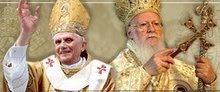
Patriarch of Constantinople Urges Touching the Word of God

Bartholomew I Explains Use of "Spiritual Senses"

VATICAN CITY, OCT. 17, 2008 (Zenit.org).- Most Christians have heard the Word of God, but have they seen it in art or nature, or realized they were touching it in the Eucharist?
Orthodox Patriarch Bartholomew I of Constantinople spoke Saturday afternoon at the celebration of vespers in the Sistine Chapel of using one's "spiritual senses" to perceive the Word of God.

The event, presided over by Benedict XVI and attended by some 400 cardinals, bishops, religious and laypeople, took place within the context of the world Synod of Bishops on the Word of God, which is under way in the Vatican through Oct. 26.

The first patriarch in history to be invited to address a world Synod of Bishops, Bartholomew I noted that his presence was "an important step toward the restoration of our full communion."

"We regard this as a manifestation of the work of the Holy Spirit leading our Churches to a closer and deeper relationship with each other," he said.

Sitting with Michelangelo's "Final Judgment" behind him, the patriarch discussed the importance of the synod's theme.

"The Church needs [...] to rediscover the Word of God in every generation," he said, "and make it head with a renewed vigor and persuasion also in our contemporary world, which deep in its heart thirsts for God’s message of peace, hope and charity."

He continued: "This duty of evangelization would have been, of course, greatly enhanced and strengthened if all Christians were in a position to perform it with one voice and as a fully united Church.

"It is, therefore, most appropriate, that this synod has opened its doors to ecumenical fraternal delegates so that we may all become aware of our common duty of evangelization as well as of the difficulties and problems of its realization in today’s world."

Scriptural Church

The patriarch, drawing on the Patristic doctrine of the "spiritual senses," then spoke of three "spiritual ways of perceiving" the Word of God: "listening to God’s Word, beholding God’s Word, and touching God’s Word."

He reflected first of all "on hearing and speaking the Word of God through the holy Scriptures."

"The Christian Church is, above all, a scriptural Church," Bartholomew I said. "Although methods of interpretation may have varied [...] Scripture was always received as a living reality and not a dead book."

"In the context of a living faith," he added, "Scripture is the living testimony of a lived history about the relationship of a living God with a living people."

The patriarch said that in this sense that Christians must "provide a unique perspective -- beyond the social, political, or economic -- on the need to eradicate poverty, to provide balance in a global world, to combat fundamentalism or racism, and to develop religious tolerance in a world of conflict."

Art and nature

Bartholomew I affirmed that the Word of God can be seen "in nature and above all in the beauty of the icons": "Nowhere is the invisible rendered more visible than in the beauty of iconography and the wonder of creation."

"Icons are a visible reminder of our heavenly vocation," he explained. "They are invitations to rise beyond our trivial concerns and menial reductions of the world. They encourage us to seek the extraordinary in the very ordinary.

"Icons underline the Church’s fundamental mission to recognize that all people and all things are created and called to be 'good' and 'beautiful.'"

Regarding nature, the patriarch affirmed: "All genuine 'deep ecology' is, therefore, inextricably linked with deep theology."

“Even a stone,” Bartholomew I stated, quoting Basil the Great, “bears the mark of God’s Word. This is true of an ant, a bee and a mosquito, the smallest of creatures. For he spread the wide heavens and laid the immense seas; and He created the tiny hollow shaft of the bee’s sting.”

The patriarch added, "Recalling our minuteness in God’s wide and wonderful creation only underlines our central role in God’s plan for the salvation of the whole world."

Sacraments and saints

Bartholomew I said that the Word of God, which "receives his full embodiment" in the sacrament of the Eucharist, can be touched and shared "in the communion of saints and the sacramental life of the Church."

In the Eucharist, he explained, "the Word becomes flesh and allows us not simply to hear or see him, but to touch him with our own hands."

"Word and sacrament become one reality," the patriarch added. "The word ceases to be 'words' and becomes a Person, embodying in himself all human beings and all creation."

Bartholomew I said the example of saints is "the tangible experience and human expression of God’s Word in our community."

"In the gentle presence of a saint," he explained, "we learn how theology and action coincide. In the compassionate love of the saint, we experience God as 'our father' and God’s mercy as 'steadfastly enduring.'"

"Each of us is called to 'become like fire,' to touch the world with the mystical force of God’s Word," he said, "so that -- as the extended Body of Christ -- the world, too, might say: 'Someone touched me!'"

Healing revolution

"Evil," continued Bartholomew I, "is only eradicated by holiness, not by harshness. And holiness introduces into society a seed that heals and transforms."

"It is like the tectonic plates of the earth’s crust," he explained. "The deepest layers need only shift a few millimeters to shatter the world’s surface.

"Yet for this spiritual revolution to occur, we must experience radical 'metanoia' -- a conversion of attitudes, habits and practices -- for ways that we have misused or abused God’s Word, God’s gifts and God’s creation."

The patriarch added: "The challenge before us is the discernment of God’s Word in the face of evil, the transfiguration of every last detail and speck of this world in the light of Resurrection.

"The victory is already present in the depths of the Church, whenever we experience the grace of reconciliation and communion."

Sunday, October 12, 2008

A Bible reading marathon... on Italian TV

Cardinal Bertone Closes Bible Marathon
Urges an Opening to Scripture

ROME, OCT. 12, 2008 (Zenit.org).- A Bible-reading marathon on Italian television, which was kicked off by Benedict XVI, drew to a close with his secretary of state reading the final passages of Revelation.

Cardinal Tarcisio Bertone read the last chapter of Revelation on "Bibbia Giorno e Notte" (Bible Day and Night), a program broadcast by RAI where the Bible was read from beginning to end in various languages by nearly 1,200 readers. The Pope called the event "a fitting accompaniment to the synod of bishops on the Word of God."

The marathon began Sunday, Oct. 5, and ended Saturday evening. The site of the reading was the Basilica of Santa Croce in Gerusaleme in Rome

Readers included, among others, 40 participants in the 12th Ordinary General Assembly of the synod of bishops on "The Word of God in the Life and Mission of the Church," underway in Rome through Oct. 26.
.
In a final address, Cardinal Bertone called upon everyone to "open yourselves to the Bible, which will carry you beyond yourselves."

The project was called the longest public television broadcast in history, at 139 hours. Readers came from 64 countries; almost 4 million viewers watched the first hour of reading last Sunday; 122,000 people followed the daily readings in the basilica.

The event was ecumenical and interreligious: Among the readers, 30 were from Protestant communities, 17 were Jewish, six were Muslim, and there were representatives of the Orthodox Churches.

Only two of the readings were pre-recorded: Benedict XVI's from the Vatican and Cardinal Carlo Martini's from Gallarate.

Among the readers were three former presidents of Italy.

Speaking to Vatican Radio, the abbot of the basilica, Cistercian Father Simone Fioraso, spoke about the experience of a "rediscovery" of the Word of God, saying it immersed the basilica in an atmosphere of deep spirituality.

"It was also very beautiful to meet many readers who before or after reading the Word of God asked to go to confession and reconcile with God," he said. "A young Muslim woman came who wanted to read and she had not registered, so there was nothing. [...] And a woman who teaches catechism here told her: ‘We'll read together.'

"And it was wonderful to see how they read the Word together, putting the Word at the center of their life. I believe that from this Word a friendship was born between them, which had its beginnings here. [...]

"Perhaps the Word that divided in times past will today become and remain the Word that, as always, unites all hearts and all men."

Monday, August 11, 2008

Sandro Magister on the pope's World Youth Day talks...


Visit Magister's site.

Download some of Benedict's talks:
Closing sermon
Sermon in St. Mary's Cathedral
Address to youth during the Vigil


Also, check here; view "Evening Vigil- part 3" where Benedict talks with the youth.
Very moving talk.

ROMA, July 22, 2008 – During Benedict XVI's trip to Australia for World Youth Day, what stood out in the worldwide media was his arrival by sea in the bay of Sydney, the dances of the aborigines, the scenes of the Via Crucis, the myriads of torch flames among the young people during the night, the sorrowful condemnation of sexual abuse committed by priests, and the meeting with four of their victims.

On this page, instead, there is an anthology of the salient passages from the words spoken by Benedict XVI during his voyage.

The selection made here inevitably sacrifices other selections that are no less important from the speeches and homilies of the pope. For example, it would be obligatory to reread in its entirety the catechesis on the Holy Spirit presented to the young people at the nighttime vigil on Saturday, July 19: and in doing so, one would understand why, in presenting it, "L'Osservatore Romano" called it "one of the most beautiful texts of the pontificate."

But in any case, one unmistakable characteristic of Benedict XVI can be gathered from this anthology: his being a pope theologian. Who, like St. Augustine – quoted extensively during his visit to Australia – wants to preach to everyone, including the humble and the simple, the marvels of God, not dumbed down or watered down, but in their complete and sometimes difficult essentiality. And in their mysterious historical reverberations.

In their content and style, the passages presented here are also the ones most easily attributed to Joseph Ratzinger personally, to his mind into his pen, rather than to the Vatican offices charged with preparing and supplementing the pontifical addresses.

For those who want to read the rest, the complete texts of all the speeches, messages, and homilies are available on this page of the Holy See's website, in multiple languages:

> Apostolic Journey to Sydney, July 12-21, 2008

Here, then, is our anthology:


1. When God is eclipsed, even the maternal womb becomes a place of unutterable violence


Arrival discourse, Barangaroo, Sydney Harbour, Thursday, July 17, 2008

Dear young people, [...] the views afforded of our planet from the air were truly wondrous. The sparkle of the Mediterranean, the grandeur of the north African desert, the lushness of Asia’s forestation, the vastness of the Pacific Ocean, the horizon upon which the sun rose and set, and the majestic splendour of Australia’s natural beauty [...]; these all evoke a profound sense of awe. It is as though one catches glimpses of the Genesis creation story – light and darkness, the sun and the moon, the waters, the earth, and living creatures; all of which are “good” in God’s eyes (cf. Gen 1:1 – 2:4). Immersed in such beauty, who could not echo the words of the Psalmist in praise of the Creator: “how majestic is your name in all the earth?” (Ps 8:1).

And there is more [...] men and women, made in nothing less than God’s own image and likeness (cf. Gen 1:26). At the heart of the marvel of creation are you and I, the human family “crowned with glory and honour” (Ps 8:5). How astounding! With the Psalmist we whisper: “what is man that you are mindful of him?” (Ps 8:4). And drawn into silence, into a spirit of thanksgiving, into the power of holiness, we ponder.

What do we discover? [...] That not only the natural but also the social environment – the habitat we fashion for ourselves – has its scars, [...] a poison which threatens to corrode what is good, reshape who we are, and distort the purpose for which we have been created. [...] There is also something sinister which stems from the fact that freedom and tolerance are so often separated from truth. This is fuelled by the notion, widely held today, that there are no absolute truths to guide our lives. Relativism, by indiscriminately giving value to practically everything, has made “experience” all-important. Yet, experiences, detached from any consideration of what is good or true, can lead, not to genuine freedom, but to moral or intellectual confusion, to a lowering of standards, to a loss of self-respect, and even to despair.

Dear friends, life is not governed by chance; it is not random. Your very existence has been willed by God, blessed and given a purpose (cf. Gen 1:28)! Life is not just a succession of events or experiences, helpful though many of them are. It is a search for the true, the good and the beautiful. It is to this end that we make our choices; it is for this that we exercise our freedom; it is in this – in truth, in goodness, and in beauty – that we find happiness and joy. Do not be fooled by those who see you as just another consumer in a market of undifferentiated possibilities, where choice itself becomes the good, novelty usurps beauty, and subjective experience displaces truth.

Christ offers more! Indeed he offers everything! Only he who is the Truth can be the Way and hence also the Life. Thus the “way” which the Apostles brought to the ends of the earth is life in Christ. This is the life of the Church. And the entrance to this life, to the Christian way, is Baptism. [...]

There are many today who claim that God should be left on the sidelines, and that religion and faith, while fine for individuals, should either be excluded from the public forum altogether or included only in the pursuit of limited pragmatic goals. This secularist vision seeks to explain human life and shape society with little or no reference to the Creator. It presents itself as neutral, impartial and inclusive of everyone. But in reality, like every ideology, secularism imposes a world-view. If God is irrelevant to public life, then society will be shaped in a godless image. When God is eclipsed, our ability to recognize the natural order, purpose, and the “good” begins to wane. [...]

But what of our social environment? [...] Do we recognize that the innate dignity of every individual rests on his or her deepest identity – as image of the Creator – and therefore that human rights are universal, based on the natural law, and not something dependent upon negotiation or patronage, let alone compromise? And so we are led to reflect on what place the poor and the elderly, immigrants and the voiceless, have in our societies. How can it be that domestic violence torments so many mothers and children? How can it be that the most wondrous and sacred human space – the womb – has become a place of unutterable violence?

My dear friends, God’s creation is one and it is good. The concerns for non-violence, sustainable development, justice and peace, and care for our environment are of vital importance for humanity. They cannot, however, be understood apart from a profound reflection upon the innate dignity of every human life from conception to natural death: a dignity conferred by God himself and thus inviolable.


2. The "critical juncture" that the ecumenical movement has reached


From the address to representatives of the other Christian confessions, Sydney, Crypt of St. Mary’s Cathedral, Friday, July 18, 2008


Dear friends in Christ, I think you would agree that the ecumenical movement has reached a critical juncture. To move forward, we must continually ask God to renew our minds with the Holy Spirit (cf. Rom 12:2), who speaks to us through the scriptures and guides us into all truth (cf. 2 Pet 1:20-21; Jn 16:13). We must guard against any temptation to view doctrine as divisive and hence an impediment to the seemingly more pressing and immediate task of improving the world in which we live. In fact, the history of the Church demonstrates that praxis is not only inseparable from, but actually flows out of didache or teaching.


3. But the Alpha and the Omega is only Jesus

From the address to representatives of the other religions, Sydney, Chapter Hall of St. Mary's Cathedral, Friday, July 18, 2008


Dear friends, [...] the Church approaches dialogue believing that the true source of freedom is found in the person of Jesus of Nazareth. Christians believe it is he who fully discloses the human potential for virtue and goodness, and he who liberates us from sin and darkness. The universality of human experience, which transcends all geographical boundaries and cultural limitations, makes it possible for followers of religions to engage in dialogue so as to grapple with the mystery of life’s joys and sufferings. In this regard, the Church eagerly seeks opportunities to listen to the spiritual experience of other religions. We could say that all religions aim to penetrate the profound meaning of human existence by linking it to an origin or principle outside itself. Religions offer an attempt to understand the cosmos as coming from and returning to this origin or principle. Christians believe that God has revealed this origin and principle in Jesus, whom the Bible refers to as the “Alpha and Omega” (cf. Rev 1:8; 22:1).


4. Be "signs of contradiction" in the world

From the homily of the Mass with the bishops, priests, seminarians, and novices, Sydney, Saint Mary's Cathedral, July 19, 2008


Dear brothers and sisters, [...] in today’s liturgy the Church reminds us that, like this altar, we too have been consecrated, set “apart” for the service of God and the building up of his Kingdom. All too often, however, we find ourselves immersed in a world that would set God “aside”. In the name of human freedom and autonomy, God’s name is passed over in silence, religion is reduced to private devotion, and faith is shunned in the public square. At times this mentality, so completely at odds with the core of the Gospel, can even cloud our own understanding of the Church and her mission. We too can be tempted to make the life of faith a matter of mere sentiment, thus blunting its power to inspire a consistent vision of the world and a rigorous dialogue with the many other visions competing for the minds and hearts of our contemporaries. [...]

Here I would like [...] to acknowledge the shame which we have all felt as a result of the sexual abuse of minors by some clergy and religious in this country. Indeed, I am deeply sorry for the pain and suffering the victims have endured, and I assure them that, as their Pastor, I too share in their suffering. These misdeeds, which constitute so grave a betrayal of trust, deserve unequivocal condemnation. They have caused great pain and have damaged the Church’s witness. I ask all of you to support and assist your Bishops, and to work together with them in combating this evil. Victims should receive compassion and care, and those responsible for these evils must be brought to justice. [...]

I wish now to turn to the seminarians and young religious in our midst, with a special word of affection and encouragement. [...] Make the daily celebration of the Eucharist the centre of your life. At each Mass, when the Lord’s Body and Blood are lifted up at the end of the Eucharistic Prayer, lift up your own hearts and lives, through Christ, with him and in him, in the unity of the Holy Spirit, as a loving sacrifice to God our Father.

In this way, dear young seminarians and religious, you yourselves will become living altars, where Christ’s sacrificial love is made present as an inspiration and a source of spiritual nourishment to everyone you meet. By embracing the Lord’s call to follow him in chastity, poverty and obedience, you have begun a journey of radical discipleship which will make you “signs of contradiction” (cf. Lk 2:34) to many of your contemporaries. Model your lives daily on the Lord’s own loving self-oblation in obedience to the will of the Father. You will then discover the freedom and joy which can draw others to the Love which lies beyond all other loves as their source and their ultimate fulfilment. Never forget that celibacy for the sake of the Kingdom means embracing a life completely devoted to love, a love that enables you to commit yourselves fully to God’s service and to be totally present to your brothers and sisters, especially those in need.


5. The Holy Spirit, the "forgotten Person" of the Most Holy Trinity

From the address to the young people at the nighttime vigil, Sydney, Randwick Racecourse, Saturday, July 19, 2008


Dear young people, [...] unity and reconciliation cannot be achieved through our efforts alone. God has made us for one another (cf. Gen 2:24) and only in God and his Church can we find the unity we seek. Yet, in the face of imperfections and disappointments – both individual and institutional – we are sometimes tempted to construct artificially a “perfect” community. That temptation is not new. The history of the Church includes many examples of attempts to bypass or override human weaknesses or failures in order to create a perfect unity, a spiritual utopia.

Such attempts to construct unity in fact undermine it! To separate the Holy Spirit from Christ present in the Church’s institutional structure would compromise the unity of the Christian community, which is precisely the Spirit’s gift! It would betray the nature of the Church as the living temple of the Holy Spirit (cf. 1 Cor 3:16). It is the Spirit, in fact, who guides the Church in the way of all truth and unifies her in communion and in the works of ministry (cf. Lumen Gentium, 4). Unfortunately the temptation to “go it alone” persists. Some today portray their local community as somehow separate from the so-called institutional Church, by speaking of the former as flexible and open to the Spirit and the latter as rigid and devoid of the Spirit. [...]

There are times when we might be tempted to seek a certain fulfilment apart from God. Jesus himself asked the Twelve: “do you also wish to go away?” Such drifting away perhaps offers the illusion of freedom. But where does it lead? To whom would we go? For in our hearts we know that it is the Lord who has “the words of eternal life” (Jn 6:67-68). To turn away from him is only a futile attempt to escape from ourselves (cf. Saint Augustine, Confessions VIII, 7). God is with us in the reality of life, not the fantasy! It is embrace, not escape, that we seek! So the Holy Spirit gently but surely steers us back to what is real, what is lasting, what is true. It is the Spirit who leads us back into the communion of the Blessed Trinity!

The Holy Spirit has been in some ways the neglected person of the Blessed Trinity. A clear understanding of the Spirit almost seems beyond our reach. Yet, when I was a small boy, my parents, like yours, taught me the Sign of the Cross. So, I soon came to realize that there is one God in three Persons, and that the Trinity is the centre of our Christian faith and life. While I grew up to have some understanding of God the Father and the Son – the names already conveyed much – my understanding of the third person of the Trinity remained incomplete. So, as a young priest teaching theology, I decided to study the outstanding witnesses to the Spirit in the Church’s history. It was on this journey that I found myself reading, among others, the great Saint Augustine.

Augustine’s understanding of the Holy Spirit evolved gradually; it was a struggle. As a young man he had followed Manichaeism – one of those attempts I mentioned earlier, to create a spiritual utopia by radically separating the things of the spirit from the things of the flesh. Hence he was at first suspicious of the Christian teaching that God had become man. Yet his experience of the love of God present in the Church led him to investigate its source in the life of the Triune God. This led him to three particular insights about the Holy Spirit as the bond of unity within the Blessed Trinity: unity as communion, unity as abiding love, and unity as giving and gift. These three insights are not just theoretical. They help explain how the Spirit works. In a world where both individuals and communities often suffer from an absence of unity or cohesion, these insights help us remain attuned to the Spirit and to extend and clarify the scope of our witness. [...]

What constitutes our faith is not primarily what we do but what we receive. After all, many generous people who are not Christian may well achieve far more than we do. Friends, do you accept being drawn into God’s Trinitarian life? Do you accept being drawn into his communion of love?

The Spirit’s gifts working within us give direction and definition to our witness. Directed to unity, the gifts of the Spirit bind us more closely to the whole Body of Christ (cf. Lumen Gentium, 11), equipping us better to build up the Church in order to serve the world (cf. Eph 4:13). They call us to active and joyful participation in the life of the Church: in parishes and ecclesial movements, in religious education classes, in university chaplaincies and other catholic organizations. Yes, the Church must grow in unity, must be strengthened in holiness, must be rejuvenated, must be constantly renewed (cf. Lumen Gentium, 4). But according to whose standard? The Holy Spirit’s! Turn to him, dear young people, and you will find the true meaning of renewal.


6. A "new age" to renew the world and the Church

From the homily of the Mass with the young people, Sydney, Randwick Racecourse, Sunday, July 20, 2008


Dear friends, [...] “You will receive power when the Holy Spirit comes upon you”. These words of the Risen Lord have a special meaning for those young people who will be confirmed, sealed with the gift of the Holy Spirit, at today’s Mass. But they are also addressed to each of us – to all those who have received the Spirit’s gift of reconciliation and new life at Baptism, who have welcomed him into their hearts as their helper and guide at Confirmation, and who daily grow in his gifts of grace through the Holy Eucharist. At each Mass, in fact, the Holy Spirit descends anew, invoked by the solemn prayer of the Church, not only to transform our gifts of bread and wine into the Lord’s body and blood, but also to transform our lives, to make us, in his power, “one body, one spirit in Christ”.

But what is this “power” of the Holy Spirit? It is the power of God’s life! It is the power of the same Spirit who hovered over the waters at the dawn of creation and who, in the fullness of time, raised Jesus from the dead. It is the power which points us, and our world, towards the coming of the Kingdom of God. In today’s Gospel, Jesus proclaims that a new age has begun, in which the Holy Spirit will be poured out upon all humanity (cf. Lk 4:21). He himself, conceived by the Holy Spirit and born of the Virgin May, came among us to bring us that Spirit. As the source of our new life in Christ, the Holy Spirit is also, in a very real way, the soul of the Church, the love which binds us to the Lord and one another, and the light which opens our eyes to see all around us the wonders of God’s grace. [...]

Yet this power, the grace of the Spirit, is not something we can merit or achieve, but only receive as pure gift. God’s love can only unleash its power when it is allowed to change us from within. We have to let it break through the hard crust of our indifference, our spiritual weariness, our blind conformity to the spirit of this age. Only then can we let it ignite our imagination and shape our deepest desires. That is why prayer is so important: daily prayer, private prayer in the quiet of our hearts and before the Blessed Sacrament, and liturgical prayer in the heart of the Church. Prayer is pure receptivity to God’s grace, love in action, communion with the Spirit who dwells within us, leading us, through Jesus, in the Church, to our heavenly Father. In the power of his Spirit, Jesus is always present in our hearts, quietly waiting for us to be still with him, to hear his voice, to abide in his love, and to receive “power from on high”, enabling us to be salt and light for our world. [...]

The power of the Holy Spirit does not only enlighten and console us. It also points us to the future, to the coming of God’s Kingdom. What a magnificent vision of a humanity redeemed and renewed we see in the new age promised by today’s Gospel! Saint Luke tells us that Jesus Christ is the fulfilment of all God’s promises, the Messiah who fully possesses the Holy Spirit in order to bestow that gift upon all mankind. The outpouring of Christ’s Spirit upon humanity is a pledge of hope and deliverance from everything that impoverishes us. It gives the blind new sight; it sets the downtrodden free, and it creates unity in and through diversity (cf. Lk 4:18-19; Is 61:1-2). This power can create a new world: it can “renew the face of the earth” (cf. Ps 104:30)!

Empowered by the Spirit, and drawing upon faith’s rich vision, a new generation of Christians is being called to help build a world in which God’s gift of life is welcomed, respected and cherished – not rejected, feared as a threat and destroyed. A new age in which love is not greedy or self-seeking, but pure, faithful and genuinely free, open to others, respectful of their dignity, seeking their good, radiating joy and beauty. A new age in which hope liberates us from the shallowness, apathy and self-absorption which deaden our souls and poison our relationships. Dear young friends, the Lord is asking you to be prophets of this new age, messengers of his love, drawing people to the Father and building a future of hope for all humanity.

The world needs this renewal! In so many of our societies, side by side with material prosperity, a spiritual desert is spreading: an interior emptiness, an unnamed fear, a quiet sense of despair. How many of our contemporaries have built broken and empty cisterns (cf. Jer 2:13) in a desperate search for meaning – the ultimate meaning that only love can give? This is the great and liberating gift which the Gospel brings: it reveals our dignity as men and women created in the image and likeness of God. It reveals humanity’s sublime calling, which is to find fulfilment in love. It discloses the truth about man and the truth about life.

The Church also needs this renewal! She needs your faith, your idealism and your generosity, so that she can always be young in the Spirit (cf. Lumen Gentium, 4)! In today’s second reading, the Apostle Paul reminds us that each and every Christian has received a gift meant for building up the Body of Christ.


7. The "yes" that changes history

From the Angelus at the end of the Mass with the young people, Sydney, Randwick Racecourse, Sunday, July 20, 2008

Dear young friends, [...] during the Old Testament, God revealed himself partially, gradually, as we all do in our personal relationships. It took time for the chosen people to develop their relationship with God. The Covenant with Israel was like a period of courtship, a long engagement. Then came the definitive moment, the moment of marriage, the establishment of a new and everlasting covenant. As Mary stood before the Lord, she represented the whole of humanity. In the angel’s message, it was as if God made a marriage proposal to the human race. And in our name, Mary said yes.

In fairy tales, the story ends there, and all “live happily ever after”. In real life it is not so simple. For Mary there were many struggles ahead, as she lived out the consequences of the “yes” that she had given to the Lord. Simeon prophesied that a sword would pierce her heart. When Jesus was twelve years old, she experienced every parent’s worst nightmare when, for three days, the child went missing. And after his public ministry, she suffered the agony of witnessing his crucifixion and death. Throughout her trials she remained faithful to her promise, sustained by the Spirit of fortitude. And she was gloriously rewarded.

Dear young people, we too must remain faithful to the “yes” that we have given to the Lord’s offer of friendship. We know that he will never abandon us. We know that he will always sustain us through the gifts of the Spirit. Mary accepted the Lord’s “proposal” in our name. [...] She is our example and our inspiration, she intercedes for us with her Son, and with a mother’s love she shields us from harm.

Sunday, August 10, 2008

Great news out of the English (Catholic, of course) Church


The Extraordinary Form at the Pantheon, or St. Mary & the Martyrs, in Roma.

From Holy Smoke, aka: Damian Thompson... and with bonus comments from Fr. Z.

From The Sunday Times
August 10, 2008
Let us pray in Latin: priests take on Catholics’ magic circle
[I am happy to be corrected, but I think this refers to the iron grip the progressivist side has on the hierarchy of the UK.]
Damian Thompson sniffs the incense of a revolution among Britain’s parish priests

For a moment it looks as if a fire has broken out in the chapel. A cloud of smoke is billowing from the back and rolling down the aisle – and it is fiercely pungent. This is grade A incense, pure enough to guarantee an instantaneous spiritual high. [Remember this?]

A young man walks through the door swinging a thurible on a gold chain. He passes it to a priest, deacon and subdeacon – all in gold vestments – who take turns wafting it at each other. Finally, the subdeacon turns round and, bowing low, shoots plumes of smoke diagonally across the choir stalls with the accuracy of a mid-fielder taking a difficult corner.

We are witnessing an unusual sight: [Increasingly more common, happily.] a Roman Catholic solemn mass, celebrated according to an ancient Latin rite effectively outlawed 40 years ago. And it’s taking place in the 13th-century chapel of Merton college, Oxford, which has been Anglican for 400 years. [Now that’s more uncommon!]

Just for a week, however, it has gone back to being Catholic – but this is not Catholicism as most people know it. I’m at the summer school of the Latin Mass Society which – to the delight of the conservative Pope Benedict XVI and the dismay of trendy British bishops – is teaching priests how to say the Tridentine mass.

The last time Merton chapel regularly witnessed this sort of complex liturgy was in the 1540s, before the Protestant reformers pulled out much of the stained glass and toppled the statues of saints. The organi-sers of the summer school are reformers, too, but their aim is precisely the opposite: to restore Latin services and rich furnishings to their own Catholic parish churches, many of which were stripped bare by modernisers after the Second Vatican Council in the 1960s.

What makes this summer school rather controversial is that most of the bishops of England and Wales disapprove of the return of the Latin mass, regarding its sonorous Latin prayers and intricate gestures as a relic of the Middle Ages. Until recently, the Tridentine mass could be celebrated only with a bishop’s permission, usually granted grudgingly for special occasions. Then, in July last year, Pope Benedict XVI swept away the right of bishops to ban the old services. Most of them were horrified.

So these are tense times. But the 60 priests who have gathered at Merton college – to brush up their skills or to learn the Tridentine mass from scratch – are careful to avoid talk of civil war in the church. All are aware that this autumn, Pope Benedict is expected to announce a successor to Cardinal Cormac Murphy-O’Connor, the Archbishop of Westminster, who presides over a liberal “magic circle” of bishops unsympathetic to the Pope’s reforms. [It seems I was right about that term.] Will Benedict break the circle that has run the English church for 40 years?

Whoever gets the job, however, nobody expects a sudden return to the Tridentine mass in parishes all over the country. The seminaries do not teach priests how to say it and teaching yourself is difficult. A glance at the manual explains why: “Bring the thumb of each hand over the upper front edge of the paten [communion plate], tilting it to let the host slide off onto the crease of the front-centre fold of the corporal [linen cloth]. Place your left hand on the altar and with your right hand set the paten halfway under the right edge of the corporal.” And all the while saying: “. . . pro innumerabilibus peccatis, et offensionibus, et negligentiis meis, et pro omnibus circumstantibus . . .” [But… you know… it isn’t that hard.]

Interestingly, the most traditionalist priests here are also the youngest – and I spot four in the choir stalls who are popular bloggers on the internet. Walking down the high street later, I encounter two clergy wearing the old-fashioned soup-plate hats beloved of Italian village padres. One of them has long knotted tassels dangling from the brim, “so I can tie them round my neck when I ride my horse through the parish”. [And I know just who that was! o{]:¬) ]

A priest who looks barely out of his teens explains what he does when unsolicited copies of The Tablet – a liberal Catholic magazine that opposes the Latin revival – arrive at his church: “I painstakingly remove the staples and feed it into the shredder. It’s time-consuming, but God’s work.” [ROFL!]

Most of the other priests at the summer school are less extreme: they have come because they are curious about the Latin mass and they can scent change in the air. “We’re not trying to turn them into traditionalists,” says Father Andrew Wadsworth, an authority on the old rite who is conducting classes. “We want to show priests how the underlying principles of the traditional liturgy can deepen their understanding of their priesthood.” [Yes yes and yes. This is really the point. As WDTPRS has been repeating for a long time now, when priests learn the older form of Mass is changes who they are as priests and changes how they say any Mass. Summorum Pontificum was above all a gift to priests. It is one of those rarest of documents which emphasis the rights of priests, rather than of bishops, and it arms them with what they need to speed the revitalization of Catholic identity for which Pope Benedict has been working.]

Father John Boyle, [blogger] a parish priest in Ashford, Kent, recently taught himself to say the Tridentine mass by watching a DVD. “It’s made a profound difference to the way I celebrate the new mass in English,” he says. [See? See?] “There’s greater reverence now. I’m more of a celebrant and less of a compere.”

I sense a huge contrast with the atmosphere at the first Merton summer school in August 2007. Then, I was allowed to poke my head round the door of a training session. Now, Wadsworth lets me watch him take a priest right through the opening sequence of a Latin mass in a student’s room, using a reversed bookcase as an altar.

The priest, Canon Michael McCreadie, is in his fifties – yet today is the first time in his life that he has acted out the ancient gestures. He removes an invisible biretta (it’s a pretend mass). “Now, father, keep your hands joined,” Wadsworth reminds him. “Go to the centre of the altar, not touching it . . . left hand flat on the page. No, you should be over here,” and he gently turns his pupil towards the window.

After half an hour, we are still only five minutes into the order of service, but McCreadie is elated: “I wasn’t looking forward to saying the old mass, but after today I most certainly am.”

It’s only now I discover that he is dean of Leeds Cathedral. A year ago there were no senior main-stream clerics at the summer school. Later in the day, even more significantly, the Rev Malcolm McMahon, the Bishop of Nottingham, celebrates old rite pontifical vespers wearing a jewelled mitre and an embroidered cope that even Cardinal Wolsey might have considered over the top.

McMahon, a Dominican, is left-wing in his politics and certainly not part of a traditionalist faction – but nor does he belong to the politically correct, back-slapping magic circle. At dinner later, he effectively breaks ranks with his fellow bishops by unambiguously endorsing Pope Benedict’s vision of a church in which the old and new rites coexist. The traditionalists give him a standing ovation and a verse of God Bless our Pope.

He also tells Father Tim Finigan, [His Hermeneuticalness] author of the Hermeneutic of Continuity, the most influential of all the conservative blogs, to keep writing. Which is interesting, given that the Bishops’ Conference would dearly like to stop that particular blog.

Afterwards, Finigan writes: “Bishop McMahon has certainly won the hearts of the priests . . . All of a sudden, there is someone that many priests loyal to Pope Benedict will be watching closely . . . ecce sacerdos magnus!”

That’s Latin for “behold the great priest”. Those words will be read carefully in the Vatican, where Pope Benedict has been informed that the magic circle is desperate to install one of its own as the next cardinal. He isn’t pleased. Watch this space.

Damian Thompson is editor-in-chief of the Catholic Herald

Friday, August 1, 2008

The Black Madonna of Mount Irazú


In 1635 a young black girl found a small black stone statue of Our Lady and the Holy Child in the woods near Cartago. She took it home with her but it returned by itself to where she had found it. After several futile attempts to keep it, she took the statue to the village priest, who tried hiding it, but to no avail. It was always found back in the woods.

The black families nearby built a little chapel to house their treasured Mother and Child on the spot that she herself had chosen to stay. In time it became a famous place of pilgrimage for all of Costa Rica. The image of the black Madonna, gaily dressed with Jesus, was solemnly crowned in 1927.

Friday, July 25, 2008

Intersting: A Spiritual Answer to Coping With Infertility

Interview With Professor Marie Meaney

By Karna Swanson

WASHINGTON, D.C., JULY 25, 2008 (Zenit.org).- The suffering of infertility can be intense for couples, but looking at the condition with the eyes of faith can turn the experience into a "spiritual journey," says professor Marie Meaney.

"Only God can prevent extreme suffering from turning into anger, resentment and bitterness," says Meaney, an Arthur J. Ennis Teaching Fellow at the University of Villanova in Philadelphia.

Meaney, who has been active in the pro-life movement for many years, is also the author of "Embracing the Cross of Infertility," a talk offered online and on CD through the Human Life International Web site.

In this interview with ZENIT, Meaney comments on the challenges facing couples struggling with infertility, and the possible spiritual consolations and rewards of embracing the condition with faith.

Q: You say accepting your infertility is much like accepting the death of a child, and that it is particularly difficult for the woman. What is at the core of this suffering?

Meaney: For those who are not suffering from infertility it may be difficult to imagine how painful it is. Before it happened to me, I had no idea how awful it was. Most couples probably go into marriage thinking that children are a given, that they will simply come along; when they don't, this opens up in a new way how central the gift of life is to marriage and in particular to the woman.

Obviously, the marriage is no less valid if the couple is infertile; but when no child is conceived, the spouses are denied the visible fruit of their love. The spouses desire to see their love embodied in the gift of life; they want to start the adventure of raising children together, seeing in them parts of themselves, and yet also completely unique persons with their own vocations and personalities.

Infertility affects both men and women, but the woman's suffering tends to be particularly pronounced. Already Rachel cried to her husband Jacob in the book of Genesis: "Give me children, or I shall die!" -- Genesis 30:1, Catechism of the Catholic Church, 2374.

The woman is the one to experience pregnancy, feeling the child grow in her womb, as Pope John Paul II said so beautifully in "Mulieris Dignitatem," and thus she will also feel more deeply the lack thereof. Since her vocation is motherhood of some kind, she suffers particularly from its absence.

Infertility is terrible for her even if she already has children, but is unable to have more. Except if she knows that the sterility is final, she will go through hope and disappointment every month; and this disappointment comes at a time when it is emotionally and hormonally the most difficult.

Some women feel that their life is on-hold during this time: They are simply waiting for children and in the mean time not much else makes sense. No profession, no successful career can fill the emptiness caused by infertility.

Q: What tips would you give to parents, friends and pastors of an infertile couple? What should they say and not say?

Meaney: As with all suffering, at the core of the response should be the willingness to suffer with the couple, to stand under the cross with them, to be there for them. After all, compassion comes from the Latin word "com-pati," "suffering with." Anything that falls short of that is less than helpful.

Let me give some examples: The spouses may go through a long period of anguish about their childlessness, which to others may seem excessively long. The worst kind of comment is to mention other people whose suffering was supposedly worse, yet who got over it more quickly and grew from it; the implication is that the couple is not meeting that standard and is at fault.

Or, previously infertile people tell the couple that once they had "let go" and had stopped being stressed about their infertility, then they had suddenly conceived. The implication to the infertile spouses is, however, that they are not abandoned to God's will, otherwise they too would be able to conceive; it is therefore their fault in some sense that they are not conceiving.

This is what Job's friends did: They held Job responsible for his suffering. At times we all become like Job's friends: We tend to make those suffering responsible for their pain when it has lasted for a long time; for otherwise we would have to stand under the cross with them.

Seeing other children, being present at baptisms or baby showers can bring out suffering in the infertile couple in a new way. Sometimes people accuse the spouses of being envious while in reality their suffering is simply surfacing in those circumstances.

Generally I'd say, don't be the one to broach the subject. Perhaps the spouses don't want to talk about it or perhaps they are not in pain about it just now. Show an openness to listen compassionately and this will be a deed of mercy.

Q: Is there a point at which a couple should stop trying to conceive? Is adoption for every infertile couple?

Meaney: Every couple must discern for itself how pro-active it wants to be about trying to overcome its infertility. Some simply don't have the financial means to explore new -- albeit ethically licit -- options. Others can't face the emotional strain of continuing to attempt new procedures, the hope and disappointment that comes with it each time. Some need closure and decide to move on, though they would be delighted by the surprise of an unexpected pregnancy.

Personally, I think it is a good idea to think out of the box, try alternative medical options and never to give up. You just never know what might work for you. In any case, it is important to find out the reasons for the infertility in order to find solutions; sometimes the pain is so great that it is hard to face medical tests, and this is where husband and wife should encourage each other.

Adoption, I believe, is a vocation and not every couple feels called to it. Some infertile spouses think they can be fruitful in other ways, and serve the Church in a manner that couples with children can't.

Q: What is the role of a childless couple in promoting a culture of life?

Meaney: On the one hand, the childless couple is in the unfortunate situation that to outsiders it seems to have embraced the contraceptive mentality and the culture of death.

On the other hand, the couple can be a great witness to the world, if it speaks out when appropriate. The spouses can talk about the pain of infertility, about the great gift that children are; if their infertility is due to previous abortions or contraception, this might make others think twice. Or by speaking out against in vitro fertilization (IVF), which might be their only option to have a child, they are a witness to the fact that children are a gift and that no one has a right to them.

Finally, by embracing this cross, the spouses will de facto be promoting the culture of life; by uniting themselves to Christ they are "serving, like Christ, the salvation of [their][…] brothers and sisters," as John Paul II states in "Salvifici Doloris" (No. 27). Only in the next life will they know the extent of their spiritual fruitfulness.

Q: Your essay underlines the spiritual elements of infertility, discussed in terms of a cross to bear. What suggestions would you make as to deal with infertility in a spiritually fruitful way?

Meaney: Looking at infertility through the eyes of faith prevents it from being merely a human disaster and turns it into a spiritual journey. Only God can prevent extreme suffering from turning into anger, resentment and bitterness. However, God does not perform magic; he does not simply take the pain away, nor does he give us the answer to our anguished question, "Why is this happening to me?"

But if we embrace this cross, then ultimately we will find inner peace. A temptation is to meet the challenge stoically, thinking one can "deal with it" without realizing that one is avoiding the cross, and thus denying oneself the necessary mourning period.

Often we think that if we are suffering much, we must be doing something wrong. We have the false conception that being abandoned to God's will means that we will sail through all difficulties and master them in Herculean fashion. But being nailed to the cross means experiencing great anguish, as Christ did; but it will ultimately become our path to salvation if we accept it.

"Do not be afraid," John Paul II exclaimed at the beginning of his pontificate. We are afraid of crosses, of the deaths we experience through them. But God will bless us a hundredfold through them and we will bear fruit for the Church and the world in ways we probably don't even know. In eternity this wound will be part of our glory, shining forth, reflecting God in a particular way. Though we may never have biological children, we will have spiritual children many of whom we will only get to know in heaven.