Barack Obama's gift for the Queen: an iPod, your Majesty
Barack Obama met the Queen at Buckingham Palace today and gave her a gift of an iPod loaded with video footage and photographs of her 2007 United States visit to Richmond, Jamestown and Williamsburg in Virginia. In return, the Queen gave the President a silver framed signed photograph of herself and the Duke of Edinburgh - apparently a standard present for visiting dignitaries.
It is believed the Queen already has an iPod, a 6GB silver Mini version she is said to have bought in 2005 at the suggestion of Prince Andrew.
UPDATE: Pool reporter Richard Wolf of USA Today says that an Obama aide told him the President also gave the Queen a "rare songbook signed by Richard Rodgers". END UPDATE
Earlier, Mr Obama had spoken of his admiration for Her Majesty but indicated that his wife was handling the details of their royal meeting. "There's one last thing that I should mention that I love about Great Britain, and that is the Queen," he said at the end of his joint press conference with Gordon Brown.
"And so I'm very much looking forward to meeting her for the first time later this evening. And as you might imagine, Michelle has been really thinking that through -- because I think in the imagination of people throughout America, I think what the Queen stands for and her decency and her civility, what she represents, that's very important."
Mr Brown added: "Well, I know the Queen is looking forward to welcoming you and she's very much looking forward to her discussion with you."
There was widespread criticism in Britain and from Anglophiles in the US of Mr Obama's recent present to Mr Brown of a box set of classic American movies on DVDs that were not compatible with British DVD players.
Showing posts with label charity. Show all posts
Showing posts with label charity. Show all posts
Wednesday, April 1, 2009
Stupid Obama? Stupid America?

Saturday, March 28, 2009
Jesus Wasn't Always 'Nice'
Jesus Wasn’t Always Nice
Posted Mar 26, 2009
BY BISHOP THOMAS J. TOBIN
The article is a response to this piece written by the bishop.
Jesus wasn’t always nice. I had to remember that in responding to some letters I received from readers who were disappointed by my recent article, My Interview with President Obama. Some folks didn’t like the rhetorical device I employed, namely the fictional interview I composed. Others felt that I was too hard on the President when I criticized him for using tax dollars to fund abortion overseas. They said that I was not being charitable as Jesus would have been.
For example, one letter writer complained that I presented the President as a clown. “I resent the insult to our President,” she said. One of my fans from Ohio wrote, “Wow! The venom really drips on this [column] . . . Easy to blast away from the comfort and security of your cemetery hermitage . . . What did you expect to accomplish?” And a third instructed me that “the Bible teaches us to love and pray for our enemies and to turn the other cheek and not attack them . . . Charity is patient and kind. It is not arrogant or rude.”
First I should note that I am seldom offended by people criticizing the things I’ve written. Inspiring healthy dialogue in the Church is one of the goals of my columns. I hope, though, that critics can always distinguish between my personal opinions and the essential teachings of the Church which, as Catholics they are obliged to accept.
I do find it intriguing, though, that the critics of the Obama column were more offended by my writing than the fact that the President is using their tax dollars to destroy unborn children. (And now to engage in the destruction of human embryos in stem cell research.) But it still seems to me that if the President’s anti-life actions don’t stir up moral outrage in you, nothing will; if they don’t offend your conscience, you need a conscience transplant, my friend.
The other premise of my critics seems to be that because we are Christians we should never be angry or challenge others. We should always be charitable, tolerant, kind and nice, they suggest. After all, isn’t that what Jesus would do?
Well, in fact, no. The Gospels are very clear that in confronting moral evil Jesus wasn’t at all nice or kind. We usually think of Jesus as a prophet of peace, and indeed He was. But His preaching also created bitter controversy and division. “I have come to set the earth on fire . . . Do you think that I have come to establish peace on the earth? No, I tell you, but rather division.” (Lk 12: 49, 51)
Think of Jesus cleansing the Temple, an incident recorded in all four Gospels. Jesus entered the Temple angrily, confronted the merchants and money-changers, made a whip out of cords, drove them away and upset their tables and booths. Doesn’t sound too charitable to me!
Jesus railed against the towns of Chorazin, Bethsaida and Capernaum for their lack of faith, and predicted a terrible judgment day for those towns. “You will go down the netherworld,” He warned. (Mt 11: 23) Doesn’t sound too charitable to me!
And of course there’s Jesus’ withering condemnation of the Scribes and Pharisees. He repeatedly called them hypocrites. He described them as “blind guides . . . whitewashed tombs . . . serpents . . . brood of vipers . . . and murderers.” (Cf. Mt, Chapter 23) Doesn’t sound too charitable to me!
There are other examples, but you get the point. In confronting moral evil, Jesus wasn’t nice, kind, gentle and sweet. He lived in a rough and tumble world and He took His message to the streets. He was a fearless prophet who spoke the truth sometimes with harsh and angry language. Jesus’ condemnations infuriated public officials and religious leaders, so much so that they were determined to kill Him. And indeed they did.
In using condemnatory language was Jesus being “uncharitable?” Of course not. It was precisely because He loved people, because He was concerned for their salvation, that He spoke the truth, that He condemned their immoral, sinful behavior.
And that should be the mission of the Church today. Sometimes as Catholics we’re hesitant to challenge the immoral behavior of others, including public officials, because we don’t want to appear judgmental or uncharitable. Our society urges us to be “tolerant” of other people and their behavior, even if it’s objectively wrong. But it’s precisely because we love others that we should never tolerate immoral behavior. As Archbishop Charles J. Chaput of Denver has written so well, “Tolerance is not an end in itself, and tolerating or excusing grave evil in a society is itself a grave evil . . . And it is not a Christian virtue.” (Render Unto Caesar, p. 145-146)
If the language in my article about President Obama’s funding of abortions seemed harsh and offensive, so be it. It has nothing to do with my personal attitude about the man. Admittedly I’m not a fan, but as I’ve written before, I pray for him and his fine family and I wish him well. As a religious leader, though, charged with carrying on the prophetic mission of Christ, I have the right, and in fact the duty, to challenge his immoral actions. I do so because Christian charity requires me to do so, because I love my country and I believe in the sanctity of human life. As St. Paul said, “Woe to me if I do not preach the Gospel.” (I Cor 9:16)
Sunday, January 25, 2009
Vatican lifts excommunications from SSPX bishops...

Check Father Z's site for the latest...
... here are some links:
Bishop Fellay addresses his, now the Church's, flock.
Bishop Williamson comments; he's a little crazed.
Priestly Fraternity of St. Peter (FFSP) reacts...
A recap of what the lift means (as far as visiting SSPX chapels etc.)
Fellay responds to Williamson interview.
Fr. Z's thoughts on communion with SSPX.
A French and German bishop react.
Press release of the lifted bans.
A somewhat 'triumphalistic' pamphlet by the SSPX on the lifting of the excommunications.
Some reflections after the fact by Fellay.
Lifted bans coincide with 50th anniversary of Vatican II convocation by John XXIII.
Sunday, October 12, 2008
Orthodox prelate: "The First Bishop" "the Pope"
From Zenit.
Orthodox Delegate Speaks of Pope as Sign of Unity
Says Tired Society Demands United Christian Voice
VATICAN CITY, OCT. 12, 2008 (Zenit.org).- A representative of the Orthodox Church who addressed the world Synod of Bishops spoke of the Bishop of Rome as a sign of unity among Christians.
Archimandrite Ignatios Sotiriadis, fraternal delegate from the Orthodox Church of Greece, spoke Saturday to the synod, which is focusing on the Word of God in the life and mission of the Church.
His address brought more applause than any other intervention in the first week of the synod.
"Your Holiness," he said, "our society is tired and sick. It seeks but does not find! It drinks but its thirst is not quenched. Our society demands of us Christians -- Catholics, Orthodox, Protestants, Anglicans -- a common witness, a unified voice. Here lies our responsibility as pastors of the Churches in the 21st Century."
"Here," the Orthodox pastor continued, "is the primary mission of the First Bishop of Christianity, of him who presides in charity, and, above all, of a Pope who is Magister Theologiae: to be the visible and paternal sign of unity and to lead under the guidance of the Holy Spirit and according to Sacred Tradition, with wisdom, humility and dynamism, together with all the bishops of the world, fellow successors of the apostles, all humanity to Christ the redeemer."
"This is the profound desire of those who have the painful longing in their heart for the undivided Church, 'Una, Sancta, Catholica et Apostolica,'" he concluded. "But it is also the desire of those who, again today, in a world without Christ, fervently, but also with filial trust and faith, repeat the words of the apostles: 'Lord, to whom shall we go? You have the words of eternal life!'"
Sunday, September 21, 2008
All are children of God

The following is a Zenit.org analysis of the abortion of down syndrome children; there is increased interest in the topic since the news of Sarah Palin's vice presidential candidacy, and her taking to full term her down syndrome child, Trig.
Unlikely to Survive
Few Down Syndrome Babies Making It to Birth
By Father John Flynn, LC
ROME, SEPT. 21, 2008, (Zenit.org).- One of the consequences of the nomination of Governor Sarah Palin as the Republican party's vice-presidential candidate is renewed attention to Down syndrome.
On April 18, Palin gave birth to Trig Paxon Van Palin, having been told by doctors the previous December that he suffered from Down syndrome, reported the Associated Press on May 3.
An article in the Washington Post on Sept. 10 by opinion columnist Michael Gerson noted that when tests reveal Down syndrome in an unborn child, around 90% are aborted.
The numbers of Down syndrome children being aborted could well rise if last year's recommendation by the American College of Obstetricians and Gynecologists is heeded, he added. The college urged universal, early testing for Down syndrome for all expectant mothers, not just those who are older and therefore have a higher chance of a child affected by the condition.
Gerson argued, however, that children born with Down syndrome "are generally not experienced by their parents as a curse but as a complex blessing." Many doctors and counselors, nevertheless, urge mothers to have an abortion instead of going ahead with a Down syndrome pregnancy, he noted.
This practice of ending "imperfect" lives, Gerson continued, cannot be separated from how we regard and treat all people who have disabilities. "And this feeds a social Darwinism in which the stronger are regarded as better, the dependent are viewed as less valuable, and the weak must occasionally be culled," he concluded.
Revealing truths
In spite of the difficulties in raising a child with Down syndrome, a number of newspapers have published stories highlighting the positive experiences of parents with such children.
Raising a child with Down syndrome can reveal many profound truths about parents and their children, reported the Washington Post on Sept 14.
The article described the situation of Adrianne Pedlikin, a mother of three, including a 10-year-old son with Down syndrome. The article acknowledged the difficulties and trials of looking after a boy with Down syndrome, but it described how at the same time, both Adrianne and her husband Philip declared their love for their son and said his birth has changed their worldviews in a positive way.
The article also referred to the experiences of other families, who frequently run into opposition from educational institutions in seeking to have their children with Down syndrome allowed into schools. They also often find that other parents tend to shut them out and that their children don't receive invitations to play with other kids.
Another personal testimony on the positive experience of being a parent of a Down syndrome child was published June 2 in the U.K. newspaper, the Guardian. Annie Rey described how when she was growing up she was terrified by people with disabilities. Then in her early 40s she became pregnant and discovered her child had Down syndrome.
"During the pregnancy I lurched from optimism to despair: optimism that the child, who at 20 weeks we discovered to be a boy, wouldn't have Down's, and despair that he would," she wrote.
Her son Paddy is now 2 years old, and she has now accepted the idea of having a child with Down. She said she realizes that "he is not a diagnosis" but a child with many qualities.
"I truly believe that if my precious boy did not exist, our world, and probably the world at large, would be a poorer place," she concluded.
Joyous
From Canada, the Shaw family recounted their experience of a Down syndrome child in an article published March 2 in the Ottawa Citizen. Michael and Lesley Shaw would have aborted if they had known their daughter, Sydney, had Down syndrome, they told the newspaper.
Now that Sydney is 9 years old, her father declared that they have changed their minds and now consider their daughter as "a wonderful, joyous child."
"She has enriched my life to a degree I didn't think was possible," said Michael Shaw. "She changed my whole focus on life, on what has value and what doesn't have value, and what we consider valuable."
Michael Shaw is also on the board of the Canadian Down Syndrome Society, an advocacy group concerned about the coming of broader prenatal testing in Canada and what it will mean for Down syndrome children.
In February 2007, the Society of Obstetricians and Gynecologists of Canada issued new guidelines recommending that every woman, regardless of age, be offered noninvasive prenatal genetic screening.
According to the Ottawa Citizen about 80%-90% of Canadian women who are given a Down syndrome diagnosis choose to have an abortion.
Read the rest here.
Friday, August 22, 2008
Pontiff Offers Monetary Support to Georgia
Pretty interesting that the Orthodox in Georgia are relying on aid from Catholics... [Where are the Russian Orthodox???]
Bishop Says Orthodox Edified by Pope's Concern
By Chiara Santomiero
TBILISI, Georgia, AUG. 22, 2008 (Zenit.org).- Benedict XVI directed $120,000 to Caritas Georgia to help the humanitarian relief effort in the wake of the tiny nation's conflict with neighboring Russia.
The money and an accompanying note were sent to Bishop Giuseppe Pasotto, apostolic administrator of Caucaso. The Pope's message expressed his hope that the contribution would give weight to the appeals he made during the Angelus addresses of Aug. 10 and 17.
Bishop Pasotta said that the Holy Father's mention of Georgia twice during the Angelus addresses have impressed the citizens of the nation.
"In a country of primarily Orthodox religion, [the fact that] the head of the Catholic Church should be concerned in such a determined way about the ongoing conflict, and that he keeps the Georgian people in his heart and prays for them, has caused a great impression," the prelate affirmed.
He added that the situation of the refugees -- which he numbered between 80,000 and 90,000 -- is dire, but that it was "lovely" to see families reaching out to those who "arrived suddenly, and who didn't even have a mattress to lie on."
Even after the ceasefire, Bishop Pasotta continued, "there still is tension. [People] cannot understand why, despite the agreements, everything is blocked and no one can go wherever he wishes."
Russia withdrew what may have been the last of its troops just today, exactly two weeks after they had arrived on their neighbor's soil in retaliation for a Georgian attack in the separatist territory of South Ossetia.
Meanwhile, Caritas has been assisting the humanitarian relief effort since almost the very beginning of the conflict Aug 7.
"Both the Georgian government and the Orthodox patriarchate have requested aid from the Catholic Church and we are doing everything possible, with a great spirit of collaboration," Bishop Pasotta affirmed.
Christian leaders, and Jewish and Muslim communities, have joined in an appeal for more humanitarian relief.
"There have been beautiful moments of encounter," the bishop said. "In situations such as this, it is important to feel united beyond differences of faith."
Nevertheless, the prelate hoped that aid would be ongoing.
"Now there is no lack of international aid, but the precarious situation threatens to last a long time. It is already said that the schools won't open because they are all occupied by refugees," he added. "It will be necessary to rebuild the houses and to see that everyone receives aid and that no one in need is forgotten. After seven or eight months, will Georgia be remembered?"
Sunday, June 29, 2008
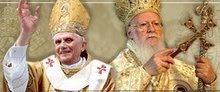
Ecumenical news: Pope & Patriarch recite the Creed in Greek (without "and the Son")!


People, you really need to check out Fr. Z's blog... very insightful, and full of goodies like this...
Today during the Mass for the Solemnity of Sts. Peter and Paul, Benedict XVI and Bartholomew I recited the Creed together in Greek.
This is just a wonderful gesture, if nothing else. However, I think it's more than just a gesture, we're slowly getting somewhere here; I really believe it. We (Orthodoxy and Catholicism) need each other. I hate to say it, but I bet I know a few Orthodox who'd think this is stupid and/or dislike it. They'd say that the pope is trying to manipulate the patriarch into a deal by providing such gestures, or that the pope is a relativist because he's not reciting the Creed with the "filioque" as he should if he's truly Roman. Go figure. As Fr. Z. notes, this really, at the end of the day, should now be a non-issue. Maybe I'm naive, but it really should, after all we know about the Holy Ghost. No reason to keep pouring salt on this wound. It's a done deal. The Roman Church believes the same thing as the Orthodox Churches about the Holy Spirit, and everyone knows that as a fact (too many pointless, semantical battles); to pretend otherwise is just intolerance and hatred. I'd be hard-pressed to find a Catholic (a serious one too) who'd balk at the prospects of not reciting the "filioque" for ecumenical reasons; and I really don't think you'd have to call them a relativist either. Yet part of me would like to see the same thing from the Orthodox, but I doubt I'll ever see a patriarch recite the Creed in Latin with the "filioque". Dare to dream. It seems somewhat clear that part of the essence of being Orthodox (for SOME), part of the identity itself (sadly), is to be anti-Roman. That's just one practical reason (and other theological reasons such as the papacy, of course), why I could never consider converting to Orthodoxy - it's tempting if you love liturgy though, but liturgy and correctly painted icons are NOT the faith (albeit important). At the end of the day, SOME Orthodox, not all, are just down-right anti-Roman no matter what. Well, God bless the patriarch for such generosity during the commemoration of the Pauline Year.
[Here them reciting the Creed! AWESOME!!! Real ecumenism in action.]

This is interesting for several reasons.
First, for so long it has been nearly obligatory to have the whole congregation sing the Creed alternating with the Sistine Chapel "Choir".
Apparently it isn’t so obligatory as we thought that the whole congregation recite the Creed.
Second, the text of the Creed is that the 381 Council of Constantinople, and thus it is the Niceno-Constantinopolitan Creed:
The Patriarch and the Pope both use the singular "I believe", rather than "We believe" of the conciliar formula. The conciliar form of the Creed was a group document, that needed a plural form. The liturgical form is a personal declaration made together with everyone else gathered.
This brings the third point: It did not contain the so-called "Filioque" clause. This is why they could recite it together easily. The Filioque clause has been a source of division from the time when the Latin Church and the Greek Church were talking past each, with a lack of comprehension on both sides of the theology of the Holy Spirit and His relationship to the Father and the Son. Now that there is greater comprehension about this relationship and what each side means when they talk about the Holy Spirit, there is far less reason to stress the differences that historically surround the Filioque clause.
Thus, the fourth point is notice how well the Holy Father reads the Greek text.
Fifth, could you local priest, seminary instructor, or bishop do the same, even with the Creed in Latin?
Thanks, Fr. Z.!
Saturday, June 28, 2008


Wednesday, May 14, 2008
Another saint of WWII

From Crunchy-Con Rod Dreher:
Irena Sendler, a Polish Catholic who saved the lives of 2,500 Jewish children in the Warsaw Ghetto, has died:
Sendler, a Roman Catholic, was born in Otwock, outside Warsaw, on February 15, 1910. Her father was a physician who directed a spa hospital. Sendler remembered him as someone who taught great compassion: “If you see someone drowning, you must try to rescue them, even if you cannot swim.”
She was an administrator in Warsaw’s welfare department in 1940, when Nazi Germany occupied Poland. Nearly half a million Jews were sequestered in Warsaw’s tiny ghetto, where conditions were appalling. The Nazis ordered a stop to normal social services, such as food and health care. Charged with warding off typhus and tuberculosis, Sendler had official permission to move freely in the ghetto. She convinced Jewish parents to let her hide their children. She used an ambulance to smuggle children in burlap sacks and coffins. A dog seated next to her would sometimes bark to drown out the children’s cries. She received aid from the Zegota, the Polish Council to Aid the Jews.
The children were given new names and false documents, and placed with Christian Polish families and at Christian religious establishments. Sendler wrote their real names on slips of paper that she hid in bottles underground, intending to retrieve them later.
The Gestapo arrested Sendler in 1943 and tortured her brutally, breaking her legs and feet with wooden clubs. She was sentenced to be executed, but she escaped after the Zegota bribed a guard. She remained in hiding until the end of the war, then dug up the bottles under the apple tree and tried to reunite the children with their families. Most of the families had perished, though some were placed with relatives around Europe. She was known within Poland, but she received little publicity in the West during the Cold War years. In 1980, she joined the Solidarity movement.
In her interview with the Sun, Sendler said: “If someone is drowning, you have to give them your hand. When the war started, all of Poland was drowning in a sea of blood, and those who were drowning the most were the Jews. And among the Jews, the worst off were the children. So I had to give them my hand.”
And her head today is no doubt resplendent with a crown. God rest her soul.

Sunday, May 11, 2008
Knights of Columbus: positive results after papal visit...
Poll: Papal Trip Had Impact on US Catholics
Helped Understanding of Church Teaching
Helped Understanding of Church Teaching
NEW HAVEN, Connecticut, MAY 9, 2008 (Zenit.org).- A Knights of Columbus poll shows U.S. Catholics grew in their understanding of Church teaching, have a more positive impression of the Pope and are more likely to vote since Benedict XVI visited the United States.
The data collected by the Marist College Institute for Public Opinion and released today shows that the Holy Father's April trip affected both practicing and non-practicing Catholics.
For example, the proportion of practicing Catholics describing Benedict XVI positively as a spiritual leader went from 70% before the visit to 82% afterward, a 12% jump. Among non-practicing Catholics, the proportion went from 62% before the visit to 79% afterward, a 17% jump.
A majority of Catholics, 54%, said they were more in touch with their spiritual values as a result of the Pope's visit, and 41% said they were more likely to vote in the November elections. Sixty-four percent of Catholics said they better understand the Catholic Church's position on important issues as a result of the trip.
Eighty-eight percent of practicing Catholics, and 73% of non-practicing Catholics say the trip met or exceeded their expectations. And more than 70% of Catholics have a more positive view of the Church as a result of the visit, including 82% of practicing Catholics and 56% of non-practicing Catholics.
Half of those polled say they are more likely to make family a bigger part of their lives, while nearly 40% say they are more likely to become more active in their community or church.
Supreme Knight Carl Anderson said that the poll results "show clearly that Pope Benedict has presented the Catholics of the United States with a tremendous opportunity. Americans are a religious people, and they responded very positively to the message of faith, hope and love that the Holy Father delivered throughout his visit. It is now up to all of us in the Catholic community to walk through the door he has opened for us, and work together to build a civilization of love."
The Marist College Institute for Public Opinion interviewed 1,013 adults nationwide, and the survey results issued today are from an over sample of an additional 502 Catholics nationwide, and are statistically significant at ±4.4%. All polling was done between April 22 and April 29, 2008, immediately following the Pope's return to Rome.
Friday, April 11, 2008
Peggy Noonan: "Something Beautiful Has Begun" - on Benedict's USA visit...

At the open-air mass in St. Peter's on April 2, the third anniversary of the death of John Paul II, Pope Benedict XVI spoke movingly – he brought mist to the eyes of our little group of visiting Americans – of John Paul's life, and the meaning of his suffering. "Among his many human and supernatural qualities he had an exceptional spiritual and mystical sensitivity," said the pontiff, who knew John Paul long and intimately. (Those who hope for swift canonization please note: "supernatural." Benedict the philosopher does not use words lightly.)
He spoke of the distilled message of John Paul's reign: "Be not afraid," the words "of the angel of the Resurrection, addressed to the women before the empty tomb." Which words were themselves a condensed message: Nothing has ended, something beautiful has begun, but you won't understand for a while.
Benedict was doing something great leaders usually don't do, which is invite you to dwell on the virtues of his predecessor.
We did. You couldn't hear Benedict without your eyes going to the small white window in the plain-walled Vatican where John Paul's private chambers were, and from which he spoke to the world. Quick memory-images: the windows open, the crowd goes wild, and John Paul is waving, or laughingly shooing away a white bird that repeatedly tried to fly in and join him, or, most movingly, at the end, trying to speak and not able to, and trying again and not able to, and how the crowd roared its encouragement.
Oh, you miss that old man when you are here! You feel the presence of his absence. The souvenir shops know. They sell framed pictures and ceramic plates of the pope: John Paul. Is there no Benedict? There is. A photo of Cardinal Joseph Ratzinger being embraced by . . . John Paul. It's now on my desk in New York. They have their hands on each other's shoulders and look in each other's eyes. A joyful image. They loved each other and were comrades.
When I was writing a book about John Paul, I'd ask those who'd met him or saw him go by: What did you think, or say? And they'd be startled and say, "I don't know, I was crying."
John Paul made you burst into tears. Benedict makes you think. It is more pleasurable to weep, but at the moment, perhaps it is more important to think.
A Vatican reporter last week said John Paul was the perfect pope for the television age, "a man of images." Think of the pictures of him storm-tossed, tempest-tossed, standing somewhere and leaning into a heavy wind, his robes whipping behind him, holding on to his crosier, the staff bearing the image of a crucified Christ, with both hands, for dear life, as if consciously giving Christians a picture of what it is to be alive.
Benedict, the reporter noted, is the perfect pope for the Internet age. He is a man of the word. You download the text of what he said, print it, ponder it.
* * *
Now he is the man at the window. What do we see? This is what I saw as his popemobile came close by in the square: tall man, white hair, shy eyes, deep-set. He is waving, trying to act out pleasure at being the focus of all eyes, center stage. He is not a showman but a scholar, an engaged philosopher nostalgic for the days – he has spoken of them – when he was a professor in a university classroom, surrounded by professors operating in a spirit of academic camaraderie and debate. But, his friends tell you, he enjoys being pope. He has become acclimated.
There is a sweetness about him – all in the Vatican who knew him in the old days speak of it – and a certain vagueness, as if he is preoccupied.
He lacks an immediately accessible flair. Popes didn't use to have to have flair, but now perhaps it is expected of them. John Paul was many things – theologian, canny anticommunist – but he was a showman, too. Woo woo, he teased the cheering children of America on his first trip. John Paul II, he loves you! Such a small thing, and yet somehow it broke your heart. The world then needed the liveliness of faith, its joy, its gaiety even. I was told this week his Vatican hadn't quite approved of what they saw as his antics. Well, that's why God didn't make them pope.
* * *
Now Benedict comes to America, his first trip as pope. The highlight in the Vatican's eyes is his address to the United Nations. No one knows what he will say. He will no doubt call for peace, for that is what popes do, and should do. Beyond that? Perhaps some variation on themes from his famous Regensburg address, in September 2006.
There he traced and limned some of the development of Christianity, but he turned first to Islam. Faith in God does not justify violence, he said. "The right use of reason" prompts us to understand that violence is incompatible with the nature of God, and the nature, therefore, of the soul. God, he quotes an ancient Byzantine ruler, "is not pleased by blood," and "not acting reasonably is contrary to God's nature." More: "To convince a reasonable soul, one does not need a strong arm." This is a message for our time, and a courageous one, too. (The speech was followed by riots and by Osama bin Laden's charge that the pope was starting a new "crusade.")
The trip begins in Washington, and the White House has announced that the pope and the president will "continue their dialogue on the interplay of faith and reason." (This prompted a long-suffering Bush supporter to say, "I'm seeing the collision of matter and antimatter.")
Catholics who hope for a successful visit have some anxiety that a distracted Vatican apparatus, working, sort of, with a confused American team waiting on decisions, will fail to allow Benedict to be what he is to best effect, to break through and reveal some of his nature. An American journalist took it upon himself to remind papal representatives that the pope turns 81 while in Washington. Perhaps people could be urged to sing . . . "Happy Birthday"? Benedict some time back wowed a group of schoolchildren when he spoke to them of Antonietta Meo, who may in time become the church's youngest nonmartyred saint. Is he meeting with schoolchildren here?
Another small fear, born of hearing him last week at the mass. Benedict spoke in many languages including English, which he speaks fluidly and with a strong German accent. This is an accent that 60 years of World War II movies have taught Americans to hear as vaguely sinister, or comic. The nicer commentators may say he sounds like Col. Klink in "Hogan's Heroes." I hope he speaks even more than usual about love, for that may remove the sting, as love does.
* * *
I forgot to say that as he went through the crowds last week, after the mass, thousands from all over the world ran toward him, reached for him, applauded. It was festive, sprawling, and as they cheered, for a moment St. Peter's felt like what Benedict said it was in the days after John Paul's death, the beating "heart of the world." It was rousing, but also comforting. Afterward I thought: Nothing is ended, something beautiful has begun, we just won't understand it for a while.
Nun saves burning man with her habit

Don't worry, nuns can take care of anything!
Reason # 2,435 for religious men and women to wear habits....
From the British paper Daily Record.
A NUN saved a burning man from death by jumping on him - then smothering the flames with her habit.
Brave Sister Donatella Ciucciumei, 51, saw the elderly man douse himself in petrol in a street in San Severino Marche, in Italy.
She ran towards the 71-year-old as he raised a lit match to his body.
And as he was engulfed in flames, she jumped on top of him, spreading her habit to douse the flames.
The nun was unhurt and the man is recovering after sustaining second degree burns to most of his body.
Sister Donatella has visited daily to offer him counselling. Police said he was depressed because his wife left him.
Nice work, sister!
Tuesday, April 8, 2008
Other peoples' kids...

Seriously, what are their parents teaching them? If anything? How does this happen?
Disturbing... Apparently they were cheerleaders too- another reason to despise cheerleadering.
POLK COUNTY, Fla. -- Video was released late Monday afternoon showing a brutal beating at the hands of a gang of teenage girls. Their motivation for the attack was allegedly so they could post the video on YouTube and MySpace [the obsession with media among young people is disturbing; no TV for my kids... or at least very, very little!].
Girls Record Brutal Attack On Teen To Allegedly Post On YouTube
POSTED: 5:14 pm EDT April 7, 2008
UPDATED: 7:43 am EDT April 8, 2008
The victim reported the attack after she was beaten so badly she had to be treated at the hospital. That's when the sheriff's office started looking into it and learned about the video.
The sheriff calls it shocking, saying he's never seen anything like it. It was a vicious attack all captured on home video inside a Polk County home.When 16-year-old Victoria Lindsay arrived at her friend's house where she had been staying, six girls were waiting. Immediately, they started yelling and one girl began pummeling the victim.
On the video, the girls can be heard encouraging the fight in the background, even taunting Lindsay to fight back, all while one of them held the camera. The victim's family has said it was an elaborate plot to injure and embarrass Victoria Lindsay. Lindsay's parents couldn't believe their daughter had to endure the attack.
"That's my Tori. Don't do that to my Tori," said the victim's mother.
The 16-year-old suffered a concussion, eye injuries and several bruises. During the attack, two others were outside keeping watch according to the sheriff's office.
In fact, the sheriff said, Lindsay was lured into the home for the sole purpose of capturing and posting the video on the Internet. According to the sheriff's office arrest affidavit, Lindsay told deputies they "were going to post the beating on MySpace and YouTube."
The whole story...
Saturday, February 16, 2008
Mother refuses to abort twin babies... babies save her life!

Michelle Stepney with her girls Alice and Harriet / Photo Credit: The Daily Mail
Mother refuses to abort twin girls who knocked loose tumor
London, Feb 7, 2008 / 04:41 am (CNA).- A British woman’s twin girls saved her life when, while still in the womb, they kicked free a tumor growing in their mother’s uterus, the Daily Mail reports.
Though advised she needed to abort the twins so she could be treated for cancer, the mother avoided harsh cancer treatment so her babies could be born.
Michelle Stepney, 35, was expecting twins when she went to a hospital with a suspected miscarriage. The doctors realized that she had cervical cancer, saying that the kicking of the twins had dislodged a tumor.
Had the tumor not been dislodged, the cancer may not have been discovered in time for successful treatment.
After the discovery of the cancer, Stepney’s doctors told her that she would need to undergo chemotherapy and a hysterectomy. To do this, she would need to abort the twins.
Stepney refused. "I couldn't believe it when the doctors told me that the babies had dislodged the tumor," she said, according to the Daily Mail.
"I'd felt them kicking, but I didn't realize just how important their kicking would turn out to be.
"I owe my life to my girls, and that's why I could have never agreed with a termination."
"I knew I could have an operation straight away and it would cure me of the cancer, but that would mean getting rid of my babies and I couldn't do that.
"I had two lives inside me and I just couldn't give up on them - especially after they had saved me like this," Stepney said.
The twins are now one year old and thriving. She and her husband, Scott, also have a five-year-old son.
"I feel so lucky. And one day I will tell my daughters how they saved their mummy's life."
Read the full story here:
http://www.catholicnewsagency.com/new.php?n=11713
Wednesday, January 30, 2008
The New Monasticism?

I just came across a site dedicated to the 'New Monasticism'. This group is made up of dissatisfied Evangelicals who want to experience the early church. Little do they know, but monastic life is growing again in the historical churches of Catholicism and Orthodoxy- the two traditions in which both monasticism and the early church were originated. God bless them in their ventures. Here is how they describe themselves:
Throughout the history of the church, monastic movements have arisen during times of rapid social change. When the minority movement that Jesus started was flooded by converts after Constantine, desert mothers and fathers went into their cells to discern a new way of life. When Europe collapsed into the Dark Ages, Benedictines carved out spaces for community and new life. When the advent of a cash economy revolutionized European culture, St. Francis started an order of beggars to proclaim the divine economy of providence. Over the past two thousand years, monasticism has helped the church remember who we are.
Ours is a time of rapid social change. We are post-modern, post-Cold War, post-9/11, even post-Christian. All signs point to change, and we know things aren’t what they used to be. But we hardly know who we are. Amidst wars and rumors of war, our global identity crisis threatens to consume us.
But we have hope. The Holy Spirit is stirring in the places overlooked by Empire to raise up a new monastic movement. We don’t know yet what this movement of the Spirit will become. “New Monasticism” is the language we’re using to talk about it in the meantime.
For the sake of discernment and mutual encouragement, we have connected with other followers of Jesus who are experimenting with a new way of life in community. The “12 Marks of a New Monasticism” name what God is doing in our communities. The Community of Communities is an online directory of where communities are and descriptions of what they’re about.
In the summer of 2006, we started School for Conversion to offer community-based training and theological education for the church. Seeing a need to learn what community looks like across the dividing lines of our time, we initiated School for Conversion Latin America [link] in 2007. SFC courses are offered throughout the United States and Canada, as well as in Argentina and Brazil.
To clarify our own thoughts and share the good news we’ve seen and heard, we have written a number of books which you can find here. In the fall of 2007, we announced a partnership with Cascade Books to publish the New Monastic Library Series [link].
We’re not sure just what will come of all this. But we’re so grateful for the good news that God has not abandoned the world. Something new is stirring, drawing deeply from the old. People who’ve stumbled in darkness are glimpsing light. We pray for grace to remember who we are in Christ.
Moved by God’s Spirit in this time called America to assemble at St. Johns Baptist Church in Durham, NC, we wish to acknowledge a movement of radical rebirth, grounded in God’s love and drawing on the rich tradition of Christian practices that have long formed disciples in the simple Way of Christ. This contemporary school for conversion which we have called a “new monasticism,” is producing a grassroots ecumenism and a prophetic witness within the North American church which is diverse in form, but characterized by the following marks:
1) Relocation to the abandoned places of Empire.
2) Sharing economic resources with fellow community members and the needy among us.
3) Hospitality to the stranger
4) Lament for racial divisions within the church and our communities
combined with the active pursuit of a just reconciliation.
5) Humble submission to Christ’s body, the church.
6) Intentional formation in the way of Christ and the rule of the
community along the lines of the old novitiate.
7) Nurturing common life among members of intentional community.
8) Support for celibate singles alongside monogamous married couples and their children.
9) Geographical proximity to community members who share a common rule of life.
10) Care for the plot of God’s earth given to us along with support of our local economies.
11) Peacemaking in the midst of violence and conflict resolution within communities along the lines of Matthew 18.
12) Commitment to a disciplined contemplative life.
May God give us grace by the power of the Holy Spirit to discern rules for living that will help us embody these marks in our local contexts as signs of Christ’s kingdom for the sake of God’s world.
Here's their website:
http://www.newmonasticism.org/12marks/12marks.php
Orthodox Archbishop Christodoulus of Athens and All Greece has died...
The image below is of Archbishop Christodoulus & Pope Benedict XVI.

Papal Message to Orthodox Church of Greece
VATICAN CITY, JAN. 29, 2008 (Zenit.org).- Here is the telegram Benedict XVI sent today to Orthodox Metropolitan Seraphim of Karystia and Skyros upon hearing the news of the death of Orthodox Archbishop Christodoulus of Athens and All Greece.
* * *
His Eminence Seraphim
Metropolitan of Karystia and Skyros
The Locum Tenens
Deeply saddened by the news of the untimely death of his Beatitude Christodoulos, Archbishop of Athens and All Greece, I express to you, to the holy Synod and all the faithful my earnest condolences, assuring you of my spiritual closeness to all those who mourn the passing of this distinguished pastor of the Church of Greece. The fraternal welcome which His Beatitude gave my predecessor Pope John Paul II on the occasion of his visit to Athens in May 2001 and the return visit of Archbishop Christodoulos to Rome in December 2006 opened a new era of cordial cooperation between us, leading to increased contacts and improved friendship in the search for closer communion in the context of the growing unity of Europe. I and Catholics around the world pray that the Orthodox Church of Greece will be sustained by the grace of God in continuing to build on the pastoral achievements of the late Archbishop and that in commending the noble soul of his Beatitude to our heavenly Father's loving mercy you will be comforted by the Lord's promise to reward his faithful servants.
Please accept, your eminence, this expression of my closeness in prayer to you and your brother bishops as you guide the Church in this time of transition. With fraternal affection in the Lord.
BENEDICTUS PP. XVI

Papal Message to Orthodox Church of Greece
VATICAN CITY, JAN. 29, 2008 (Zenit.org).- Here is the telegram Benedict XVI sent today to Orthodox Metropolitan Seraphim of Karystia and Skyros upon hearing the news of the death of Orthodox Archbishop Christodoulus of Athens and All Greece.
* * *
His Eminence Seraphim
Metropolitan of Karystia and Skyros
The Locum Tenens
Deeply saddened by the news of the untimely death of his Beatitude Christodoulos, Archbishop of Athens and All Greece, I express to you, to the holy Synod and all the faithful my earnest condolences, assuring you of my spiritual closeness to all those who mourn the passing of this distinguished pastor of the Church of Greece. The fraternal welcome which His Beatitude gave my predecessor Pope John Paul II on the occasion of his visit to Athens in May 2001 and the return visit of Archbishop Christodoulos to Rome in December 2006 opened a new era of cordial cooperation between us, leading to increased contacts and improved friendship in the search for closer communion in the context of the growing unity of Europe. I and Catholics around the world pray that the Orthodox Church of Greece will be sustained by the grace of God in continuing to build on the pastoral achievements of the late Archbishop and that in commending the noble soul of his Beatitude to our heavenly Father's loving mercy you will be comforted by the Lord's promise to reward his faithful servants.
Please accept, your eminence, this expression of my closeness in prayer to you and your brother bishops as you guide the Church in this time of transition. With fraternal affection in the Lord.
BENEDICTUS PP. XVI
Tuesday, January 8, 2008
"Bella" - a true story


Introducing Rediet...
This little girl was adopted by someone I know recently. A beautiful little child, and a wonderful story of hope and love.
Here's what her parents said:
Thank you so much for all of your prayers and support, everyone! We will be eternally grateful!
Please continue to pray that we get a speedy embassy date...(we hope to travel in 3-5 weeks)!
And please pray for Rediet, that her three year old little heart may have peace in the transition.
Indeed, pray for this little gal and her parents.
Friday, January 4, 2008
A humble servant of God passes on...

REQUIESCAT IN PACE, BONE PATER.
This is the story of a truly great priest. Whether Protestant, Catholic, or Orthodox, one cannot deny that we need more manly, conservative, serious, honorable, and humble servants like Msgr Mejak. The Lord needs more good men like this to serve his Church until their dying day.
----------------------------------------------------------
The nation's longest-serving parish priest has gone to his reward.
[from Whispers in the Loggia]
A priest of the archdiocese of Kansas City in Kansas, Msgr Heliodore Mejak died at 98 on Christmas Eve.
A native of Austria ordained in 1935, Mejak labored at Holy Family in Kansas City until the day of his death -- a pastorate that spanned 63 years and five months... or, to put it another way, six pontificates.
He will be remembered not only for his longevity but for his staunchly traditional Catholicism and his devotion to his parish, where he was also the church handyman, lawn cutter, financial manager and compiler of the weekly bulletin.
“He was a stellar priest,” said Mary Ann Grelinger, a former parishioner at Holy Family who wrote a 2006 biography on Mejak for a priests’ magazine called Homiletic & Pastoral Review. “He said Mass every day. He never took a day off or a vacation. Most priests do. He didn’t.”
Mejak celebrated Mass until about a week before he died, even though he had become progressively weaker, was losing his vision and used a walker.
“He couldn’t see,” said Kevin Fogarty, a Wyandotte County firefighter who has been attending Holy Family Church regularly for about 10 years. “He wore ‘welding goggles’ with huge magnifiers. When he said Mass, it was obvious he was reciting from memory. He couldn’t read it at all.”
Mejak may be best known for his resistance to changes in the church. Holy Family, a Slovenian parish, drew people who believed as he did. He was the last priest in the archdiocese to stop celebrating Mass in Latin in the wake of the Vatican II church reforms approved in the 1960s.
Mejak did not want laypeople to serve communion and said the host should only be served directly from a priest’s hand, rather than placing it in the hand of the recipient. He wanted people to kneel rather than stand for communion.
When Vatican II called on people to shake hands or hug as a sign of peace during Mass, Mejak ignored it.... [NICE!]
Charles Andalikiewicz, 77, had known Mejak since he was a boy growing up in the neighborhood of the church. Andalikiewicz is priest of Immaculate Conception Church in Louisburg, Kan.
“He was very humble, very loyal and a gentle man,” Andalikiewicz said. “He was also very scholarly.”
Mejak was a train buff who built electric trains in the church basement that he liked to show children, Grelinger recalled. He built the trains using old pictures and drawings as a guide....
He served several churches in Kansas before being assigned to the Holy Family, where he had to learn the Slovenian language.
"We all knew that he wouldn’t live forever, but at times he certainly seemed indestructible," Archbishop Joseph Naumann told a local paper.
“Monsignor is somebody you don’t replace.”
While an administrator will be named shortly, Naumann said that, in time, Holy Family will likely be consolidated with two other parishes under the leadership of a shared pastor. [Terrible.]
Indeed, in more ways than one, it's the end of an era.
Saturday, December 29, 2007
Cassocks and Christmas charity...

The Rev. Benedict J. Groeschel with Desire Matos, 2, and her mother, Joanna Brown, at the St. Francis Center in the South Bronx. An aid effort grew from an idea he had in 1962.
A Circle of Faith Grows in Unexpected Ways
By PETER APPLEBOME
Published: December 23, 2007 New York Times Religion Section
LARCHMONT, N.Y.
Forty-five years ago, the Rev. Benedict J. Groeschel had a small idea.
Then the chaplain at the Children’s Village for troubled youths in Dobbs Ferry in Westchester County, he decided in December 1962 to take Christmas dinner, other food and a smattering of presents to the impoverished families of five children from the South Bronx and Harlem whom he worked with.
Those families mentioned others — nephews, cousins, friends who were also in need. He thought: Why not? So next year the circle widened a bit. Word spread in the neighborhood. A building superintendent or neighbor would mention other names. Each December the list continued to grow.
Before long, he realized he had begun something that couldn’t be stopped, a Christmas tradition with a regular cast of characters, a past as well as a present, one of those reminders that the more noble notions of Christmas can sometimes creep in amid the seasonal clutter of commerce, bustle and noise.
Pick your religion, the essence of the season is the enormous things that can flow from small ones — a birth among the poor in a humble stable, a day’s worth of oil that somehow burns for eight.
And so, when Father Groeschel and his crew of helpers went to the South Bronx for the 45th year on Saturday, this time with around 700 boxes of food and thousands of presents, the message was not just about the importance of service to the poor. It was also about the huge things that can come from tiny ones.
“As a psychologist, I have to say I have a Santa Claus complex,” Father Groeschel said on Friday, the calm day between the loading and delivering of the food and toys and their distribution. “But I never, ever anticipated that this would become anything like this.”
Actually, there’s a second reason why this Christmas is so special. It’s a miracle he has lived to see it. Father Groeschel, an author of religious books and a fixture on the Roman Catholic EWTN television network, was crossing a street in Orlando, Fla., on Jan. 11, 2004, when he was hit by a car. He was near death three times in the next month, particularly on the night of the accident when he had no blood pressure, heartbeat or pulse for about 20 minutes. A few days later, he almost died from toxins that were overloading his system, then later from heart failure while on a respirator.
The accident left him without much use of his right arm and trouble walking, but he recovered to a degree almost no one expected.
“They said I would never live. I lived,” he said. “They said I would never think. I think. They said I would never walk. I walked. They said I would never dance, but I never danced anyway.”
Father Groeschel, a Franciscan friar who is the director of the Roman Catholic Archdiocese of New York’s office of spiritual development, which assists priests, now presides over an ad-hoc partnership of the faithful for the Christmas operation.
In addition to hundreds of donors, it includes Teresa Catullo, a local woman who spends the entire year buying up hundreds of off-price toys and gifts, which clutter her house until packed and shipped off; Cathy Hickey, who has worked with him since 1986; Jim Hogg, who runs a homeless shelter in Bethlehem, Pa., but comes in every year to help load trucks and deliver the food and toys; and two women, Doris Reeves and Anne Duffy, who for the second year flew in from California to help out as needed.
“If we believe what we say we do, then we should put our words into action,” Mr. Hogg said. “The Bible says, ‘If you do this unto these, the least of my brethren, you have done it for me.’”
Father Groeschel, who is 74, with a long white beard that’s more Merlin than Santa, is considered liberal on social justice issues like poverty and immigration, and extremely orthodox on church issues like abortion and homosexuality.
He figures Christmas has long been in a struggle between the sacred and the temporal, between charity and marketing, tensions that are particularly out of whack now. But then that’s true in our society overall, where the notion of service to the poor that is the focus of the order he helped start seems as quaint as friars in cassocks.
“I’m the only person in Larchmont who wishes he lived in the South Bronx,” Father Groeschel said, in his home and office in what used to be a garage at the archdiocese’s Trinity Retreat House, overlooking a bay off Long Island Sound.
Still, there are consolations. On a frigid Friday, it feels astoundingly peaceful. There’s no television with the overheated cavalcade of daily astonishments in the news and the commercials for luxury cars with bows on top. Priests and fellows and helpers of various stripes pad quietly to and fro. For a moment, in this quiet corner of Westchester all is calm, all is bright.