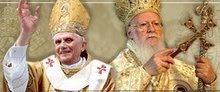
Dear Brothers in the Episcopal Ministry!
The remission of the excommunication of the four Bishops consecrated in 1988 by Archbishop Lefebvre without a mandate of the Holy See has for many reasons caused, both within and beyond the Catholic Church, a discussion more heated than any we have seen for a long time. Many Bishops felt perplexed by an event which came about unexpectedly and was difficult to view positively in the light of the issues and tasks facing the Church today. Even though many Bishops and members of the faithful were disposed in principle to take a positive view of the Pope’s concern for reconciliation, the question remained whether such a gesture was fitting in view of the genuinely urgent demands of the life of faith in our time. Some groups, on the other hand, openly accused the Pope of wanting to turn back the clock to before the Council: as a result, an avalanche of protests was unleashed, whose bitterness laid bare wounds deeper than those of the present moment. I therefore feel obliged to offer you, dear Brothers, a word of clarification, which ought to help you understand the concerns which led me and the competent offices of the Holy See to take this step. In this way I hope to contribute to peace in the Church.
An unforeseen mishap for me was the fact that the Williamson case came on top of the remission of the excommunication. The discreet gesture of mercy towards four Bishops ordained validly but not legitimately suddenly appeared as something completely different: as the repudiation of reconciliation between Christians and Jews, and thus as the reversal of what the Council had laid down in this regard to guide the Church’s path. A gesture of reconciliation with an ecclesial group engaged in a process of separation thus turned into its very antithesis: an apparent step backwards with regard to all the steps of reconciliation between Christians and Jews taken since the Council -- steps which my own work as a theologian had sought from the beginning to take part in and support. That this overlapping of two opposed processes took place and momentarily upset peace between Christians and Jews, as well as peace within the Church, is something which I can only deeply deplore. I have been told that consulting the information available on the internet would have made it possible to perceive the problem early on. I have learned the lesson that in the future in the Holy See we will have to pay greater attention to that source of news. I was saddened by the fact that even Catholics who, after all, might have had a better knowledge of the situation, thought they had to attack me with open hostility. Precisely for this reason I thank all the more our Jewish friends, who quickly helped to clear up the misunderstanding and to restore the atmosphere of friendship and trust which -- as in the days of Pope John Paul II -- has also existed throughout my pontificate and, thank God, continues to exist.
Another mistake, which I deeply regret, is the fact that the extent and limits of the provision of 21 January 2009 were not clearly and adequately explained at the moment of its publication. The excommunication affects individuals, not institutions. An episcopal ordination lacking a pontifical mandate raises the danger of a schism, since it jeopardizes the unity of the College of Bishops with the Pope. Consequently the Church must react by employing her most severe punishment -- excommunication -- with the aim of calling those thus punished to repent and to return to unity. Twenty years after the ordinations, this goal has sadly not yet been attained. The remission of the excommunication has the same aim as that of the punishment: namely, to invite the four Bishops once more to return. This gesture was possible once the interested parties had expressed their recognition in principle of the Pope and his authority as Pastor, albeit with some reservations in the area of obedience to his doctrinal authority and to the authority of the Council. Here I return to the distinction between individuals and institutions. The remission of the excommunication was a measure taken in the field of ecclesiastical discipline: the individuals were freed from the burden of conscience constituted by the most serious of ecclesiastical penalties. This disciplinary level needs to be distinguished from the doctrinal level. The fact that the Society of Saint Pius X does not possess a canonical status in the Church is not, in the end, based on disciplinary but on doctrinal reasons. As long as the Society does not have a canonical status in the Church, its ministers do not exercise legitimate ministries in the Church. There needs to be a distinction, then, between the disciplinary level, which deals with individuals as such, and the doctrinal level, at which ministry and institution are involved. In order to make this clear once again: until the doctrinal questions are clarified, the Society has no canonical status in the Church, and its ministers -- even though they have been freed of the ecclesiastical penalty -- do not legitimately exercise any ministry in the Church.
In light of this situation, it is my intention henceforth to join the Pontifical Commission "Ecclesia Dei" -- the body which has been competent since 1988 for those communities and persons who, coming from the Society of Saint Pius X or from similar groups, wish to return to full communion with the Pope -- to the Congregation for the Doctrine of the Faith. This will make it clear that the problems now to be addressed are essentially doctrinal in nature and concern primarily the acceptance of the Second Vatican Council and the post-conciliar magisterium of the Popes. The collegial bodies with which the Congregation studies questions which arise (especially the ordinary Wednesday meeting of Cardinals and the annual or biennial Plenary Session) ensure the involvement of the Prefects of the different Roman Congregations and representatives from the world’s Bishops in the process of decision-making. The Church’s teaching authority cannot be frozen in the year 1962 -- this must be quite clear to the Society. But some of those who put themselves forward as great defenders of the Council also need to be reminded that Vatican II embraces the entire doctrinal history of the Church. Anyone who wishes to be obedient to the Council has to accept the faith professed over the centuries, and cannot sever the roots from which the tree draws its life. [hahahahaha!]
I hope, dear Brothers, that this serves to clarify the positive significance and also the limits of the provision of 21 January 2009. But the question still remains: Was this measure needed? Was it really a priority? Aren’t other things perhaps more important? Of course there are more important and urgent matters. I believe that I set forth clearly the priorities of my pontificate in the addresses which I gave at its beginning. Everything that I said then continues unchanged as my plan of action. The first priority for the Successor of Peter was laid down by the Lord in the Upper Room in the clearest of terms: "You… strengthen your brothers" (Lk 22:32). Peter himself formulated this priority anew in his first Letter: "Always be prepared to make a defence to anyone who calls you to account for the hope that is in you" (1 Pet 3:15). In our days, when in vast areas of the world the faith is in danger of dying out like a flame which no longer has fuel, the overriding priority is to make God present in this world and to show men and women the way to God. Not just any god, but the God who spoke on Sinai; to that God whose face we recognize in a love which presses "to the end" (cf. Jn 13:1) -- in Jesus Christ, crucified and risen. The real problem at this moment of our history is that God is disappearing from the human horizon, and, with the dimming of the light which comes from God, humanity is losing its bearings, with increasingly evident destructive effects.
Leading men and women to God, to the God who speaks in the Bible: this is the supreme and fundamental priority of the Church and of the Successor of Peter at the present time. A logical consequence of this is that we must have at heart the unity of all believers. Their disunity, their disagreement among themselves, calls into question the credibility of their talk of God. Hence the effort to promote a common witness by Christians to their faith -- ecumenism -- is part of the supreme priority. Added to this is the need for all those who believe in God to join in seeking peace, to attempt to draw closer to one another, and to journey together, even with their differing images of God, towards the source of Light -- this is interreligious dialogue. Whoever proclaims that God is Love "to the end" has to bear witness to love: in loving devotion to the suffering, in the rejection of hatred and enmity -- this is the social dimension of the Christian faith, of which I spoke in the Encyclical Deus Caritas Est.
So if the arduous task of working for faith, hope and love in the world is presently (and, in various ways, always) the Church’s real priority, then part of this is also made up of acts of reconciliation, small and not so small. That the quiet gesture of extending a hand gave rise to a huge uproar, and thus became exactly the opposite of a gesture of reconciliation, is a fact which we must accept. But I ask now: Was it, and is it, truly wrong in this case to meet half-way the brother who "has something against you" (cf. Mt 5:23ff.) and to seek reconciliation? Should not civil society also try to forestall forms of extremism and to incorporate their eventual adherents -- to the extent possible -- in the great currents shaping social life, and thus avoid their being segregated, with all its consequences? Can it be completely mistaken to work to break down obstinacy and narrowness, and to make space for what is positive and retrievable for the whole? I myself saw, in the years after 1988, how the return of communities which had been separated from Rome changed their interior attitudes; I saw how returning to the bigger and broader Church enabled them to move beyond one-sided positions and broke down rigidity so that positive energies could emerge for the whole. Can we be totally indifferent about a community which has 491 priests, 215 seminarians, 6 seminaries, 88 schools, 2 university-level institutes, 117 religious brothers, 164 religious sisters and thousands of lay faithful? Should we casually let them drift farther from the Church? I think for example of the 491 priests. We cannot know how mixed their motives may be. All the same, I do not think that they would have chosen the priesthood if, alongside various distorted and unhealthy elements, they did not have a love for Christ and a desire to proclaim him and, with him, the living God. Can we simply exclude them, as representatives of a radical fringe, from our pursuit of reconciliation and unity? What would then become of them?
Certainly, for some time now, and once again on this specific occasion, we have heard from some representatives of that community many unpleasant things -- arrogance and presumptuousness, an obsession with one-sided positions, etc. Yet to tell the truth, I must add that I have also received a number of touching testimonials of gratitude which clearly showed an openness of heart. But should not the great Church also allow herself to be generous in the knowledge of her great breadth, in the knowledge of the promise made to her? Should not we, as good educators, also be capable of overlooking various faults and making every effort to open up broader vistas? And should we not admit that some unpleasant things have also emerged in Church circles? At times one gets the impression that our society needs to have at least one group to which no tolerance may be shown; which one can easily attack and hate. And should someone dare to approach them -- in this case the Pope -- he too loses any right to tolerance; he too can be treated hatefully, without misgiving or restraint. [Boom.]
Dear Brothers, during the days when I first had the idea of writing this letter, by chance, during a visit to the Roman Seminary, I had to interpret and comment on Galatians 5:13-15. I was surprised at the directness with which that passage speaks to us about the present moment: "Do not use your freedom as an opportunity for the flesh, but through love be servants of one another. For the whole law is fulfilled in one word: ‘You shall love your neighbour as yourself’. But if you bite and devour one another, take heed that you are not consumed by one another." I am always tempted to see these words as another of the rhetorical excesses which we occasionally find in Saint Paul. To some extent that may also be the case. But sad to say, this "biting and devouring" also exists in the Church today, as expression of a poorly understood freedom. Should we be surprised that we too are no better than the Galatians? That at the very least we are threatened by the same temptations? That we must always learn anew the proper use of freedom? And that we must always learn anew the supreme priority, which is love? The day I spoke about this at the Major Seminary, the feast of Our Lady of Trust was being celebrated in Rome. And so it is: Mary teaches us trust. She leads us to her Son, in whom all of us can put our trust. He will be our guide -- even in turbulent times. And so I would like to offer heartfelt thanks to all the many Bishops who have lately offered me touching tokens of trust and affection, and above all assured me of their prayers. My thanks also go to all the faithful who in these days have given me testimony of their constant fidelity to the Successor of Saint Peter. May the Lord protect all of us and guide our steps along the way of peace. This is the prayer that rises up instinctively from my heart at the beginning of this Lent, a liturgical season particularly suited to interior purification, one which invites all of us to look with renewed hope to the light which awaits us at Easter.
With a special Apostolic Blessing, I remain
Yours in the Lord,
BENEDICTUS PP. XVI
From the Vatican, 10 March 2009
Showing posts with label SSPX. Show all posts
Showing posts with label SSPX. Show all posts
Saturday, March 14, 2009
Benedict's letter to bishops on the SSPX bungle...
This is a letter from a humble shepherd.

Friday, February 27, 2009


Wednesday, February 11, 2009
Williamson hits a homerun in the Der Spiegel interview...
Bishop Richard Williamson's denial of the Holocaust has done serious damage to the Catholic Church. In an e-mail and fax exchange with SPIEGEL, the ultra-conservative bishop says that he is willing to "review the historical evidence."
SPIEGEL: The Vatican is demanding that you retract your denial of the Holocaust, and it is threatening to not allow you to resume your activities as a bishop. How will you react?
Williamson: Throughout my life, I have always sought the truth. That is why I converted to Catholicism and became a priest. And now I can only say something, the truth of which I am convinced. Because I realize that there are many honest and intelligent people who think differently, I must now review the historical evidence once again. I said the same thing in my interview with Swedish television: Historical evidence is at issue, not emotions. And if I find this evidence, I will correct myself. But that will take time.
SPIEGEL: How can an educated Catholic deny the Holocaust?
Williamson: I addressed the subject in the 1980s. I had read various writings at the time. I cited the Leuchter report (eds. note: a debunked theory produced in the 1980s claiming erroneously that the Nazi gas chambers were technically impractical) in the interview, and it seemed plausible to me. Now I am told that it has been scientifically refuted. I plan now to look into it.
SPIEGEL: You could travel to Auschwitz yourself.
Williamson: No, I will not travel to Auschwitz. I've ordered the book by Jean-Claude Pressac. It's called "Auschwitz: Technique and Operation of the Gas Chambers." A printout is now being sent to me, and I will read it and study it.
SPIEGEL: The Society of Saint Pius X has set an ultimatum for the end of February. Are you not risking a break with the group?
Williamson: In the Old Testament, the Prophet Jonah tells the sailors when their ship is in distress: " Take me up, and cast me forth into the sea; so shall the sea be calm unto you: for I know that for my sake this great tempest is upon you." The Society has a religious mission that is suffering because of me. I will now examine the historic evidence. If I do not find it convincing, I will do everything in my power to avoid inflicting any further harm on the Church and the Society.
SPIEGEL: What does the repeal of the excommunication by Pope Benedict XVI mean to you?
Williamson: We just want to be Catholic, nothing else. We have not developed our own teachings, but are merely preserving the things that the Church has always taught and practiced. And in the sixties and seventies, when everything was changed in the name of this Council (eds. note: the Second Vatican Council), it was suddenly a scandal. As a result, we were forced to the margins of the church, and now that empty churches and an aging clergy make it clear that these changes were a failure, we are returning to the center. That's the way it is for us conservatives: we are proved right, as long as we wait long enough.
SPIEGEL: People at the Vatican claimed that they didn't know you. Is that true?
Williamson: Most contacts pass through Bishop Fellay and the General Council, of which I am not a member. But three of us four bishops attended a private dinner with Cardinal Castrillon Hoyos in 2000. It was more about getting to know each other, but we certainly talked about theological issues and even a bit of philosophy. The cardinal was very friendly.
SPIEGEL: The Second Vatican Council counts as one of the great achievements of the Catholic Church. Why do you not fully recognize it?
Williamson: It is absolutely unclear what we are supposed to recognize. An important document is called "Gaudium et spes," or Joy and Hope. In it, the writers rhapsodize about the ability of mass tourism to bring people together. But one can hardly expect a conservative society to embrace package tours. It discusses fears and hardships. And then a nuclear war between the superpowers is mentioned. You see, much of this is already outdated. These Council documents are always ambiguous. Because no one knew what exactly this was supposed to mean, everyone started doing as he wished shortly after the Council. This has resulted in this theological chaos we have today. What are we supposed to recognize, the ambiguity or the chaos?
SPIEGEL: Are you actually aware that you are dividing the Church with your extreme views?
Williamson: Only violation of the dogmas, that is, the infallible principles, destroys faith. The Second Vatican Council declared that it would proclaim no new dogmas. Today the liberal bishops act as though it were some sort of all-encompassing super-dogma, and they use it as justification for a dictatorship of relativism. This contradicts the texts of the Council.
SPIEGEL: Your position on Judaism is consistently anti-Semitic.
Williamson: St. Paul put it this way: The Jews are beloved for the sake of Our Father, but our enemies for the sake of the gospel.
SPIEGEL: Do you seriously intend to use Catholic tradition and the Bible to justify your anti-Semitism?
Williamson: Anti-Semitism means many things today, for instance, when one criticizes the Israeli actions in the Gaza Strip. The Church has always understood the definition of anti-Semitism to be the rejection of Jews because of their Jewish roots. This is condemned by the Church. Incidentally, this is self-evident in a religion whose founders and all important individuals in its early history were Jews. But it was also clear, because of the large number of Jewish Christians in early Christianity, that all men need Christ for their salvation -- all men, including the Jews.
SPIEGEL: The pope will travel to Israel soon, where he plans to visit the Holocaust Memorial. Are you also opposed to this?
Williamson: Making a pilgrimage to the Holy Land is a great joy for Christians. I wish the Holy Father all the best on his journey. What troubles me about Yad Vashem is that Pope Pius XII is attacked there, even though no one saved more Jews during the Nazi period than he did. For instance, he had baptismal certificates issued for persecuted Jews to protect them against arrest. These facts have been distorted to mean exactly the opposite. Otherwise, I hope that the pope will also have an eye and a heart for the women and children who were injured in the Gaza Strip, and that he will speak out in support of the Christian population in Bethlehem, which is now walled in.
SPIEGEL: Your statements have caused great injury and outrage in the Jewish world. Why don't you apologize?
Williamson: If I realize that I have made an error, I will apologize. I ask every human being to believe me when I say that I did not deliberately say anything untrue. I was convinced that my comments were accurate, based on my research in the 1980s. Now I must review everything again and look at the evidence.
SPIEGEL: Do you at least recognize universal human rights?
Williamson: When human rights were declared in France, hundreds of thousands were killed throughout France. Where human rights are considered an objective order for the state to implement, there are constantly anti-Christian policies. When it comes to preserving the individual's freedom of conscience against the democratic state, then human rights perform an important function. The individual needs these rights against a country that behaves like a Leviathan. But the Christian concept of the state is a different one, so that the Christian theories of human rights emphasize that freedom is not an end in itself. The point is not freedom from something, but freedom for something. For good.
SPIEGEL: Your statements and the lifting of your excommunication have triggered protests worldwide. Can you understand this?
Williamson: A single interview on Swedish television has dominated the news for weeks in Germany. Yes, it does surprise me. Is this the case with all violations of the law in Germany? Hardly. No, I am only the tool here, so that action can be taken against the SSPX and the pope. Apparently Germany's leftist Catholicism has not yet forgiven Ratzinger for becoming pope.
SPIEGEL: The Vatican is demanding that you retract your denial of the Holocaust, and it is threatening to not allow you to resume your activities as a bishop. How will you react?
Williamson: Throughout my life, I have always sought the truth. That is why I converted to Catholicism and became a priest. And now I can only say something, the truth of which I am convinced. Because I realize that there are many honest and intelligent people who think differently, I must now review the historical evidence once again. I said the same thing in my interview with Swedish television: Historical evidence is at issue, not emotions. And if I find this evidence, I will correct myself. But that will take time.
SPIEGEL: How can an educated Catholic deny the Holocaust?
Williamson: I addressed the subject in the 1980s. I had read various writings at the time. I cited the Leuchter report (eds. note: a debunked theory produced in the 1980s claiming erroneously that the Nazi gas chambers were technically impractical) in the interview, and it seemed plausible to me. Now I am told that it has been scientifically refuted. I plan now to look into it.
SPIEGEL: You could travel to Auschwitz yourself.
Williamson: No, I will not travel to Auschwitz. I've ordered the book by Jean-Claude Pressac. It's called "Auschwitz: Technique and Operation of the Gas Chambers." A printout is now being sent to me, and I will read it and study it.
SPIEGEL: The Society of Saint Pius X has set an ultimatum for the end of February. Are you not risking a break with the group?
Williamson: In the Old Testament, the Prophet Jonah tells the sailors when their ship is in distress: " Take me up, and cast me forth into the sea; so shall the sea be calm unto you: for I know that for my sake this great tempest is upon you." The Society has a religious mission that is suffering because of me. I will now examine the historic evidence. If I do not find it convincing, I will do everything in my power to avoid inflicting any further harm on the Church and the Society.
SPIEGEL: What does the repeal of the excommunication by Pope Benedict XVI mean to you?
Williamson: We just want to be Catholic, nothing else. We have not developed our own teachings, but are merely preserving the things that the Church has always taught and practiced. And in the sixties and seventies, when everything was changed in the name of this Council (eds. note: the Second Vatican Council), it was suddenly a scandal. As a result, we were forced to the margins of the church, and now that empty churches and an aging clergy make it clear that these changes were a failure, we are returning to the center. That's the way it is for us conservatives: we are proved right, as long as we wait long enough.
SPIEGEL: People at the Vatican claimed that they didn't know you. Is that true?
Williamson: Most contacts pass through Bishop Fellay and the General Council, of which I am not a member. But three of us four bishops attended a private dinner with Cardinal Castrillon Hoyos in 2000. It was more about getting to know each other, but we certainly talked about theological issues and even a bit of philosophy. The cardinal was very friendly.
SPIEGEL: The Second Vatican Council counts as one of the great achievements of the Catholic Church. Why do you not fully recognize it?
Williamson: It is absolutely unclear what we are supposed to recognize. An important document is called "Gaudium et spes," or Joy and Hope. In it, the writers rhapsodize about the ability of mass tourism to bring people together. But one can hardly expect a conservative society to embrace package tours. It discusses fears and hardships. And then a nuclear war between the superpowers is mentioned. You see, much of this is already outdated. These Council documents are always ambiguous. Because no one knew what exactly this was supposed to mean, everyone started doing as he wished shortly after the Council. This has resulted in this theological chaos we have today. What are we supposed to recognize, the ambiguity or the chaos?
SPIEGEL: Are you actually aware that you are dividing the Church with your extreme views?
Williamson: Only violation of the dogmas, that is, the infallible principles, destroys faith. The Second Vatican Council declared that it would proclaim no new dogmas. Today the liberal bishops act as though it were some sort of all-encompassing super-dogma, and they use it as justification for a dictatorship of relativism. This contradicts the texts of the Council.
SPIEGEL: Your position on Judaism is consistently anti-Semitic.
Williamson: St. Paul put it this way: The Jews are beloved for the sake of Our Father, but our enemies for the sake of the gospel.
SPIEGEL: Do you seriously intend to use Catholic tradition and the Bible to justify your anti-Semitism?
Williamson: Anti-Semitism means many things today, for instance, when one criticizes the Israeli actions in the Gaza Strip. The Church has always understood the definition of anti-Semitism to be the rejection of Jews because of their Jewish roots. This is condemned by the Church. Incidentally, this is self-evident in a religion whose founders and all important individuals in its early history were Jews. But it was also clear, because of the large number of Jewish Christians in early Christianity, that all men need Christ for their salvation -- all men, including the Jews.
SPIEGEL: The pope will travel to Israel soon, where he plans to visit the Holocaust Memorial. Are you also opposed to this?
Williamson: Making a pilgrimage to the Holy Land is a great joy for Christians. I wish the Holy Father all the best on his journey. What troubles me about Yad Vashem is that Pope Pius XII is attacked there, even though no one saved more Jews during the Nazi period than he did. For instance, he had baptismal certificates issued for persecuted Jews to protect them against arrest. These facts have been distorted to mean exactly the opposite. Otherwise, I hope that the pope will also have an eye and a heart for the women and children who were injured in the Gaza Strip, and that he will speak out in support of the Christian population in Bethlehem, which is now walled in.
SPIEGEL: Your statements have caused great injury and outrage in the Jewish world. Why don't you apologize?
Williamson: If I realize that I have made an error, I will apologize. I ask every human being to believe me when I say that I did not deliberately say anything untrue. I was convinced that my comments were accurate, based on my research in the 1980s. Now I must review everything again and look at the evidence.
SPIEGEL: Do you at least recognize universal human rights?
Williamson: When human rights were declared in France, hundreds of thousands were killed throughout France. Where human rights are considered an objective order for the state to implement, there are constantly anti-Christian policies. When it comes to preserving the individual's freedom of conscience against the democratic state, then human rights perform an important function. The individual needs these rights against a country that behaves like a Leviathan. But the Christian concept of the state is a different one, so that the Christian theories of human rights emphasize that freedom is not an end in itself. The point is not freedom from something, but freedom for something. For good.
SPIEGEL: Your statements and the lifting of your excommunication have triggered protests worldwide. Can you understand this?
Williamson: A single interview on Swedish television has dominated the news for weeks in Germany. Yes, it does surprise me. Is this the case with all violations of the law in Germany? Hardly. No, I am only the tool here, so that action can be taken against the SSPX and the pope. Apparently Germany's leftist Catholicism has not yet forgiven Ratzinger for becoming pope.
Thursday, February 5, 2009
Another solid Rabii from NY speaks out on behalf of the pope
Defusing Vatican-Jewish Tensions
Amid the strains and ructions in Catholic-Jewish relations these past few weeks, an Orthodox Jewish Rabbi has been at the Vatican, offering a viable, though less trodden, way to lessen the tensions.
Rabbi Yehuda Levin, spokesman for the Union of Orthodox Rabbis of the United States and Canada, visited senior curial officials last week to lobby the Church's support in opposing a gay pride march to be held in Jerusalem later this year. He hopes the Vatican and the apostolic nuncio to Israel can help him build a coalition of other religions and denominations to block the march.
A straight-talking, no-nonsense New Yorker, Levin has a missionary's zeal for defending the pro-life cause. Speaking at the Rome offices of Human Life International Jan. 29, he says he firmly believes that when it comes to Jewish-Catholic relations, defending life and the family should supersede controversies such as the denial of the extent of the Holocaust by Lefebvrite bishop, Richard Williamson.
"Our children are being given a case of moral AIDS," says Levin, a father of nine. "I'm not saying there isn't a place for that [discussion over Williamson] but we should be asking ourselves 'What can we do together to save babies and save young children's minds so that they know right and wrong on life and family issues?'"
He gives his full backing to Benedict XVI over the recent controversy. "People who are saying that Pope Benedict is anti-Semitic and insensitive -- that's ridiculous," he says. "He [the Pope] has a decades-long track record of anti-Nazism and sympathy for the Jews." Levin also says he understands what the Pope is trying to do in reaching out to traditionalists as they have some "very important things" to contribute to Catholicism.
"I absolutely support him. Why? Because he understands the big picture, which is that the Catholic Church has a problem with a strong left wing that is doing immeasurable harm to the faith." The Left, Levin says, "are helping to destroy and corrupt the values of the Church and that has a trickle-down effect on every religious community in the world." He points out that a Church of 1.25 billion members cannot be easily ignored. "When you [Catholics] sneeze," he warns, "the rest of us get a cold – we are affected by what happens."
Rabbi Levin also apologises for the reaction of some of his fellow Jews. "My guys have not acted with great sophistication," he says. "If he [the Pope] inadvertently includes somebody who's prominent in that movement and who says some strange things, is that a reason to throw out the baby with the bathwater and start to condemn Pope Benedict right away?" he asks. "Absolutely not." He also believes the Vatican should do a "better job" in conveying how far the Church has come in relations with Jews and, on the Pope Pius XII controversy, the Church should stress that "the Jewish community wouldn't want to be told what we should do and who we should venerate."
Rabbi Levin, who every year takes part in the March for Life in Washington, has little time for the new U.S. administration. He warns of the "Obamafication" of society -- meaning President Obama's efforts to try to reach consensus on all sides of the abortion debate.
Obama, he says, "doesn't get it." A woman cannot be "a little bit pregnant," nor is it possible to agree to a "little bit of homosexual marriage" and then argue against homosexual marriage. "You can't be all things to all people," Rabbi Levin says. "He [Obama] is prostituting godly values and, as an American, I'm offended. He thinks we're dumb."
Wednesday, February 4, 2009
Vatican Clarification on Lefebvrites, Holocaust
"The Holy Father Asks Accompaniment in Prayer"
VATICAN CITY, FEB. 4, 2009 (Zenit.org).- Here is a translation of a note issued today by the Vatican Secretariat of State regarding last month's lifting of the excommunication of four bishops of the Society of St. Pius X.
* * *
In the wake of the reactions elicited by the recent decree from the Congregation for Bishops, with which the excommunication of four prelates of the Fraternity of St. Pius X were lifted, and in relation to negationist or reductionist declarations on the Shoah from Bishop Williamson of that same fraternity, it is considered opportune to clarify certain aspects of the issue.
1. Remission of the excommunication.
As has already been published previously, the decree of the Congregation for Bishops, dated Jan. 21, 2009, was an act by which the Holy Father graciously took in the reiterated petitions from the superior-general of the Fraternity of St. Pius X.
His Holiness wished to remove an impediment that adversely affected the opening of a door to dialogue. Now he expects that the same willingness be expressed by the four bishops, in total adhesion to the doctrine and discipline of the Church.
The most grave penalty of excommunication latae sententiae, which these bishops incurred June 30, 1988, afterward declared formally on July 1 of the same year, was a consequence of their illegitimate ordination by Archbishop Marcel Lefebvre.
The lifting of the excommunication has freed the four bishops from a most grave canonical penalty, but it has not changed in any way the juridical situation of the Fraternity of St. Pius X, which for the moment does not enjoy any canonical recognition in the Catholic Church. Neither do the four bishops, though liberated from the excommunication, have a canonical function in the Church and they do not licitly exercise a ministry in it.
2. Tradition, doctrine and the Second Vatican Council.
For a future recognition of the Fraternity of St. Pius X, the full recognition of the Second Vatican Council and the magisterium of Popes John XXIII, Paul VI, John Paul I, John Paul II and Benedict XVI himself is an indispensable condition.
As has already been affirmed in the decree of Jan. 21, 2009, the Holy See will not cease, in the ways in which it judges opportune, to go deeper with the interested parties in the questions that remain open, in such a way that a full and satisfactory solution to the problems that have given rise to this painful fracture can be reached.
3. Declaration on the Shoah.
The viewpoints of Bishop Williamson on the Shoah are absolutely unacceptable and firmly rejected by the Holy Father, as he himself noted last Jan. 28, when, referring to that savage genocide, he reaffirmed his full and indisputable solidarity with our brother recipients of the First Covenant, and affirmed that the memory of that terrible genocide should induce "humanity to reflect on the unpredictable power of evil when it conquers the human heart," adding that the Shoah remains "for everyone a warning against forgetting, against negating or reductionism, because violence committed against even one human being is violence against all."
Bishop Williamson, to be admitted to episcopal functions in the Church, must also distance himself in an absolutely unmistakable and public way from his position on the Shoah, which was unknown to the Holy Father in the moment of the lifting of the excommunication.
The Holy Father asks accompaniment in prayer from all the faithful, that the Lord may enlighten the path of the Church. May there be an increase in the determination of the pastors and all the faithful in support of the delicate and heavy mission of the Successor of the Apostle Peter as "guardian of the unity" of the Church.
From the Vatican, February 4, 2009
The SSPX fiasco continues to boil....
... unreasonably, of course.
The crazy reaction of some secular leaders, as well as the blatant, unfaithful and pusillanimous statements of bishops within the Church has made this one big tempest in a teapot.
So much for moving toward mercy and forgiveness, the chief tenants of the Catholic faith. So much for understanding and contextualizing truth. So much for level headed dialogue within and without the Church.
Well, finally there is a very clear article about what is going on here, and who really is to blame for this 'scandal'. A NY rabbi speaks on behalf of the pope, and quite well, in fact.
The crazy reaction of some secular leaders, as well as the blatant, unfaithful and pusillanimous statements of bishops within the Church has made this one big tempest in a teapot.
So much for moving toward mercy and forgiveness, the chief tenants of the Catholic faith. So much for understanding and contextualizing truth. So much for level headed dialogue within and without the Church.
Well, finally there is a very clear article about what is going on here, and who really is to blame for this 'scandal'. A NY rabbi speaks on behalf of the pope, and quite well, in fact.
Jewish Reaction to Pope Disproportionate
[Father Z. comments]
The official Jewish response to Pope Benedict XVI recent decision to reach out to the St. Pious [sic] X Society and to revoke the excommunication (though not yet determining the status) of four bishops says a great deal about the psycho-social state of American Jewish leadership or at least the leadership that claims to speak for American Jews. [nicely phrased]
The admittedly unnerving if not hurtful Holocaust denying views of one of those bishops, British born Richard Williamson, an obscure, irrelevant, cranky old man, offered on Swedish television, evoked the wrath of no less than the Anti-Defamation League, the American Jewish Committee, the B’nai B’rith International, the International Jewish Commission on Interreligious Consultations and the U.S. Holocaust Memorial Museum. "The decision undermines the strong relationship between Catholics and Jews", they protested. "We are stunned that the Vatican has ignored our concerns", they proclaimed.
This will have "serious implications for Catholic-Jewish relations" and there will be a "political cost for the Vatican" they threatened. And from Israel, the Chief Rabbinate in Israel, one of the most corrupt religious establishments in Western democracies, [wow] entered the fray calling into doubt the Pope’s impending visit to Israel. All this hubbub and anxious lashing out about an internal Church matter regarding the sort of crabby, crotchety, trivial, unknown sort of jerk – the ratty uncle who embarrasses you every time he is in public—who we all recognize exists in our communities. [Okay… so that’s a "no" vote for Williamson, I think.]
As an eighth generation rabbi and someone who lost much family in the Holocaust, it could just be me, but this official Jewish response seems outrageously over the top. [!] Do millions of American Jews sufficiently care that the Pope revoked the excommunication of this unheard of bishop such that major Jewish organizations should devote so much energy and attention to this and turn it into a cause célèbre worthy of front page attention? And is this the way we speak to each other after decades of successful interfaith work on improving our relationship? [Unless those who are going over the top really don’t want good relations….?]
How is it that the view of some cranky bishop who has no power evokes calls of a crisis in Catholic – Jewish relations despite the revolutionary changes in Church teachings regarding Jews since Vatican II? Where is the "proportionality", [Isn’t that tern usually used in responses to acts of terror, etc?] where is the giving the benefit of the doubt – a central religious and spiritual imperative – in response to something that is admittedly upsetting but in the scheme of things is less than trivial especially given this Pope’s historic visit to Auschwitz in which he unambiguously recognized the evil perpetrated upon Jews in the Holocaust and in his way "repented" for any contribution distorted Church teachings made to create the ground for such evil to erupt.
Something is off-kilter here. Is it possible that the leadership of Jewish defense agencies, people with the best of motivation who have historically done critical work in fighting anti-Semitism, have become so possessed by their roles as monitors of anti-Semitism, so haunted by unresolved fears, guilt, and even shame regarding the Holocaust, and perhaps so unconsciously driven by how these issues literally keep their institutions afloat, that they have become incapable of distinguishing between a bishop’s ridiculous, loopy, discredited views about the Holocaust and a Church from the Pope down which has clearly and repeatedly recognized the evil done to Jews in the Holocaust and called for that evil to never be forgotten. [!]
Perhaps, this called for a little understanding of what it must be like to actually run a 1.2 billion person spiritual community (one with which I disagree on many issues) and to be trying to create some sense of unity from right to left, from extreme liberalism to extreme traditionalism – sort of like the liberal Barack Obama inviting Rick Warren, despite his hurtful [?] views on homosexuality, to give the invocation at the inauguration. How about cutting a Pope, who we know along with the previous Pope is probably amongst the most historically sensitive Popes to the issues of anti-Semitism, Holocaust, and the relationship to Judaism and Jews, a little slack given how he is trying to heal his own community. And is it possible that the Pope’s desire/hope/need to reintegrate the Church (he has also reached out to Liberal theologian Hans Kung) may be of more importance both to the Church and actually to religion on this planet [!] than whether we Jews are upset about the lifting of excommunication of one irrelevant bishop. [well said]
Would we Jews like to be judged by the crankiest, most outlandish, hurtful, and stupid thing any rabbi in the world said about Catholics or Christians? We Jews are no longer organized to excommunicate and a rabbi can’t be defrocked the way the Church does with its clergy but surely there are individual rabbi’s who say things so abhorrent about the "other" that though we still call the person rabbi we would not want to be taken to task for doing so.
And isn’t it possible that bringing Richard Williamson back inside the Church may actually influence him to see how wrong he is on this issue given how clear the Church is regarding the Holocaust and its commitment to Catholic Jewish relations? After all the Pope himself said, "I hope my gesture is followed by the hoped for commitment on their part to take the further steps necessary to realize full communion with the Church, thus witnessing true fidelity, and true recognition of the magisterium and the authority of the pope and of the Second Vatican Council." There is no way to read this other than to conclude that to be fully reinstated in the Catholic Church, all those who have passed the first test must now clear the big hurdle: either accept what the Catholic Church teaches or remain on the sidelines. And what the Church teaches, among other things, is the necessity of respecting Jews.
Moreover, shouldn’t the Jewish defense agency leadership, which to its credit is probably the most effective at its work of any ethnic and religious group in this country, try to understand the inner categories of the other, [good] especially after decades of inter-faith and inter-group work? In this case, that there is a difference between heresy – an accusation from which the Pope is trying to heal part of his community- and stupidity. And what is the cost of not seeing the difference between heresy and stupidity? [Very well put!]
Finally, when the Pope as well as key Vatican officials said within a day that Williamson’s views are "absolutely indefensible" and that in the Pope’s own words, the Church feels "full and indispensable solidarity with Jews against any Holocaust denial" where was a little humility in response? Wouldn’t it have been interesting, yet alone ethically compelling, for those who initially lashed out to have acknowledged that perhaps they did overreact and that they do know that the Church and specifically this Pope are very sensitive to these issues. But that we ask the Pope and church hierarchy to please understand that, whether fully justified or not, we are still very very raw and very vulnerable regarding the Holocaust and so we are sorry if we did over react and we are deeply grateful for the Pope’s unambiguous reiteration of that which we do know is his view and is contemporary Catholic teachings.
Saturday, January 31, 2009
John Allen on 'The Lefebvrite case' (bad PR stunt)
[Fr. Z's commentary]
The Lefebvrite case: What was the Vatican thinking?
By John L Allen Jr Weekly
Created Jan 30 2009 – 12:58
On the lecture circuit, I’m sometimes asked for my opinion about the Vatican’s communications strategy. My glib answer generally is, "As soon as they have one, I’ll be glad to tell you what I think of it." [He got it right.]
The line usually draws a few chuckles. However, this week’s furor over the lifting of the excommunication of four traditionalist bishops, including one who’s a Holocaust denier, offers a reminder that the lack of PR savvy in Rome is actually no laughing matter.
The story has followed a familiar arc, which one might call the "Regensburg syndrome." The pope says or does something obviously destined to set off fireworks; nonetheless, the Vatican purports to be surprised by the reaction; then, damage control follows. [The premise is that they are not doing this on purpose.]
The containment strategy this time featured a Jan. 27 apology [2] from Bishop Bernard Fellay, superior of the traditionalist Fraternity of St. Pius X, for the incendiary comments of Bishop Richard Williamson, who denied in an interview with Swedish television that the Nazis used gas chambers and asserted that no more than 300,000 Jews were killed in World War II. In a statement released by the Vatican, Fellay also said that Williamson has been barred from further comment on political or historical subjects.
The next day, Benedict XVI recalled the deaths of "millions of Jews" in the Nazi death camps, and expressed his "full and indisputable solidarity" with the Jews. He also said that lifting the excommunications was an act of "paternal mercy" which he hopes will lead the traditionalists to embrace full communion in the church, including acceptance of the teaching of the Second Vatican Council (1962-65).
As welcome as those statements obviously are, they’ve come only in response to a crisis that clearly should have been anticipated. Claims that the Vatican was caught off-guard don’t cut it; well before Williamson appeared on Swedish TV, he had a public record of Holocaust denial and antagonism toward Jews which a 30-second Google search would have unearthed. [right]
At the outset, let’s stipulate several important bits of nuance:
* First, Benedict XVI sees himself as a friend of the Jewish people, and has no sympathy whatsoever for anti-Semitism or attempts to deny or diminish the Holocaust.
* Second, Williamson’s views don’t represent the whole traditionalist movement. The vast majority of ordinary Catholics attracted to the Latin Mass, or who harbor reservations about doctrinal innovations in the church, are neither bigots nor crackpots.
* Third, the motive for lifting the excommunication is the noble end of fostering unity in the church, striving to heal the only formal schism in the wake of Vatican II.
* Fourth, lifting the excommunication does not mean the Lefebvrites have been "rehabilitated." Canonists say the four prelates remain suspended a divinis, which means they can’t legitimately ordain anyone, establish parishes, and so on. The Fraternity of St. Pius X still has no juridical status. The bottom line, in the words of a Jan. 25 statement from French Cardinal Jean-Pierre Ricard, a member of the Vatican’s "Ecclesia Dei" Commission, is that this marks "not the end, but the beginning of a process of dialogue."
* Fifth, part of Benedict’s strength as a leader is that he’s not shackled to the short-term considerations of tomorrow’s headlines. No one should expect him to shrink from making a decision simply because some people might misconstrue his motives.
I want to put all this on the record, [HARK] because I don’t want to be accused of over-simplification or partisanship when I submit the following: The way this decision was communicated was a colossal blunder, and one that’s frankly difficult to either understand or excuse.
To be clear, my point has nothing to do with whether the excommunications should have been lifted in the first place. There’s legitimate debate on that front, and not just due to its implications for Catholic/Jewish relations. There’s also intra-Catholic discussion about what it means for the interpretation of Vatican II, and for the broader direction of the church. Instead, my argument is that even granting that the aim of restoring unity in the church justifies this step, its presentation was stunningly inept.
I take at face value the assurances of Vatican officials that they were unaware of Williamson’s interview, but they hardly needed Swedish television to alert them that something was amiss. In 1989, Williamson narrowly escaped prosecution in Canada for praising the writings of Ernst Zundel, a German-born Canadian immigrant whose works include The Hitler We Loved and Why and Did Six Million Really Die?, both mainstays of Holocaust denial literature. All this was documented in press coverage at the time. In 1991, Williamson published an open letter referring to "the false messianic vocation of Jewish world-dominion, to prepare the Anti-Christ’s throne in Jerusalem." In 2000, Williamson went on record asserting that the "Protocols of the Elders of Zion" are legitimate. His reputation was so well-known that in 2008, Shimon Samuels, director of international relations at the Simon Weisenthal Center, told the Catholic Herald in England that Williamson is "the Borat of the schismatic Catholic far-right." [Remember that whole Google search part?]
Further, it’s not as if the Vatican can claim to have been surprised by Jewish reaction. In September 2006, Benedict set off a similar firestorm in the Muslim world with his lecture at Regensburg, in which he quoted a 14th century Byzantine emperor to the effect that Muhammad had "brought things only evil and inhuman." Regensburg should have brought home the lesson that when the pope does something likely to cause alarm in another religious community, you have to see the train wreck coming in order to avert it. [Unless, of course, they did it on purpose that way.]
What might a more effective communications strategy have looked like? [A valid question.]
Rather than dropping this decree on an unsuspecting world, the Vatican could have called a press conference to present it, with senior officials such as Cardinal William Levada, prefect of the Congregation for the Doctrine of the Faith, and Cardinal Walter Kasper, head of the Commission for Religious Relations with the Jews—so that the interpretation would be simultaneous, not after-the-fact. At that time, four key points could have been made:
* This move is not an endorsement of the personal views of these four bishops. In particular, in light of Williamson’s past comments, the pope wishes to clearly repudiate any attempt to diminish or deny the horror of the Holocaust.
* Catholicism’s commitment to fighting anti-Semitism, and to good relations with the Jewish people, is unchanged.
* Lifting the excommunication gets the traditionalists in the door, but it does not mean they have arrived. If they are to be fully reintegrated, they must accept official Catholic teaching, including religious freedom and respect for other religions.
* The pope feels he’ll have more leverage to nudge traditionalists in this direction by opening a dialogue, rather than keeping them on the outside.
That might not have been enough to short-circuit all the negative reaction, but it surely would have softened the blow. All four points were implied in the Jan. 25 statement from Ricard, as well as the Jan. 28 comments by Benedict XVI, but coming only in the wake of negative public reaction they inevitably smack of spin.
In short, the Vatican under Benedict XVI still has not learned the lessons of Regensburg. The terrible irony of these meltdowns is that they’re a boon for people hostile to the pope or the church, who can cluck about how "I told you so," while they fall hardest on those most inclined to be sympathetic. [He has a point.]
Of course, if this cycle continues, there may not be many people left in that second category to worry about. [ouch]
* * *
As noted above, Williamson’s views should not be used to discredit every Catholic who feels the tug of classical liturgical forms, or who takes a traditional doctrinal stance. Many of the people drawn to the Society of St. Pius X, or any of the various traditionalist groups already in communion with Rome, are simply Catholics hungry for a clear sense of spiritual identity in a rootless world.
On the other hand, it would be equally misleading to style Williamson as a "lone gunman," an isolated crank with no connection to broader currents of thought in the traditionalist world.
The folly of that view was illustrated on Thursday by Fr. Floriano Abrahamowicz [5], a well-known priest of the Society of St. Pius X in northeastern Italy, who gave an interview to an Italian paper in which he defended Williamson. Abrahamowicz said he wasn’t sure that gas chambers had been used by the Nazis for anything other than "disinfection," seemed to cast doubt on the number of six million Jews killed, complained that the Holocaust has been exalted by Jews at the expense of other acts of genocide, and called the Jews a "people of deicide," referring to the death of Christ.
The fact that Abrahamowicz would voice these sentiments even after Fellay had apologized, and after Fellay insisted that the Society of St. Pius X has no competence to speak on anything other than faith and morals, illustrates how deeply entrenched they are in some quarters of traditionalist Catholicism.
The Abrahamowicz interview prompted the Vatican spokesperson, Jesuit Fr. Federico Lombardi, to go on Vatican Radio to say that "whoever denies the fact of the Shoah knows nothing of the mystery of God, nor of the Cross of Christ." Holocaust denial is "even more serious," Lombardi said, when it "comes from the mouth of a priest or a bishop, meaning a Christian minister, whether or not he’s in union with the Catholic church."
Meanwhile, Fr. Pierpaolo Petrucci, a prior within the Society of St. Pius X, told reporters on Thursday that traditionalists still believe that many aspects of Vatican II "contradict the teaching of previous popes." In particular, Petrucci said the Lefebvrites remain "scandalized" by Pope Benedict XVI’s 2006 trip to Turkey, in which the pope paused for a moment of silent prayer in the Blue Mosque alongside the Grand Mufti of Istanbul. Petrucci said that popes before Vatican II had rejected inter-religious relations as a matter of principle, implying that Benedict XVI (like John Paul before him) is some sort of apostate.
In the wake of all this, the leadership of the Society of St. Pius X in Italy has canceled an upcoming national meeting, in order to avoid "further polemics and confusion." Translation: the leadership wasn’t sure it could keep a lid on what might be said on the floor of the meeting, or around the edges. [good thinking]
What recent events make clear is that there are two camps in the small universe that rotates around the Society of St. Pius X. The first, represented by Fellay, is composed of traditionalists whose concerns are solely liturgical and doctrinal, and who see the future of their movement as a leaven within the formal structures of the church; the second, represented by Williamson and Abrahamowicz, includes people for whom theological traditionalism bleeds off into far-right politics, xenophobia, and conspiracy theories, and who are far more suspicious of any "deal" with the post-conciliar church.
Benedict XVI’s calculation seems to be that the former represent the majority, and that the best way to isolate them from the latter is to open the door wide enough that only the real intransigents will refuse to walk through it.The risk, of course, is that the outside world won’t see the pope trying to steer the traditionalists toward moderation; it will instead see the pope rolling out the red carpet for a group that includes Holocaust deniers and hate-mongers.
All the more reason that somebody in the Vatican must think now about how to present the next act in this saga, rather than waiting for misunderstanding and heartache to erupt before cranking into motion.
The e-mail address for John L. Allen Jr. is jallen@ncronline.org