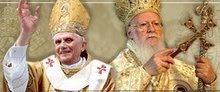
History may be in the making. It appears Rome is on the brink of welcoming close to half a million members of the Traditional Anglican Communion into membership of the Roman Catholic Church, writes Anthony Barich. Such a move would be the most historic development in Anglican-Catholic relations in the last 500 years. But it may also be a prelude to a much greater influx of Anglicans waiting on the sidelines, pushed too far by the controversy surrounding the consecration of practising homosexual bishops, women clergy and a host of other issues.
The Vatican’s Congregation for the Doctrine of the Faith has decided to recommend the Traditional Anglican Communion be accorded a personal prelature akin to Opus Dei, if talks between the TAC and the Vatican aimed at unity succeed, it is understood.
The TAC is a growing global community of approximately 400,000 members that took the historic step in 2007 of seeking full corporate and sacramental communion with the Catholic Church – a move that, if fulfilled, will be the biggest development in Catholic-Anglican relations since the English Reformation under King Henry VIII.
TAC members split from the Canterbury-based Anglican Communion headed by Archbishop Rowan Williams over issues such as its ordination of women priests and episcopal consecrations of women and practising homosexuals.
The TAC’s case appeared to take a significant step forwards in October 2008 when it is understood that the CDF decided not to recommend the creation of a distinct Anglican rite within the Roman Catholic Church – as is the case with the Eastern Catholic Churches - but a personal prelature, a semi-autonomous group with its own clergy and laity.
Opus Dei was the first organisation in the Catholic Church to be recognised as a personal prelature, a new juridical form in the life of the Church. A personal prelature is something like a global diocese without boundaries, headed by its own bishop and with its own membership and clergy.
Because no such juridical form of life in the Church had existed before, the development and recognition of a personal prelature took Opus Dei and Church officials decades to achieve.
An announcement could be made soon after Easter this year. It is understood that Pope Benedict XVI, who has taken a personal interest in the matter, has linked the issue to the year of St Paul, the greatest missionary in the history of the Church.
The Basilica of St Paul outside the Walls could feature prominently in such an announcement for its traditional and historical links to Anglicanism. Prior to the English Reformation it was the official Church of the Knights of the Garter.
The TAC’s Primate, Adelaide-based Archbishop John Hepworth, told The Record he has also informed the Holy See he wants to bring all the TAC’s bishops to Rome for the beatification of Cardinal Henry Newman, also an Anglican convert to the Catholic Church, as a celebration of Anglican-Catholic unity.
Although Cardinal Newman’s beatification is considered to be likely by many, the Church has made no announcement that Cardinal Newman will be beatified.
Archbishop Hepworth personally wrote to Pope Benedict in April 2007 indicating that the TAC planned a meeting of its world bishops, where it was anticipated they would unanimously agree to sign the Catechism of the Catholic Church and to seek full union with the Catholic Church.
This took place at a meeting of the TAC in the United Kingdom. TAC bishops placed the signed Catechism on the altar of the most historical Anglican and Catholic Marian shrine in the UK, the National Shrine of Our Lady of Walsingham in Norfolk, before posting it up in the main street in an effort to gather public support.
Archbishop Hepworth, together with TAC bishops Robert Mercer and Peter Wilkinson, presented the signed items personally to Fr Augustine Di Noia OP, the CDF’s senior ecumenical theologian, on October 11, 2007, in a meeting organised by CDF secretary Archbishop Angelo Amato.
Bishop Mercer, a monk who is now retired and living in England, is the former Anglican Bishop of Matabeleland, Zimbabwe. Bishop Wilkinson is the TAC’s diocesan bishop in Canada.
TAC’s Canadian Bishop Peter Wilkinson has close ties to the Catholic hierarchy in British Columbia, which has also met the CDF on the issue. He has already briefed Vancouver archdiocesan priests.
One potential problem for the Holy See would be the TAC’s bishops, most of whom are married. Neither the Roman Catholic nor Eastern Catholic churches permit married bishops.
Before he became Pope, Cardinal Joseph Ratzinger discussed the issue of married bishops in the 1990s during meetings of the Anglican Roman Catholic International Commission exploring unity, before the Anglican Church’s ordination of women priests derailed it.
One former Anglican priest who became a Catholic priest told The Record that the ideal end for the TAC would be to become the 28th Rite within the Catholic Church, along with the Eastern Churches, which have the same sacraments and are recognised by Rome.
The TAC’s request is the closest any section of the Anglican Church has ever come to full communion with Rome because the TAC has set no preconditions. Instead it has explicitly submitted itself entirely to the Holy See’s decisions.
Six days prior to the October 11 meeting between TAC bishops and the Holy See – on October 5 – the TAC’s bishops, vicars-general of dioceses without bishops, and theological advisers who assisted in a plenary meeting signed a declaration of belief in the truth of the whole Catechism of the Catholic Church.
The declaration said, in part: “We accept that the most complete and authentic expression and application of the Catholic faith in this moment of time is found in the Catechism of the Catholic Church and its Compendium, which we have signed, together with this letter as attesting to the faith we aspire to teach and hold.”
Statements about the seriousness of the division between the Anglican Communion and the Catholic Church caused by issues such as the ordination of women priests were emphasised at the wordwide Lambeth Conference held in the UK in 2008.
At the conference, three Catholic cardinals – Walter Kasper, president of the Pontifical Council for Promoting Christian Unity, the Archbishop of Westminster Cormac Murphy-O’Connor and the Prefect for the Vatican’s Congregation for the Evangelisation of Peoples, Ivan Dias, the Pope’s personal envoy, all addressed the issue.
Cardinal Dias, who favours welcoming traditionalist Anglicans into the Catholic Church, bluntly told the Anglican Communion’s 650 bishops that they are heading towards “spiritual Alzheimer’s” and “ecclesial Parkinson’s”.
“By analogy, (Alzheimer’s and Parkinson’s) symptoms can, at times, be found even in our own Christian communities. For example, when we live myopically in the fleeting present, oblivious of our past heritage and apostolic traditions, we could well be suffering from spiritual Alzheimer’s. And when we behave in a disorderly manner, going whimsically our own way without any co-ordination with the head or the other members of our community, it could be ecclesial Parkinson’s.”
Cardinal Kasper warned Anglican bishops that Rome would turn to smaller ecumenical communities if the Anglican Communion at large proved unapproachable ecumenically.
This is bad news for the Anglican Communion, but good news for the TAC.
Showing posts with label Anglicanism. Show all posts
Showing posts with label Anglicanism. Show all posts
Thursday, January 29, 2009
Rome & Traditional Anglicans get ready for union
Wednesday, 28 January 2009

Friday, October 31, 2008
Latest Old Books Club discussion...

We've been reading "Hymns on Paradise" by St. Ephrem the Syrian.
This, again, is an ecumenical book club. Some interesting topics covered.
Here's a snapshot of our discussion:
I responded....
(1) Ephrem as a Catholic & Orthodox Father
One thing that I forgot to bring up during our great discussion on Wednesday night was the fact that Ephrem is both part of the Patrimony of the Catholic and Orthodox Churches. When discussing the "intermediate state" theory posited by Ephrem, the discussion seemed to follow a line that this was a great idea and one that was outside the thinking of the Catholic Church. I would simply point out that all of the Fathers we are reading are within both Traditions, respectively.
(2) O Happy Fault (Felix Culpa)
A decent explanation from Wikipedia...
Felix culpa is a Latin phrase that literally translated means a "blessed fault" or "fortunate fall". As a religious term it refers to Adam and Eve's fall and the loss of the Garden of Eden, known theologically as the source of original sin. The phrase is sung annually in the Exsultet of the Easter Vigil: "O felix culpa quae talem et tantum meruit habere redemptorem," "O happy fault that merited such and so great a Redeemer." The medieval theologian Thomas Aquinas cited this line when he explained how the principle that "God allows evils to happen in order to bring a greater good therefrom" (not to say that it ought or needs to happen) underlies the causal relationship between original sin and the Divine Redeemer's Incarnation.
The phrase "Oh happy fault!" is used in colloquial English, especially among literary intellectuals.
In a literary context, the term "felix culpa" can be used to describe how a series of miserable events will eventually lead to a happier outcome. The theological concept is one of the underlying themes of Raphael Carter's science fiction novel The Fortunate Fall; the novel's title is explicitly derived from the Latin phrase. John Milton also invokes ideas of felix culpa in his epic poem Paradise Lost.
Mike chimes in... So, ultimately, the main point is this: felix culpa is from a beautiful song sung during the epic Easter Vigil mass at midnight... it is not any sort of theological maxim or hermeneutic by which Catholics operate. It does however say something profound about the faith that we have in God to transform such a calamity as Original Sin in such a powerful, redemptive manner, renewing the face of the earth.
(3) Intermediate State/Sanctification or 'being clothed in Glory' w/o Original Sin
I would actually like to couple this with a side remark made by Tim yesterday about Marian devotion, specifically the Immaculate Conception. Let me retrace some steps first. Again, Ephrem was positing that Original Sin did not need to occur; the Tree was a 'test' so to speak, and God wanted Adam and Eve to use their radical freedom for the good. If they were to choose righteously and faithfully (not eat the fruit), then they would have (without 'needing' to sin) been 'clothed in Glory' and essentially been given the graces won through Christ on the Cross without all the suffering and death. We all seemed to like and be intrigued by this idea.
Ok, here's the move...
If Adam and Eve were created in an intermediate state (not Glorified, not fallen, yet created in God's image) then couldn't God also create another human (if He so wished) in such an 'intermediate state'? Could He not create, say the Mother of His Divine Son, in this 'intermediate state'? Clearly the roots of the idea behind the Immaculate Conception are within such a doctrine. This is precisely what the Catholic Church teaches on this manner; Mary, set aside for the specific mission of bearing the Son of Man, could not have been born with Original Sin, thus God in all His Omnipotence created her in an 'immaculate state/intermediate state'. She still had radical freedom just like Eve, but not the 'concupiscence' or tendency of fallenness to sin. That's why there's all these Patristic references to Mary as the "new Eve". Hence, when Gabriel announced to her the great task of bearing the Son of God, she was able to answer with a resounding "Let it be done to me according to they will!". Hence, the great Archangel's response: "Hail, full of grace, the Lord is with thee."
The Immaculate Conception, contrary to common belief, is not a new idea. It was discussed even in the time of Thomas Aquinas in the 11th century. The Orthodox, and Aquinas, reject the idea because in those days most believed that the soul did not "quicken" the body at conception, but ensouled the fetus/embryo 40 days later. This was even posited by Augustine in the 4th century. Aquinas openly rejected the theological idea being debated even way back then. Orthodox theology, like Catholicism, developed from Pentecost until around the 10th or 11th century; then, in my interpretation, it became ossified and static, though still quite rich. The Catholic Church, after the schism, still continued the thoughtful, prayerful, and slow 'development of doctrine', for it is like a seed, growing and revealing more to us. Theology is not static. As we know now via science, the embryo is 'kicking' almost at conception, and most would now say that the ancient/medieval idea of 'quickening' was wrong. The body clearly appears to be ensouled at conception, the cornerstone of pro-life teaching.
Thus, it is not extraordinary that 800 years later (after Aquinas et al.) the pope proclaimed it a dogma of Mary, divinely revealed (Immaculate Conception 1854; Assumption of Mary 1950... Orthodox 'dormition' is essentially the same= Matt, correct me on this if necessary!).
Also, the Catholic Church, through the exercise of God given reason and Divine Revelation, thinks about, prays about, and asks God for his assistance in such matters of faith and morals. The Church believes that Peter and his papal successors have the "keys of the Kingdom" to "bind and loose" guided infallibly by the Holy Ghost. God is in fact the authority behind such a declaration. Keep in mind there have really only been 6 major 'infallible statements' made by popes throughout the ages; it is not a power-play as is typically believed.
Here they are:
* "Tome to Flavian", Pope Leo I, 449, on the two natures in Christ, received by the Council of Chalcedon;
* Letter of Pope Agatho, 680, on the two wills of Christ, received by the Third Council of Constantinople;
* Benedictus Deus, Pope Benedict XII, 1336, on the beatific vision of the just prior to final judgment;
* Cum occasione, Pope Innocent X, 1653, condemning five propositions of Jansen as heretical;
* Auctorem fidei, Pope Pius VI, 1794, condemning seven Jansenist propositions of the Synod of Pistoia as heretical;
* Ineffabilis Deus, Pope Pius IX, 1854, defining the immaculate conception; and
* Munificentissimus Deus, Pope Pius XII, 1950, defining the assumption of Mary.
(This is from Wikipedia, and seems correct, so don't take this as 'dogma'... ha, ha, ha.)
In conclusion, the theological groundwork is within Ephrem for such a dogma of Mary via the 'intermediate state' doctrine.
What say you fellas on all these matters?
One fellow, currently attending a High Anglican parish, replied:
Hmmm, on part 3-- that is an interesting move, which I will consider.
This whole "intermediate state" is all new to my thinking, so I'm
still processing it, but you propose an interesting twist. It is
possible that it begins to work toward a resolution of my major
objection--an objection that I thought otherwise could only be dealt
with by a very mystical explanation of the nature of kairos v chronos.
(Are these the right terms?)
I am aware that the germs of some of the modern innovations in Marian
theology have been around for some considerable time, but to my
curmudgeonly anti-modern sensibility, it still seems all too
innovative for me.
On 2, my hesitation is that the phrase could possibly be seen as
trying to make the fall less bad than it was. Maybe this phrase and
the hymn, properly understood, do not do this. But the idea could
easily lead some in that direction. (Similarly--and I don't think you
object to any of this--Death is truly bad, a result of the fall.
Christ's conquest of death does not make death not-bad, but rather
conquered. It is a mistake, then, to think that because of Christ,
death can be a good thing in itself. I think a similar thing could
happen with this fortunate fall idea.)
On 1, yes, of course, pre-schism.
Another friend, newly converted to Orthodoxy, also said he found the connection of Immaculate Conception and St. Ephrem's 'intermediate state' interesting.
Good stuff...
Sunday, August 10, 2008
Alas, more on Rowan and the tragedy that is the C of E...

Bishop Gene Robinson and his 'husband'... He said in an interview that he "always wanted to be a June bride".
In private correspondence, seen by the Daily Telegraph, Dr Rowan Williams, refutes the Anglican Communion's traditional teaching that homosexuality is sinful.
Furthermore, he expresses his hope that the Church will change its position to be more accepting of gay partnerships.
His comments – made in a letter written shortly before he became Archbishop of Canterbury – will infuriate the conservatives who boycotted the recent Lambeth Conference in protest at the presence of liberals who elected Anglicanism's first openly gay bishop.
Leading evangelicals have claimed that he is in an "untenable position".
"The Bible does not address the matter of appropriate behaviour for those who are, for whatever reason, homosexual by instinct or nature," Dr Williams writes.
"By the end of the 80s I had definitely come to the conclusion that scripture was not dealing with the predicament of persons whom we should recognise as homosexual by nature.
"I concluded that an active sexual relationship between two people of the same sex might therefore reflect the love of God in a way comparable to marriage, if and only if it had the about it the same character of absolute covenanted faithfulness."
Although Dr Williams was known to have liberal views on the issue of homosexuality when he was appointed as archbishop in 2002, since moving to Canterbury he has tried to hold a traditional line for the sake of unity in the Church.
However, he makes clear in the letter that he believes that the Church could relax its strict teaching with time.
"The Church has shifted its stance on several matters – notably the rightness of lending money at interest and the moral admissibility of contraception so I am bound to ask if this is another such issue," he says.
"If I am really seriously wrong on this, I can only pray to be shown the truth."
Dr Williams is critical of those who have politicised the issue, "treating it as the sole or primary marker of Christian orthodoxy".
This will be perceived as an attack at conservative Anglican leaders who have since claimed that the Church is split following the consecration of Gene Robinson, the openly gay bishop of New Hampshire.
Conservative Anglican leaders said that the disclosure of the letter revealed the true mind of Dr Williams and significantly weakens his position as he battles to save the Church from schism.
Read the rest of this truly tragic and never-ending tale....
Tuesday, August 5, 2008
A crazy but interesting analysis of Lambeth 2008...
The death of liberal Anglicanism
The Anglican church has sacrificed liberalism in order to achieve unity. Now it's just a slightly nicer version of Roman Catholicism [What???! Hilarious.]
By Theo Hobson
What has the Lambeth Conference accomplished? It has impressed Anglicanism more strongly with the spirit of its leader. Despite the boycott, it has given his vision new authority. A few years ago it looked like Archbishop Rowan Williams was an essentially solitary figure, doing an impossible tightrope dance. The weird thing is that he has persuaded mainstream Anglicanism to join him on the high wire. He has said: "My intensely awkward position is representative of the church at large" – and the church has agreed. Perhaps it has no other option, but dissolution.
A few years ago it seemed that Williams was asking liberal Anglicanism to make an impossible sacrifice. He was saying, "Let us bite our liberal tongues, for the sake of unity. Let us suffer the accusations of appeasing the homophobes, for the sake of unity. Let us put our desire for an inclusive church on hold, for the sake of unity. Let us be patient." It seemed outrageous. Surely most British Anglicans were committed to gay rights, and would not agree to compromise? Surely the liberals would not allow the identity of Anglicanism to be determined by the evangelical hard line on homosexuality? Surely this would do intolerable violence to the traditional openness of this church? It seemed axiomatic that the evangelicals were a minority movement – a pushy and growing one, but still a minority movement.
Yet liberal Anglicanism failed to make a stand. There were obviously lots of angry noises, but they didn't add up to anything. Amazingly enough, Williams' call for patience was generally heeded. The nature of liberal Anglicanism quietly shifted. It became meek before the rise of evangelical orthodoxy.
Is it still possible to be a liberal Anglican? Not in the old way. Liberal Anglicans have to follow Williams onto the high wire, to some extent. By staying within an institution that has taken an anti-liberal turn, they collude in his act. In other words, liberal Anglicans have been Rowanised. They buy his long-range hope for reform that the church as a whole can accept.
Why has this happened? Why hasn't a tougher liberal Anglicanism emerged that says that the truth of liberalism must not be sacrificed to "unity"? If Christian unity is so important (it would say), then surely the break with Rome was a mistake – surely Anglicans should repent of it right now. Isn't this version of Christianity one that tries to incorporate liberal principles? Why is such liberal Christian rhetoric more or less absent among Anglican clergy?
The answer, as I see it, is that institutional religion is not very compatible with liberalism, at the end of the day. It is addicted to some degree of authoritarianism, legalism. The Church of England concealed this, for centuries – thanks to its cultural establishment it was a fairly liberal Christian institution. But that era's over. It now follows the logic of Roman Catholicism – liberalism is a threat to unity.
As Giles Fraser writes in the Church Times, Christianity is an anti-legalistic religion. It emerges from a rejection of rigid moral rules. The current neo-conservative shift in the church ignores this – it "is all about the creation of a set of rules that will systematically make gospel faith all-but-impossible for Anglicans in the 21st century".
Maybe liberal Anglicans are waking up to the fact that liberalism and institutional Christianity are not gently compatible, as they were told by lots of well-meaning Anglican thinkers. That tradition is admirable, but it is dead. Williams is a deeply admirable man, but he has no vision for Christianity's renewal in the context of liberal culture. He is offering a slightly nicer version of Roman Catholicism – an international communion whose unity trumps all other concerns.
So a fairly stark choice has emerged: stay within Anglicanism, and be part of its post-liberal realignment. Or seek a new sort of Christian culture, accepting of liberalism, free of the old power-itch. Leave the ruins of Christendom behind, and build afresh, on new foundations.
Thursday, July 31, 2008
Damian Thompson on Lambeth 2008

Split at birth?
The Anglican Communion's 10 year meeting is getting more crazy and interesting by the minute.
Thompson reports that Rt Rev David Rossdale, Bishop of Grimsby, wrote the following about the C of E recently:
"We have been a Church which has been held together by belief, as contained in the historic creeds, and not by agreeing to particular statements about that faith."
Excellent.
In other Lambeth Conference news...
A senior Vatican Cardinal visiting the Lambeth Conference has delivered an incredible rebuff to its 650 Anglican bishops, telling them they are heading towards "spiritual Alzheimer's" and "ecclesial Parkinson's".
The comments by Cardinal Ivan Dias, Prefect of the Congregation for Evangelisation, must count as one of the rudest things a Vatican prelate has said to Anglicans since the dawn of the ecumenical era.
It can mean only one thing: Rome - and therefore the Pope - has given up on the Anglican Communion. Here is the quote, from Cardinal Dias's address to the conference yesterday evening:
"Much is spoken today of diseases like Alzheimer's and Parkinson's. By analogy, their symptoms can, at times, be found even in our own Christian communities. For example, when we live myopically in the fleeting present, oblivious of our past heritage and apostolic traditions, we could well be suffering from spiritual Alzheimer's. And when we behave in a disorderly manner, going whimsically our own way without any co-ordination with the head or the other members of our community, it could be ecclesial Parkinson's."
Diaz is one of those Cardinals who favours welcoming traditionalist Anglicans into the Catholic Church. I reckon that liberals will be deeply insulted by his barbs - not least on grounds of political correctness - but that traditionalists will be nodding their heads in agreement.
One thing I'd love to know: did Cardinal Dias clear his speech with Cardinals Kasper and Murphy-O'Connor before he delivered it? Don't bet on it.
Tuesday, July 29, 2008
Ecclesiology doesn't get more messed up than this...

The African bishops- laying down the smack on heresy in the Anglican Communion!
"For the Sake of Unity" by Austin Ivereigh
From the ultra-liberal (click for whole article) America Catholic magazine...
Being a member of the clergy in the C of E sounds like working in Washinton D.C.; lots of personalities, but no substance and little accomplished.
Here are some choice quotes from the article (I saved the best for last...)
During a recent debate at the Church of England’s General Synod, N. T. Wright, the Scripture scholar and bishop of Durham, summed up the crisis facing the Anglican Communion rather graphically. “We are living through, on many levels, a massive outworking of the law of unintended consequences,” he said. “Or, in plain English, a slow-moving train wreck.”
[snip]
As the Lambeth Conference of Anglican Primates, which is held every 10 years, meets in Canterbury (July 16-Aug. 3) against a backdrop of what journalists are calling the “summer of schism,” it is worth noting that the cause of the current Anglican crisis is not disagreement over homosexuality. Most Catholics as well as nonbelievers I know have strongly diverse views about same-sex blessings, civil partnerships and gay adoptions; homosexuality is one of the great divisive issues of our age.
But disagreements do not necessarily lead to divisions or crises. The real question is why the Anglican Church has not been able to contain the disagreements, and why they are causing the church to tear itself apart.
The current crisis is not, in other words, doctrinal; it is ecclesiological. As the center of Anglicanism has moved away from the Church of England to the global communion, the glue that has held the Church of England together has been exposed as inadequate for binding the Anglican Churches worldwide.
[snip]
He [describing Rowan Williams] exemplified this when—although personally he is convinced that the church will come to accept homosexual partnerships—he vetoed in 2004 the appointment of a gay friend, Jeffrey John, as Bishop of Reading, because he knew it would inflame disunity. The “pro-gay” lobby accused him of surrendering to evangelical pressure, but they misread the decision. Archbishop Williams was demonstrating that a move too soon—however principled—can destroy unity. [what 'principle' is being referred to here????]He has more than once quoted to both the Episcopal Church and the Fellowship of Confessing Anglicans St. Paul’s words to the Corinthians (1 Cor 11:33) to “wait for one another.” [what the hell does that even mean? If you know eventually that the C of E will slide into further relativism, why does it matter to wait? What cowardice. If it's the truth that gays should be bishops, then Williams has no principles to stand up for it, and if it's wrong (obviously) then he has shown a lack of character with those words. By the way, what kind of ecclesiology is this? And who ever accused the Catholic Church of clericalism? This is amazing!]
So far they have not. A willingness to “suffer for the sake of the unity of the church” [you'll never hear of the Catholic Church speaking an untruth for the sake of unity, but the C of E prides itself on it] is something many Anglicans assume only Catholics have to do. The openly gay bishop of New Hampshire, Gene Robinson, is in England, popping up on television and radio to declare that Jesus loves him and that history is on his side, while the Global Anglican Future Conference evangelicals are growling from abroad, convinced the Bible is on their side. Kenosis for the sake of unity is not on the minds of any of them.
But that does not stop two-thirds of the world’s Anglican bishops who are gathering in Canterbury. If at the Lambeth Conference they can listen to each other—and to God—long enough, there may be a chance for Archbishop Williams still to build the structures on which future global Anglican coexistence so obviously depends. Global Anglicanism after the Lambeth Conference may still look like a “slow-moving train wreck,” but there is a good chance, under Archbishop Williams, that it will still be on the rails [are we supossed to root for this train wreck to NOT happen? sounds pretty pathetic. The writer clearly doesn't get something.].
BEST QUOTE OF THE ARTICLE (an unintended consequence?)
The gravitational center of Anglicanism has drifted southward, to countries where the church is not part of a liberal political project, and where excessive compromise and nuance mute its proclamation of the Gospel.
Tuesday, July 15, 2008
The future of the Anglican Communion?
Do the Anglicans really think this is going to bolster the faithful????


Thursday, July 10, 2008
"So much for the 'via media' approach, Dr. Williams."

More on the horrid leadership of Dr. Rowan Williams and the crumbling C of E.
This is from Damian Thompson:
Andrew Carey, son of Archbishop Carey, has produced a pretty devastating analysis of Monday night's "train wreck" on the American Anglican website Stand Firm:
"While Dr Williams has often given traditionalists hope that he would back a structural solution to their problems of conscience, he seems to have completely ruled out strong leadership on theological and ecclesial issues. Wearing permanently now, it seems, the persona of the mediator, Dr Williams was seen by Synod trying to have it both ways. 'I am deeply unhappy with any scheme... which ends up structurally humiliating women.' But he was equally unhappy about marginalising traditionalists. [uhhhhh... I want to have my cake and eat it too.] He therefore came 'not very comfortably to the conclusion', we needed a 'more rather than less robust form of structural provision'.
Monday, July 7, 2008
A SAD DAY: Church of England - now officially protestant forever
"We want female bishops not tradition. We want to ape the relativistic mores of the secular 'whatever feels good and is popular now' culture." That's what the C of E bishops voted today.
So much for reconciliation and real ecumenism. The C of E has officially decided to ape the secular culture's superficial ideas of feminism (all about power), and reject its roots with the Catholic/Orthodox churches and Scripture itself. Instead of seeking wisdom from the sources, the C of E will now fade away into time.
I cannot imagine a church shepherded by old women with a large and dynamic sheepfold.
We'll see how quickly the C of E declines... Sad.
The Anglo-Catholics have now been totally alienated, and as Thompson notes below, it would be foolish for them to stay.
Read it and weep.
Here's what Rowan Williams said before the vote
... pathetic.
Well, I guess we'll see when and how and if traditional/orthodox C of E bishops will break with Canterbury.
So much for reconciliation and real ecumenism. The C of E has officially decided to ape the secular culture's superficial ideas of feminism (all about power), and reject its roots with the Catholic/Orthodox churches and Scripture itself. Instead of seeking wisdom from the sources, the C of E will now fade away into time.
I cannot imagine a church shepherded by old women with a large and dynamic sheepfold.
We'll see how quickly the C of E declines... Sad.
The Anglo-Catholics have now been totally alienated, and as Thompson notes below, it would be foolish for them to stay.
Read it and weep.
A couple of hours ago, the Church of England decisively severed itself from its Catholic roots. By voting to ordain women bishops without significant safeguards for traditionalists, it reasserted its identity as a Protestant Church. Whether it will be a liberal or conservative Protestant denomination remains to be seen. But any hope of unity with Rome and the Orthodox has gone forever.
I'm not sorry. From the moment the C of E voted to ordain women priests in 1992, it cut itself off from the Catholic mainstream. But unexpectedly generous safeguards allowed traditionalists to cordon themselves off from the rest of the Church, persuading themselves that they, rather than the main body, preserved its true Catholic identity.
This was always a delusion, and now it is truly unsustainable. The General Synod tonight made a commonsense decision. If you have women priests, you must have women bishops - indeed, I remember Dr David Hope, then Bishop of London, telling me that the Church should in theory have started with women bishops and then moved on to priests. [Good point.]
What the Anglo-Catholics have lost tonight is their standing in the Church of England. They are no longer honoured traditionalists who have been allowed to preserve an (almost) watertight communion of their own, nurtured by powerful bishops who sustain their sacramental purity.
From now on, they will be the C of E's granny in the attic, whose eccentricities are tolerated only at family get-togethers. If, that is, they are silly enough to stay.
What a painful debate this was. This time round, in contrast to 1992, the Synod knew it was demolishing a wing of the building, and there was preciously little triumphalism. Dr Rowan Williams seemed especially crushed: he had argued - reluctantly - for tight safeguards for traditionalists, but the assembly ignored his advice. That doesn't bode well for Lambeth.
Here's what Rowan Williams said before the vote
... pathetic.
Well, I guess we'll see when and how and if traditional/orthodox C of E bishops will break with Canterbury.
Saturday, June 28, 2008
Gay rites: 'Bishop' Gene Robinson

From The Times
April 29, 2008
Gay rites; New Hampshire's Bishop Gene Robinson is about to enter into a civil union
In a new book the Anglican clergyman explains why he wanted to formalise his 20 year relationship
[The article is by Gene Robinson]
“I always wanted to be a June bride.” [great start!] As soon as the words were out of my mouth, I knew there'd be trouble. I'd just delivered an hour-long lecture on the relationship between religion and public discourse, and why religious fervour over homosexuality plays such a large and negative role in the securing of full civil rights for gay people.
During the question-and-answer period, someone asked me about the forthcoming civil union between me and Mark, my partner of 20 years. The audience had been welcoming and sympathetic, full of laughter and understanding, and for one moment, I forgot that the C-SPAN cameras were rolling and that every word I said would be parsed by my critics. Within hours, those eight words had made it around the world, thanks to conservative bloggers and the magic of the internet.
No context; nothing about the preceding hour of carefully constructed comments; nothing about my defence of - and love for - the Scriptures; nothing about the loving God to whom I constantly pointed. Just this one sentence.
Surely no one thinks that I'll don a wedding gown and wear flowers in my hair. But I suspect that a lot of people are uncomfortable with me using the word “bride” - a word associated with women as property - to describe a man. For many centuries marriage was about the transfer of property (the bride) from one man (the father) to another man (the groom), in some places accompanied by the payment of a dowry or bride price. Is calling myself a “bride” offensive because it relegates a “privileged” man to the status of a woman? I'll be the first to admit that it would have been better if I'd never uttered those eight words - not because they aren't true, but simply because they gave the conservative forces something else to use against me. It was a stupid thing to say, and I should have known better.
Read the rest...
Here's what online readers said (I love the St. Paul, MN guy!)
"Not my will thine be done," prayed Jesus, the Good Shepherd. He surrendered. Men like Gene Robinson do not. He has a docile manner yet is defiant, forcing his own will above God's. Unfaithful. Scripture warns about leaders intentionally sinning and encouraging others to do the same.
Cheryl, Foothill Ranch, USA
I want my daughters! I want my boyfriend! I want to marry him! I want to be Bishop with all its trappings! I will lead my flock astray! I will go to Lambeth even if I've been uninvited! I want, I want! Me, me, ME! Where is CHRIST in your life? You are bereft of self-sacrifice and self-denial.
Aileen, London, UK
To live free from criticism? To live without having to think about what you say before you say it? Who lives life in that way, gay or straight? [HA!] From weakness of character, Gene Robinson is demanding of the world more than any reasonable adult would expect; certainly any religious leader.
christopher menzhuber, St. Paul, USA
Thinking Anglicans...

I ran accross an interesting blog...
http://www.thinkinganglicans.org.uk/
Here's how it describes itself: my emphasis & [my comments].
Thinking Anglicans is a website for thoughtful contributions to the proclamation of the gospel message. Here writers reflect on what it means to be a Christian, particularly in Britain today.
Thinking Anglicans will actively report news, events and documents that affect church people, and will comment on them from a liberal Christian perspective [too bad, I thought the site would be useful].
Thinking Anglicans proclaims a tolerant, progressive and compassionate Christian spirituality, in which justice is central to the proclamation of the good news of the kingdom of God. Our spirituality must engage with the world, and be consistent with the scientific and philosophical understanding on which our modern world is based. It must address the changes which science and technology have brought into our lives.
Thinking Anglicans takes the form of weblogs (or ‘blogs’) in which writers place their thoughts in public for all to read. We each take responsibility for our own words. There is no central definition or declaration of faith to which contributors must subscribe, although most of our writers are active Christians in communion with the see of Canterbury. [So, basically like Anglicanism itself= no clear creed, doctrine, or orthodoxy] Rather there is a range of opinions, which contributes to debate, and is legitimate diversity within the Christian faith. The site will be updated frequently, with regular contributions from our team of writers, commenting on news events and exploring wider issues and deeper meanings.
Thinking Anglicans is a focal point where you can find the words of informed contributors to the contemporary understanding of Christian faith, as well as the views of ordinary ‘Anglicans in the pew’. In a world where the voices of fundamentalism and conservatism are frequently heard, Thinking Anglicans is a place for a tolerant, thoughtful and understanding exploration of Christian faith. We hope this shared witness of the vision of God’s kingdom in the world will help and encourage both Christians and others.
Posted by Simon Kershaw on Saturday, 9 August 2003 at 7:00pm BST | Comments (5) | TrackBack
C of E bishop returning with his flock to Rome?

Check out this news...
The Anglican Communion is in shambles, bogged down by relativism; this is a win for all of Christianity if it happens. Praise God.
At least one Church of England bishop will defect to Rome soon after the Lambeth Conference, I gather from Anglo-Catholic sources. And there could be more to follow.
[snip]
Fortunately, Pope Benedict XVI is more open to experiment than Pope John Paul II. He is taking a close interest in the progress of the rebel Traditional Anglican Communion towards reunion - a process which is under the control of the Congregration for the Doctrine of the Faith, not the Vatican's woolly-minded ecumenists.
I can't betray confidences, but my advice is: look at the new church structures, such as Old Rite parishes, that the Pope is already encouraging, and ask yourself how those models might be adapted for the use of former Anglicans.
But I've already said too much...
Read it all here.
Wednesday, May 14, 2008
The Pathetic State of Christianity in England...

This is truly a depressing story.
Churchgoing on its knees as Christianity falls out of favour
Ruth Gledhill, Religion Correspondent TIMESONLINE UK
Church attendance in Britain is declining so fast that the number of regular churchgoers will be fewer than those attending mosques within a generation, research published today suggests.
The fall - from the four million people who attend church at least once a month today - means that the Church of England, Catholicism and other denominations will become financially unviable. A lack of funds from the collection plate to support the Christian infrastructure, including church upkeep and ministers’ pay and pensions, will force church closures as ageing congregations die.
In contrast, the number of actively religious Muslims will have increased from about one million today to 1.96 million in 2035.
According to Religious Trends, a comprehensive statistical analysis of religious practice in Britain, published by Christian Research, even Hindus will come close to outnumbering churchgoers within a generation. The forecast to 2050 shows churchgoing in Britain declining to 899,000 while the active Hindu population, now at nearly 400,000, will have more than doubled to 855,000. By 2050 there will be 2,660,000 active Muslims in Britain - nearly three times the number of Sunday churchgoers.
St. Thomas More prophesied this in his Dialogue of Comfort Against Tribulation.
Also, check out Aidan Nichols' The Realm, on converting England back to Catholicism, which by the way won't take much effort anymore. The majority of Christians are already Catholic on the island.
Monday, April 7, 2008
Tony Blair: Save religion and help it become a force for good...

The recent convert to Catholicism has some interesting things to say about Christianity as a good for the world.
Read the full article here.
"For religion to be a force for good, it must be rescued not simply from extremism, faith as a means of exclusion; but also from irrelevance, an interesting part of our history but not of our future." Too many people saw religious faith as stark dogmatism and empty ritual, he added.
"Faith is reduced to a system of strange convictions and actions that, to some, can appear far removed from the necessities and anxieties of ordinary life," Blair said. "It is this face that gives militant secularism an easy target."
He went on to argue that religion could help to advance humanity and end global poverty. One of his foundation's aims is to bring people of faith together in pursuit of the UN's millennium development goals, which include the eradication of extreme poverty and hunger, promoting gender equality and combating diseases.
Saving Christianity in England: a great interview...

Aiming to Re-evangelize England
Father Aidan Nichols Tells Why the Realm Is Ripe for Conversion
By Annamarie Adkins
CAMBRIDGE, England, APRIL 6, 2008 (Zenit.org).- A great civilization can only be built on a religious or metaphysical principle, begins the "unfashionable" argument of Father Aidan Nichols in his new book on the re-evangelization of England.
The Dominican priest and theologian is the author of “The Realm: An Unfashionable Essay on the Conversion of England” (Family Publications), in which he makes the case that in England, that principle is the Catholic Church.
Father Nichols is the first John Paul II Memorial Visiting Lecturer at Oxford University, a lecturer in the Cambridge University Divinity Faculty, and Visiting Professor of Systematic Theology in the John Paul II Institute for Marriage and Family in Melbourne.
He told ZENIT why the conditions are right for the re-conversion of England.
Q: The subtitle of your book is “An Unfashionable Essay on the Conversion of England.” What makes your thesis unfashionable?
Father Nichols: It is unfashionable to hold -- over against contemporary pluralism, liberalism and multiculturalism -- that a great civilization can only be formed on a metaphysical or religious principle.
This is especially true if one adds that in the case of England -- whose emergence as a nation coincides with its conversion -- this principle can only be Christianity, and more especially, the Catholic Church.
Q: You challenge the assumption that Protestantism is an essential mark of the character of England. In what ways was Catholicism central to the making of England, and what does the Church offer today that can remake it?
Father Nichols: Protestantism was central to the attempt to remake English identity under Elizabeth Tudor; to the reaction against the Catholicizing tendencies of the Stuarts after the Restoration of the monarchy; and to the project of welding England and Scotland together as a united “Britain” over and against France, after the union of Parliaments at the beginning of the 18th century.
But the almost 1,000 years of Catholic Christianity that preceded any of that are responsible for the origins of the English literary imagination, for the principles of the common law, for the concept of a covenanted people under God which permeates the induction of a sovereign, and for the range of virtues which have been commended -- and sometimes practiced -- in English culture and society.
What the faith of the Catholic Church can offer today is an intellectual, moral, and imaginative framework for the salvaging of these virtues, and their re-energizing by sacramental grace.
Read the rest.
This author regularly write solid articles for Zenit!
Saturday, February 16, 2008
'Tis Outrage!

Bishop Hilarion Alfeyev
Geneva, Feb 15, 2008 / 07:36 pm (CNA).- Russian Orthodox bishop Hilarion Alfeyev, the Moscow Patriarchate’s delegate for international relationships, said on February 15 that liberal Christianity is on its way to extinction. [Well, maybe not yet, but it is heading that way slowly, kicking and gnashing its teeth. I hope he's right in any case.]
"Liberal Christianity will not survive long and political correctness within the Christian environment is destined to die," said during a conference addressing the Ecumenical Council of Churches at Geneva, Switzerland.
The Orthodox bishop also criticized the words of the Anglican primate, Rowan Williams, regarding the "inevitability" of introducing the "sharia" (Muslim Law) in England. [Criticizing Williams is like taking candy from a baby; Williams is a fool not so much because of his Sharia comments, but because he has totally embraced the idea of surrender. He's unwilling to put aside his liberalism to experiment with unity through orthodoxy; we'll see, but I bet the Anglican communion dissolves at this summer's Lambeth Conference.]
"I would like to warn you about the perils of liberal Christianity," a trend, he said, that has sharply divided the Christian community in the last decades.
"Today we can't talk about Christian morality because the standards of 'traditional' and 'liberal' Christians are dramatically different and the abyss between these two branches of Christianity is growing," he added.
[snip]
Finally in a veiled criticism to the Anglican primate, Hilarion said that "it is not our duty to defend sharia, promote alternative lifestyles or secularized values. Our mission is to announce what Christ himself announced".
Read the full article here:
http://www.catholicnewsagency.com/new.php?n=11800
Tuesday, February 12, 2008
More madness from Rowan Williams, archb. of Canterbury

Read the following and pray for the Lord's will to be done in the crumbling Anglican communion.
The Archbishop of Canterbury has today said that the adoption of Islamic Sharia law in the UK is "unavoidable" and that it would help maintain social cohesion.
Rowan Williams told BBC Radio 4's World At One that the UK has to "face up to the fact" that some of its citizens do not relate to the British legal system.
He says that Muslims could choose to have marital disputes or financial matters dealt with in a Sharia court. He added Muslims should not have to choose between "the stark alternatives of cultural loyalty or state loyalty".
Dr Williams said there was a place for finding a "constructive accommodation" in areas such as marriage - allowing Muslim women to avoid Western divorce proceedings.
Other religions enjoyed such tolerance of their own laws, he pointed out, but stressed that it could never be allowed to take precedence over an individual's rights as a citizen.
He said it would also require a change in perception of what Sharia involved beyond the "inhumanity" of extreme punishments and attitudes to women seen in some Islamic states.
Dr Williams said: "It seems unavoidable and, as a matter of fact, certain conditions of Sharia are already recognised in our society and under our law, so it is not as if we are bringing in an alien and rival system.
"We already have in this country a number of situations in which the internal law of religious communities is recognised by the law of the land as justifying conscientious objections in certain circumstances."
Here's the full story: (sorry, I still can't put in links!)
http://www.thisislondon.co.uk/news/article-23436203-
details/Adoption+of+Islamic+Sharia+law+in+Britain+is+'unavoidable'
%2C+says+Archbishop+of+Canterbury/article.do
Monday, January 21, 2008
Christian unity
I teach a course in Catholic Doctrine, and on a worksheet recently I asked my students to define ecumenism; here's what one of them said:
"it's when different Christians forget their differences and try to get along without actually unifying or resolving any disagreements."
Yes, that's really what he said. This is obviously not something I taught him or the class, but this youngster is in tune to what the prevailing perception of ecumenism is around him. From the mouths of babes...
Here's what Pope Benedict said on Jan. 20th about the Week of Prayer for Christian Unity:
"it's when different Christians forget their differences and try to get along without actually unifying or resolving any disagreements."
Yes, that's really what he said. This is obviously not something I taught him or the class, but this youngster is in tune to what the prevailing perception of ecumenism is around him. From the mouths of babes...
Here's what Pope Benedict said on Jan. 20th about the Week of Prayer for Christian Unity:
Two days ago began the Week of Prayer for Christian Unity during which Catholics, Orthodox, Anglicans and Protestants, knowing that their divisions constitute an obstacle to the reception of the Gospel, together implore the Lord, in a yet more intense way, for the gift of full communion. This providential initiative was born 100 years ago, when Father Paul Wattson started the “Octave” of prayer for the unity of all the disciples of Christ. Today for this occasion the spiritual sons and daughters of Father Wattson, the friars and sisters of the Atonement, are present in St. Peter’s Square and I greet them cordially and encourage them to pursue the cause of unity with their special dedication.
We all have the duty to pray and work for the overcoming of every division between Christians, responding to Christ’s desire “ut unum sint.” Prayer, conversion of heart, the reinforcement of the bonds of communion, form the essence of this spiritual movement that we hope will soon lead the disciples of Christ to celebrate the Eucharist together, the manifestation of their full unity.
This year’s biblical theme is dense with meaning: “Pray without ceasing” (1 Thessalonians 5:17). St. Paul addresses himself to the community of Thessalonica, which was experiencing internal clashes and conflicts, to remind them with insistence about certain fundamental attitudes, among which there stands out, indeed, incessant prayer. With this invitation of his, he wants it to be understood that from the new life in Christ and in the Holy Spirit there flows forth the capacity to overcome all egoism, to live together in peace and fraternal union, to bear in large measure the burdens and sufferings of others. We must never tire of praying for the unity of Christians! When Jesus, during the Last Supper, prayed that his disciples “be one,” he had a precise goal in mind: “That the world believe” (John 17:21).
The Church’s evangelizing mission, therefore, moves along the path of ecumenism, the path of unity of faith, of evangelical witness and authentic fraternity. As is done every year, on Thursday, Jan. 25, I will go to the Basilica of St. Paul Outside the Walls to conclude the Week of Prayer for Christian Unity with solemn vespers. I invite Romans and pilgrims to join with me and with Christians of all the churches and ecclesial communities who will take part in the celebration, to ask of God the precious gift of reconciliation among all the baptized.
May the Mother of God, whose appearance to Alphonse Ratisbonne in the Church of Sant’Andrea delle Frate in Rome we remember today, obtain from the Lord the abundance of the Holy Spirit for all disciples in such a way that we can arrive at perfect unity and in this way offer the witness of faith and life that the world urgently needs.
Thursday, January 10, 2008
Saint John Henry Newman?!
Vatican City, Jan 8, 2008 / 05:16 pm (CNA).- Cardinal Jose Saraiva Martins, Prefect of the Vatican’s Congregation for the Cause of the Saints, has announced that the beatification of the great British convert and scholar, Cardinal John Henry Newman, is "imminent."
In an interview to be published on Wednesday in the daily Italian edition of L’Osservatore Romano, Cardinal Saraiva said that among the most important personalities to be beatified "soon" is "the case of Cardinal Newman, a relevant intellectual, and an emblematic figure of conversion from Anglicanism to Catholicism."
"Personally, I wish his beatification to happen very soon because it would be very important at this moment for the path of ecumenical dialogue,” Cardinal Martins said.
Cardinal Saraiva Martins also revealed the beatification, latter this year, of the parents of St, Therese of Lisieux, Louis Martin and Azelia Guérin. The heroic virtues of the parents of St. Therese, who is now one of the most popular saints in the Catholic Church and a Doctor of the Church, were proclaimed on March 26, 1944.
Cardinal Saraiva implied that the miracle needed to proclaim them Blessed has been approved by his congregation, and will be announced at the next Consistory.
Sunday, January 6, 2008
Bishop warns of no-go zones for non-Muslims
More troubles for England and the Anglican communion. Truly, the faith lost its identity when the schism occurred after Henry's 'great matter.' St. Thomas More prophetically foresaw this disaster for England and Christianity in his Dialogue of Comfort Against Tribulation.

By Jonathan Wynne-Jones
Last Updated: 1:31am GMT 07/01/2008
from the UK Telegraph
Islamic extremists have created "no-go" areas across Britain where it is too dangerous for non-Muslims to enter, one of the Church of England's most senior bishops warns today.
The Rt Rev Michael Nazir-Ali, the Bishop of Rochester and the Church's only Asian bishop, says that people of a different race or faith face physical attack if they live or work in communities dominated by a strict Muslim ideology.
The Right Reverend Michael Nazir-Ali, the Bishop of Rochester
Bishop Nazir-Ali warns that attempts are being made to give Britain an increasingly Islamic character
The Muslim Council of Britain today described his comments as "frantic scaremongering", while William Hague, the shadow foreign secretary, said the bishop had "probably put it too strongly".
Liberal Democrat leader Nick Clegg said the idea of no-go areas was "a gross caricature of reality".
Writing in The Sunday Telegraph, Bishop Nazir-Ali compares the threat to the use of intimidation by the far-Right, and says that it is becoming increasingly difficult for Christianity to be the nation's public religion in a multifaith, multicultural society.
His comments come as a poll of the General Synod - the Church's parliament - shows that its senior leaders, including bishops, also believe that Britain is being damaged by large-scale immigration.
Bishop Nazir-Ali, who was born in Pakistan, gives warning that attempts are being made to give Britain an increasingly Islamic character by introducing the call to prayer and wider use of sharia law, a legal system based on the Koran.
advertisement
In an attack on the Government's response to immigration and the influx of "people of other faiths to these shores", he blames its "novel philosophy of multiculturalism" for allowing society to become deeply divided, and accuses ministers of lacking a "moral and spiritual vision".
Echoing Trevor Phillips, the chairman of the Commission for Equalities and Human Rights, who has said that the country is "sleepwalking into segregation", the bishop argues that multiculturalism has led to deep divisions.
David Davis, the shadow home secretary, has accused Muslims of promoting a kind of "voluntary apartheid" by shutting themselves in closed societies and demanding immunity from criticism.
In the Synod survey, to be published this week, bishops, senior clergy and influential churchgoers said that an increasingly multi-faith society threatens the country's Christian heritage and blamed the divisions on the Government's failure to integrate immigrants into their communities.
It found that more than one in three believe that a mass influx of people of other faiths is diluting the Christian nature of Britain and only a quarter feel that they have been integrated into society.
The overwhelming majority - 80 per cent - said that the Government has not upheld the place of religion in public life and up to 63 per cent fear that the Church will be disestablished within a generation, breaking a bond that has existed between the Church and State since the Reformation.
Calls for disestablishment have grown following research showing that attendance at Mass has overtaken the number of worshippers at Church of England Sunday services.
Bishop Nazir-Ali, whose father converted from Islam to Catholicism, was criticised by Ibrahim Mogra, of the Muslim Council of Britain. He said: "It's irresponsible for a man of his position to make these comments.
"He should accept that Britain is a multicultural society in which we are free to follow our religion at the same time as being extremely proud to be British. We wouldn't allow 'no-go' areas to happen. I smell extreme intolerance when people criticise multiculturalism without proper evidence of what has gone wrong."
Religious membership in Britain:
click to enlarge
But the Bishop's concerns are shared by other members of the General Synod.
The Rt Rev Nicholas Reade, the Bishop of Blackburn, which has a large Muslim community, said that it was increasingly difficult for Christians to share their faith in areas where there was a high proportion of immigrants of other faiths.
He believes that increasing pressure will be put on the Government to begin the process of disestablishment and end the preferential status given to the Church of England. "The writing is on the wall," he said.
Gordon Brown relinquished Downing Street's involvement in appointing bishops in one of his first facts as Prime Minister - a move viewed by some as a significant step towards disestablishment.
Last night, Mr Davis said: "Bishop Nazir-Ali has drawn attention to a deeply serious problem. The Government's confused and counter-productive approach risks creating a number of closed societies instead of one open, cohesive one. It generates the risk of encouraging radicalisation and creating home-grown terrorism."
Inayat Bunglawala, assistant secretary-general of the Muslim Council of Britain, said: "Bishop Nazir-Ali appears to be exercised by what he perceives as the decline in the influence of Christianity upon this country, but trying to frantically scaremonger about Islam and Muslims seems to us to be a rather unethical way of trying to reverse this.
"He talks about the rise of 'Islamic extremism' but fails to mention how some of the policies of our government and especially that of the United States in the Middle East over several decades now has clearly contributed to this phenomenon."
------------------------
Read the bishop's article with this title:
Extremism flourished as UK lost Christianity
By Michael Nazir-Ali, Bishop of Rochester

By Jonathan Wynne-Jones
Last Updated: 1:31am GMT 07/01/2008
from the UK Telegraph
Islamic extremists have created "no-go" areas across Britain where it is too dangerous for non-Muslims to enter, one of the Church of England's most senior bishops warns today.
The Rt Rev Michael Nazir-Ali, the Bishop of Rochester and the Church's only Asian bishop, says that people of a different race or faith face physical attack if they live or work in communities dominated by a strict Muslim ideology.
The Right Reverend Michael Nazir-Ali, the Bishop of Rochester
Bishop Nazir-Ali warns that attempts are being made to give Britain an increasingly Islamic character
The Muslim Council of Britain today described his comments as "frantic scaremongering", while William Hague, the shadow foreign secretary, said the bishop had "probably put it too strongly".
Liberal Democrat leader Nick Clegg said the idea of no-go areas was "a gross caricature of reality".
Writing in The Sunday Telegraph, Bishop Nazir-Ali compares the threat to the use of intimidation by the far-Right, and says that it is becoming increasingly difficult for Christianity to be the nation's public religion in a multifaith, multicultural society.
His comments come as a poll of the General Synod - the Church's parliament - shows that its senior leaders, including bishops, also believe that Britain is being damaged by large-scale immigration.
Bishop Nazir-Ali, who was born in Pakistan, gives warning that attempts are being made to give Britain an increasingly Islamic character by introducing the call to prayer and wider use of sharia law, a legal system based on the Koran.
advertisement
In an attack on the Government's response to immigration and the influx of "people of other faiths to these shores", he blames its "novel philosophy of multiculturalism" for allowing society to become deeply divided, and accuses ministers of lacking a "moral and spiritual vision".
Echoing Trevor Phillips, the chairman of the Commission for Equalities and Human Rights, who has said that the country is "sleepwalking into segregation", the bishop argues that multiculturalism has led to deep divisions.
David Davis, the shadow home secretary, has accused Muslims of promoting a kind of "voluntary apartheid" by shutting themselves in closed societies and demanding immunity from criticism.
In the Synod survey, to be published this week, bishops, senior clergy and influential churchgoers said that an increasingly multi-faith society threatens the country's Christian heritage and blamed the divisions on the Government's failure to integrate immigrants into their communities.
It found that more than one in three believe that a mass influx of people of other faiths is diluting the Christian nature of Britain and only a quarter feel that they have been integrated into society.
The overwhelming majority - 80 per cent - said that the Government has not upheld the place of religion in public life and up to 63 per cent fear that the Church will be disestablished within a generation, breaking a bond that has existed between the Church and State since the Reformation.
Calls for disestablishment have grown following research showing that attendance at Mass has overtaken the number of worshippers at Church of England Sunday services.
Bishop Nazir-Ali, whose father converted from Islam to Catholicism, was criticised by Ibrahim Mogra, of the Muslim Council of Britain. He said: "It's irresponsible for a man of his position to make these comments.
"He should accept that Britain is a multicultural society in which we are free to follow our religion at the same time as being extremely proud to be British. We wouldn't allow 'no-go' areas to happen. I smell extreme intolerance when people criticise multiculturalism without proper evidence of what has gone wrong."
Religious membership in Britain:
click to enlarge
But the Bishop's concerns are shared by other members of the General Synod.
The Rt Rev Nicholas Reade, the Bishop of Blackburn, which has a large Muslim community, said that it was increasingly difficult for Christians to share their faith in areas where there was a high proportion of immigrants of other faiths.
He believes that increasing pressure will be put on the Government to begin the process of disestablishment and end the preferential status given to the Church of England. "The writing is on the wall," he said.
Gordon Brown relinquished Downing Street's involvement in appointing bishops in one of his first facts as Prime Minister - a move viewed by some as a significant step towards disestablishment.
Last night, Mr Davis said: "Bishop Nazir-Ali has drawn attention to a deeply serious problem. The Government's confused and counter-productive approach risks creating a number of closed societies instead of one open, cohesive one. It generates the risk of encouraging radicalisation and creating home-grown terrorism."
Inayat Bunglawala, assistant secretary-general of the Muslim Council of Britain, said: "Bishop Nazir-Ali appears to be exercised by what he perceives as the decline in the influence of Christianity upon this country, but trying to frantically scaremonger about Islam and Muslims seems to us to be a rather unethical way of trying to reverse this.
"He talks about the rise of 'Islamic extremism' but fails to mention how some of the policies of our government and especially that of the United States in the Middle East over several decades now has clearly contributed to this phenomenon."
------------------------
Read the bishop's article with this title:
Extremism flourished as UK lost Christianity
By Michael Nazir-Ali, Bishop of Rochester