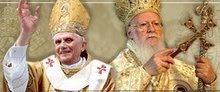
"Why Have You Wounded the Unity of My Body?"
VATICAN CITY, JAN. 25, 2009 (Zenit.org).- Here is a translation of the homily Benedict XVI gave today at the celebration of vespers for the feast of the Conversion of St. Paul. With this ceremony, held at the Basilica of St. Paul Outside the Walls, the Week of Prayer for Christian Unity concluded.
Representatives of Churches and ecclesial communities of Rome were present at the event.
* * *
Dear Brothers and Sisters,
It is a great joy every time we find ourselves gathered at the tomb of the Apostle Paul on the liturgical feast of his conversion to conclude the Week of Prayer for Christian Unity. I greet all of you with affection. I greet in a special way Cardinal Cordero Lanza di Montezemolo, the abbot and the community of monks who are hosting us. I also greet Cardinal Kasper, the president of the Pontifical Council for Promoting Christian Unity. I greet along with him the lord cardinals who are present, the bishops and the pastors of the various Churches and ecclesial communities gathered here this evening.
A special word of recognition goes to those who worked together in preparing the prayer guides, experiencing firsthand the exercise of reflecting and meeting in listening to each other and, all together, to the Word of God.
St. Paul's conversion offers us a model that shows us the way to full unity. Unity in fact requires a conversion: from division to communion, from broken unity to healed and full unity. This conversion is the gift of the Risen Christ, as it was for St. Paul. We heard this from the Apostle himself in the reading proclaimed just a moment ago: "By the grace of God I am what I am" (1 Corinthians 15:10).
The same Lord, who called Saul on the road to Damascus, addresses himself to the members of the Church -- which is one and holy -- and calling each by name asks: Why have you divided me? Why have you wounded the unity of my body?
Conversion implies two dimensions. In the first step we recognize our faults in the light of Christ, and this recognition becomes sorrow and repentance, desire for a new beginning. In the second step we recognize that this new road cannot come from us. It consists in letting ourselves be conquered by Christ. As St. Paul says: "I continue my pursuit in hope that I may possess it, since I have indeed been conquered by Christ Jesus" (Philippians 3:12).
Conversion demands our yes, my "pursuit"; it is not ultimately my activity, but a gift, a letting ourselves be formed by Christ; it is death and resurrection. This is why St. Paul does not say: "I converted" but rather "I died" (Galatians 2:19), I am a new creature. In reality, St. Paul's conversion was not a passage from immorality to morality, from a mistaken faith to a right faith, but it was a being conquered by Christ: the renunciation of his own perfection; it was the humility of one who puts himself without reserve in the service of Christ for the brethren. And only in this renunciation of ourselves, in this conforming to Christ are we also united among ourselves; we become "one" in Christ. It is communion with the risen Christ that gives us unity.
We can observe an interesting analogy with the dynamic of St. Paul's conversion also in meditating on the biblical text of the prophet Ezekiel (37:15-28), which was chosen as a basis for our prayer this year. In it, in fact, the symbolic gesture is presented of two sticks being joined into one in the prophet's hand, who represents God's future action with this gesture. It is the second part of Chapter 37, which in the first part contains the celebrated vision of the dry bones and the resurrection of Israel, worked by the Spirit of God.
How can we not see that the prophetic sign of the reunification of the people of Israel is placed after the great symbol of the dry bones brought to life by the Spirit? There follows from this a theological pattern analogous to that of St. Paul's conversion: God's power is first and he works the resurrection as a new creation by his Spirit. This God, who is the Creator and is able to resurrect the dead, is also able to bring a people divided in two back to unity.
Paul -- like Ezekiel but more than Ezekiel -- becomes the chosen instrument of the preaching of the unity won by Christ through his cross and resurrection: the unity between the Jews and the pagans, to form one new people. Christ's resurrection extends the boundary of unity: not only the unity of the tribes of Israel, but the unity of the Jews and the pagans (cf. Ephesians 2; John 10:16); the unification of humanity dispersed by sin and still more the unity of all who believe in Christ.
We owe this choice of the passage from the prophet Ezekiel to our Korean brothers, who felt the call of this biblical passage strongly, both as Koreans and Christians. In the division of the Jewish people into two kingdoms they saw themselves reflected, the children of one land who, on account of political events, have been divided, north from south. Their human experience helped them to better understand the drama of the division among Christians.
Now, from this Word of God, chosen by our Korean brothers and proposed to all, a truth full of hope emerges: God allows his people a new unity, which must be a sign and an instrument of reconciliation and peace, even at the historical level, for all nations. The unity that God gives his Church, and for which we pray, is naturally communion in the spiritual sense, in faith and in charity; but we know that this unity in Christ is also the ferment of fraternity in the social sphere, in relations between nations and for the whole human family. It is the leaven of the Kingdom of God that makes all the dough rise (cf. Matthew 13:33).
In this sense, the prayer that we offer up in these days, taking our cue from the prophecy of Ezekiel, has also become intercession for the different situations of conflict that afflict humanity at present. There where human words become powerless, because the tragic noise of violence and arms prevails, the prophetic power of the Word of God does not weaken and it repeats to us that peace is possible, and that we must be instruments of reconciliation and peace. For this reason our prayer for unity and peace always requires confirmation by courageous gestures of reconciliation among us Christians.
Once again I think of the Holy Land: how important it is that the faithful who live there, and the pilgrims who travel there, offer a witness to everyone that diversity of rites and traditions need not be an obstacle to mutual respect and to fraternal charity. In the legitimate diversity of different positions we must seek unity in faith, in our fundamental "yes" to Christ and to his one Church. And thus the differences will no longer be an obstacle that separates but richness in the multiplicity of the expressions of a common faith.
I would like to conclude this reflection of mine with a reference to an event that we older people here have certainly not forgotten. In this place on Jan. 25, 1959, exactly 50 years ago, Blessed Pope John XXIII announced for this first time his desire to convoke "an ecumenical Council for the universal Church" (AAS LI [1959], p. 68). He made this announcement to the cardinals in the chapter room of the Monastery of St. Paul, after having celebrated solemn Mass in the Basilica.
From the providential decision, suggested to my venerable predecessor, according to his firm conviction, by the Holy Spirit, there also derived a fundamental contribution to ecumenism, condensed in the decree "Unitatis Redintegratio." In that document we read: "There can be no ecumenism worthy of the name without a change of heart. For it is from renewal of the inner life of our minds, from self-denial and an unstinted love that desires of unity take their rise and develop in a mature way" (7).
The attitude of interior conversion in Christ, of spiritual renewal, of increased charity toward other Christians, created a new situation in ecumenical relations. The fruits of theological dialogues, with their convergences and with the more precise identification of the differences that still remain, led to a courageous pursuit in two directions: in the reception of what was positively achieved and a renewed dedication to the future.
Opportunely, the Pontifical Council for Promoting Christian Unity, which I thank for the service it renders to all the disciples of the Lord, has recently reflected on the reception and future of ecumenical dialogue. Such a reflection, if on one hand rightly desires to emphasize what has already been achieved, on the other hand intends to find new ways to continue the relations between the Churches and the ecclesial Communities in the present context.
The horizon of full unity remains open before us. It is an arduous task, but it is exciting for those Christians who want to live in harmony with the prayer of the Lord: "that all be one so that the world believes" (John 17:21). The Second Vatican Council explained to us "that human powers and capacities cannot achieve this holy objective -- the reconciling of all Christians in the unity of the one and only Church of Christ" ("Unitatis redintegratio," 24).
Trusting in the prayer of the Lord Jesus Christ, and encouraged by the significant steps made by the ecumenical movement, with faith we invoke the Holy Spirit that he continue to illumine our path. May the Apostle Paul, who worked so hard and suffered for the unity of the mystical body of Christ, spur us on from heaven; and may the Blessed Virgin Mary, Mother of the unity of the Church, accompany and sustain us.
Showing posts with label St. Paul. Show all posts
Showing posts with label St. Paul. Show all posts
Sunday, January 25, 2009
Papal Homily at Conclusion of Unity Week

Wednesday, January 21, 2009
On Seeking Christian Unity
"We Should Respond With Generosity"
VATICAN CITY, JAN. 21, 2009 (Zenit.org).- Here is a translation of the address Benedict XVI delivered during today's general audience in Paul VI Hall.
* * *
Dear brothers and sisters:
The Week of Prayer for Christian Unity began last Sunday and will conclude this Sunday, feast of the Conversion of St. Paul, the Apostle. This is a beautiful spiritual initiative, which is spreading more and more among Christians, in harmony, and we could say, in response to the pressing invocation that Jesus directed to the Father from the Upper Room: "That they may all be one, that the world may believe that you sent me" (John 17:21).
On four occasions during this priestly prayer, the Lord asks that his disciples be one, according to the image of the unity between the Father and the Son. This is a unity that can only grow in the example of the surrender of the Son to the Father, that is, going out of oneself and uniting oneself to Christ. Twice, moreover, in this prayer, Jesus adds as the objective of this union: That the world may believe. Full unity is connected, therefore with the life and the very mission of the Church in the world. [The Church] should live a unity that can only be derived from her unity with Christ, with its transcendence, as a sign that Christ is the truth.
This is our responsibility: That the gift of unity be visible for the world, in virtue of which our faith is made credible. For this, it is important that each Christian community become aware of the urgency of working in every way possible to reach this grand objective. Only going out of ourselves and toward Christ, only in this relationship with him can we come to be truly united among ourselves. This is the invitation that, with the present week [of prayer], is directed to believers in Christ of every Church and ecclesial community; to him, dear brothers and sisters, we should respond with generosity.
This year, the Week of Prayer for Christian Unity proposes for our meditation and prayer words taken from the book of the prophet Ezekiel: "That They May Become One in Your Hand" (37:17). The theme was chosen by an ecumenical group from Korea and then revised for its international use by the Mixed Committee of Prayer, formed by representatives of the Pontifical Council for Promoting Christian Unity and the Ecumenical Council of the Churches of Geneva. The process itself of preparation has been a stimulating and fruitful exercise of authentic ecumenism.
In the passage of the book of the prophet Ezekiel from which the theme has been taken, the Lord orders the prophet to take two sticks, one as a symbol of Judah and his tribes and the other as a symbol of Joseph and of the whole house of Israel united to him, and he asks him to "join" the two such that they form "just one stick" in his hand. The parable of unity is transparent. To the "sons of the people" who ask for an explanation, Ezekiel, enlightened from on high, will say that the Lord himself takes the two sticks and joins them, such that the two kingdoms with their respective tribes, divided among themselves, become "one in your hand." The hand of the prophet, which joins the two shoots, is considered as the hand of God himself that gathers and unites his people and finally, the whole of humanity.
We can apply the words of the prophet to Christians, as an exhortation to pray and to work, doing everything possible so that the unity of all the disciples of Christ is fulfilled, to work so that our hand is an instrument of the unifying hand of God. This exhortation appears particularly moving and urgent in the words of Jesus after the Last Supper. The Lord wants his entire people to walk -- and he sees in this the Church of the future, of future centuries -- with patience and perseverance toward the fulfillment of full union. This is a commitment that implies the docile and humble adherence to the commandment of the Lord, who blesses it and makes it fruitful. The prophet Ezekiel assures us that it will be precisely him, our only Lord, the only God, who takes us in "his hand."
In the second part of the biblical reading, the meaning and the conditions for the unity of the various tribes in just one kingdom are considered in depth. In the dispersion among the Gentiles, the Israelites had learned erroneous cults, had assimilated mistaken concepts of life, had taken on customs foreign to divine law. Now the Lord declares that they will no longer be contaminated with idols from the pagan peoples, with their abominations, with all of their iniquities (cf. Ezekiel 37:23). He reclaims the need to liberate them from sin, to purify their heart: "I will deliver them from all their sins of apostasy," he affirms" and cleanse them." And thus, "they may be my people and I may be their God" (ibid.)
In this condition of interior renovation, they will "live by my statutes and carefully observe my decrees." And the prophetic text concludes with the definitive and fully salvific promise: "I will make with them a covenant of peace … and put my sanctuary among them forever" (Ezekiel 37:26).
Ezekiel's vision is particularly eloquent for the whole ecumenical movement because it makes clear the unavoidable demand of an authentic interior renewal in every component of the People of God, which only the Lord can bring about. We too should be open to this renewal, because we too, dispersed among the peoples of the world, have learned customs very far from the Word of God: "Every renewal of the Church," reads the decree on ecumenism from the Second Vatican Council, "is essentially grounded in an increase of fidelity to her own calling. Undoubtedly this is the basis of the movement toward unity" ("Unitatis Redintegratio," 6), that is, greater fidelity to the vocation from God.
The decree emphasizes as well the interior dimension of the conversion of the heart. "There can be no ecumenism worthy of the name," it adds, "without a change of heart. For it is from renewal of the inner life of our minds, from self-denial and an unstinted love that desires of unity take their rise and develop in a mature way" ("Unitatis Redintegratio," 7). The Week of Prayer for Christian Unity becomes for all of us, in this way, a stimulant toward a sincere conversion and an ever more docile listening to the Word of God, toward an ever deeper faith.
The week is also a conducive occasion for thanking the Lord for how much he has conceded already "to join" one to another, divided Christians, and the Churches themselves and ecclesial communities. This spirit has animated the Catholic Church, which, during the last year, has progressed with firm conviction and sure hope, maintaining fraternal and respectful relations with all the Churches and ecclesial communities of East and West. In the diversity of situations, sometimes more positive, and sometimes more difficult, it has worked to never fail in the effort of implementing every effort for the restoration of full unity. The relationships between the Churches and the theological dialogues have continued giving encouraging signs of spiritual convergence. I myself have had the joy of meeting, here in the Vatican and in the course of my apostolic trips, Christians coming from every horizon.
I have welcomed with joy on three occasions the ecumenical patriarch, His Holiness Bartholomew I, and -- an extraordinary happening -- we heard him take the floor, with fraternal ecclesial warmth and with convinced trust in the future, during the recent assembly of the synod of bishops. I have had the pleasure of receiving the two catholicoi of the Armenian Apostolic Church, His Holiness Karekin II of Etchmiadzin and His Holiness Aram I of Antelias. And finally, I have shared the sorrow of the Patriarchate of Moscow at the passing of our beloved brother in Christ, Patriarch His Holiness Alexy II, and I continue remaining in communion of prayer with these our brothers who prepare to choose the new patriarch of that venerated and great Orthodox Church.
Likewise, I have had the chance to meet with representatives of the diverse Christian Communions of the West, with whom continues the dialogue about the important testimony that Christians should give today in harmony, in a world ever more divided and facing so many challenges of a cultural, social, economic and ethical character. For these and for so many other meetings, dialogues and gestures of fraternity that the Lord has permitted us to be able to carry out, let us give thanks together with joy.
Dear brothers and sisters, let us take advantage of the opportunity that the Week of Prayer for Christian Unity offers us to ask the Lord for a continuation, and if it is possible, an intensification of ecumenical dialogue and commitment. In the context of the Pauline year, which commemorates the 2,000th anniversary of the birth of St. Paul, we cannot fail to refer to what the Apostle Paul left written for us regarding the unity of the Church.
Every Wednesday, I am dedicating my reflections to his letters and his beautiful teaching. I take up again here simply what he wrote to the community of Ephesus: "One body and one Spirit, as you were also called to the one hope of your call; one Lord, one faith, one baptism" (Ephesians 4:4-5). Let us make our own the desire of St. Paul, who dedicated his entire life for the one Lord and for the unity of his mystical body, the Church, giving with his martyrdom, a supreme testimony of fidelity and love for Christ.
Following his example and counting on his intercession, may each community grow in the determination for unity, thanks to the diverse spiritual and pastoral initiatives and the assemblies of common prayer, which tend to become more numerous and intense in this week, bringing us to already foretaste, in a certain way, the joy of full union.
Let us pray so that between the Churches and ecclesial communities, dialogue in the truth continues, indispensable for resolving divergences, and [dialogue] in charity, which conditions the theological dialogue and helps to live united for a common testimony. The desire that dwells in our hearts is that the day of full communion arrives soon, when all of the disciples of our one Lord can finally celebrate the Eucharist together, the divine sacrifice for the life and salvation of the world. We invoke the maternal intercession of Mary so that she helps all Christians to cultivate a more attentive listening to the Word of God and a more intense prayer for unity.
[Translation by ZENIT]
[The Holy Father then greeted the people in several languages. In English, he said:]
Dear Brothers and Sisters,
Last Sunday we began the annual Week of Prayer for Christian Unity dedicated this year to the theme: "that they may become one in your hand" (Ezek 37:17). This scripture passage recalls God’s command to Ezekiel to take two sticks, one representing Judah and the other Israel, and join them together as a symbol of the Lord’s power to gather his people into one. As Christians, we read these words as an exhortation to pray and work for the full unity of Christ’s disciples. As the Second Vatican Council reminds us, "there can be no ecumenism worthy of the name without a change of heart" (Unitatis Redintegratio, 7). This week offers us an opportunity to thank God for all he has done and continues to do to bring Christians closer to one another. I am personally grateful for the many opportunities I have had to meet with representatives of Churches and Ecclesial Communities, both in the Vatican and during my travels abroad. Let us pray that the various initiatives this week at the local and universal levels will encourage all who confess "one Lord, one faith, and one baptism" to listen more attentively to the Word of God, to deepen prayer, and to intensify dialogue, so as to imitate Saint Paul’s example of a life completely devoted to the Lord and the unity of his Body, the Church.
I offer a warm welcome to all the English-speaking visitors present at today’s Audience. My particular greeting goes to the pilgrimage group from Malta led by Archbishop Paul Cremona. Upon all of you I cordially invoke an abundance of joy and peace in the Lord.
© Copyright 2009 - Libreria Editrice Vaticana
Wednesday, October 22, 2008
On Paul's Christology

"The Radical Humility of Christ Is the Expression of Divine Love"
VATICAN CITY, OCT. 22, 2008 (Zenit.org).- Here is a translation of the address Benedict XVI delivered during today's general audience in St. Peter's Square.
The Holy Father continued today the cycle of catecheses dedicated to the figure and thought of St. Paul.
* * *
Dear brothers and sisters:
In the catecheses from previous weeks, we have meditated on the "conversion" of St. Paul, fruit of a personal encounter with the crucified and risen Christ, and we have asked ourselves about the reaction of the Apostle to the Gentiles to the earthly Jesus. Today I would like to speak of the teaching St. Paul left us about the centrality of the risen Christ in the mystery of salvation, about his Christology.
In reality, the risen Jesus Christ, "exalted above every name," is at the center of all his reflections. Christ is for the Apostle the standard to evaluate events and things, the purpose of every effort that he makes to announce the Gospel, the great passion that sustains his steps along the paths of the world. And he is a living Christ, concrete: The Christ, Paul says, "who loved me and gave himself up for me" (Galatians 2:20). This person who loves me, with whom I can speak, who listens and responds to me, this is really the principle for understanding the world and for finding the way in history.
Anyone who has read the writings of St. Paul knows well that he does not concern himself with narrating the events that made up the life of Christ, even though we can imagine that in his catecheses, he recounted much more about the pre-Easter Jesus than what he wrote in his letters, which are admonitions for concrete situations. His pastoral and theological work was so directed toward the edification of the nascent communities, that it was natural for him to concentrate everything on the announcement of Jesus Christ as "Lord," alive today and present among his own.
Here we see the essentiality that is characteristic of Pauline Christology, which develops the depths of the mystery with a constant and precise concern: To announce, with certainty, Jesus and his teaching, but to announce above all the central reality of his death and resurrection as the culmination of his earthly existence and the root of the successive development of the whole Christian faith, of the whole reality of the Church.
For the Apostle, the Resurrection is not an event in itself that is separated from the Death. The risen One is the same One who was crucified. The risen One also had his wounds: The Passion is present in him and it can be said with Pascal that he is suffering until the end of the world, though being the risen One and living with us and for us. Paul had understood on the road to Damascus this identification of the risen One with Christ crucified: In that moment, it was revealed with clarity that the Crucified is the risen One and the risen One is the Crucified, who says to Paul, "Why do you persecute me?" (Acts 9:4). Paul was persecuting Christ in the Church and then understood that the cross is "a curse of God" (Deuteronomy 21:23), but a sacrifice for our redemption.
The Apostle contemplates with fascination the hidden secret of the crucified-risen One, and through the sufferings endured by Christ in his humanity (earthly dimension) arrives to this eternal existence in which he is one with the Father (pre-temporal dimension): "But when the fullness of time had come," he writes, "God sent his Son, born of a woman, born under the law, to ransom those under the law, so that we might receive adoption" (Galatians 4:4-5).
These two dimensions -- the eternal pre-existence with the Father and the descent of the Lord in the incarnation -- are already announced in the Old Testament, in the figure of Wisdom. We find in the wisdom literature of the Old Testament certain texts that exalt the role of Wisdom pre-existent to the creation of the world. In this sense, you can see passages such as Psalm 90: "Before the mountains were born, the earth and the world brought forth, from eternity to eternity you are God" (verse 2). Or passages such as those that speak of creating Wisdom: "The Lord begot me, the firstborn of his ways, the forerunner of his prodigies of long ago; From of old I was poured forth, at the first, before the earth" (Proverbs 8:22-23). Indicative as well is the praise of Wisdom, contained in the book by that name: "Indeed, she reaches from end to end mightily and governs all things well" (Wisdom 8:1).
The same wisdom texts that speak of the eternal pre-existence of Wisdom also speak of its descent, of the abasement of this Wisdom, which has made for itself a tent among men. Thus we can already feel resonate the words from the Gospel of John that speak of the tent of the flesh of the Lord. A tent was created in the Old Testament: Here is indicated the temple, worship according to the "Torah"; but from the point of view of the New Testament, we can understand that this was only a pre-figuration of the much more real and significant tent: the tent of the flesh of Christ.
And we already see in the books of the Old Testament that this abasement of Wisdom, its descent into flesh, also implies the possibility of being rejected. St. Paul, developing his Christology, refers precisely to this wisdom perspective: He recognizes in Jesus the eternal Wisdom existing from all time, the Wisdom that descends and creates a tent among us, and thus he can describe Christ as "the power of God and the wisdom of God." He can say that Christ has become for us "wisdom from God, as well as righteousness, sanctification, and redemption" (1 Corinthians 1:24, 30). In the same way, Paul clarifies that Christ, like Wisdom, can be rejected above all by the rulers of this age (cf. 1 Corinthians 2:6-9), such that in the plans of God a paradoxical situation is created: the cross, which will become the path of salvation for the whole human race.
A later development to this wisdom cycle, which sees Wisdom abase itself so as to be later exalted despite rejection, is found in the famous hymn in the Letter to the Philippians (cf. 2:6-11). This involves one of the most elevated texts of the New Testament. Exegetes mainly concur in considering that this pericope was composed prior to the text of the Letter to the Philippians. This is an important piece of information, because it means that Judeo-Christianity, before St. Paul, believed in the divinity of Jesus. In other words, faith in the divinity of Christ is not a Hellenistic invention, arising after the earthly life of Christ, an invention that, forgetting his humanity, had divinized him. We see in reality that the early Judeo-Christianity believed in the divinity of Jesus. Moreover, we can say that the apostles themselves, in the great moments of the life of the Master, had understood that he was the Son of God, as St. Peter says at Caesarea Philippi: "You are the Messiah, the Son of the living God" (Matthew 16:16).
But let us return to the hymn from the Letter to the Philippians. The structure of this text can be articulated in three stanzas, which illustrate the principle moments of the journey undertaken by Christ. His pre-existence is expressed with the words: "though he was in the form of God, [he] did not regard equality with God something to be grasped" (verse 6). Afterward follows the voluntary abasement of the Son in the second stanza: "he emptied himself, taking the form of a slave" (verse 7) "he humbled himself, becoming obedient to death, even death on a cross" (verse 8). The third stanza of the hymn announces the response of the Father to the humiliation of the Son: "Because of this, God greatly exalted him and bestowed on him the name that is above every name" (verse 9).
What is impressive is the contrast between the radical abasement and the resulting glorification in the glory of God. It is evident that this second stanza contrasts with the pretension of Adam, who wanted to make himself God, and it contrasts as well with the actions of the builders of the Tower of Babel, who wanted to construct for themselves a bridge to heaven and make themselves divine. But this initiative of pride ended with self-destruction: In this way, one doesn't arrive to heaven, to true happiness, to God. The gesture of the Son of God is exactly the contrary: not pride, but humility, which is the fulfillment of love, and love is divine. The initiative of abasement, of the radical humility of Christ, which contrasts with human pride, is really the expression of divine love; from it follows this elevation to heaven to which God attracts us with his love.
Besides the Letter to the Philippians, there are other places in Pauline literature where the themes of the pre-existence and the descent of the Son of God to earth are united. A reaffirmation of the assimilation between Wisdom and Christ, with all its cosmic and anthropological consequences, is found in the First Letter to Timothy: "[He] was manifested in the flesh, vindicated in the spirit, seen by angels, proclaimed to the Gentiles, believed in throughout the world, taken up in glory" (3:16). It is above all based on these premises that the function of Christ as mediator could be better defined, within the framework of the only God of the Old Testament (cf. 1 Timothy 2:5 in relation to Isaiah 43:10-11; 44:6). Christ is the true bridge who leads us to heaven, to communion with God.
And finally, just a point regarding the last developments of the Christology of St. Paul in the Letters to the Colossians and the Ephesians. In the first, Christ is designated as the "firstborn of all creation" (1:15-20). This word "firstborn" implies that the first among many children, the first among many brothers and sisters, has lowered to draw us and make us brothers and sisters. In the Letter to the Ephesians, we find the beautiful exposition of the divine plan of salvation, when Paul says that in Christ, God wanted to recapitulate all things (cf. Ephesians 1:23). Christ is the recapitulation of everything, he takes up everything and guides us to God. And thus is implied a movement of descent and ascent, inviting us to participate in his humility, that is, in his love for neighbor, so as to thus be participants in his glorification, making ourselves with him into sons in the Son. Let us pray that the Lord helps us to conform ourselves to is humility, to his love, to thus be participants in his divinization.
[Translation by ZENIT]
On How St. Paul Knew Christ
"Jesus Lives Now and Speaks With Us Now"
VATICAN CITY, OCT. 8, 2008 (Zenit.org).- Here is a translation of the address Benedict XVI delivered during today's general audience in St. Peter's Square.
The Holy Father continued today the cycle of catecheses dedicated to the figure and thought of St. Paul.
* * *
[Translation by Karna Swanson]
VATICAN CITY, OCT. 8, 2008 (Zenit.org).- Here is a translation of the address Benedict XVI delivered during today's general audience in St. Peter's Square.
The Holy Father continued today the cycle of catecheses dedicated to the figure and thought of St. Paul.
* * *
Dear Brothers and Sisters,
In the previous catecheses on St. Paul, I spoke of his encounter with the Risen Christ, which fundamentally changed his life, and then of his relationship with the Twelve Apostles called by Jesus, particularly with Sts. James, Peter and John, and of his relationship with the Church of Jerusalem.
The question that now remains is what St. Paul knew of the earthly Jesus: of his life, his teachings, his passion. Before entering into this question it could be useful to have in mind that Paul himself distinguished two ways of knowing Jesus and, in general, two ways of knowing a person.
He writes in the Second Letter to the Corinthians: "Consequently, from now on we regard no one according to the flesh; even if we once knew Christ according to the flesh, yet now we know him so no longer” (5:16). To know "according to the flesh," in a corporeal way, means to know only from the outside, with external criteria: one can see a person many times, recognize the individual's facial characteristics and the many details of how he acts: how he talks, moves, etc. Yet, even knowing someone in this way, one does not really know the person, one doesn't know the nucleus of the person. Only with the heart is one able to truly know a person.
In fact the Pharisees, the Sadducees, knew Christ from the outside, they heard his teachings, and knew many details of him, but they did not know him in his truth. There is an analogous distinction in the words of Jesus. After the Transfiguration, he asked the apostles: "Who do people say I am?" And, "Who do you say that I am?" The people know him, but superficially; they know many things about him, but they do not really know him. On the other hand, thanks to their friendship, and the role of their hearts, the Twelve at least substantially understood and began to learn more of who Christ really was.
This distinctive manner of knowing also exists today: There are learned individuals who know many details of Christ, and simple people who don't know these details, but they know Christ in his truth: "The heart speaks to the heart." And Paul essentially says that he knows Jesus in this way, with the heart, and that he knows essentially the person in his truth; and then afterward, he knows the details.
Having said this, the question remains: What did Paul know about the life, words, passion and miracles of Jesus? It seems he never met Christ during his early life. Surely he learned the details of Christ's earthly life from the apostles and the nascent Church. In his letters we find three forms of reference to the pre-Easter Jesus. First, there are explicit and direct references. Paul spoke of the Davidic lineage of Jesus (cf. Romans 1:3), he knew of the existence of his "brothers" or blood relatives (1 Corinthians 9:5; Galatians 1:19), he knew of the development of the Last Supper (cf 1 Corinthians 11:23). He know other phrases of Jesus, for example on the indissolubility of marriage (cf 1 Corinthians 7:10 with Mark 10:11-12), on the need that those who announce the Gospel be sustained by the community as the worker deserves his wage (cf 1 Corinthians 9:14 with Luke 10:7). Paul knew the words Jesus spoke at the Last Supper (cf 1 Corinthians 11:24-25 with Luke 22:19-20), and he also knew the cross of Jesus. These are direct references to the words and facts of the life of Jesus.
Second, we can see in some phrases of the Pauline letters various allusions to the confirmed tradition in the synoptic Gospels. For example, the words we read in 1 Thessalonians, according to which "the day of the Lord will come like a thief at night” (5:2), cannot be explained by referring to the Old Testament prophecies, because the metaphor of the thief at night is only found in the Gospels of Matthew and Luke, hence taken from the synoptic tradition. And when one reads that God "chose the foolish of the world" (1 Corinthians 1:27-28), one notes the faithful echo of the teachings of Jesus on the simple and the poor (cf Matthew 5:3; 11:25; 19:30). There are also the words of Jesus in the messianic Jubilee: “I give you praise, Father, Lord of heaven and earth, for although you have hidden these things from the wise and the learned you have revealed them to the childlike.” Paul knows -- from his missionary experience -- that these words are true, those who are childlike are the ones who have their hearts open to knowledge of Christ. Also, the mention of the obedience of Jesus "to death" that is found in Philippians 2:8 can't but point to the total willingness of the earthly Christ to fulfill the will of the Father (cf Mark 3:35; Jn 4:34).
Paul therefore knew the passion of Christ, his cross, and the way in which he lived the last moments of his life. The cross of Jesus and the tradition regarding the fact of the cross is at the center of the Pauline Kerygma. Another pillar of the life of Jesus that Paul knew was the Sermon on the Mount, some elements of which he cites almost literally when he writes to the Romans: "Love one another. ... Blessed are the persecuted. ... Live in peace with all. ... Overcome evil with good." In his letters there is a faithful expression of the Sermon on the Mount (cf Matthew 5-7).
Finally, it is possible to find a third way that the words of Jesus are in the letters of Paul: It is when he transposed the pre-Easter tradition to the post-Easter period. A typical example is the theme of the Kingdom of God. This is certainly at the center of the preaching of the historical Christ (cf Matthew 3:2; Mark 1:15; Luke 4:43). In Paul the transposition of this theme is revealed, for after the resurrection it is evident that Jesus, the Resurrected One, is the Kingdom of God. The Kingdom, then, is where Jesus is. And then necessarily the theme of the Kingdom of God, in which the mystery of Christ had been anticipated, is transformed into Christology.
Jesus' own instructions for entering the Kingdom of God are valid for Paul in regard to the justification by faith: Both require an attitude of great humility and availability, free of presumptions, to receive the grace of God. For example, the parable of the Pharisee and the publican (cf Luke 18:9-14) teaches exactly what St. Paul discusses when he insists that nobody should glorify themselves in the presence of God. Also, the teaching of Jesus on the publicans and the prostitutes, who are more willing than the Pharisees to receive the Gospel (cf Matthew 21:31; Luke 7:36-50), and his decisions to share a table with them (cf Matthew 9:10-13; Luke 15:1-2), are found in the doctrine of Paul on the mysterious love of God toward sinners (cf Romans 5:8-10 and Ephesians 2:3-5). In this way the theme of the Kingdom of God is proposed in a new manner, but always faithful to the tradition of the historic Jesus.
Another example of the faithful transposition of the doctrinal nucleus of Jesus is found in the "titles" that refer to him. Before Easter, Christ called himself "Son of Man"; after Easter it is evident that the Son of Man is also the Son of God. Therefore, the preferred title of Paul for Jesus is "Kyrios" -- Lord (cf Phillipians 9:11) -- that indicates the divinity of Jesus. With this title the Lord Jesus appears in the full light of his resurrection.
On the Mount of Olives, in the moment of Jesus' extreme anguish (cf Mark 14:36), the disciples, before going to sleep, heard how Jesus spoke with the Father and called him "Abba -- Father.” This is a very informal word, equal to "daddy," used only by children for their father. Until that moment it was unthinkable that a Hebrew use a word such as that to address God; but Jesus, being truly a son, talked in this way during this hour of intimacy and said "Abba, Father."
In the letters of St. Paul to the Romans and Galatians, surprisingly, this word "Abba," which expresses the exclusivity of the sonship of Jesus, appears in the mouths of the baptized (cf Romans 8:15; Galatians 4:6). They have received the "Spirit of the Son" and now carry in themselves this Spirit, and they can talk as Jesus and with Jesus as true sons of the Father. They can say "Abba" because they have been converted into sons and daughters in the Son.
And finally, I would like to point out the salvific dimension of the death of Jesus, as we find in the Gospel in which "the Son of Man did not come to be served but to serve and to give his life as a ransom for many” (Mark 10:45; Matthew 20:28). The faithful expression of this phrase of Jesus appears in the Pauline doctrine on the death of Jesus as a rescue (cf 1 Corinthians 6:20), as redemption (cf Romans 3:24), as liberation (cf Galatians 5:1) and as reconciliation (cf Romans 5:10; 2 Corinthians 5:18-20). Here is the center of Pauline theology, which is based in this phrase of Jesus.
In conclusion, St. Paul did not think Jesus was something historical, as a person from the past. He certainly knew the great tradition regarding his life, his words, his death and his resurrection, but he did not treat them as something from the past; he proposed them as the reality of the living Jesus. The words and actions of Jesus for Paul do not pertain to a historic time, to the past. Jesus lives now and speaks with us now, and lives for us. This is the true manner to get to know Jesus, and to learn the tradition of him. We should also learn to know Jesus, not physically, as a person of the past, but as our Lord and brother, that today is with us and shows us how to live and how to die.
[Translation by Karna Swanson]