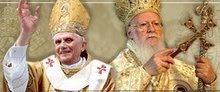
History may be in the making. It appears Rome is on the brink of welcoming close to half a million members of the Traditional Anglican Communion into membership of the Roman Catholic Church, writes Anthony Barich. Such a move would be the most historic development in Anglican-Catholic relations in the last 500 years. But it may also be a prelude to a much greater influx of Anglicans waiting on the sidelines, pushed too far by the controversy surrounding the consecration of practising homosexual bishops, women clergy and a host of other issues.
The Vatican’s Congregation for the Doctrine of the Faith has decided to recommend the Traditional Anglican Communion be accorded a personal prelature akin to Opus Dei, if talks between the TAC and the Vatican aimed at unity succeed, it is understood.
The TAC is a growing global community of approximately 400,000 members that took the historic step in 2007 of seeking full corporate and sacramental communion with the Catholic Church – a move that, if fulfilled, will be the biggest development in Catholic-Anglican relations since the English Reformation under King Henry VIII.
TAC members split from the Canterbury-based Anglican Communion headed by Archbishop Rowan Williams over issues such as its ordination of women priests and episcopal consecrations of women and practising homosexuals.
The TAC’s case appeared to take a significant step forwards in October 2008 when it is understood that the CDF decided not to recommend the creation of a distinct Anglican rite within the Roman Catholic Church – as is the case with the Eastern Catholic Churches - but a personal prelature, a semi-autonomous group with its own clergy and laity.
Opus Dei was the first organisation in the Catholic Church to be recognised as a personal prelature, a new juridical form in the life of the Church. A personal prelature is something like a global diocese without boundaries, headed by its own bishop and with its own membership and clergy.
Because no such juridical form of life in the Church had existed before, the development and recognition of a personal prelature took Opus Dei and Church officials decades to achieve.
An announcement could be made soon after Easter this year. It is understood that Pope Benedict XVI, who has taken a personal interest in the matter, has linked the issue to the year of St Paul, the greatest missionary in the history of the Church.
The Basilica of St Paul outside the Walls could feature prominently in such an announcement for its traditional and historical links to Anglicanism. Prior to the English Reformation it was the official Church of the Knights of the Garter.
The TAC’s Primate, Adelaide-based Archbishop John Hepworth, told The Record he has also informed the Holy See he wants to bring all the TAC’s bishops to Rome for the beatification of Cardinal Henry Newman, also an Anglican convert to the Catholic Church, as a celebration of Anglican-Catholic unity.
Although Cardinal Newman’s beatification is considered to be likely by many, the Church has made no announcement that Cardinal Newman will be beatified.
Archbishop Hepworth personally wrote to Pope Benedict in April 2007 indicating that the TAC planned a meeting of its world bishops, where it was anticipated they would unanimously agree to sign the Catechism of the Catholic Church and to seek full union with the Catholic Church.
This took place at a meeting of the TAC in the United Kingdom. TAC bishops placed the signed Catechism on the altar of the most historical Anglican and Catholic Marian shrine in the UK, the National Shrine of Our Lady of Walsingham in Norfolk, before posting it up in the main street in an effort to gather public support.
Archbishop Hepworth, together with TAC bishops Robert Mercer and Peter Wilkinson, presented the signed items personally to Fr Augustine Di Noia OP, the CDF’s senior ecumenical theologian, on October 11, 2007, in a meeting organised by CDF secretary Archbishop Angelo Amato.
Bishop Mercer, a monk who is now retired and living in England, is the former Anglican Bishop of Matabeleland, Zimbabwe. Bishop Wilkinson is the TAC’s diocesan bishop in Canada.
TAC’s Canadian Bishop Peter Wilkinson has close ties to the Catholic hierarchy in British Columbia, which has also met the CDF on the issue. He has already briefed Vancouver archdiocesan priests.
One potential problem for the Holy See would be the TAC’s bishops, most of whom are married. Neither the Roman Catholic nor Eastern Catholic churches permit married bishops.
Before he became Pope, Cardinal Joseph Ratzinger discussed the issue of married bishops in the 1990s during meetings of the Anglican Roman Catholic International Commission exploring unity, before the Anglican Church’s ordination of women priests derailed it.
One former Anglican priest who became a Catholic priest told The Record that the ideal end for the TAC would be to become the 28th Rite within the Catholic Church, along with the Eastern Churches, which have the same sacraments and are recognised by Rome.
The TAC’s request is the closest any section of the Anglican Church has ever come to full communion with Rome because the TAC has set no preconditions. Instead it has explicitly submitted itself entirely to the Holy See’s decisions.
Six days prior to the October 11 meeting between TAC bishops and the Holy See – on October 5 – the TAC’s bishops, vicars-general of dioceses without bishops, and theological advisers who assisted in a plenary meeting signed a declaration of belief in the truth of the whole Catechism of the Catholic Church.
The declaration said, in part: “We accept that the most complete and authentic expression and application of the Catholic faith in this moment of time is found in the Catechism of the Catholic Church and its Compendium, which we have signed, together with this letter as attesting to the faith we aspire to teach and hold.”
Statements about the seriousness of the division between the Anglican Communion and the Catholic Church caused by issues such as the ordination of women priests were emphasised at the wordwide Lambeth Conference held in the UK in 2008.
At the conference, three Catholic cardinals – Walter Kasper, president of the Pontifical Council for Promoting Christian Unity, the Archbishop of Westminster Cormac Murphy-O’Connor and the Prefect for the Vatican’s Congregation for the Evangelisation of Peoples, Ivan Dias, the Pope’s personal envoy, all addressed the issue.
Cardinal Dias, who favours welcoming traditionalist Anglicans into the Catholic Church, bluntly told the Anglican Communion’s 650 bishops that they are heading towards “spiritual Alzheimer’s” and “ecclesial Parkinson’s”.
“By analogy, (Alzheimer’s and Parkinson’s) symptoms can, at times, be found even in our own Christian communities. For example, when we live myopically in the fleeting present, oblivious of our past heritage and apostolic traditions, we could well be suffering from spiritual Alzheimer’s. And when we behave in a disorderly manner, going whimsically our own way without any co-ordination with the head or the other members of our community, it could be ecclesial Parkinson’s.”
Cardinal Kasper warned Anglican bishops that Rome would turn to smaller ecumenical communities if the Anglican Communion at large proved unapproachable ecumenically.
This is bad news for the Anglican Communion, but good news for the TAC.
Showing posts with label Cardinal Newman. Show all posts
Showing posts with label Cardinal Newman. Show all posts
Thursday, January 29, 2009
Rome & Traditional Anglicans get ready for union
Wednesday, 28 January 2009

Wednesday, October 22, 2008
Cardinal Newman: Doctor of the Church?

Father Ian Ker on the Priest’s Cause, Teachings
BURFORD, England, OCT. 22, 2008 (Zenit.org).- Did Cardinal John Henry Newman pick up where St. Bernard left off?
Father Ian Ker thinks so; he claims that reading Cardinal Newman is like reading the great Church Fathers.
The expert on Cardinal Newman and professor of theology at Oxford University shared with ZENIT how the venerable Oratorian was a pioneer in the renewal of theology, anticipated the Second Vatican Council and was a writer of great faith.
Q: Why has the momentum suddenly increased for Cardinal Newman’s cause for canonization during Benedict XVI’s pontificate? What is the Holy Father’s interest in Cardinal Newman?
Father Ker: Although Newman worked as an ordinary parish priest among the very poor in inner city Birmingham when he began the Oratory there, and later in the more salubrious suburb of Edgbaston where the Oratory was finally established and where he continued to carry out ordinary parish duties, his main work lay in his intellectual apostolate and writings.
So, although known locally to be a holy man, there was never the kind of popular cult that a less intellectual figure -- working, for example, among the poor or the sick or on the foreign missions -- would have inspired.
The momentum for his canonization in fact began some years before the present pontificate. Previously, the people interested in Newman were mainly scholars and theologians, the kind of people who are not necessarily particularly committed to intercessory prayer.
But once the cause was fully launched -- and there had been long delays -- it was possible to undertake a formal examination of his life and writings and conclude that he was indeed a man of heroic sanctity and worthy of being raised to the altars of the Church.
With this verdict the Holy See concurred and in 1991 Pope John Paul II declared Newman to be “Venerable,”’ the first step toward canonization. That development has led more and more people to ask Newman for his intercession and -- assuming Newman is a saint -- was bound sooner or later to lead to a miracle.
Benedict XVI became interested in Newman while at the seminary through the interest of one of his teachers. And, of course, he would have been aware as a theologian that Newman was a great pioneer in the renewal of theology.
Q: Cardinal Newman was certainly a great theologian and Church historian, but what is it about his writings that make him worthy of being elevated to the status of doctor of the Church?
Father Ker: Newman is more than simply a very learned and clever thinker. Indeed, it has been said that he took over where St Bernard left off.
Anyone reading his writings cannot but be aware that reading Newman is like reading the great Church Fathers. In his writings we encounter a writer of profound faith.
Q: Why is Cardinal Newman known as the "father of the Second Vatican Council?"
Father Ker: In the 1830s in Oxford, Newman and his fellow Tractarians launched a forerunner of the movement of “ressourcement,” [which arose] in France a hundred years later.
It was this return to the scriptural and patristic sources that made possible the theology of Vatican II.
Newman most clearly anticipated the Council in his theory of doctrinal development and his personalist understanding of revelation (Constitution on Divine Revelation), his stress on the role of the laity and more fundamentally his understanding of the Church as communion (Constitution on the Church), his sense of the need for the Church to engage with the modern world and to abandon the siege mentality (Constitution on the Modern World), and his cautious support for ecumenism in its early days (Decree on Ecumenism).
Q: Many traditionalists are skeptical of Cardinal Newman and believe he is a stalking horse for modernism because of his ideas regarding the “development of doctrine” and his statements regarding the role of conscience. In his day he was deemed a liberal, but Russell Kirk featured him in a book titled “The Conservative Mind.” Why is Cardinal Newman so controversial and misunderstood?
Father Ker: Cardinal Newman is most obviously misunderstood because of the common misinterpretation of his account of the relation of conscience to Church authority. Newman never envisaged so-called conscientious dissent from Church teachings.
What he did envisage was the possibility of a person conscientiously resisting an order from higher authority. His theory of development is no longer controversial but is part of mainstream theology and indeed is actually echoed in Vatican II’s Constitution on Divine Revelation.
In his own day, Newman was indeed a radical in his thinking because he was ahead of his times as I mentioned earlier in this interview. But he was never a liberal in the sense in which we use the word today, but was always deeply loyal to the tradition and the teachings of the Church.
Q: Cardinal Newman famously said that to be steeped in history is to cease to be Protestant, yet he was not known to be triumphalistic. What counsel might he give to Anglicans today, as well as to Catholics participating in ecumenical conversations with Anglicans?
Father Ker: By the end of his life Newman came to believe that Anglicans were “giving up everything.” That process is now considerably advanced, and my view is that Newman would not regard as Christian in any meaningful sense large swathes of Western Anglicanism.
But long before that he was clear that any kind of corporate reunion with a body as disparate and divided as Anglicanism was totally impossible.
I believe that today he would warmly support any efforts to help disaffected high Anglicans enter the Catholic Church -- the idea that they should stay and try and leaven the lump he would regard as completely fanciful and unrealistic.
I think he would encourage dialogue with Evangelicals generally, not only in Anglicanism, and would not be surprised by the many conversions that have taken place since the reforms of Vatican II.
Q: What does Cardinal Newman’s decision to join the Oratory of St. Philip Neri tell us about his spiritual and devotional life? Why not the Jesuits or Dominicans, both of whom had strong reputations for fostering theological scholarship?
Father Ker: Newman joined the Oratory of St Philip Neri partly in order to remain with his former Anglican community at Littlemore; partly because he did not find himself particularly attracted to any of the orders; partly because being already middle-aged he did not wish to begin again as it were, but rather to pursue continuity of his life as a secular priest living in community; and partly because his life at Oxford had always combined pastoral with academic work, a combination that he saw as typical of the Oratory.