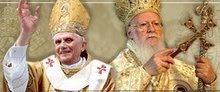
From Zenit.org.Patriarch at the Synod: Unexpected Impact
Interview With Fraternal Delegate From Orthodox ChurchBy Jesús Colina
VATICAN CITY, OCT. 24, 2008 (Zenit.org).- The intervention from Ecumenical Patriarch Bartholomew I of Constantinople at the synod of bishops marked an ecumenical milestone, says a representative of the Orthodox Church of Greece.
Archimandrite Ignatios Sotiriadis is a fraternal delegate at the world Synod of Bishops on the Word of God, which ends Sunday.
The Church of Greece representative spoke with ZENIT about the intervention from Bartholomew I, given as a homily Oct. 18 in a celebration of vespers together with Benedict XVI.
Q: You have been participating in the entire synod. What have you heard from the synod fathers about Bartholomew I's homily?
Archimandrite Ignatios: First of all, I feel proud to see His Holiness Ecumenical Patriarch Bartholomew I in the Sistine Chapel, where popes are elected, also famous worldwide for its artistic value, because I consider the invitation from Pope Benedict to the "primus inter pares" of the Orthodox Church a most great honor.
The event was welcomed by the synod fathers -- all of them were present -- as a true moment of "grace" and in the same way, the Vatican daily L'Osservatore Romano has presented it in a headline on the front page.
The patriarch made reference in his homily to the interpretation of the Word of God-Divine Word, according to the teaching and the writings of the fathers of the Church. It was a magisterial homily, since it presented the position of the Orthodox Church on the discussion, inspired in the richness of Eastern and Orthodox spirituality.
It was a historical event, in which a Pope celebrates vespers before the representatives of the entire Catholic episcopate and on this occasion, doesn't exercise his ministry as teacher, but concedes it to the second bishop of the Church when it was not yet divided.
What most impressed me was what the Pope said when the patriarch's homily, received with long applause, was over: "If we have common fathers, how can we not be brothers?"
Q: The synod fathers have commented on the mediation of the patriarch. In particular, they were impressed by the passage in which he explained how to "see" the Word of God through icons, expression of the incarnation of God, and in creation, highlighting the importance of protecting it, as respect for the divine Logos.
Archimandrite Ignatios: The ecumenical patriarch is known for his passion and his tireless commitment at the ecological level and the synod fathers have much appreciated his contribution to a discussion of maximum importance and current value, in which the Church should be a protagonist.
Q: But the great novelty, perhaps, has not been the patriarch's intervention, but rather the desire of the Pope, expressed at the end of vespers, to include the patriarch's proposals in the synodal proposals. This is an initiative that appears to have been welcomed by the synod fathers. In this way, for the first time in history, the magisterium of an ecumenical patriarch could be taken up by the official magisterium of the Catholic Church in the postsynodal apostolic exhortation.
Archimandrite Ignatios: When we are united in the Word of God, our path inevitably leads us toward a second stage, which is full unity, that is, a common celebration of the Eucharist. But this will not be reached as much with human efforts as with the breath and will of the Holy Spirit.
Q: Yet those who hope for this unity sometimes see it as something far off …
Archimandrite Ignatios: The separation of the Eastern and Western Church occurred over various centuries; it was not an isolated event in the year 1054, but a long cultural, linguistic process. … I think that the re-encounter will happen in the same way, following a gradual path. We separated slowly, and slowly we will unite. But it is not for us to talk of dates.
What is certain is the desire of the Orthodox Church that the Church of Rome parts with its temporal power and dedicates itself totally to its spiritual mission for the transformation of the world.
Here are Barthowlemew's words at Vespers. ==================Patriarch's Words at Vespers
"Unity of the Church Is Unbreakably Related With Her Mission"
VATICAN CITY, OCT. 19, 2008 (Zenit.org).- Here is the address Ecumenical Patriarch Bartholomew I delivered Saturday afternoon at the celebration of early vespers in the Sistine Chapel, presided over by Benedict XVI.
The event took place within the context of the world Synod of Bishops, which is under way in the Vatican through Oct. 26. The theme of the assembly is on "The Word of God in the Life and Mission of the Church."
* * *
Your Holiness,
Synodal Fathers,
It is at once humbling and inspiring to be graciously invited by Your Holiness to address the XII Ordinary General Assembly of this auspicious Synod of Bishops, an historical meeting of Bishops of the Roman Catholic Church from throughout the world, gathered in one place to meditate on “the Word of God” and deliberate on the experience and expression of this Word “in the Life and Mission of the Church.”
This gracious invitation of Your Holiness to our Modesty is a gesture full of meaning and significance -- we dare say an historic event in itself. For it is the first time in history that an Ecumenical Patriarch is offered the opportunity to address a Synod of the Bishops of the Roman Catholic Church, and thus be part of the life of this sister Church at such a high level. We regard this as a manifestation of the work of the Holy Spirit leading our Churches to a closer and deeper relationship with each other, an important step towards the restoration of our full communion.
It is well known that the Orthodox Church attaches to the Synodical system fundamental ecclesiogical importance. Together with primacy synodality constitutes the backbone of the Church’s government and organisation. As our Joint International Commission on the Theological Dialogue between our Churches expressed it in the Ravenna document, this interdependence between synodality and primacy runs through all the levels of the Church’s life: local, regional and universal. Therefore, in having today the privilege to address Your Synod our hopes are raised that the day will come when our two Churches will fully converge on the role of primacy and synodality in the Church’s life, to which our common Theological Commission is devoting its study at the present time.
The theme to which this episcopal synod devotes its work is of crucial significance not only for the Roman Catholic Church but also for all those who are called to witness to Christ in our time. Mission and evangelization remain a permanent duty of the Church at all times and places; indeed they form part of the Church’s nature, since she is called “Apostolic” both in the sense of her faithfulness to the original teaching of the Apostles and in that of proclaiming the Word of God in every cultural context every time. The Church needs, therefore, to rediscover the Word of God in every generation and make it head with a renewed vigour and persuation also in our contemporary world, which deep in its heart thirsts for God’s message of peace, hope and charity.
This duty of evangelization would have been, of course, greatly enhanced and strengthened, if all Christians were in a position to perform it with one voice and as a fully united Church. In his prayer to the Father little before His passion our Lord has made it clear that the unity of the Church is unbreakably related with her mission “so that the world may believe” (John 17, 21). It is, therefore, most appropriate that this Synod has opened its doors to ecumenical fraternal delegates so that we may all become aware of our common duty of evangelization as well as of the difficulties and problems of its realization in today’s world.
This Synod has undoubtedly been studying the subject of the Word of God in depth and in all its aspects, theological as well as practical and pastoral. In our modest address to you we shall limit ourselves to sharing with you some thoughts on the theme of your meeting, drawing from the way the Orthodox tradition has approached it throughout the centuries and in the Greek patristic teaching, in particular. More concretely we should like to concentrate on three aspects of the subject, namely: on hearing and speaking the Word of God through the Holy Scriptures; on seeing God’s Word in nature and above all in the beauty of the icons; and finally on touching and sharing God’s Word in the communion of saints and the sacramental life of the Church. For all these are, we think, crucial in the life and mission of the Church.
In so doing, we seek to draw on a rich Patristic tradition, dating to the early third century and expounding a doctrine of five spiritual senses. For listening to God’s Word, beholding God’s Word, and touching God’s Word are all spiritual ways of perceiving the unique divine mystery. Based on Proverbs 2.5 about “the divine faculty of perception (αἴσθησις),” Origen of Alexandria claims:
This sense unfolds as sight for contemplation of immaterial forms, hearing for discernment of voices, taste for savoring the living bread, smell for sweet spiritual fragrance, and touch for handling the Word of God, which is grasped by every faculty of the soul.
The spiritual senses are variously described as “five senses of the soul,” as “divine” or “inner faculties,” and even as “faculties of the heart” or “mind.” This doctrine inspired the theology of the Cappadocians (especially Basil the Great and Gregory of Nyssa) as much as it did the theology of the Desert Fathers (especially Evagrius of Pontus and Macarius the Great).
1. Hearing and Speaking the Word through Scripture
At each celebration of the Divine Liturgy of St. John Chrysostom, the presiding celebrant at the Eucharist entreats “that we may be made worthy to hear the Holy Gospel.” For “hearing, beholding and handling the Word of life” (1 Jn 1.1) are not first and foremost our entitlement or birthright as human beings; they are our privilege and gift as children of the living God. The Christian Church is, above all, a scriptural Church. Although methods of interpretation may have varied from Church Father to Church Father, from “school” to “school,” and from East to West, nevertheless, Scripture was always received as a living reality and not a dead book.
In the context of a living faith, then, Scripture is the living testimony of a lived history about the relationship of a living God with a living people. The Word, “who spoke through the prophets” (Nicene-Constantinopolitan Creed), spoke in order to be heard and take effect. It is primarily an oral and direct communication intended for human beneficiaries. The scriptural text is, therefore, derivative and secondary; the scriptural text always serves the spoken word. It is not conveyed mechanically, but communicated from generation to generation as a living word. Through the Prophet Isaiah, the Lord vows:
As rain and snow descend from heaven, watering the earth … so shall my word go from mouth to mouth, accomplishing that which I purpose. (55.10-11)
Moreover, as St. John Chrysostom explains, the divine Word demonstrates profound considerateness (συγκατάβασις) for the personal diversity and cultural contexts of those hearing and receiving. Adaptation of the divine Word to the specific personal readiness and the particular cultural context defines the missionary dimension of the Church, which is called to transform the world through the Word. In silence as in declaration, in prayer as in action, the divine Word addresses the whole world, “preaching to all nations” (Mt 28.19) without either privilege or prejudice to race, culture, gender and class. When we carry out that divine commission, we are assured: “Behold, I am with you always.” (Mt 28.20) We are called to speak the divine Word in all languages, “becoming all things to all people, that [we] might by all means save some.” (1 Cor. 9.22)
As disciples of God’s Word, then, it is today more imperative than ever that we provide a unique perspective -- beyond the social, political, or economic -- on the need to eradicate poverty, to provide balance in a global world, to combat fundamentalism or racism, and to develop religious tolerance in a world of conflict. In responding to the needs of the world’s poor, vulnerable and marginalized, the Church can prove a defining marker of the space and character of the global community. While the theological language of religion and spirituality differs from the technical vocabulary of economics and politics, the barriers that at first glance appear to separate religious concerns (such as sin, salvation, and spirituality) from pragmatic interests (such as commerce, trade, and politics) are not impenetrable, crumbling before the manifold challenges of social justice and globalization.
Whether dealing with environment or peace, poverty or hunger, education or healthcare, there is today a heightened sense of common concern and common responsibility, which is felt with particular acuteness by people of faith as well as by those whose outlook is expressly secular. Our engagement with such issues does not of course in any way undermine or abolish differences between various disciplines or disagreements with those who look at the world in different ways. Yet the growing signs of a common commitment for the well-being of humanity and the life of the world are encouraging. It is an encounter of individuals and institutions that bodes well for our world. And it is an involvement that highlights the supreme vocation and mission of the disciples and adherents of God’s Word to transcend political or religious differences in order to transform the entire visible world for the glory of the invisible God.
2. Seeing the Word of God -- The Beauty of Icons and Nature
Nowhere is the invisible rendered more visible than in the beauty of iconography and the wonder of creation. In the words of the champion of sacred images, St. John of Damascus: “As maker of heaven and earth, God the Word was Himself the first to paint and portray icons.” Every stroke of an iconographer’s paintbrush – like every word of a theological definition, every musical note chanted in psalmody, and every carved stone of a tiny chapel or magnificent cathedral – articulates the divine Word in creation, which praises God in every living being and every living thing. (cf. Ps. 150.6)
In affirming sacred images, the Seventh Ecumenical Council of Nicaea was not concerned with religious art; it was the continuation and confirmation of earlier definitions about the fullness of the humanity of God’s Word. Icons are a visible reminder of our heavenly vocation; they are invitations to rise beyond our trivial concerns and menial reductions of the world. They encourage us to seek the extraordinary in the very ordinary, to be filled with the same wonder that characterized the divine marvel in Genesis: “God saw everything that He made; and, indeed, it was very good.” (Gn. 1.30-31) The Greek (Septuagint) word for “goodness” is κάλλος, which implies -- etymologically and symbolically -- a sense of “calling.” Icons underline the Church’s fundamental mission to recognize that all people and all things are created and called to be “good” and “beautiful."
Indeed, icons remind us of another way of seeing things, another way of experiencing realities, another way of resolving conflicts. We are asked to assume what the hymnology of Easter Sunday calls “another way of living.” For we have behaved arrogantly and dismissively toward the natural creation. We have refused to behold God’s Word in the oceans of our planet, in the trees of our continents, and in the animals of our earth. We have denied our very own nature, which calls us to stoop low enough to hear God’s Word in creation if we wish to “become participants of divine nature.” (2 Pet 1.4) How could we ignore the wider implications of the divine Word assuming flesh? Why do we fail to perceive created nature as the extended Body of Christ?
Eastern Christian theologians always emphasized the cosmic proportions of divine incarnation. The incarnate Word is intrinsic to creation, which came to be through divine utterance. St. Maximus the Confessor insists on the presence of God’s Word in all things (cf. Col. 3.11); the divine Logos stands at the center of the world, mysteriously revealing its original principle and ultimate purpose (cf. 1 Pet 1.20). This mystery is described by St. Athanasius of Alexandria:
As the Logos [he writes], he is not contained by anything and yet contains everything; He is in everything and yet outside of everything … the first-born of the whole world in its every aspect.
The entire world is a prologue to the Gospel of John. And when the Church fails to recognize the broader, cosmic dimensions of God’s Word, narrowing its concerns to purely spiritual matters, then it neglects its mission to implore God for the transformation -- always and everywhere, “in all places of His dominion” -- of the whole polluted cosmos. It is no wonder that on Easter Sunday, as the Paschal celebration reaches its climax, Orthodox Christians sing:
Now everything is filled with divine light: heaven and earth, and all things beneath the earth. So let all creation rejoice.
All genuine “deep ecology” is, therefore, inextricably linked with deep theology:
“Even a stone,” writes Basil the Great, “bears the mark of God’s Word. This is true of an ant, a bee and a mosquito, the smallest of creatures. For He spread the wide heavens and laid the immense seas; and He created the tiny hollow shaft of the bee’s sting.”
Recalling our minuteness in God’s wide and wonderful creation only underlines our central role in God’s plan for the salvation of the whole world.
3. Touching and Sharing the Word of God -- The Communion of Saints and the Sacraments of Life
The Word of God persistently “moves outside of Himself in ecstasy” (Dionysius the Areopagite), passionately seeking to “dwell in us” (Jn 1.14), that the world may have life in abundance. (Jn 10.10) God’s compassionate mercy is poured and shared “so as to multiply the objects of His beneficence.” (Gregory the Theologian) God assumes all that is ours, “in every respect being tested as we are, yet without sin” (Heb. 4.15), in order to offer us all that is God’s and render us gods by grace. “Though rich, He becomes poor that we might become rich,” writes the great Apostle Paul (2 Cor. 8.9), to whom this year is so aptly dedicated. This is the Word of God; gratitude and glory are due to Him.
The word of God receives His full embodiment in creation, above all in the Sacrament of the Holy Eucharist. It is there that the Word becomes flesh and allows us not simply to hear or see Him but to touch Him with our own hands, as St. John declares (I John 1,1) and make Him part of our own body and blood (σύσσωμοι καί σύναιμοι) in the words of St. John Chrysostom.
In the Holy Eucharist the Word heard is at the same time seen and shared (κοινωνία). It is not accidental that in the early eucharistic documents, such as the book of Revelation and the Didache, the Eucharist was associated with prophesy, and the presiding bishops were regarded as successors of the prophets (e.g. Martyrion Polycarpi). The Eucharist was already by St. Paul (I Cor. 11) described us “proclamation” of Christ’s death and Second Coming. As the purpose of Scripture is essentially the proclamation of the Kingdom and the announcement of eschatological realities, the Eucharist is a foretaste of the Kindom, and in this sense the proclamation of the Word par excellence. In the Eucharist Word and Sacrament become one reality. The word ceases to be “words” and becomes a Person, embodying in Himself all human beings and all creation.
Within the life of the Church, the unfathomable self-emptying (κένωσις) and generous sharing (κοινωνία) of the divine Logos is reflected in the lives of the saints as the tangible experience and human expression of God’s Word in our community. In this way, the Word of God becomes the Body of Christ, crucified and glorified at the same time. As a result, the saint has an organic relationship with heaven and earth, with God and all of creation. In ascetic struggle, the saint reconciles the Word and the world. Through repentance and purification, the saint is filled -- as Abba Isaac the Syrian insists -- with compassion for all creatures, which is the ultimate humility and perfection.
This is why the saint loves with warmth and spaciousness that are both unconditional and irresistible. In the saints, we know God’s very Word, since -- as St. Gregory Palamas claims -- God and His saints share the same glory and splendor.” In the gentle presence of a saint, we learn how theology and action coincide. In the compassionate love of the saint, we experience God as “our father” and God’s mercy as “steadfastly enduring.” (Ps. 135, LXX) The saint is consumed with the fire of God’s love. This is why the saint imparts grace and cannot tolerate the slightest manipulation or exploitation in society or in nature. The saint simply does what is “proper and right” (Divine Liturgy of St. John Chrysostom), always dignifying humanity and honoring creation. “His words have the force of actions and his silence the power of speech” (St. Ignatius of Antioch).
And within the communion of saints, each of us is called to “become like fire” (Sayings of the Desert Fathers), to touch the world with the mystical force of God’s Word, so that -- as the extended Body of Christ -- the world, too, might say: “Someone touched me!” (cf. Mt 9.20) Evil is only eradicated by holiness, not by harshness. And holiness introduces into society a seed that heals and transforms. Imbued with the life of the sacraments and the purity of prayer, we are able to enter the innermost mystery of God’s Word. It is like the tectonic plates of the earth’s crust: the deepest layers need only shift a few millimeters to shatter the world’s surface. Yet for this spiritual revolution to occur, we must experience radical metanoia -- a conversion of attitudes, habits and practices -- for ways that we have misused or abused God’s Word, God’s gifts and God’s creation.
Such a conversion is, of course, impossible without divine grace; it is not achieved simply through greater effort or human willpower. “For mortals, it is impossible; but for God all things are possible.” (Mt 19.26) Spiritual change occurs when our bodies and souls are grafted onto the living Word of God, when our cells contain the life-giving blood-flow of the sacraments, when we are open to sharing all things with all people. As St. John Chrysostom reminds us, the sacrament of “our neighbor” cannot be isolated from the sacrament of “the altar.” Sadly, we have ignored the vocation and obligation to share. Social injustice and inequality, global poverty and war, ecological pollution and degradation result from our inability or unwillingness to share. If we claim to retain the sacrament of the altar, we cannot forgo or forget the sacrament of the neighbor -- a fundamental condition for realizing God’s Word in the world within the life and mission of the Church.
Beloved Brothers in Christ,
We have explored the patristic teaching of the spiritual senses, discerning the power of hearing and speaking God’s Word in Scripture, of seeing God’s Word in icons and nature, as well as of touching and sharing God’s Word in the saints and sacraments. Yet, in order to remain true to the life and mission of the Church, we must personally be changed by this Word. The Church must resemble the mother, who is both sustained by and nourishes through the food she eats. Anything that does not feed and nourish everyone cannot sustain us either. When the world does not share the joy of Christ’s Resurrection, this is an indictment of our own integrity and commitment to the living Word of God. Prior to the celebration of each Divine Liturgy, Orthodox Christians pray that this Word will be “broken and consumed, distributed and shared” in communion. And “we know that we have passed from death to life when we love our brothers” and sisters (1 Jn 3.14).
The challenge before us is the discernment of God’s Word in the face of evil, the transfiguration of every last detail and speck of this world in the light of Resurrection. The victory is already present in the depths of the Church, whenever we experience the grace of reconciliation and communion. As we struggle -- in ourselves and in our world -- to recognize the power of the Cross, we begin to appreciate how every act of justice, every spark of beauty, every word of truth can gradually wear away the crust of evil. However, beyond our own frail efforts, we have the assurance of the Spirit, who “helps us in our weakness” (Rom. 8.26) and stands beside us as advocate and “comforter” (Jn 14-6), penetrating all things and “transforming us -- as St. Symeon the New Theologian says -- into everything that the Word of God says about the heavenly kingdom: pearl, grain of mustard seed, leaven, water, fire, bread, life and mystical wedding chamber.” Such is the power and grace of the Holy Spirit, whom we invoke as we conclude our address, extending to Your Holiness our gratitude and to each of you our blessings:
Heavenly King, Comforter, Spirit of Truth
Present everywhere and filling all things;
Treasury of goodness and giver of life:
Come, and abide in us.
And cleanse us from every impurity;
And save our souls.
For you are good and love humankind.
Amen!