Showing posts with label evolution. Show all posts

Monday, April 13, 2009

Brooks on 'the end of philosophy' or 'the end of humanity'

The End of Philosophy by David Brooks (New York Times)

Socrates talked. The assumption behind his approach to philosophy, and the approaches of millions of people since, is that moral thinking is mostly a matter of reason and deliberation: Think through moral problems. Find a just principle. Apply it.

One problem with this kind of approach to morality, as Michael Gazzaniga writes in his 2008 book, “Human,” is that “it has been hard to find any correlation between moral reasoning and proactive moral behavior, such as helping other people. In fact, in most studies, none has been found.”

Today, many psychologists, cognitive scientists and even philosophers embrace a different view of morality. In this view, moral thinking is more like aesthetics. As we look around the world, we are constantly evaluating what we see. Seeing and evaluating are not two separate processes. They are linked and basically simultaneous.

As Steven Quartz of the California Institute of Technology said during a recent discussion of ethics sponsored by the John Templeton Foundation, “Our brain is computing value at every fraction of a second. Everything that we look at, we form an implicit preference. Some of those make it into our awareness; some of them remain at the level of our unconscious, but ... what our brain is for, what our brain has evolved for, is to find what is of value in our environment.”

Think of what happens when you put a new food into your mouth. You don’t have to decide if it’s disgusting. You just know. You don’t have to decide if a landscape is beautiful. You just know.

Moral judgments are like that. They are rapid intuitive decisions and involve the emotion-processing parts of the brain. Most of us make snap moral judgments about what feels fair or not, or what feels good or not. We start doing this when we are babies, before we have language. And even as adults, we often can’t explain to ourselves why something feels wrong.

In other words, reasoning comes later and is often guided by the emotions that preceded it. Or as Jonathan Haidt of the University of Virginia memorably wrote, “The emotions are, in fact, in charge of the temple of morality, and ... moral reasoning is really just a servant masquerading as a high priest.”

The question then becomes: What shapes moral emotions in the first place? The answer has long been evolution, but in recent years there’s an increasing appreciation that evolution isn’t just about competition. It’s also about cooperation within groups. Like bees, humans have long lived or died based on their ability to divide labor, help each other and stand together in the face of common threats. Many of our moral emotions and intuitions reflect that history. We don’t just care about our individual rights, or even the rights of other individuals. We also care about loyalty, respect, traditions, religions. We are all the descendents of successful cooperators.

Read the rest of this wretched but interesting piece here.


My commentary:
As science comes up with 'explanations' for why humans feel the need to be moral, the moral 'values' that we hold will become useless. This is because, as science will have proven, it's all biologically determined anyway. This sort of reasoning admits a limit on what is reason; reason is strictly limited to the verifiable or empirical. Science hasn't accounted for feelings like "patriotism", but as Brooks asserts, eventually it will. Hence the title: "The Death of Philosophy". How does this not give a person pause? Reason is limited to materialistic determinism? Say 'bye, bye' to philosophy, theology, and reason-based ethics. An "epochal" shift. I think the article should be titled: "The End of Humanity". Brooks doesn't seem to get where this is going.... the topic is "above his pay grade".

The scientists seek to pair human morality with the reigning dogma on evolution/chance. This, of course, is not science but ideology. How are terms of 'value' and 'morality' and 'purpose' scientific? Explain why it is valid for scientists to be theorizing about such topics. Brook's article assumes evolution of random chance is true (so much for God's creative Spirit), and is more interested in taking such a view into the realm of morality with metaphysical underpinnings. The article posits, at least the scientists (it seems to me that Brooks doesn't get it), that reason is the slave of emotions because that's the only account empiricism can make for any 'moral' judgments. It very much appears that the 'science' going on here in Brooks' piece is just what you rail against in the quote above. This is especially seen when Dr. Quartz moves from 'the brain processing info at a vast rate' to 'this is what the brain is for' (assigning purpose... but I thought we were just moving particles at random?) to assigning 'value' to 'this is how we make moral judgments'. Where did the science end and the philosophy begin? I don't know about you, but I find it absurd when humans are compared to bees, moral decisions to tasting food, and that adults are no more qualified to make moral judgments than babies (yes, the article asserts all of those things). Hence, Brooks notes in the conclusion that the proposition of the 'moral scientists' is "an epochal" change; aka kiss religion, reason based morality, and what Lewis calls "the Tao" goodbye. Forget "The End of Philosophy" and enter "The End of Humanity". Which reminds me, you need to read The Abolition of Man if you haven't already; it's a great account of reason based morality that gives a role to emotion that I think you will find interesting.

At this point, the more important discussion is about the Brooks piece, and it gets back to The Metaphysical Club as well as Neuhaus' brilliant summation of Rorty and liberal irony.
One must choose:
a) To be with the materialists asserting that man's reason is slave to the emotions, and morality is simply as pragmatism describes (ready, fire, aim); truth is also always evolving and in-flux and determined by the utility in any given time by 'majority' consensus. Reality is really just what man percieves in his own mind; it does not apply to others. Such claims foundationally are anti-institution, anti-tradition, and anti-religious; usually if not always they favor a radical and unbridled positivism in the academy/polis.
-or-
b) To be with the realists who believe that man ought to and can order his emotions by using right reason and conquer his appetites, striving for the good, true, and beautiful which exist 'out there' and is accessible by our (God-given) reason, and embodied in the eternal Logos (in this account one can still recognize that we often act on emotions without thinking.) Such claims are friendly to religions, traditions, and hierarchical institutions (they are also not 'western' arguments exclusively); positivism has its place, but it is ordered to right reason.

There is no half-way house between the two. It's option 'a' or 'b'. This is the crux of our entire discussion! Again, even Brooks sees it as "an epochal" change - hence the problems of modern education as Deneen, Fish, and many others argue. Neither choice gives any road to a 'third' option; they are diametrically opposed. I'm interested to see what your choice is, and why.

Saturday, April 4, 2009

Hilarious irony! Robot independed from creator...


I wonder if they intentionally named the robot... naw, I bet they are just stupid.

Robot achieves scientific first

By Clive Cookson, Science Editor

Published: April 2 2009 19:17 | Last updated: April 2 2009 19:17

A laboratory robot called Adam has been hailed as the first machine in history to have discovered new scientific knowledge independently of its human creators.

Adam formed a hypothesis on the genetics of bakers’ yeast and carried out experiments to test its predictions, without intervention from its makers at Aberystwyth University.


Read the rest.
Can anyone say "Terminator 4" here we come?

Wednesday, April 1, 2009

Stupid Obama? Stupid America?

Barack Obama's gift for the Queen: an iPod, your Majesty

Barack Obama met the Queen at Buckingham Palace today and gave her a gift of an iPod loaded with video footage and photographs of her 2007 United States visit to Richmond, Jamestown and Williamsburg in Virginia. In return, the Queen gave the President a silver framed signed photograph of herself and the Duke of Edinburgh - apparently a standard present for visiting dignitaries.

It is believed the Queen already has an iPod, a 6GB silver Mini version she is said to have bought in 2005 at the suggestion of Prince Andrew.

UPDATE: Pool reporter Richard Wolf of USA Today says that an Obama aide told him the President also gave the Queen a "rare songbook signed by Richard Rodgers". END UPDATE

Earlier, Mr Obama had spoken of his admiration for Her Majesty but indicated that his wife was handling the details of their royal meeting. "There's one last thing that I should mention that I love about Great Britain, and that is the Queen," he said at the end of his joint press conference with Gordon Brown.

"And so I'm very much looking forward to meeting her for the first time later this evening. And as you might imagine, Michelle has been really thinking that through -- because I think in the imagination of people throughout America, I think what the Queen stands for and her decency and her civility, what she represents, that's very important."

Mr Brown added: "Well, I know the Queen is looking forward to welcoming you and she's very much looking forward to her discussion with you."

There was widespread criticism in Britain and from Anglophiles in the US of Mr Obama's recent present to Mr Brown of a box set of classic American movies on DVDs that were not compatible with British DVD players.

Sunday, November 2, 2008

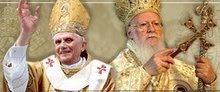
Scientists, Theologians Gather for Vatican Conference on Evolution

At right, Pope Benedict blesses Stephen Hawking.


Pope Benedict XVI opened a five-day Vatican meeting on evolution Friday morning by affirming that the world did not emerge out of chaos but was intentionally created by "the First Being."

"In order to develop and evolve, the world must first be, and thus have come from nothing into being,” the pontiff told an audience of 80 scientists, philosophers and theologians who have gathered for the conference, themed "Scientific Insights into the Evolution of the Universe and of Life."

“It must be created, in other words, by the First Being who is such by essence," he added, according to Zenit News.

Benedict also went further to assert that the Creator was not only involved in the origins of the universe but continually sustains the development of life and the world.

The Creator, he said, “is the cause of every being and all becoming.”

The five-day conference, sponsored by the Pontifical Academy of Sciences, is the latest initiative in an effort by the Vatican to promote dialogue between scientists and theologians. It also comes as debates over creation and evolution continue to rage on.

Like many Christians today, most members of the Catholic Church accept a brand of evolution known as "theistic evolution," which teaches that evolution was a tool used by God in the creation process.

During a press gathering in September, the Vatican said the theory of evolution was compatible with the Bible and that it was even planning to hold a new interdisciplinary conference to celebrate the 150th anniversary of Charles Darwin's Origin of the Species next March in Rome.

The Catholic Church rejects a fundamentalist interpretation of the Creation story in Genesis, regarding the six-day account as an allegory. Though this view aligns with that of many Protestant Christians, many conservatives maintain the belief in a literal six-day Creation.

On Friday, Benedict said he saw no contradiction between believing in God and empirical science.

"There is no opposition between faith's understanding of creation and the evidence of the empirical sciences," he said, quoting from Popes Pius XII and John Paul II.

He also cited Galileo, whom, he said "saw nature as a book whose author is God in the same way that Scripture has God as its author."

"It is a book whose history, whose evolution, whose ‘writing’ and meaning, we ‘read’ according to the different approaches of the sciences, while all the time presupposing the foundational presence of the Author who has wished to reveal Himself therein," said the pontiff, according to Catholic News Service.

Following Benedict’s opening remarks, world renowned physicist Stephen Hawking, a professor of Mathematics at Cambridge University, was scheduled to give a lecture Friday afternoon entitled "The Origin and Destiny of the Universe."

The physicist’s appearance was to mark his second at a Vatican scientific conference since 1981, when Hawking had attended at Vatican conference on cosmology.

Though he has never professed a belief in God, Hawking has never denied the existence of God either. Furthermore, in his 1988 publication, A Brief History of Time, Hawking discussed the possibility of a creator.

"So long as the universe had a beginning, we could suppose it had a creator,” wrote Hawking, who later said that his theories show the possibility for the laws of science to dictate how the universe began.

The world renown physicist has also admitted to being religious, though not “in the normal sense," in an interview with Reuters last year.

"I believe the universe is governed by the laws of science," he told Reuters.

"The laws may have been decreed by God, but God does not intervene to break the laws," he added.


Read the rest.

Wednesday, June 25, 2008

Spanish parliment - defending the 'rights' of apes...


Yes, yes, yes... of course. My favorite line, from the liberal-material fascists interviewed was: "This is a historic day in the struggle for animal rights and in defense of our evolutionary comrades, which will doubtless go down in the history of humanity." Indeed, it will go down in history...
It certainly made it on this blog half-way around the world already, but probably not for the reasons Pedro Pozas was intending! Dumba$$.

Spanish parliament to extend rights to apes
By Martin Roberts

MADRID (Reuters) - Spain's parliament voiced its support on Wednesday for the rights of great apes to life and freedom in what will apparently be the first time any national legislature has called for such rights for non-humans.

Parliament's environmental committee approved resolutions urging Spain to comply with the Great Apes Project, devised by scientists and philosophers who say our closest genetic relatives deserve rights hitherto limited to humans.

"This is a historic day in the struggle for animal rights and in defense of our evolutionary comrades, which will doubtless go down in the history of humanity," said Pedro Pozas, Spanish director of the Great Apes Project.

Spain may be better known abroad for bull-fighting than animal rights but the new measures are the latest move turning once-conservative Spain into a liberal trailblazer.


The rest.

Wednesday, May 14, 2008

The Gospel According to Han Solo?


Did you hear what the Vatican's astronomer said???? Sometimes some ideas, no matter how well intentioned and seemingly harmless, are actually really stupid. I can just imagine a gay person or a divorced Catholic wondering "I can't receive Communion, but Chewbacca can?"

This story is beyond stupid. It's a good excuse to use the sweet picture of JPII though!

Some help from the AmericanPapist...

Vatican Chief Astronomer: "The extraterrestrial is my brother"
Okay, that's how the headline of the article read, reportes the Associated Press.

Hmm, can we say "slow news day"?

CNA has a good summary of what happened:

The Director of the Vatican's Observatory, Fr. José Gabriel Funes, said in an interview with the Vatican daily, L'Osservatore Romano, that believing in the possible existence of extraterrestrial life is not opposed to Catholic doctrine.

.... The astronomer began the interview titled, "The Alien is my Brother," by saying that, "Astronomy has a profound human value. It is a science that opens the heart and the mind. It helps us to put our lives, our hopes, our problems in the right perspective. In this regard, and here I speak as a priest and a Jesuit, it is an apostolic instrument that can bring us closer to God", said Fr. Funes in the interview.

Fr. Roderick translates the portions of the article that treat the implications of extraterrestial life:

Do you refer also to beings similar to us, or even more evolved?

It’s possible. However, so far we haven’t got any proof. But in such a big universe, this hypothesis can’t be excluded.

And that wouldn’t be a problem for our faith?

I don’t think so. Just like there is an abundance of creatures on earth, there could also be other beings, even intelligent ones, that were created by God. That doesn’t contradict our faith, because we cannot put boundaries to God’s creative freedom. As saint Francis would say, when we consider the earthly creatures to be our “brothers” and “sisters”, why couldn’t we also talk about a “extraterrestrial brother”? He would still be part of creation.

And what about redemption?

Let’s borrow the image from the gospel about the lost sheep. The shepherd leaves the 99 of the sheepfold to search for the one that got lost. Let’s imagine that in this universe there are 100 sheep, corresponding to the different forms of creatures. We who belong to the human race, could very well be the lost sheep, the sinners that need the shepherd. Got has become man in Jesus to save us. In that way, even when other intelligent beings exist, it’s not said that they would need redemption. They might have stayed in full friendship with their Creator.

I insist: when they would, on the contrary, be sinners, would redemption also be possible for them?

Jesus incarnated once and for all. The incarnation is a unique and non-repeatable event. However, I am certain that they too, in one way or another, would have the possibility to experience God’s mercy, just like we men have.

I think Curt Jester has the perfect response to this .... "The Star Wars Ewok Gospel":

Wednesday, April 9, 2008

Satire on Richard (The God Delusion) Dawkins

This video is pretty funny. It rips on the sheer arrogance of the man behind the book, The God Delusion: Richard Dawkins. Dawkins is known for his staunch atheism and his harsh rhetoric against Christianity and any belief in something higher than his intellect.
He coined the name "the Brights" referring to himself and other 'enlightened' atheist -scientists who scoffed at religion.

Here he is avoiding an innocent question, and displaying his ever-acrimonious wit against believers...


Now for the well-deserved roast... (beware, the video has some questionable content). What's funnier, after watching a few moments of the satire, is reading Mark Shea's post on the Crisis blog.


Mark Shea writes about the Dawkins video:

As we know, Chesterton famously observed that the mark of madness is not the loss of reason, but the loss of everything except reason. Periodically, something in our culture will show me the brilliance of that insight with great force.

Chad, one of the readers over on the Vox Popoli blog summarizes Dawkins & Co.'s lightning-swift-on-the-uptake response to the satire:

1. Video posted around 11:00 PM

2. 1 hour and 44 minutes later, Dawkins implores his more intelligent readers to help inform him as to whose side the video is on (his side, or not his side). He then pokes fun at people that think things are funny that he doesn't understand just in case it turns out to be 'not on his side.' Comment #151544

3. Dawkins now presumably goes to sleep.

4. Nearly nine hours later, he wakes up and checks the post again. He sees that his fellow scientific elites like the video, but also don't understand it. Dawkins tries to get in a little dig on postmodernism, but just ends up making fun of his posters. Comment #151685

5. Nine and a half hours after posting, Dawkins wonders how his fellow comrades could laugh at something they don't understand. He then lauds The Life of Brian as the pinnacle of comedic evolution. Comment #151704

6. A couple minutes after the last post, he gets in another jab at Postmodernism. Comment #151713

7. Under chastisement for his humbuggery, Dawkins admits that Daniel Dennett popping his head up from out of nowhere is, in fact, funny. Comment #151715

8. Nearly ten hours after posting the video, someone postulates that the humor is derived from the silly dancing bodies (not the satire). Dawkins seems to accept this theory and thanks the poster for his intellect. Comment #151723

9. Sixteen hours after first watching the video, Dawkins finally realizes that it is, in fact, making fun of 'his side.' Dawkins defends himself again by saying that he didn't understand it. Comment #151849.

10. Seventeen hours after posting, Dawkins attempts to comprehend the humor by equating similar scenes of incongruousness that Monty Python has also done. Dawkins has apparently not yet pondered why, if this were the only thing funny about the video, he did not catch on before this. Dawkins chalks this up to the video not being funny, and dismisses the obvious conclusion that his head is too big to see the satire behind it. Comment #151889

11. The next day, Dawkins chimes in again to defend his Ph.D. status to a poster who dared question it. Comment #152142

12. Nearly 36 hours after posting, Dawkins discovers what a 'grill' is and waxes philosophic as to why Sam Harris would have one in the video. The conclusion he comes up with is that it adds no humor to the video and should not have been put in. Comment #152168

13. After a full three and a half days after first watching the video, Dawkins (obviously perturbed at the fact he didn't get that he was the butt of the joke, when every other non-elite who saw it could tell in an instant) attempts to equate the video with 'The worst poem ever written.' He then satisfies himself by settling on the conclusion that this is the only reason why people might like it. The final analysis is that it's not only 'not good,' and not even 'pretty bad,' but so incredibly bad, that it is in fact, good. He gets in a snobbish comment about the Bible for good measure. Comment #153061


It is hilarious to read about how divorced these people are from reality- and humanity... a bit sad too.

Let's commence the "Pray For Richard Dawkins Apostolate".

Tuesday, January 1, 2008

Stem Cells, Then and Now


Check out Cardinal Schoenborn's excellent book.

From First Things blog...
Posted by Joseph Bottum on December 27, 2007, 12:45 PM

In the January issue of Commentary, there’s a fascinating article called “Stem Cells and the President—An Inside Account,” written by Jay Lefkowitz, who was the official “primarily responsible for advising the President” on the issue of stem cells during the debates that produced Bush’s compromise in the summer of 2001.

In “Stem Cells and the President,” Lefkowitz writes, “Now that the debate seems to be over, what can we say about Bush’s policy and the long months it took for him to devise it? I think it is fair to look upon it as a model of how to deal with the complicated scientific and ethical dilemmas that will continue to confront political leaders in the age of biotechnology.”

That’s a large claim, and it requires not only thinking about how recent breakthroughs have changed the debate but also remembering what the situation was like in 2001. There’s a touch of beyondism in the Commentary piece—a bit of the move that suggests “We must have been correct because we were attacked from both the left and the right.” It’s true, for example, that Judie Brown, the president of the American Life League, told the New York Times that after the stem-cell compromise in 2001 President Bush could “no longer describe himself as pro-life.” But if being attacked at some point by the hard-line American Life League is the criterion, few of us would qualify as pro-life.

For that matter, the two sides would gradually change their opinions in opposite directions: Many on the supporters of stem-cell researcher—including, as Lefkowitz notes, the actor Christopher Reeve and Irving Weissman of Stanford—began with mild praise of the decision and moved over the next three years to raging opposition.

Meanwhile, the compromise was generally received with mild disappointment by the pro-life side (including by First Things, which characterized the compromise as “morally defensible in principle but gravely imprudent.”) But the political left increasingly decided the issue was a winning one, and their attacks on President Bush escalated until, at the 2004 Democratic convention in Boston, the phrase stem cells was spoken from the dais dozens of times, in nearly every major speech—while the word abortion was never heard. The effect of all this work by the left was that, across the nation, Bush’s 2001 position was no longer understood as a compromise. The Democrats insisted it was a complete surrender to a pro-life extremism, and the nation, I think, came to believe the Democrats (and voted, one notes, for President Bush over John Kerry anyway—or, perhaps, voted for Bush precisely because of what it perceived as the president’s enduring pro-life stand).

Still, Lefkowitz is basically right about the reaction to the president’s address on August 9, 2001: It pleased no one particularly at the time. He attributes the president’s position to Bush’s courage in 2001, but, the man’s courage may have been better displayed by the fact that Bush stuck to his compromise even as the Democrats and the mainstream media ginned the issue up into one of the major themes of the elections of 2004, 2006, and 2008. Or, rather, what was going to be one of the major issues of the 2008 election, until this year’s breakthroughs suddenly changed the entire landscape of the debate—and gave an enormous victory to the pro-life side.

Let’s think for a moment, however, about the 2001 compromise. We tend to forget that confusion and disorganization in the first days of the Bush administration helped produce the original political crisis over stem cells: An executive order, issued in the first flurry of such orders as the new administration took office, might well have passed without comment for some time.

Once the issue was on the table, however, Bush was forced to act in the full glare of publicity. It’s easy to accept Lefkowitz’s claim that the 2001 compromise seemed the clearest solution at the time. But Lefkowitz makes too easy an elision to move from there to the claim that the recent breakthroughs are a vindication of Bush’s 2001 position—for that would require showing that the new results would not have happened, or would have happened slower, if Bush had instead refused to fund even previously created stem-cell lines.

Meanwhile, it’s not as though Bush’s compromise bought him much respite from attacks by the pro-research world or the political left. And though his speech on August 9, 2001, was a brilliant one, he missed—as he has often missed during his presidency—the chance to educate the public on the deeper pro-life position.

And yet, along the way, the public did get educated. The political left’s endless attacks on the 2001 compromise made it seem less of a compromise and more of an entirely pro-life stand. And then the new breakthroughs suddenly stranded the attackers in odd and unsustainable positions. Lefkowitz is surely right that all this marks a great triumph for President Bush. But it is one with many twists and turns between 2001 and 2007.