Showing posts with label Patristic Writings. Show all posts

Monday, February 9, 2009

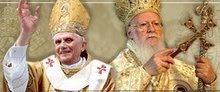
Ravenna & the Roman Primacy


An interesting piece from Homiletic & Pastoral Review.

How is it that no other bishop
but the Roman bishop
ever claimed a universal primacy in the Church?


Ravenna and the Roman primacy


by Daniel S. Hamilton


After two decades of modest progress, the Joint International Catholic-Orthodox Theological Commission, meeting in Ravenna, Italy, October 8-14, 2007, issued a study document on ecclesial communion, conciliarity and authority (1) that acknowledged the Roman primacy in the universal Church as a historical fact, but called for an extensive study and clarification of its basis and nature, issues hotly debated for centuries.

My purpose here is to outline the conflicting positions on the basis and nature of the Roman primacy as these issues are presented generally by leaders and scholars of the two Church communions, including Anglicans, and to suggest how these mutually opposed positions may be brought closer together, followed by a personal reflection.

The Catholic position

Some may be surprised to learn that Orthodox leaders and theologians, together with classical Anglicans, do not dispute the historical fact of Rome’s universal primacy from the earliest Christian centuries; but they differ radically with the Catholic Church regarding the basis and nature of this primacy, arguing, in some cases, that because of heresy it has been lost.

The Catholic Church has insisted from time immemorial—and, indeed, has dogmatized this conviction—that our Lord Jesus Christ gave the ministerial leadership of his Church to Peter and intended this office (like the Church itself) to continue permanently and, by the guidance of the Holy Spirit, to continue in the leadership or episcopate of the Roman Church, in the city where Peter (with Paul) exercised Church leadership and where both Peter and Paul were martyred, and in which was the capital and center of the Church’s first principal missionary field—namely, the Roman Empire.

This leadership derived from Peter, the chief apostle, was first exercised, then specified and later defined by the Church itself in the course of history, as a leadership of real and final authority to be invoked when needed for the good and, above all, for the unity of all the churches. This authority was spiritual, doctrinal and governmental—and in all cases decisive. Vatican Council I, reaffirmed by Vatican II, described the office as episcopal, ordinary and immediate; namely, that the Roman bishop has the same authority within the whole Church that a diocesan bishop has within his own diocese, that this universal authority inheres in the Roman bishop’s office and that it can be exercised independently (canonically speaking) and personally without need for recourse to any other authority. Inherent also in this office of the Roman bishop is the charism to teach inerrantly under precise conditions specified by the conciliar definition.

The Catholic teaching on the Roman primacy is thus clear, precise, forthright and, for many, overwhelming.(2) It is accompanied by a long list of supportive testimonies from Scripture, the apostolic and post-apostolic Church, the patristic age and subsequent centuries.(3)

The Orthodox and Anglican position

The Orthodox and the Anglicans generally have no dogmatic position on these issues; but they nonetheless have a long tradition of firmly rejecting the Catholic position. They have evaluated the factual and historical Roman primacy as, variously, 1) an office inconsistent with the nature of the Church as a Eucharistic communion of local churches all of which are equally the Church, where primacy on all levels is exercised only in a conciliar context; 2) an office needed in the universal Church and one that was perhaps providentially initiated but that was actually conferred upon the Roman See and its bishop by the other ancient local churches, as witnessed by ecumenical or other councils such as Nicaea (325), Sardica (342), Constantinople I (381) and Chalcedon (451).(4)

This designation of Rome as having the universal primacy came, it is maintained, by reason of Rome’s position at the center of the world in which the Church was then planted and growing—the Roman Empire. The city and its Church also enjoyed the unique heritage of the two apostles Peter and Paul both having ministered there and been martyred there; and, as the centuries followed, it boasted a Church whose authority grew tremendously in the religious and political circumstance of the times and, also, it is said, by arrogating authority to itself within the communion of churches.

Such commentators view the legitimate original Roman primacy of leadership—in the sense of a norm of faith and practice—as having evolved or devolved into a “papalism” or “papal supremacy,” terms and phrases that signify a kind of distortion or wrongful aggrandizement of the original office, which was Peter’s or was conferred on the Roman See by its ancient sister churches. The Roman primacy became, in this perspective, a supreme, monarchical and dictatorial office analogous to an oppressive secular power.

Thus, though universal primacy may have emerged in the Church because of a need for such leadership, the kind of primacy that factually developed rather quickly, asserting its foundation in the indemonstrable claim of the Lord’s gift to Peter, had, in any case, evolved into an objectionable papal supremacy that ever since has become a stone of stumbling for Christians who do not admit it.(5)

A resolution?

How are these conflicting positions to be harmonized? Clearly, the path of resolution will be neither easy nor short. In 1995, however, Pope John Paul II (in Ut Unum Sint)(6) invited the leaders and theologians of all the Christian church communities (a sparse response) to join him in a dialogue as to how the Roman primacy, its essential mission preserved, may best be exercised in our time. This dialogue was not to obscure, however, the basis and nature of this primacy.

All parties to this dialogue would need to commit themselves to a thorough and objective examination of the extant data, beginning with the Scriptures and the very early Church testimonies and those of the Fathers, of the major councils, and of the Eastern and Western Churches’ twenty centuries of mutual relations and doctrinal teaching, distinguishing the various levels of authority in this teaching. A sifting and evaluating of all this material would follow. Joint committees would appropriately pursue these tasks, as well as individual theologians.

True, this task has been done in large measure before. But, today joint committees of scholars are needed to replicate, authenticate and, if need be, correct the work of the past and accomplish new research called for now. Scholars striving equally for objectivity will evaluate evidence differently. Scholarly thoroughness and objectivity will, therefore, not eliminate all differences but will narrow them. Ultimately conclusions from a scientific point of view will need to be drawn in some cases on the basis of the preponderance of evidence and possible alternative interpretations noted.

But scholarship alone—even the most professional and objective—is not enough. Beyond scholarship there is needed prayerful intercession. The Church is not a community of scholars but the Mystical Body of Christ into which we are ingrafted by faith and baptism for the conversion of hearts, the healing of memories and the gift of reconciliation. We must have an intensified dialogue of love and that mutual cooperation which the Church communions have sought with greater or lesser success over these last fifty years. We must seek the guidance of the Holy Spirit for a full reconciliation and we must dearly want it.(7)

Read the full piece here.

Msgr. Daniel S. Hamilton, Ph.D., a former editor of The Long Island Catholic (1975-1985) and chairman of the Rockville Centre Diocesan Ecumenical Commission (1968-1988), is pastor emeritus of Our Lady of Perpetual Help Church, Lindenhurst, New York and consultant to the Anglican Use Society and the Pastoral Provision.

This article appears in the February 2009 issue of HPR.

Wednesday, December 10, 2008

The Immaculate Conception - Eastern Fathers speak


Some Eastern Father's on the Immaculate Conception...

Monday, 08 December 2008
The Immaculate Conception of the Blessed Virgin Mary - Solemnity


Saint Ephrem : «You allowed no stain of Adam's sin to touch the Virgin Mary. Full of grace, she was to be a worthy mother of your Son» (Proper preface of the Mass)


Book of Genesis 3,9-15.20.

The LORD God then called to the man and asked him, "Where are you?" He answered, "I heard you in the garden; but I was afraid, because I was naked, so I hid myself." Then he asked, "Who told you that you were naked? You have eaten, then, from the tree of which I had forbidden you to eat!" The man replied, "The woman whom you put here with me--she gave me fruit from the tree, so I ate it." The LORD God then asked the woman, "Why did you do such a thing?" The woman answered, "The serpent tricked me into it, so I ate it." Then the LORD God said to the serpent: "Because you have done this, you shall be banned from all the animals and from all the wild creatures; On your belly shall you crawl, and dirt shall you eat all the days of your life. I will put enmity between you and the woman, and between your offspring and hers; He will strike at your head, while you strike at his heel." The man called his wife Eve, because she became the mother of all the living.

Psalms 98,1.2-3.3-4.


Sing a new song to the LORD, who has done marvelous deeds, Whose right hand and holy arm have won the victory.
The LORD has made his victory known; has revealed his triumph for the nations to see,
Has remembered faithful love toward the house of Israel. All the ends of the earth have seen the victory of our God.
Shout with joy to the LORD, all the earth; break into song; sing praise.


Letter to the Ephesians 1,3-6.11-12.


Blessed be the God and Father of our Lord Jesus Christ, who has blessed us in Christ with every spiritual blessing in the heavens, as he chose us in him, before the foundation of the world, to be holy and without blemish before him. In love he destined us for adoption to himself through Jesus Christ, in accord with the favor of his will, for the praise of the glory of his grace that he granted us in the beloved. In him we were also chosen, destined in accord with the purpose of the one who accomplishes all things according to the intention of his will, so that we might exist for the praise of his glory, we who first hoped in Christ.

Holy Gospel according to Saint Luke 1,26-38.

In the sixth month, the angel Gabriel was sent from God to a town of Galilee called Nazareth, to a virgin betrothed to a man named Joseph, of the house of David, and the virgin's name was Mary. And coming to her, he said, "Hail, favored one! The Lord is with you." But she was greatly troubled at what was said and pondered what sort of greeting this might be. Then the angel said to her, "Do not be afraid, Mary, for you have found favor with God. Behold, you will conceive in your womb and bear a son, and you shall name him Jesus. He will be great and will be called Son of the Most High, and the Lord God will give him the throne of David his father, and he will rule over the house of Jacob forever, and of his kingdom there will be no end." But Mary said to the angel, "How can this be, since I have no relations with a man?" And the angel said to her in reply, "The holy Spirit will come upon you, and the power of the Most High will overshadow you. Therefore the child to be born will be called holy, the Son of God. And behold, Elizabeth, your relative, has also conceived a son in her old age, and this is the sixth month for her who was called barren; for nothing will be impossible for God." Mary said, "Behold, I am the handmaid of the Lord. May it be done to me according to your word." Then the angel departed from her.

Commentary of the day :

Saint Ephrem (c.306-373), deacon in Syria, Doctor of the Church
Marian hymn


«You allowed no stain of Adam's sin to touch the Virgin Mary. Full of grace, she was to be a worthy mother of your Son» (Proper preface of the Mass)


St. Ephrem the Syrian
Son of God, grant me your own admirable Gift that I may celebrate the wondrous beauty of your beloved Mother! The Virgin gave birth to a son while preserving her virginity; she suckled him who gives nourishment to the peoples; in her immaculate breast she bore him who carries the whole world in his hands. She is Virgin and Mother, what will she not be hereafter? Holy in body, all beautiful in soul, pure of mind, upright in intelligence, perfect in feeling, chaste and faithful, pure of heart and filled with virtue.

May the hearts of virgins rejoice in Mary since of her was born the one who set humankind free from dreadful slavery. May the old Adam, wounded by the serpent, rejoice in Mary; it is Mary who gives Adam a posterity that allows him to crush the accursed serpent and who cures him of his mortal wound (Gen 3,15). Let priests rejoice in the blessed Virgin; she has brought the High Priest into the world who gave himself as a victim, putting an end to the sacrifices of the Old Covenant... Let the prophets rejoice in Mary, since in her were fulfilled their visions, in her were realized their prophecies, in her were confirmed their oracles. Let all the patriarchs rejoice in Mary since she received the blessing promised to them, she who, in her son, has brought them to completion...

Mary is the new tree of life who, instead of the bitter fruit picked by Eve, gives to mankind that sweet fruit on which the whole world is fed. [Sounds like St. Ephrem's 'intermediate' state language at work here; definitely coincides with the Immaculate Conception dogma of the west.]


-------------------------------------------------------------

On the Immaculate Conception
"The Reflection of the Beauty That Saves the World"

ROME, DEC. 9, 2008 (Zenit.org).- Here is a translation of the address Benedict XVI gave Monday, the solemnity of the Immaculate Conception of the Virgin Mary, before praying the Angelus with those gathered in St. Peter's Square.

* * *

Dear Brothers and Sisters:

The mystery of Mary's Immaculate Conception, which we celebrated solemnly today, reminds us of two fundamental truths of our faith: in the first place original sin, and then the victory of Christ's grace over it, a victory that shines sublimely in Mary Most Holy. The existence of what the Church calls "original sin" is, sadly, a crushing truth, suffice it to look around us and above all in our interior. The experience of evil is, in fact, so consistent, that it imposes itself and makes us ask the question: from whence does it come? For a believer especially, the question is even more profound: If God, who is absolute goodness, has created everything, where does evil come from?

The first pages of the Bible (Genesis 1-3) respond precisely to the fundamental question -- posed by every human generation -- with the account of creation and our parents' fall: God created everything so that it would exist, in particular he created man in his own image; he did not create death, rather, the latter entered the world because of the envy of the devil (cf. Wisdom 1:13-14; 2:23-24), who, rebelling against God, also attracted men with deceit, inducing them to rebellion. It is the drama of freedom, which God accepts totally out of love, but promising that there would be the son of a woman that would crush the head of the ancient serpent (Genesis 3:15).

Hence, from the beginning, the "eternal counsel" -- as Dante would say -- has a "fixed term" (Paradise, XXXIII, 3): The Woman predestined to be mother of the Redeemer, mother of him who humbled himself to the extreme to lead us back to our original dignity. In God's eyes, this Woman has always had a face and name: "full of grace" (Luke 1:28), as the Angel called her when visiting her in Nazareth. She is the new Eve, spouse of the new Adam, destined to be the mother of all the redeemed. Thus wrote St. Andrew of Crete: "The Theotokos Mary, the common refuge of all Christians, was the first to be delivered from the primitive fall of our parents" (Homily IV, on Christmas, PG 97, 880 A). And today's liturgy states that God has "prepared a worthy dwelling for his Son and, in anticipation of his death, preserved her from all stain of sin" (Collect Prayer).


St. Andrew of Crete
Beloved, in Mary Immaculate we contemplate the reflection of the Beauty that saves the world: the beauty of God that shines on the face of Christ. In Mary, this beauty is totally pure, humble, free of all pride and presumption. The Virgin showed herself in this way to St. Bernadette 150 years ago in Lourdes, and in this way she is venerated in so many shrines. This afternoon, in keeping with tradition, I will also render her homage before the monument dedicated to her in the Piazza di Spagna. Let us now invoke the Immaculate Virgin with confidence, recalling with the Angelus the words of the Gospel, which today's liturgy proposes for our meditation.

Monday, November 10, 2008

Feast of St. Leo the Great

An article written by Father Z.

Attila the Hun, aka the Scourge of God, was ravaging the lands. In the 440’s the western part of the Empire was disintegrating. Burgundians had invaded Gaul but were driven off by the powerful general Aetius. In 439 Geiseric conquered Carthage in North Africa. In 441 he defeated a Roman force sent against him. The West was suffering from a critical shortage of military manpower and they were beset everywhere (sound familiar?). In 450 the Eastern Emperor Marcian cancelled the annual bribe to the Huns, which the Huns did not find amusing. It happened that the Emperor Valentinian III was trying marry off his sister, Justa Grata Honoria, to an elderly dignitary. She had other ideas. Honoria sent a ring to Attila, King of the Huns. Attila took this as an offer of marriage and demanded half the Western Empire as a dowry. He then invaded Gaul. In 451 near modern Châlons, the general Aetius defeated Attila who, instead of withdrawing back into Germany, moved into defenseless Italy in 452. Aetius was unable to stop him. The Huns sacked Milan, destroyed Aquileia, began to march on Rome. Nothing stood in Attila’s way.

In living memory Rome had been sacked in 410 by Alaric the Visigoth. You can still see coins from fused into the marble floor of the Basilica Aemilia in the Roman Forum. The Sack of Rome had a more profound impact on the Romans throughout the West than 9/11 had on the USA and its allies. In fact, the year 410 in part provided St. Augustine of Hippo with the inspiration to write The City of God, which changed the course of Western civilization. However, in the 450’s, Italy was nearly prostrate and no army could rescue Italy from Attila the Hun. The only figure of any prestige in Italy at the time was the Pope of Rome, Leo. Leo rode north from Rome with a small group of followers and met with Attila before he could reach City and pillage it. They had a private conversation, legend has it. We have no idea what Leo said to the Hunnish King, but immediately thereafter Attila turned his army around, left Italy.

In the Vatican Basilica of St. Peter, in the “Cappella della Colonna” we see the tomb and altar of St. Pope Leo the Great. Over the tomb is a marble relief by Alessandro Algardi (made in 1646-50) depicting the moment of the colloquium of the Saint and the Scourge. Attila is reeling backward from the sight of the menacing and heavily armed Sts. Peter and Paul swooping down from heaven behind Leo’s shoulder. A frowning Peter points authoritatively at Leo while the glowering Paul is aiming his finger in a classic “scram” signal. In 453 (the year Leo gave the sermon that influenced our prayer this week) Attila was heading back through Eastern Europe in preparation for another assault on the Byzantines. He set up camp so that he could get married, drank himself unconscious and promptly did everyone a favor by drowning in his own blood from a nosebleed. Attila’s empire fell apart almost at once and the Hunnish menace dissipated as swiftly as it had arisen. All this in 453 when Leo said: “Beloved, promptly expressing this profession of faith with your whole heart, spew out the impious comments of the heretics, so that your fasting and almsgiving may be polluted by the contagion of no errors. For then both the offering of sacrifice and the holy bestowing of mercy is clean.”

Thursday, November 6, 2008

A contemporary heretic's errors help us understand papal jurisdiction in the 5th century!


Father Z's comments in bold...

"Leo the Great’s legacy remains a challenge for the church today"

Fr. Richard McBrien [Notre Dame resident heretic
Essays in Theology
Publication date: November 3, 2008

...

Leo was still only a deacon ["only a deacon" is a bit silly here, when describing what Leo’s role. Leo wielded immense political and theological influence and more than likely had oversight of the material goods of the Church of Rome. For example, Leo executed the mosaics in St. Mary Major: the images were by his design according to his theological perspective and he took take that they be constructed.] when elected to succeed Pope Sixtus III. Indeed, he was not even present at the conclave that chose him, having been away from Rome on a diplomatic mission [even though he was "only a deacon".]. [Old Books: McBrien seems to forget that any Catholic male in good standing, regardless of ecclesiastical office, can be elected pope.]

As pope, Leo became a strong advocate of papal authority, but he himself was not interested in power for power’s sake. [This is a set-up phrase for what comes down the line. McBrien is planting in the reader’s mind what he hopes you the reader will see as a contrast between Leo’s approach and the power motivated approach of modern Popes. For single-issues types like McBrien and other feminists, you can usually reduce their objective to power.]

He used his authority to root out abuses in the church, to resolve disputes, to insure unity in pastoral practices, and to help clarify the church’s teaching about the divinity and humanity of Jesus Christ. [He also used his authority to clarify that he had authority and whence that authority came.]

When another bishop, Hilary of Arles, presumed to exercise authority over neighboring French dioceses, Leo ordered Hilary to confine his pastoral activities to his own diocese.

Bishops, Leo insisted, are to be elected by their own clergy and leading laity, and their elections are to be ratified by the rest of the diocesan community, without interference even from Rome. [First, that phrase "without interference from Rome" is what McBrien wants you to remember. But let’s get to some history and Leo’s texts. First, consult Leo’s Letter 40 of 22 August 449 to a group of bishops in the province of Arles, France: "Accordingly we ratify without sanction the good action done by your Fraternities in the diocese of Arles. On the death of Hilary of holy memory you unanimously consecrated a man approved also by us, our brother Ravennius, according to the wishes of the clergy, the nobles and the people." Thereafter, Leo exorts the new bishop Ravennius to be a good bishop. On 5 May 450 Leo would again write in Letter 66 to the bishops around Arles to settle a dispute about the rights of the Bishop of Arles and the Bishop of Vienne. Leo determines the extent and limits of their jurisdiction. He wrote several letters to this effect, including Letter 10 in 445. In other words, though the locals elected the new bishop Ravennius, Leo ratified that election, just as he worked to settle to dispute between the Churches of Arles and Vienne.]

Leo’s electoral principle, “He who is to preside over all must be elected by all,” has been quoted throughout the subsequent history of the church and to this very day, but unfortunately the principle has not been observed for centuries. [McBrien thinks that today bishops should be elected in the local Churches without "interference" from Rome. He is claiming Leo to back that up. That quote is from the above mentioned Letter 10. In ep. 10 Leo also writes: "And although the power to bind and loose was given to Peter before the others, still, in an even more special way, the pasturing of the sheep was entrusted to him. Anyone who thinks that the primacy should be denied to Peter cannot in any way lessen the Apostle’s dignity; inflated with the wind of his own pride, he buries himself in hell." In Letter 10 Leo also describes what was going on in Arles with old Bishop Hilary. Leo describes Hilary: "He seeks to subject you to his authority while not allowing himself to be under the jurisdiction of the blessed Apostle Peter", meaning Leo himself. Also, Hilary had a group of soldiers, armed thugs, who went everywhere with him. They imposed Hilary’s will as to who would be bishop in towns of the province. Hilary also convoked synods and interfered with other bishops. Leo works to lay down the parameters of how the dioceses and province should be governed. He writes: "We have not reserved to ourself consecrations in your provinces – a false claim which Hilary, as is his custom, can perhaps make in order to mislead your Holinesses’ minds. But in our solicitude we justify your right in order that no innovation may be allowed in the future and no further opportunity may exist for the usurper to infringe upon your privileges." Leo was concerned that pushy clerics with bands of thugs not interfere in the election of bishops. So, we learn from this that Leo thinks he can reserve to himself the right to consecrate in Arles and Vienne. The problem here is not that McBrien’s claim that bishops were elected is false: people did elect bishops in those days. The problem is that McBrien tries to use Leo as a prop for his own notion that we should have elections for bishops today, and that Leo did not vindicate rights to himself or "interfere", and modern Popes do. This is all part of McBrien’s flailing polemic against John Paul II and Benedict XVI and the sort of bishops being named more and more frequently.]

Indeed, the writings of Pope Leo the Great and also those of another great pope, Gregory I (590-604), testify that it was entirely normal for the church in the West, that is, in Italy (including Rome), Gaul, northern Europe, and North Africa, to select its pastoral leaders with and through the consent of the clergy and laity, as well as the bishops of neighboring dioceses. [Again… this is not a dispute. However, it is entirely laughable to think that neither Leo nor Gregory did not claim rights in this regard. Think for a moment about how Gregory sent a bishop to England and then advised as to the governance there, leaving freedom of course, but still maintaining authority.]

However, if the bishops and clergy were to prefer a candidate whom the laity disapproved of, that candidacy would not likely survive. That is how decisive the voice of the lay faithful was in the early church. [Again, he cannot claim that Leo did not claims rights for himself in these matters. Leo was very clear about his own rights, as the haeres of Peter over the whole Church.]

Only later did temporal rulers and the pope himself become directly involved in the selection of bishops. But not even the pope had a direct hand in episcopal appointments outside of Italy until the end of the First Christian Millennium. [To which we must respond: The Church found a better way to select bishops. What McBrien is revealing here is the penchant of some progressivists to claim that the early Church, the pristine Church, had the better way of doing things simply because, well, that was a longer time ago than the long time ago when other ways developed. Medieval bad. Late Antiquity better. Apostolic best. This doesn’t allow for the possibility that with the changes of the times we actually learned something as a Church. Our praxis follows on a deepening of our theological reflection.]

By the 10th century, however, the role of the local clergy and laity in the election of their bishops was practically non-existent, having been supplanted by political leaders and powerful families. [Of course McBrien thinks that is bad. He can’t conceive that members of the powerful families of Christendom might have warm and concerned hearts of charity for their people. This is nothing more but the flip side of the "big business is bad" view. Companies must be evil. Nobles must be selfish. He can’t fathom than perhaps big business might have social aims together with making a buck.]

With the reform movement of the 11th century, led by Pope Gregory VII (1073-85), the extra-ecclesiastical hold on church offices began to weaken, but the reforms also produced an unintended consequence, namely, the centralization of authority in the papacy. This development would shape the history of the papacy throughout the Second Christian Millennium and even into our own time. [And this is what McBrien wants to undermine.]

The reform movement did try over the next several decades to restore the ancient practice where the clergy and laity as well as neighboring bishops had some decisive input into the selection of bishops, but the effort eventually failed and popes, kings, and local princes filled the void. [Get that? "the reform movement". He is holding them up as a model. I think he might mean the Protestant Reformation, by the way.]

The laity were limited to consenting “humbly” to whatever choice had been made for them, just as is the case today. [All in all… has that been bad? I don’t think we can claim that it has, in the balance. And there isn’t much wrong with humility.]

It was Pope Pius VII’s concordat with Napoleon in 1801 that had the effect of vesting in the pope alone the power to appoint bishops anywhere in the Roman Catholic church. And that system has remained in place ever since.

The fact that this method of appointing and promoting bishops has absolutely nothing to do with the will of Christ or with the authentic tradition of the church seems to escape many Catholics, and not a few bishops who themselves have benefitted from the break with the ancient practices. [So… the decision of the Church has nothing to do with Christ. The appointing of bishops by the Holy See has nothing to do with the "authentic" tradition of the Church? Really?]

Finally, it was also Leo the Great who made a point of referring to himself as the Vicar of Peter, always careful to add that “the blessed apostle Peter does not cease from presiding over his see.” [This is where McBrien really goes off the rails. Bad history is one thing, but bad theology is another. McBrien has probably latched onto a line in some book, like the Encyclopedia of the Early Church and made it into something Leo would not have recognized. What McBrien does not consider is that Leo, who was a key figure in the development of the theology of the Petrine ministry, uses various terms to describe his own connection with Peter and in light of Peter’s connection with Christ. Leo often describes Peter’s authority as Christ gave it to him. In the sermons Leo only once uses a word related to "vicar" to describe his rapport with Peter. In tr. 3.4 he says, "We we present our exhortations to your holy ears, consider that you are being addressing by the one in place (cuius vice fungimur) of whom we exercise this function." I don’t think anything occurs in the letters. To get at what Leo really thinks, you have to expand the pool of technical terms and look especially at how he describes himself as haeres ("heir") with all its Roman legal connotation, and how he is in the sedes and what that means both from biblical language and Roman juridical force. In the Roman view, still functioning in Leo’s day, the haeres takes the place of the giver. Think of how Octavian Augustus vindicated his rights as Caesar, and not just as the stand in for the dead Julius. If Leo, and other Popes before him, referred to themselves as "vicar of Peter", it was first because of their understanding of the close relationship of the haeres with the testator. Secondly it was because of humility. Whenever Leo refers to his close connection with Peter, he always does so with a reference to his own smallness. In tr. 3.2 we find a good distillation of how Leo shows humility, the close bond he has with Peter, and that Peter is wielding Christ’s power: "Therefore, dearly beloved, though we be found weak and slothful in carrying out the duties of our office … still we have the constant propitiation of the omnipotent and perpetual Priest. ... We rightly and piously rejoice in his arrangement because, although he has delegated the care of his sheep to many shepherds, he himself has not relinquished custody of his beloved flock. From his eternal protection derives the reinforcement of apostolic help that we have received. This never stops working either, ... Just as what Peter believed in Christ remains, there likewise remains what Christ instituted in Peter." We must also remember that in Letter 93 writing to the Synod at Nicea in 451 – moved later to Chalcedon, Leo wrote that, "I am present in my representatives". He understood that Christ worked in Peter and he himself had Peter’s role. This does not say he thought explicitly he was "Vicar of Christ", but it is less than a very daring step away. By the way… Leo thought he could "interfere" to approve councils and synods.]

The popes of the 5th and 6th centuries regarded themselves as “holding the place” of Peter, and even into the 11th and 12th centuries the title “Vicar of Peter” remained in use to designate the Bishop of Rome, alongside “Vicar of Peter and Paul” and “Vicar of the Apostolic See.”

“Vicar of Christ” also has a long history, but not as a papal title. It was applied to every priest at least from the 3rd century and to all bishops in the Middle Ages. Vatican II also referred to bishops as “the vicars and ambassadors of Christ” (Dogmatic Constitution on the Church, n. 27).

Leo the Great’s legacy remains a challenge for the church today. [It is apparently a challenge for McBrien too.]

[In reading McBrien I am reminded of one of the central plot lines of Windswept House, by the oddball Malachi Martin. Windswept House contains some irresponsible fictions, but it was spot on when it describes the sort of creeping incrementalism and rot behind the push to see the Pope not so much as Vicar of Christ but only as Vicar of Peter. In that book, there is a (diabolically inspired) conspiracy of subverted (masonic) cardinals et al. to get the Pope to sign a document reducing his own authority as one who is more primus inter pares along the lines of a Vicar of Peter rather than a Vicar of Christ.

I am not saying that these are McBrien’s starting points. I refer to this book only because it can give you a sense of the thinking behind this effort to shift people’s view from the Pope as Vicar of Christ, with the authority that implies, to Vicar of Peter with the less extensive authority that implies.

McBrien is working from a specific ecclesiological view, one with a very weak Petrine ministry, one with a strong element of "church from below", very horizontal, not vertical. Christ selected the Apostles and Peter did not. Thus, Peter’s Successor cannot selected the Apostles’ Successors. The real voice of Christ is in the people, thus the people should select the successors of the Apostle’s, not the Bishop of Rome, who is only Vicar of Peter.

Moreover, if McBrien likes Leo’s ecclesial "democracy", at least as it exists in McBrien’s theological fantasy world, then would he also advocate that the Pope should rule Italy and Rome as a secular ruler?]

Friday, October 31, 2008

Latest Old Books Club discussion...


We've been reading "Hymns on Paradise" by St. Ephrem the Syrian.
This, again, is an ecumenical book club. Some interesting topics covered.
Here's a snapshot of our discussion:

I responded....

(1) Ephrem as a Catholic & Orthodox Father
One thing that I forgot to bring up during our great discussion on Wednesday night was the fact that Ephrem is both part of the Patrimony of the Catholic and Orthodox Churches. When discussing the "intermediate state" theory posited by Ephrem, the discussion seemed to follow a line that this was a great idea and one that was outside the thinking of the Catholic Church. I would simply point out that all of the Fathers we are reading are within both Traditions, respectively.

(2) O Happy Fault (Felix Culpa)
A decent explanation from Wikipedia...

Felix culpa is a Latin phrase that literally translated means a "blessed fault" or "fortunate fall". As a religious term it refers to Adam and Eve's fall and the loss of the Garden of Eden, known theologically as the source of original sin. The phrase is sung annually in the Exsultet of the Easter Vigil: "O felix culpa quae talem et tantum meruit habere redemptorem," "O happy fault that merited such and so great a Redeemer." The medieval theologian Thomas Aquinas cited this line when he explained how the principle that "God allows evils to happen in order to bring a greater good therefrom" (not to say that it ought or needs to happen) underlies the causal relationship between original sin and the Divine Redeemer's Incarnation.

The phrase "Oh happy fault!" is used in colloquial English, especially among literary intellectuals.

In a literary context, the term "felix culpa" can be used to describe how a series of miserable events will eventually lead to a happier outcome. The theological concept is one of the underlying themes of Raphael Carter's science fiction novel The Fortunate Fall; the novel's title is explicitly derived from the Latin phrase. John Milton also invokes ideas of felix culpa in his epic poem Paradise Lost.
Mike chimes in... So, ultimately, the main point is this: felix culpa is from a beautiful song sung during the epic Easter Vigil mass at midnight... it is not any sort of theological maxim or hermeneutic by which Catholics operate. It does however say something profound about the faith that we have in God to transform such a calamity as Original Sin in such a powerful, redemptive manner, renewing the face of the earth.

(3) Intermediate State/Sanctification or 'being clothed in Glory' w/o Original Sin
I would actually like to couple this with a side remark made by Tim yesterday about Marian devotion, specifically the Immaculate Conception. Let me retrace some steps first. Again, Ephrem was positing that Original Sin did not need to occur; the Tree was a 'test' so to speak, and God wanted Adam and Eve to use their radical freedom for the good. If they were to choose righteously and faithfully (not eat the fruit), then they would have (without 'needing' to sin) been 'clothed in Glory' and essentially been given the graces won through Christ on the Cross without all the suffering and death. We all seemed to like and be intrigued by this idea.
Ok, here's the move...
If Adam and Eve were created in an intermediate state (not Glorified, not fallen, yet created in God's image) then couldn't God also create another human (if He so wished) in such an 'intermediate state'? Could He not create, say the Mother of His Divine Son, in this 'intermediate state'? Clearly the roots of the idea behind the Immaculate Conception are within such a doctrine. This is precisely what the Catholic Church teaches on this manner; Mary, set aside for the specific mission of bearing the Son of Man, could not have been born with Original Sin, thus God in all His Omnipotence created her in an 'immaculate state/intermediate state'. She still had radical freedom just like Eve, but not the 'concupiscence' or tendency of fallenness to sin. That's why there's all these Patristic references to Mary as the "new Eve". Hence, when Gabriel announced to her the great task of bearing the Son of God, she was able to answer with a resounding "Let it be done to me according to they will!". Hence, the great Archangel's response: "Hail, full of grace, the Lord is with thee."
The Immaculate Conception, contrary to common belief, is not a new idea. It was discussed even in the time of Thomas Aquinas in the 11th century. The Orthodox, and Aquinas, reject the idea because in those days most believed that the soul did not "quicken" the body at conception, but ensouled the fetus/embryo 40 days later. This was even posited by Augustine in the 4th century. Aquinas openly rejected the theological idea being debated even way back then. Orthodox theology, like Catholicism, developed from Pentecost until around the 10th or 11th century; then, in my interpretation, it became ossified and static, though still quite rich. The Catholic Church, after the schism, still continued the thoughtful, prayerful, and slow 'development of doctrine', for it is like a seed, growing and revealing more to us. Theology is not static. As we know now via science, the embryo is 'kicking' almost at conception, and most would now say that the ancient/medieval idea of 'quickening' was wrong. The body clearly appears to be ensouled at conception, the cornerstone of pro-life teaching.
Thus, it is not extraordinary that 800 years later (after Aquinas et al.) the pope proclaimed it a dogma of Mary, divinely revealed (Immaculate Conception 1854; Assumption of Mary 1950... Orthodox 'dormition' is essentially the same= Matt, correct me on this if necessary!).
Also, the Catholic Church, through the exercise of God given reason and Divine Revelation, thinks about, prays about, and asks God for his assistance in such matters of faith and morals. The Church believes that Peter and his papal successors have the "keys of the Kingdom" to "bind and loose" guided infallibly by the Holy Ghost. God is in fact the authority behind such a declaration. Keep in mind there have really only been 6 major 'infallible statements' made by popes throughout the ages; it is not a power-play as is typically believed.
Here they are:

* "Tome to Flavian", Pope Leo I, 449, on the two natures in Christ, received by the Council of Chalcedon;
* Letter of Pope Agatho, 680, on the two wills of Christ, received by the Third Council of Constantinople;
* Benedictus Deus, Pope Benedict XII, 1336, on the beatific vision of the just prior to final judgment;
* Cum occasione, Pope Innocent X, 1653, condemning five propositions of Jansen as heretical;
* Auctorem fidei, Pope Pius VI, 1794, condemning seven Jansenist propositions of the Synod of Pistoia as heretical;
* Ineffabilis Deus, Pope Pius IX, 1854, defining the immaculate conception; and
* Munificentissimus Deus, Pope Pius XII, 1950, defining the assumption of Mary.

(This is from Wikipedia, and seems correct, so don't take this as 'dogma'... ha, ha, ha.)

In conclusion, the theological groundwork is within Ephrem for such a dogma of Mary via the 'intermediate state' doctrine.

What say you fellas on all these matters?

One fellow, currently attending a High Anglican parish, replied:

Hmmm, on part 3-- that is an interesting move, which I will consider.
This whole "intermediate state" is all new to my thinking, so I'm
still processing it, but you propose an interesting twist. It is
possible that it begins to work toward a resolution of my major
objection--an objection that I thought otherwise could only be dealt
with by a very mystical explanation of the nature of kairos v chronos.
(Are these the right terms?)
I am aware that the germs of some of the modern innovations in Marian
theology have been around for some considerable time, but to my
curmudgeonly anti-modern sensibility, it still seems all too
innovative for me.

On 2, my hesitation is that the phrase could possibly be seen as
trying to make the fall less bad than it was. Maybe this phrase and
the hymn, properly understood, do not do this. But the idea could
easily lead some in that direction. (Similarly--and I don't think you
object to any of this--Death is truly bad, a result of the fall.
Christ's conquest of death does not make death not-bad, but rather
conquered. It is a mistake, then, to think that because of Christ,
death can be a good thing in itself. I think a similar thing could
happen with this fortunate fall idea.)

On 1, yes, of course, pre-schism.


Another friend, newly converted to Orthodoxy, also said he found the connection of Immaculate Conception and St. Ephrem's 'intermediate state' interesting.

Good stuff...