What Would Casey Kasem Do?
Wednesday May 10th 2006, 7:55 am
Filed under: Patristics
A visitor named Simon tells me that I should post my “top ten books on early Christianity…No, make that twenty!” Well, I could call him on a technicality because he never said “Simon says.” But I won’t, because I can’t resist his temptation. So I publish this list, with all the usual disclaimers: I do not, of course, endorse everything every author says in every one of these books; nor do I necessarily root for their favorite football teams. I, after all, am a Pittsburgher. Not all of these books are, strictly speaking, books on the Fathers. But these are the books whose scholarship on the Fathers has (in the words of my pre-teen kids) rocked my world.
1. The Spirit of Early Christian Thought by Robert Louis Wilken.
2. The Rise of Christianity: How the Obscure Jesus Movement Became the Dominant Religious Force in the Western World in a Few Centuries by Rodney Stark.
3. The Church of the Fathers by John Henry Newman.
4. The Spirituality of the New Testament and the Fathers by Louis Bouyer.
5. The Celebration of the Eucharist by Enrico Mazza.
6. In Procession Before the World: Martyrdom as Public Liturgy in Early Christianity by Robin Darling Young.
7. The Emergence of the Catholic Tradition (100-600), vol. 1 in The Christian Tradition by Jaroslav Pelikan.
8. Face to Face: Portraits of the Divine in Early Christianity by Robin Margaret Jensen.
9. The Christians as the Romans Saw Them by Robert Louis Wilken.
10. Mary and the Fathers of the Church: The Blessed Virgin Mary in Patristic Thought by Luigi Gambero.
11. An Essay on the Development of Christian Doctrine by John Henry Newman.
12. Easter in the Early Church: An Anthology of Jewish and Early Christian Texts by Raniero Cantalamessa.
13. Patrology (four volumes) by Johannes Quasten.
14. Fathers of the Church by Hubertus Drobner.
15. Early Christian Doctrines by J.N.D. Kelly.
16. The Theology of Jewish Christianity by Jean Danielou.
17. In the Shadow of the Temple: Jewish Influences on Early Christianity by Oskar Skarsaune.
18. Symbols of Church and Kingdom: A Study in Early Syriac Tradition by Robert Murray.
19. Letter and Spirit: From Written Text to Living Word in the Liturgy by Scott Hahn.
20. Four Witnesses: The Early Church in Her Own Words by Rod Bennett.
Showing posts with label Saints. Show all posts
Showing posts with label Saints. Show all posts
Thursday, April 16, 2009
Top 20 Patristic books by Mike Aquilina
From The Way of the Fathers author, Mike Aquilina.

Saturday, April 4, 2009
More miracles for John Paul II

These are great. Santo Subito!
Wheelchair-boy ‘miraculously walks again’ at memorial visit to tomb of Pope John Paul II
By Mail Foreign Service
Last updated at 11:25 PM on 02nd April 2009
A child crippled by a kidney tumour was able to walk again after praying at the tomb of Pope John Paul II on the eve of the fourth anniversary of the late pontiff’s death, it was claimed last night.
The nine-year-old Polish boy was brought to St Peter’s Basilica on a pilgrimage to the grave of the Polish pope who died on April 2 2005.
Last night Cardinal Stanislaw Dziwisz, the former private secretary of Pope John Paul, said that after praying at the tomb in the crypt of the Rome basilica he ‘suddenly’ started walking again.
‘He was brought in a wheelchair because he wasn’t able to walk,’ the cardinal said. As soon as the boy emerged from the basilica, he told his parents: ‘’I want to walk.’ He got up and started walking, healthy,’ the prelate said.
He said the boy is from Gdansk, the Polish seaport known as the birthplace of the Solidarity movement which helped bring down decades of Communist rule in John Paul’s homeland in the late 1980s.
If investigations reveal that there are no scientific explanations for the child’s recovery, the healing may be put forward as the miracle needed to declare John Paul II ‘blessed’. A second miracle will be required to declare him a saint. [After beatification…]
...
Only a month after John Paul’s death in 2005, Benedict put him on the fast track for sainthood by waiving the usual five years before a person’s life and works can be examined. Vatican officials say the process is taking its course, and the required miracle has been identified for examination.
One possible miracle involves the curing of a French nun with Parkinson’s disease.
Cardinal Dziwisz said ‘there is always hope’ that John Paul II will be announced a saint before the fifth anniversary of his death. But in an interview with Polish TVN24 television, he said the process must go though all necessary stages ‘so there can be no doubt.‘ [Well… there must be a moral certitude, not "no doubt".]
The cardinal – who now heads John Paul’s old diocese of Krakow, Poland – indicated there was no shortage of potential cases of possible miracles to investigate.
The head of the Vatican’s saint-making office, Archbishop Angelo Amato, said the process already got a boost when Benedict waived the five-year waiting period.
In an interview with Vatican Radio, he said the process must actually be more rigorous and thorough for a pope like John Paul since he was so well-known.
‘Promptness doesn’t mean speed or superficiality; on the contrary this requires care and professionalism,’ Amato said.
The parliament in Poland, the pope’s homeland, observed a minute of silence yesterday to mark the anniversary. Masses and prayers were also being held across Poland.
==============
‘Miraculous’ recovery from ‘non-survivable’ gunshot wound could beatify Pope John Paul II
Cleveland, Ohio, Apr 4, 2009 / 01:55 pm (CNA).- A man who suffered a "non-survivable" execution-style gunshot to the head during a mugging in Cleveland has had a "miraculous" recovery possibly due to the intercession of Pope John Paul II. If the late pontiff is credited for the miracle, it would lead to his beatification. [This from the beginning reminds me of some of the amazing stories I read when I was doing the Studium at the Cong. for Causes of Saints. Amazing and inexplicable things. Amazing.]
Jory Aebly, 26, suffered the gunshot would five weeks ago. Doctors at the Metro Health Medical Center declared it to be a "non-survivable" injury, ABC’s Good Morning America reports.
Hospital chaplain Fr. Art Nedeker administered Aebly with the Sacrament of the Sick, asking Pope John Paul II to pray for Jory and to protect him. [This is an important element: There has to be a specific intention to pray for the intercession through that specific person. This usually requires the suggestion and prompting of someone who knows about the cause and then how to report it.]
Fr. Nedeker explained that the Pope had promised him [!] he would always pray for the patients at the hospital and blessed a dozen rosaries with special patients at the hospital.
The priest gave Aebly the last of the rosaries [This is sounding to me more and more to a serious cause for a miracle.] that had been blessed by the Pope, after which Aebly consistently improved.
He was released on Tuesday, two days before the fourth anniversary of Pope John Paul II’s death.
Dr. Robert Geertman, a neurosurgeon involved in Aebly’s treatment, told Good Morning America his patient’s survival was "one in a million."
"My jaw was on the floor after a day or two of seeing he is hanging on. …I’d say it’s pretty miraculous," he said at a press conference days after the shooting.
At the press conference announcing Aebly’s release, Fr. Snedeker said:
"I stand before you today and can say, to my mind, Jory is a miracle." [At the level of the Congregation all the medical records would be reviewed.]
Aebly himself credited his recovery to "the many prayers from family, friends and co-workers" and others.
His mother Deb Wolfram told the press conference she believes in "the power of prayer" and said she believed people’s prayers helped her son through his ordeal, Good Morning America says.
A Vatican official reported that the investigation into the alleged miracle could take time. [Of course!]
"We cannot predict a precise schedule," Monsignor Angelo Amato, prefect of the Congregation for the Caucus of Saints told ANSA. "All stages, including the examination of the miracle, have to be conducted in a particularly thorough way."
Approval of the miracle could lead to Pope John Paul II’s beatification, leaving one more miracle before he can be canonized.
Here is what happens.
When people think there was a verifiable miracle, they start a cause, like a court case.
All the "proofs" must be gathered… documents and testimony gathered according to a procedure.
Once everything is gathered in the place where the alleged miracle occured, it is sent to Rome.
The Congregation verifies that the procedures were followed correctly. Then they look at the theological aspects of the claim: can it be demonstrated that the people prayed to X or asked for a miracle through X, etc. It has to be explicit and not just mixed in with "Jesus, Mary, Joseph and X, Y, Z all the saints and angels!" Often there is an image or relic or project to pray to X.
In the case of a cure (there are other kinds of miracles too!) the healing or change in condition must be sudden, complete and lasting. That must be demonstrated by proofs. The medical records are studied by a panel of doctors and other necessary experts. They look into the diagnosis and prognosis and then what happened in stark scientific terms. They determine if what happened can be explained by the science they know.
With a miracle, the Congregation has to look at the evidence and then determine that what happened. within moral certitude, through the intercession of X, the condition was grave/dire/serious and there was a sudden complete and lasting change that cannot be explained.
What I like about this case is that there was a priest who knew what was going on and there was an object associate with John Paul II and his own remark. The person’s prognoss was very bad and the healing was sudden and complete and seems to be lasting and they can’t explain it.

This is a great book...
Tuesday, March 24, 2009
British Museum finds relics of 39 saints after 100 years
See the cool video here!
Discovery made by curator when 12th-century German portable altar was opened for the first time
The new medieval gallery at the British Museum is full of beautiful images of saints in ivory, stone, gold and wood - but invisible to visitors, it also holds the bones of 39 real saints, whose discovery came as a shock to their curator.
The relics, packed in tiny bundles of cloth including one scrap of fabric over 1,000 years old, were found when a 12th-century German portable altar was opened for the first time since it came into the British Museum collection in 1902.
It was in for a condition check and cleaning, before going on display in the gallery that opens tomorrow - but to the amazement of James Robinson, curator of medieval antiquities, when it was opened a linen cloth was revealed, and inside it dozens of tiny bundles of cloth, each neatly labelled on little pieces of vellum.
The most precious was the relic of St Benedict, an Italian who in the early 6th century was credited as the father of the western monastic tradition, founding monasteries and establishing guiding principles still followed at many monasteries. The relic was wrapped in cloth that was itself an extraordinary object, a piece of silk from 8th or 9th century Byzantium.
Each Roman Catholic altar-stone is supposed to contain at least one relic of a saint, usually in the form of minute flakes of bone. There was a clue on the back of the museum's altar in a list of names beginning slightly implausibly with John the Baptist, and including saints James, John and Mary Magdalene.
There are many reliquaries in the gallery, in the form of crosses, pendants and rings, including one owned by a saint, the Georgian queen Kethevan who was executed by Shah Abbas in 1624 for refusing to convert to Islam. Almost all have long since lost their contents in the centuries of religious and political upheaval which scattered them from palaces and monasteries and eventually brought them to the British Museum. A relic of bone fragments was discovered almost 30 years ago in a spectacular lifesize head of St Eustace, but the relic was sent back to Basle cathedral in Switzerland which was forced to sell the golden reliquary in 1830.
The newly discovered saints will remain in Bloomsbury. Robinson said they were cared for and rearranged into the 19th century, the date of the most recent piece of fabric, but at some point one was lost as there are 40 engraved names but only 39 saintly bundles.
Sunday, January 25, 2009
Papal Homily at Conclusion of Unity Week
"Why Have You Wounded the Unity of My Body?"
VATICAN CITY, JAN. 25, 2009 (Zenit.org).- Here is a translation of the homily Benedict XVI gave today at the celebration of vespers for the feast of the Conversion of St. Paul. With this ceremony, held at the Basilica of St. Paul Outside the Walls, the Week of Prayer for Christian Unity concluded.
Representatives of Churches and ecclesial communities of Rome were present at the event.
* * *
Dear Brothers and Sisters,
It is a great joy every time we find ourselves gathered at the tomb of the Apostle Paul on the liturgical feast of his conversion to conclude the Week of Prayer for Christian Unity. I greet all of you with affection. I greet in a special way Cardinal Cordero Lanza di Montezemolo, the abbot and the community of monks who are hosting us. I also greet Cardinal Kasper, the president of the Pontifical Council for Promoting Christian Unity. I greet along with him the lord cardinals who are present, the bishops and the pastors of the various Churches and ecclesial communities gathered here this evening.
A special word of recognition goes to those who worked together in preparing the prayer guides, experiencing firsthand the exercise of reflecting and meeting in listening to each other and, all together, to the Word of God.
St. Paul's conversion offers us a model that shows us the way to full unity. Unity in fact requires a conversion: from division to communion, from broken unity to healed and full unity. This conversion is the gift of the Risen Christ, as it was for St. Paul. We heard this from the Apostle himself in the reading proclaimed just a moment ago: "By the grace of God I am what I am" (1 Corinthians 15:10).
The same Lord, who called Saul on the road to Damascus, addresses himself to the members of the Church -- which is one and holy -- and calling each by name asks: Why have you divided me? Why have you wounded the unity of my body?
Conversion implies two dimensions. In the first step we recognize our faults in the light of Christ, and this recognition becomes sorrow and repentance, desire for a new beginning. In the second step we recognize that this new road cannot come from us. It consists in letting ourselves be conquered by Christ. As St. Paul says: "I continue my pursuit in hope that I may possess it, since I have indeed been conquered by Christ Jesus" (Philippians 3:12).
Conversion demands our yes, my "pursuit"; it is not ultimately my activity, but a gift, a letting ourselves be formed by Christ; it is death and resurrection. This is why St. Paul does not say: "I converted" but rather "I died" (Galatians 2:19), I am a new creature. In reality, St. Paul's conversion was not a passage from immorality to morality, from a mistaken faith to a right faith, but it was a being conquered by Christ: the renunciation of his own perfection; it was the humility of one who puts himself without reserve in the service of Christ for the brethren. And only in this renunciation of ourselves, in this conforming to Christ are we also united among ourselves; we become "one" in Christ. It is communion with the risen Christ that gives us unity.
We can observe an interesting analogy with the dynamic of St. Paul's conversion also in meditating on the biblical text of the prophet Ezekiel (37:15-28), which was chosen as a basis for our prayer this year. In it, in fact, the symbolic gesture is presented of two sticks being joined into one in the prophet's hand, who represents God's future action with this gesture. It is the second part of Chapter 37, which in the first part contains the celebrated vision of the dry bones and the resurrection of Israel, worked by the Spirit of God.
How can we not see that the prophetic sign of the reunification of the people of Israel is placed after the great symbol of the dry bones brought to life by the Spirit? There follows from this a theological pattern analogous to that of St. Paul's conversion: God's power is first and he works the resurrection as a new creation by his Spirit. This God, who is the Creator and is able to resurrect the dead, is also able to bring a people divided in two back to unity.
Paul -- like Ezekiel but more than Ezekiel -- becomes the chosen instrument of the preaching of the unity won by Christ through his cross and resurrection: the unity between the Jews and the pagans, to form one new people. Christ's resurrection extends the boundary of unity: not only the unity of the tribes of Israel, but the unity of the Jews and the pagans (cf. Ephesians 2; John 10:16); the unification of humanity dispersed by sin and still more the unity of all who believe in Christ.
We owe this choice of the passage from the prophet Ezekiel to our Korean brothers, who felt the call of this biblical passage strongly, both as Koreans and Christians. In the division of the Jewish people into two kingdoms they saw themselves reflected, the children of one land who, on account of political events, have been divided, north from south. Their human experience helped them to better understand the drama of the division among Christians.
Now, from this Word of God, chosen by our Korean brothers and proposed to all, a truth full of hope emerges: God allows his people a new unity, which must be a sign and an instrument of reconciliation and peace, even at the historical level, for all nations. The unity that God gives his Church, and for which we pray, is naturally communion in the spiritual sense, in faith and in charity; but we know that this unity in Christ is also the ferment of fraternity in the social sphere, in relations between nations and for the whole human family. It is the leaven of the Kingdom of God that makes all the dough rise (cf. Matthew 13:33).
In this sense, the prayer that we offer up in these days, taking our cue from the prophecy of Ezekiel, has also become intercession for the different situations of conflict that afflict humanity at present. There where human words become powerless, because the tragic noise of violence and arms prevails, the prophetic power of the Word of God does not weaken and it repeats to us that peace is possible, and that we must be instruments of reconciliation and peace. For this reason our prayer for unity and peace always requires confirmation by courageous gestures of reconciliation among us Christians.
Once again I think of the Holy Land: how important it is that the faithful who live there, and the pilgrims who travel there, offer a witness to everyone that diversity of rites and traditions need not be an obstacle to mutual respect and to fraternal charity. In the legitimate diversity of different positions we must seek unity in faith, in our fundamental "yes" to Christ and to his one Church. And thus the differences will no longer be an obstacle that separates but richness in the multiplicity of the expressions of a common faith.
I would like to conclude this reflection of mine with a reference to an event that we older people here have certainly not forgotten. In this place on Jan. 25, 1959, exactly 50 years ago, Blessed Pope John XXIII announced for this first time his desire to convoke "an ecumenical Council for the universal Church" (AAS LI [1959], p. 68). He made this announcement to the cardinals in the chapter room of the Monastery of St. Paul, after having celebrated solemn Mass in the Basilica.
From the providential decision, suggested to my venerable predecessor, according to his firm conviction, by the Holy Spirit, there also derived a fundamental contribution to ecumenism, condensed in the decree "Unitatis Redintegratio." In that document we read: "There can be no ecumenism worthy of the name without a change of heart. For it is from renewal of the inner life of our minds, from self-denial and an unstinted love that desires of unity take their rise and develop in a mature way" (7).
The attitude of interior conversion in Christ, of spiritual renewal, of increased charity toward other Christians, created a new situation in ecumenical relations. The fruits of theological dialogues, with their convergences and with the more precise identification of the differences that still remain, led to a courageous pursuit in two directions: in the reception of what was positively achieved and a renewed dedication to the future.
Opportunely, the Pontifical Council for Promoting Christian Unity, which I thank for the service it renders to all the disciples of the Lord, has recently reflected on the reception and future of ecumenical dialogue. Such a reflection, if on one hand rightly desires to emphasize what has already been achieved, on the other hand intends to find new ways to continue the relations between the Churches and the ecclesial Communities in the present context.
The horizon of full unity remains open before us. It is an arduous task, but it is exciting for those Christians who want to live in harmony with the prayer of the Lord: "that all be one so that the world believes" (John 17:21). The Second Vatican Council explained to us "that human powers and capacities cannot achieve this holy objective -- the reconciling of all Christians in the unity of the one and only Church of Christ" ("Unitatis redintegratio," 24).
Trusting in the prayer of the Lord Jesus Christ, and encouraged by the significant steps made by the ecumenical movement, with faith we invoke the Holy Spirit that he continue to illumine our path. May the Apostle Paul, who worked so hard and suffered for the unity of the mystical body of Christ, spur us on from heaven; and may the Blessed Virgin Mary, Mother of the unity of the Church, accompany and sustain us.
Saturday, December 27, 2008
Christmas Warmth Between Orthodox and Catholics
Present of St. Nick Brings Churches in Russia Together
KEMEROVO, Russia, DEC. 22, 2008 (Zenit.org).- A Catholic bishop in Russia presented a relic of St. Nicholas to a Russian Orthodox bishop during a solemn liturgy in celebration of the saint, as an expression of brotherhood between the Churches.
The Russian feast of St. Nicholas on Dec. 19 was celebrated with special enthusiasm in Kemerovo, as a relic of the saint was presented by Catholic Bishop Josef Werth of the Diocese of the Transfiguration of the Lord in Novosibirsk to Russian Orthodox Bishop Aristarch of Kemerovo and Novokuznetsk, reported Aid to the Church in Need.
The Orthodox cathedral of St. Nicholas overflowed with people in attendance at the solemn liturgy, including the apostolic nuncio in the Russian Federation, Archbishop Antonio Mennini.
In an address at the liturgy, Bishop Aristarch spoke of the veneration of many saints that the two Churches share, and called the relic a "a true sign of love and esteem between the Russian Orthodox and the Catholic Church."
Bishop Werth, who recognized Bishop Aristarch as his "brother in the episcopate," affirmed that "Orthodox and Catholic bishops, priests and faithful are meeting with one another and praying to the same Lord. I am certain that in future the same kind of cordial relationships will also develop in other cities and towns of Siberia."
Benedict XVI personally requested that the relic be given to the Orthodox bishop and faithful of Kemerovo, Archbishop Mennini explained, as a "gesture of fraternal love." He underlined the importance of using every opportunity to further dialogue between the Catholic and Orthodox Churches.
Wednesday, December 10, 2008
The Immaculate Conception - Eastern Fathers speak

Some Eastern Father's on the Immaculate Conception...
Monday, 08 December 2008
The Immaculate Conception of the Blessed Virgin Mary - Solemnity
Saint Ephrem : «You allowed no stain of Adam's sin to touch the Virgin Mary. Full of grace, she was to be a worthy mother of your Son» (Proper preface of the Mass)
Book of Genesis 3,9-15.20.
The LORD God then called to the man and asked him, "Where are you?" He answered, "I heard you in the garden; but I was afraid, because I was naked, so I hid myself." Then he asked, "Who told you that you were naked? You have eaten, then, from the tree of which I had forbidden you to eat!" The man replied, "The woman whom you put here with me--she gave me fruit from the tree, so I ate it." The LORD God then asked the woman, "Why did you do such a thing?" The woman answered, "The serpent tricked me into it, so I ate it." Then the LORD God said to the serpent: "Because you have done this, you shall be banned from all the animals and from all the wild creatures; On your belly shall you crawl, and dirt shall you eat all the days of your life. I will put enmity between you and the woman, and between your offspring and hers; He will strike at your head, while you strike at his heel." The man called his wife Eve, because she became the mother of all the living.
Psalms 98,1.2-3.3-4.
Sing a new song to the LORD, who has done marvelous deeds, Whose right hand and holy arm have won the victory.
The LORD has made his victory known; has revealed his triumph for the nations to see,
Has remembered faithful love toward the house of Israel. All the ends of the earth have seen the victory of our God.
Has remembered faithful love toward the house of Israel. All the ends of the earth have seen the victory of our God.
Shout with joy to the LORD, all the earth; break into song; sing praise.
Letter to the Ephesians 1,3-6.11-12.
Blessed be the God and Father of our Lord Jesus Christ, who has blessed us in Christ with every spiritual blessing in the heavens, as he chose us in him, before the foundation of the world, to be holy and without blemish before him. In love he destined us for adoption to himself through Jesus Christ, in accord with the favor of his will, for the praise of the glory of his grace that he granted us in the beloved. In him we were also chosen, destined in accord with the purpose of the one who accomplishes all things according to the intention of his will, so that we might exist for the praise of his glory, we who first hoped in Christ.
Holy Gospel according to Saint Luke 1,26-38.
In the sixth month, the angel Gabriel was sent from God to a town of Galilee called Nazareth, to a virgin betrothed to a man named Joseph, of the house of David, and the virgin's name was Mary. And coming to her, he said, "Hail, favored one! The Lord is with you." But she was greatly troubled at what was said and pondered what sort of greeting this might be. Then the angel said to her, "Do not be afraid, Mary, for you have found favor with God. Behold, you will conceive in your womb and bear a son, and you shall name him Jesus. He will be great and will be called Son of the Most High, and the Lord God will give him the throne of David his father, and he will rule over the house of Jacob forever, and of his kingdom there will be no end." But Mary said to the angel, "How can this be, since I have no relations with a man?" And the angel said to her in reply, "The holy Spirit will come upon you, and the power of the Most High will overshadow you. Therefore the child to be born will be called holy, the Son of God. And behold, Elizabeth, your relative, has also conceived a son in her old age, and this is the sixth month for her who was called barren; for nothing will be impossible for God." Mary said, "Behold, I am the handmaid of the Lord. May it be done to me according to your word." Then the angel departed from her.
Commentary of the day :
Saint Ephrem (c.306-373), deacon in Syria, Doctor of the Church
Marian hymn
«You allowed no stain of Adam's sin to touch the Virgin Mary. Full of grace, she was to be a worthy mother of your Son» (Proper preface of the Mass)
St. Ephrem the Syrian
Son of God, grant me your own admirable Gift that I may celebrate the wondrous beauty of your beloved Mother! The Virgin gave birth to a son while preserving her virginity; she suckled him who gives nourishment to the peoples; in her immaculate breast she bore him who carries the whole world in his hands. She is Virgin and Mother, what will she not be hereafter? Holy in body, all beautiful in soul, pure of mind, upright in intelligence, perfect in feeling, chaste and faithful, pure of heart and filled with virtue.
May the hearts of virgins rejoice in Mary since of her was born the one who set humankind free from dreadful slavery. May the old Adam, wounded by the serpent, rejoice in Mary; it is Mary who gives Adam a posterity that allows him to crush the accursed serpent and who cures him of his mortal wound (Gen 3,15). Let priests rejoice in the blessed Virgin; she has brought the High Priest into the world who gave himself as a victim, putting an end to the sacrifices of the Old Covenant... Let the prophets rejoice in Mary, since in her were fulfilled their visions, in her were realized their prophecies, in her were confirmed their oracles. Let all the patriarchs rejoice in Mary since she received the blessing promised to them, she who, in her son, has brought them to completion...
Mary is the new tree of life who, instead of the bitter fruit picked by Eve, gives to mankind that sweet fruit on which the whole world is fed. [Sounds like St. Ephrem's 'intermediate' state language at work here; definitely coincides with the Immaculate Conception dogma of the west.]

-------------------------------------------------------------
On the Immaculate Conception
"The Reflection of the Beauty That Saves the World"
ROME, DEC. 9, 2008 (Zenit.org).- Here is a translation of the address Benedict XVI gave Monday, the solemnity of the Immaculate Conception of the Virgin Mary, before praying the Angelus with those gathered in St. Peter's Square.
* * *
Dear Brothers and Sisters:
The mystery of Mary's Immaculate Conception, which we celebrated solemnly today, reminds us of two fundamental truths of our faith: in the first place original sin, and then the victory of Christ's grace over it, a victory that shines sublimely in Mary Most Holy. The existence of what the Church calls "original sin" is, sadly, a crushing truth, suffice it to look around us and above all in our interior. The experience of evil is, in fact, so consistent, that it imposes itself and makes us ask the question: from whence does it come? For a believer especially, the question is even more profound: If God, who is absolute goodness, has created everything, where does evil come from?
The first pages of the Bible (Genesis 1-3) respond precisely to the fundamental question -- posed by every human generation -- with the account of creation and our parents' fall: God created everything so that it would exist, in particular he created man in his own image; he did not create death, rather, the latter entered the world because of the envy of the devil (cf. Wisdom 1:13-14; 2:23-24), who, rebelling against God, also attracted men with deceit, inducing them to rebellion. It is the drama of freedom, which God accepts totally out of love, but promising that there would be the son of a woman that would crush the head of the ancient serpent (Genesis 3:15).
Hence, from the beginning, the "eternal counsel" -- as Dante would say -- has a "fixed term" (Paradise, XXXIII, 3): The Woman predestined to be mother of the Redeemer, mother of him who humbled himself to the extreme to lead us back to our original dignity. In God's eyes, this Woman has always had a face and name: "full of grace" (Luke 1:28), as the Angel called her when visiting her in Nazareth. She is the new Eve, spouse of the new Adam, destined to be the mother of all the redeemed. Thus wrote St. Andrew of Crete: "The Theotokos Mary, the common refuge of all Christians, was the first to be delivered from the primitive fall of our parents" (Homily IV, on Christmas, PG 97, 880 A). And today's liturgy states that God has "prepared a worthy dwelling for his Son and, in anticipation of his death, preserved her from all stain of sin" (Collect Prayer).
St. Andrew of Crete
Beloved, in Mary Immaculate we contemplate the reflection of the Beauty that saves the world: the beauty of God that shines on the face of Christ. In Mary, this beauty is totally pure, humble, free of all pride and presumption. The Virgin showed herself in this way to St. Bernadette 150 years ago in Lourdes, and in this way she is venerated in so many shrines. This afternoon, in keeping with tradition, I will also render her homage before the monument dedicated to her in the Piazza di Spagna. Let us now invoke the Immaculate Virgin with confidence, recalling with the Angelus the words of the Gospel, which today's liturgy proposes for our meditation.

Wednesday, December 3, 2008
Catholic - Orthodox (the latest)
Apostles' Unity Seen as Link for 2 Churches
Patriarch Points to Brotherhood of Peter and Andrew
ISTANBUL, Turkey, DEC. 2, 2008 (Zenit.org).- The social, political and economic crisis has an answer, Christian leaders say: the common path toward full union between the Catholic and Orthodox Churches.
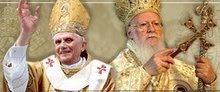
This was the main point of the homilies of Orthodox Patriarch Bartholomew I and Cardinal Walter Kasper, the president of the Pontifical Council for Promoting Christian Unity, during a joint celebration of the feast of St. Andrew on Sunday, L'Osservatore Romano reported today.
The patriarch of Constantinople recalled the meeting in Jerusalem between Pope Paul VI and then Patriarch Athenagoras I, which began the journey of dialogue between the two Churches.
He went on to refer to the brotherhood -- not only spiritual, but also physical, of the Apostles Peter and Andrew. This fact, he said, should be recalled by both Catholics and Orthodox so that both sides respect unity: "Because one cannot think of Peter and Andrew as separated."
"This bond between two apostles, which has a beginning of a biological nature, becomes also a spiritual legacy in the name of Our Lord and ends by constituting the link that unites the two Churches," the patriarch said.
He also affirmed: "It is necessary to cut the thorns that have wounded relations between the two Churches for a millennium, and take as a precious guide toward unity the spirit of the common tradition of the seven councils of the first millennium."
For his part, Cardinal Kasper declared that unity "is not an option, it is a duty to Our Lord."
The cardinal said after the visit that, though the path of dialogue between Orthodox and Catholics will not be short, it is coming along well, "because with the Orthodox, we have much in common."
Patriarch Points to Brotherhood of Peter and Andrew
ISTANBUL, Turkey, DEC. 2, 2008 (Zenit.org).- The social, political and economic crisis has an answer, Christian leaders say: the common path toward full union between the Catholic and Orthodox Churches.
This was the main point of the homilies of Orthodox Patriarch Bartholomew I and Cardinal Walter Kasper, the president of the Pontifical Council for Promoting Christian Unity, during a joint celebration of the feast of St. Andrew on Sunday, L'Osservatore Romano reported today.
The patriarch of Constantinople recalled the meeting in Jerusalem between Pope Paul VI and then Patriarch Athenagoras I, which began the journey of dialogue between the two Churches.
He went on to refer to the brotherhood -- not only spiritual, but also physical, of the Apostles Peter and Andrew. This fact, he said, should be recalled by both Catholics and Orthodox so that both sides respect unity: "Because one cannot think of Peter and Andrew as separated."
"This bond between two apostles, which has a beginning of a biological nature, becomes also a spiritual legacy in the name of Our Lord and ends by constituting the link that unites the two Churches," the patriarch said.
He also affirmed: "It is necessary to cut the thorns that have wounded relations between the two Churches for a millennium, and take as a precious guide toward unity the spirit of the common tradition of the seven councils of the first millennium."
For his part, Cardinal Kasper declared that unity "is not an option, it is a duty to Our Lord."
The cardinal said after the visit that, though the path of dialogue between Orthodox and Catholics will not be short, it is coming along well, "because with the Orthodox, we have much in common."
Wednesday, November 19, 2008
This story of conversion is simply mind-blowing
St. Thomas Aquinas, ora pro nobis!
Madrid, Nov 12, 2008 / 09:21 pm (CNA).- The Spanish daily “La Razon” has published an article on the pro-life conversion of a former “champion of abortion.” Stojan Adasevic, who performed 48,000 abortions, sometimes up to 35 per day, is now the most important pro-life leader in Serbia, after 26 years as the most renowned abortion doctor in the country.
“The medical textbooks of the Communist regime said abortion was simply the removal of a blob of tissue,” the newspaper reported. “Ultrasounds allowing the fetus to be seen did not arrive until the 80s, but they did not change his opinion. Nevertheless, he began to have nightmares.”
In describing his conversion, Adasevic “dreamed about a beautiful field full of children and young people who were playing and laughing, from 4 to 24 years of age, but who ran away from him in fear. A man dressed in a black and white habit stared at him in silence. The dream was repeated each night and he would wake up in a cold sweat. One night he asked the man in black and white who he was. ‘My name is Thomas Aquinas,’ the man in his dream responded. Adasevic, educated in communist schools, had never heard of the Dominican genius saint. He didn’t recognize the name” [woah....]
“Why don’t you ask me who these children are?” St. Thomas asked Adasevic in his dream.
“They are the ones you killed with your abortions,’ St. Thomas told him.
“Adasevic awoke in amazement and decided not to perform any more abortions,” the article stated.
“That same day a cousin came to the hospital with his four months-pregnant girlfriend, who wanted to get her ninth abortion—something quite frequent in the countries of the Soviet bloc. The doctor agreed. Instead of removing the fetus piece by piece, he decided to chop it up and remove it as a mass. However, the baby’s heart came out still beating. Adasevic realized then that he had killed a human being,” [Good Lord. How terrible, but how wonderfully the Holy Ghost indicted this man and converted him.]
After this experience, Adasevic “told the hospital he would no longer perform abortions. Never before had a doctor in Communist Yugoslavia refused to do so. They cut his salary in half, fired his daughter from her job, and did not allow his son to enter the university.” [bastards]
After years of pressure and on the verge of giving up, he had another dream about St. Thomas.
“You are my good friend, keep going,’ the man in black and white told him. Adasevic became involved in the pro-life movement and was able to get Yugoslav television to air the film ‘The Silent Scream,’ by Doctor Bernard Nathanson, two times.”
Adasevic has told his story in magazines and newspapers throughout Eastern Europe. He has returned to the Orthodox faith of his childhood and has studied the writings of St. Thomas Aquinas.
“Influenced by Aristotle, Thomas wrote that human life begins forty days after fertilization,” Adasevic wrote in one article. La Razon commented that Adasevic “suggests that perhaps the saint wanted to make amends for that error.” Today the Serbian doctor continues to fight for the lives of the unborn.
Tuesday, November 18, 2008
Today's readings: faith is not an experience or feeling, but an "obedience of the mind"


Today the Church celebrates : St. Rose Philippine, Feast of Basilicas of Sts. Peter & Paul
Book of Revelation 3,1-6.14-22.
"To the angel of the church in Sardis, write this: " 'The one who has the seven spirits of God and the seven stars says this: "I know your works, that you have the reputation of being alive, but you are dead. Be watchful and strengthen what is left, which is going to die, for I have not found your works complete in the sight of my God. Remember then how you accepted and heard; keep it, and repent. If you are not watchful, I will come like a thief, and you will never know at what hour I will come upon you. However, you have a few people in Sardis who have not soiled their garments; they will walk with me dressed in white, because they are worthy. " '"The victor will thus be dressed in white, and I will never erase his name from the book of life but will acknowledge his name in the presence of my Father and of his angels. " '"Whoever has ears ought to hear what the Spirit says to the churches."' "To the angel of the church in Laodicea, write this: " 'The Amen, the faithful and true witness, the source of God's creation, says this: "I know your works; I know that you are neither cold nor hot. I wish you were either cold or hot. So, because you are lukewarm, neither hot nor cold, I will spit you out of my mouth. For you say, 'I am rich and affluent and have no need of anything,' and yet do not realize that you are wretched, pitiable, poor, blind, and naked. I advise you to buy from me gold refined by fire so that you may be rich, and white garments to put on so that your shameful nakedness may not be exposed, and buy ointment to smear on your eyes so that you may see. Those whom I love, I reprove and chastise. Be earnest, therefore, and repent. " '"Behold, I stand at the door and knock. If anyone hears my voice and opens the door, (then) I will enter his house and dine with him, and he with me. I will give the victor the right to sit with me on my throne, as I myself first won the victory and sit with my Father on his throne. " '"Whoever has ears ought to hear what the Spirit says to the churches."'"
Psalms 15(14),2-3.3-4.5.
Whoever walks without blame, doing what is right, speaking truth from the heart;
Who does not slander a neighbor, does no harm to another, never defames a friend;
Who does not slander a neighbor, does no harm to another, never defames a friend;
Who disdains the wicked, but honors those who fear the LORD; Who keeps an oath despite the cost,
lends no money at interest, accepts no bribe against the innocent. III Whoever acts like this shall never be shaken.
Holy Gospel of Jesus Christ according to Saint Luke 19,1-10.
He came to Jericho and intended to pass through the town. Now a man there named Zacchaeus, who was a chief tax collector and also a wealthy man, was seeking to see who Jesus was; but he could not see him because of the crowd, for he was short in stature. So he ran ahead and climbed a sycamore tree in order to see Jesus, who was about to pass that way. When he reached the place, Jesus looked up and said to him, "Zacchaeus, come down quickly, for today I must stay at your house." And he came down quickly and received him with joy. When they all saw this, they began to grumble, saying, "He has gone to stay at the house of a sinner." But Zacchaeus stood there and said to the Lord, "Behold, half of my possessions, Lord, I shall give to the poor, and if I have extorted anything from anyone I shall repay it four times over." And Jesus said to him, "Today salvation has come to this house because this man too is a descendant of Abraham. For the Son of Man has come to seek and to save what was lost."
Copyright © Confraternity of Christian Doctrine, USCCB
Commentary of the day :
Blessed Jan van Ruusbroec (1293-1381), Canon Regular
A Mirror of eternal blessedness (©Classics of Western Spirituality)
"Today I must stay at your house"
Some people are very like Zacchaeus. They desire to see Jesus as he is. All power of reason and all natural light are too short and small for this, so they run ahead of all crowds and all the multiplicity of creatures. Through faith and love they climb up to the highest part of their mind, where their spirit lives in its freedom, devoid of images and obstacles. It is there that Jesus is seen, known, and loved in his divinity, for there he is always present to the free and exalted spirit which has risen above itself in love of him. Jesus there flows forth with a fullness of grace and favors.
But he says to all: "Come down quickly, for the exalted freedom of the spirit cannot be maintained except through lowly obedience of mind. You must know and love me as both God and a human being, higher than all and lower than all. You will savor me when I raise you up above all things and above yourself to myself, and when you lower yourself beneath all things and beneath yourself to me and for my sake. Then I will have to come to your house and remain living with you and in you, and you with me and in me."
When these persons know, taste, and feel this, they come down quickly in great disdain of themselves, and with a humble heart and true displeasure over their life and all their works they say: "Lord, I am not worthy-but am truly unworthy-that I should receive your glorious body in the blessed Sacrament into the sinful house of my body and soul. But be gracious to me, Lord, and have mercy on my poor life and all my transgressions."
Monday, November 10, 2008
Feast of St. Leo the Great
An article written by Father Z.
Attila the Hun, aka the Scourge of God, was ravaging the lands. In the 440’s the western part of the Empire was disintegrating. Burgundians had invaded Gaul but were driven off by the powerful general Aetius. In 439 Geiseric conquered Carthage in North Africa. In 441 he defeated a Roman force sent against him. The West was suffering from a critical shortage of military manpower and they were beset everywhere (sound familiar?). In 450 the Eastern Emperor Marcian cancelled the annual bribe to the Huns, which the Huns did not find amusing. It happened that the Emperor Valentinian III was trying marry off his sister, Justa Grata Honoria, to an elderly dignitary. She had other ideas. Honoria sent a ring to Attila, King of the Huns. Attila took this as an offer of marriage and demanded half the Western Empire as a dowry. He then invaded Gaul. In 451 near modern Châlons, the general Aetius defeated Attila who, instead of withdrawing back into Germany, moved into defenseless Italy in 452. Aetius was unable to stop him. The Huns sacked Milan, destroyed Aquileia, began to march on Rome. Nothing stood in Attila’s way.
In living memory Rome had been sacked in 410 by Alaric the Visigoth. You can still see coins from fused into the marble floor of the Basilica Aemilia in the Roman Forum. The Sack of Rome had a more profound impact on the Romans throughout the West than 9/11 had on the USA and its allies. In fact, the year 410 in part provided St. Augustine of Hippo with the inspiration to write The City of God, which changed the course of Western civilization. However, in the 450’s, Italy was nearly prostrate and no army could rescue Italy from Attila the Hun. The only figure of any prestige in Italy at the time was the Pope of Rome, Leo. Leo rode north from Rome with a small group of followers and met with Attila before he could reach City and pillage it. They had a private conversation, legend has it. We have no idea what Leo said to the Hunnish King, but immediately thereafter Attila turned his army around, left Italy.
In the Vatican Basilica of St. Peter, in the “Cappella della Colonna” we see the tomb and altar of St. Pope Leo the Great. Over the tomb is a marble relief by Alessandro Algardi (made in 1646-50) depicting the moment of the colloquium of the Saint and the Scourge. Attila is reeling backward from the sight of the menacing and heavily armed Sts. Peter and Paul swooping down from heaven behind Leo’s shoulder. A frowning Peter points authoritatively at Leo while the glowering Paul is aiming his finger in a classic “scram” signal. In 453 (the year Leo gave the sermon that influenced our prayer this week) Attila was heading back through Eastern Europe in preparation for another assault on the Byzantines. He set up camp so that he could get married, drank himself unconscious and promptly did everyone a favor by drowning in his own blood from a nosebleed. Attila’s empire fell apart almost at once and the Hunnish menace dissipated as swiftly as it had arisen. All this in 453 when Leo said: “Beloved, promptly expressing this profession of faith with your whole heart, spew out the impious comments of the heretics, so that your fasting and almsgiving may be polluted by the contagion of no errors. For then both the offering of sacrifice and the holy bestowing of mercy is clean.”
Tuesday, November 4, 2008
Pius XII, the Miracle of the sun, & The Assumption of Mary


Does a pope use 'papal infallibly' at his whim? Indeed, not! Why Pius XII was confirmed in declaring the Dogma of the Assumption of Mary.
Pius XII Saw "Miracle of the Sun"
Handwritten Note Reveals Pope's Experience
By Antonio Gaspari
ROME, NOV. 4, 2008 (Zenit.org).- According to his own testimony, the Pope who declared the dogma of the Assumption saw the "miracle of the sun" four times.
This information is confirmed by a handwritten, unpublished note from Pope Pius XII, which is part of the "Pius XII: The Man and the Pontificate" display. The display opened in the Vatican to the public today and will run through Jan. 6.
A commissioner of the display and a Vatican reporter for the Italian daily Il Giornale, Andrea Tornielli, explained to ZENIT that the note was found in the Pacelli family archives. It describes the "miracle of the sun," an episode that until today had only been affirmed by the indirect testimony of Cardinal Federico Tedeschini (1873-1959), who recounted in a homily that the Holy Father had seen the miracle.
Pius XII wrote, "I have seen the 'miracle of the sun,' this is the pure truth."
The miracle of the sun is most known as the episode that occurred in Fatima, Portugal, on Oct. 13, 1917. According to the Fatima visionaries, Mary had said there would be a miracle that day so that people would come to believe. Thousands had gathered at the site of the visions, and the sun "danced," reportedly drying instantaneously the rain-soaked land and spectators.
Confirming the dogma
Pius XII's note says that he saw the miracle in the year he was to proclaim the dogma of the Assumption, 1950, while he walked in the Vatican Gardens.
He said he saw the phenomenon various times, considering it a confirmation of his plan to declare the dogma.
The papal note says that at 4 p.m. on Oct. 30, 1950, during his "habitual walk in the Vatican Gardens, reading and studying," having arrived to the statue of Our Lady of Lourdes, "toward the top of the hill […] I was awestruck by a phenomenon that before now I had never seen."
"The sun, which was still quite high, looked like a pale, opaque sphere, entirely surrounded by a luminous circle," he recounted. And one could look at the sun, "without the slightest bother. There was a very light little cloud in front of it."
The Holy Father's note goes on to describe "the opaque sphere" that "moved outward slightly, either spinning, or moving from left to right and vice versa. But within the sphere, you could see marked movements with total clarity and without interruption."
Pius XII said he saw the same phenomenon "the 31st of October and Nov. 1, the day of the definition of the dogma of the Assumption, and then again Nov. 8, and after that, no more."
The Pope acknowledged that on other days at about the same hour, he tried to see if the phenomenon would be repeated, "but in vain -- I couldn't fix my gaze [on the sun] for even an instant; my eyes would be dazzled."
Pius XII spoke about the incident with a few cardinals and close collaborators, such that Sister Pascalina Lehnert, the nun in charge of the papal apartments, declared that "Pius XII was very convinced of the reality of the extraordinary phenomenon, which he had seen on four occasions."
Son of Our Lady
Tornielli told ZENIT that there was always a close link between the life of Eugenio Pacelli and the mystery of the Virgin Mary.
"Since childhood," he said, "Eugenio Pacelli was devoted [to Our Lady] and was registered in the Congregation of the Assumption, which had a chapel close to the Church of Jesus. A devotion that seemed prophetic, since he would be precisely the one to declare the dogma of the Assumption in 1950."
The future Pope celebrated his first Mass on April 3, 1899, at the altar of the icon of Mary "Salus Populi Romani" in the Basilica of St. Mary Major. "And then," Tornielli continued, "Eugenio Pacelli received episcopal ordination from Pope Benedict XV in the Sistine Chapel on May 13, 1917, the day of the first apparition of the Virgin of Fatima."
As Pope, in 1940, he approved the Fatima apparitions, and in 1942, consecrated the entire world to the Immaculate Heart of Mary.
As well, Pius XII often spoke with Sister Lucia, the visionary of Fatima, and he asked her to transcribe the messages she received from the Virgin. He thus became the first Pope to know the "third secret of Fatima," which Pope John Paul II would later make public.
Friday, October 31, 2008
Latest Old Books Club discussion...

We've been reading "Hymns on Paradise" by St. Ephrem the Syrian.
This, again, is an ecumenical book club. Some interesting topics covered.
Here's a snapshot of our discussion:
I responded....
(1) Ephrem as a Catholic & Orthodox Father
One thing that I forgot to bring up during our great discussion on Wednesday night was the fact that Ephrem is both part of the Patrimony of the Catholic and Orthodox Churches. When discussing the "intermediate state" theory posited by Ephrem, the discussion seemed to follow a line that this was a great idea and one that was outside the thinking of the Catholic Church. I would simply point out that all of the Fathers we are reading are within both Traditions, respectively.
(2) O Happy Fault (Felix Culpa)
A decent explanation from Wikipedia...
Felix culpa is a Latin phrase that literally translated means a "blessed fault" or "fortunate fall". As a religious term it refers to Adam and Eve's fall and the loss of the Garden of Eden, known theologically as the source of original sin. The phrase is sung annually in the Exsultet of the Easter Vigil: "O felix culpa quae talem et tantum meruit habere redemptorem," "O happy fault that merited such and so great a Redeemer." The medieval theologian Thomas Aquinas cited this line when he explained how the principle that "God allows evils to happen in order to bring a greater good therefrom" (not to say that it ought or needs to happen) underlies the causal relationship between original sin and the Divine Redeemer's Incarnation.
The phrase "Oh happy fault!" is used in colloquial English, especially among literary intellectuals.
In a literary context, the term "felix culpa" can be used to describe how a series of miserable events will eventually lead to a happier outcome. The theological concept is one of the underlying themes of Raphael Carter's science fiction novel The Fortunate Fall; the novel's title is explicitly derived from the Latin phrase. John Milton also invokes ideas of felix culpa in his epic poem Paradise Lost.
Mike chimes in... So, ultimately, the main point is this: felix culpa is from a beautiful song sung during the epic Easter Vigil mass at midnight... it is not any sort of theological maxim or hermeneutic by which Catholics operate. It does however say something profound about the faith that we have in God to transform such a calamity as Original Sin in such a powerful, redemptive manner, renewing the face of the earth.
(3) Intermediate State/Sanctification or 'being clothed in Glory' w/o Original Sin
I would actually like to couple this with a side remark made by Tim yesterday about Marian devotion, specifically the Immaculate Conception. Let me retrace some steps first. Again, Ephrem was positing that Original Sin did not need to occur; the Tree was a 'test' so to speak, and God wanted Adam and Eve to use their radical freedom for the good. If they were to choose righteously and faithfully (not eat the fruit), then they would have (without 'needing' to sin) been 'clothed in Glory' and essentially been given the graces won through Christ on the Cross without all the suffering and death. We all seemed to like and be intrigued by this idea.
Ok, here's the move...
If Adam and Eve were created in an intermediate state (not Glorified, not fallen, yet created in God's image) then couldn't God also create another human (if He so wished) in such an 'intermediate state'? Could He not create, say the Mother of His Divine Son, in this 'intermediate state'? Clearly the roots of the idea behind the Immaculate Conception are within such a doctrine. This is precisely what the Catholic Church teaches on this manner; Mary, set aside for the specific mission of bearing the Son of Man, could not have been born with Original Sin, thus God in all His Omnipotence created her in an 'immaculate state/intermediate state'. She still had radical freedom just like Eve, but not the 'concupiscence' or tendency of fallenness to sin. That's why there's all these Patristic references to Mary as the "new Eve". Hence, when Gabriel announced to her the great task of bearing the Son of God, she was able to answer with a resounding "Let it be done to me according to they will!". Hence, the great Archangel's response: "Hail, full of grace, the Lord is with thee."
The Immaculate Conception, contrary to common belief, is not a new idea. It was discussed even in the time of Thomas Aquinas in the 11th century. The Orthodox, and Aquinas, reject the idea because in those days most believed that the soul did not "quicken" the body at conception, but ensouled the fetus/embryo 40 days later. This was even posited by Augustine in the 4th century. Aquinas openly rejected the theological idea being debated even way back then. Orthodox theology, like Catholicism, developed from Pentecost until around the 10th or 11th century; then, in my interpretation, it became ossified and static, though still quite rich. The Catholic Church, after the schism, still continued the thoughtful, prayerful, and slow 'development of doctrine', for it is like a seed, growing and revealing more to us. Theology is not static. As we know now via science, the embryo is 'kicking' almost at conception, and most would now say that the ancient/medieval idea of 'quickening' was wrong. The body clearly appears to be ensouled at conception, the cornerstone of pro-life teaching.
Thus, it is not extraordinary that 800 years later (after Aquinas et al.) the pope proclaimed it a dogma of Mary, divinely revealed (Immaculate Conception 1854; Assumption of Mary 1950... Orthodox 'dormition' is essentially the same= Matt, correct me on this if necessary!).
Also, the Catholic Church, through the exercise of God given reason and Divine Revelation, thinks about, prays about, and asks God for his assistance in such matters of faith and morals. The Church believes that Peter and his papal successors have the "keys of the Kingdom" to "bind and loose" guided infallibly by the Holy Ghost. God is in fact the authority behind such a declaration. Keep in mind there have really only been 6 major 'infallible statements' made by popes throughout the ages; it is not a power-play as is typically believed.
Here they are:
* "Tome to Flavian", Pope Leo I, 449, on the two natures in Christ, received by the Council of Chalcedon;
* Letter of Pope Agatho, 680, on the two wills of Christ, received by the Third Council of Constantinople;
* Benedictus Deus, Pope Benedict XII, 1336, on the beatific vision of the just prior to final judgment;
* Cum occasione, Pope Innocent X, 1653, condemning five propositions of Jansen as heretical;
* Auctorem fidei, Pope Pius VI, 1794, condemning seven Jansenist propositions of the Synod of Pistoia as heretical;
* Ineffabilis Deus, Pope Pius IX, 1854, defining the immaculate conception; and
* Munificentissimus Deus, Pope Pius XII, 1950, defining the assumption of Mary.
(This is from Wikipedia, and seems correct, so don't take this as 'dogma'... ha, ha, ha.)
In conclusion, the theological groundwork is within Ephrem for such a dogma of Mary via the 'intermediate state' doctrine.
What say you fellas on all these matters?
One fellow, currently attending a High Anglican parish, replied:
Hmmm, on part 3-- that is an interesting move, which I will consider.
This whole "intermediate state" is all new to my thinking, so I'm
still processing it, but you propose an interesting twist. It is
possible that it begins to work toward a resolution of my major
objection--an objection that I thought otherwise could only be dealt
with by a very mystical explanation of the nature of kairos v chronos.
(Are these the right terms?)
I am aware that the germs of some of the modern innovations in Marian
theology have been around for some considerable time, but to my
curmudgeonly anti-modern sensibility, it still seems all too
innovative for me.
On 2, my hesitation is that the phrase could possibly be seen as
trying to make the fall less bad than it was. Maybe this phrase and
the hymn, properly understood, do not do this. But the idea could
easily lead some in that direction. (Similarly--and I don't think you
object to any of this--Death is truly bad, a result of the fall.
Christ's conquest of death does not make death not-bad, but rather
conquered. It is a mistake, then, to think that because of Christ,
death can be a good thing in itself. I think a similar thing could
happen with this fortunate fall idea.)
On 1, yes, of course, pre-schism.
Another friend, newly converted to Orthodoxy, also said he found the connection of Immaculate Conception and St. Ephrem's 'intermediate state' interesting.
Good stuff...
Tuesday, October 28, 2008
Feast of St. Jude - my patron

Today's readings and a nice reflection from Pope Benedict XVI.
Letter to the Ephesians 2,19-22.
So then you are no longer strangers and sojourners, but you are fellow citizens with the holy ones and members of the household of God, built upon the foundation of the apostles and prophets, with Christ Jesus himself as the capstone. Through him the whole structure is held together and grows into a temple sacred in the Lord; in him you also are being built together into a dwelling place of God in the Spirit.
Psalms 19(18),2-3.4-5.
The heavens declare the glory of God; the sky proclaims its builder's craft.
One day to the next conveys that message; one night to the next imparts that knowledge.
There is no word or sound; no voice is heard;
Yet their report goes forth through all the earth, their message, to the ends of the world. God has pitched there a tent for the sun;
Holy Gospel according to Saint Luke 6,12-16.
In those days he departed to the mountain to pray, and he spent the night in prayer to God. When day came, he called his disciples to himself, and from them he chose Twelve, whom he also named apostles: Simon, whom he named Peter, and his brother Andrew, James, John, Philip, Bartholomew, Matthew, Thomas, James the son of Alphaeus, Simon who was called a Zealot, and Judas the son of James, and Judas Iscariot, who became a traitor.
Commentary of the day :
Pope Benedict XVI
General Audience of 03/05/2006 (©Libreria Editrice Vaticana)
"He called his disciples to himself, and from them he chose Twelve, whom he also named apostles"
The apostolic Tradition is not a collection of things or words, like a box of dead things. Tradition is the river of new life that flows from the origins, from Christ down to us, and makes us participate in God's history with humanity. This topic of Tradition... is of great importance for the life of the Church. The Second Vatican Council pointed out in this regard that Tradition is primarily apostolic in its origins: "God graciously arranged that the things he had once revealed for the salvation of all peoples should remain in their entirety, throughout the ages, and be transmitted to all generations. Therefore, Christ the Lord, in whom the entire Revelation of the Most High God is summed up (2Cor 1,20; and 3,16-4, 6), commanded the Apostles to preach the Gospel and communicate the gifts of God to all men. This Gospel was to be the source of all saving truth and moral discipline" (Dogmatic Constitution on Divine Revelation 'Dei Verbum', n. 7). The Council noted further that this was faithfully done "by the Apostles who handed on, by the spoken word of their preaching, by the example they gave, by the institutions they established, what they themselves had received - whether from the lips of Christ, from his way of life and his works, or whether they had learned it at the prompting of the Holy Spirit" The Council adds that there were "other men associated with the Apostles, who, under the inspiration of the same Holy Spirit, committed the message of salvation to writing".
As heads of the eschatological Israel, and likewise as Twelve, the number of the tribes of the Chosen People, the Apostles continued the "gathering" begun by the Lord and did so first and foremost by transmitting faithfully the gift received, the Good News of the Kingdom that came to people in Jesus Christ. Their number not only expresses continuity with the holy root, the Israel of the twelve tribes, but also the universal destination of their ministry, which brought salvation to the very ends of the earth. This can be understood from the symbolic value that the numbers have in the Semitic world: twelve results from the multiplication of three, a perfect number, and four, a number that refers to the four cardinal points, hence, to the whole world.
Wednesday, October 22, 2008
On Paul's Christology

"The Radical Humility of Christ Is the Expression of Divine Love"
VATICAN CITY, OCT. 22, 2008 (Zenit.org).- Here is a translation of the address Benedict XVI delivered during today's general audience in St. Peter's Square.
The Holy Father continued today the cycle of catecheses dedicated to the figure and thought of St. Paul.
* * *
Dear brothers and sisters:
In the catecheses from previous weeks, we have meditated on the "conversion" of St. Paul, fruit of a personal encounter with the crucified and risen Christ, and we have asked ourselves about the reaction of the Apostle to the Gentiles to the earthly Jesus. Today I would like to speak of the teaching St. Paul left us about the centrality of the risen Christ in the mystery of salvation, about his Christology.
In reality, the risen Jesus Christ, "exalted above every name," is at the center of all his reflections. Christ is for the Apostle the standard to evaluate events and things, the purpose of every effort that he makes to announce the Gospel, the great passion that sustains his steps along the paths of the world. And he is a living Christ, concrete: The Christ, Paul says, "who loved me and gave himself up for me" (Galatians 2:20). This person who loves me, with whom I can speak, who listens and responds to me, this is really the principle for understanding the world and for finding the way in history.
Anyone who has read the writings of St. Paul knows well that he does not concern himself with narrating the events that made up the life of Christ, even though we can imagine that in his catecheses, he recounted much more about the pre-Easter Jesus than what he wrote in his letters, which are admonitions for concrete situations. His pastoral and theological work was so directed toward the edification of the nascent communities, that it was natural for him to concentrate everything on the announcement of Jesus Christ as "Lord," alive today and present among his own.
Here we see the essentiality that is characteristic of Pauline Christology, which develops the depths of the mystery with a constant and precise concern: To announce, with certainty, Jesus and his teaching, but to announce above all the central reality of his death and resurrection as the culmination of his earthly existence and the root of the successive development of the whole Christian faith, of the whole reality of the Church.
For the Apostle, the Resurrection is not an event in itself that is separated from the Death. The risen One is the same One who was crucified. The risen One also had his wounds: The Passion is present in him and it can be said with Pascal that he is suffering until the end of the world, though being the risen One and living with us and for us. Paul had understood on the road to Damascus this identification of the risen One with Christ crucified: In that moment, it was revealed with clarity that the Crucified is the risen One and the risen One is the Crucified, who says to Paul, "Why do you persecute me?" (Acts 9:4). Paul was persecuting Christ in the Church and then understood that the cross is "a curse of God" (Deuteronomy 21:23), but a sacrifice for our redemption.
The Apostle contemplates with fascination the hidden secret of the crucified-risen One, and through the sufferings endured by Christ in his humanity (earthly dimension) arrives to this eternal existence in which he is one with the Father (pre-temporal dimension): "But when the fullness of time had come," he writes, "God sent his Son, born of a woman, born under the law, to ransom those under the law, so that we might receive adoption" (Galatians 4:4-5).
These two dimensions -- the eternal pre-existence with the Father and the descent of the Lord in the incarnation -- are already announced in the Old Testament, in the figure of Wisdom. We find in the wisdom literature of the Old Testament certain texts that exalt the role of Wisdom pre-existent to the creation of the world. In this sense, you can see passages such as Psalm 90: "Before the mountains were born, the earth and the world brought forth, from eternity to eternity you are God" (verse 2). Or passages such as those that speak of creating Wisdom: "The Lord begot me, the firstborn of his ways, the forerunner of his prodigies of long ago; From of old I was poured forth, at the first, before the earth" (Proverbs 8:22-23). Indicative as well is the praise of Wisdom, contained in the book by that name: "Indeed, she reaches from end to end mightily and governs all things well" (Wisdom 8:1).
The same wisdom texts that speak of the eternal pre-existence of Wisdom also speak of its descent, of the abasement of this Wisdom, which has made for itself a tent among men. Thus we can already feel resonate the words from the Gospel of John that speak of the tent of the flesh of the Lord. A tent was created in the Old Testament: Here is indicated the temple, worship according to the "Torah"; but from the point of view of the New Testament, we can understand that this was only a pre-figuration of the much more real and significant tent: the tent of the flesh of Christ.
And we already see in the books of the Old Testament that this abasement of Wisdom, its descent into flesh, also implies the possibility of being rejected. St. Paul, developing his Christology, refers precisely to this wisdom perspective: He recognizes in Jesus the eternal Wisdom existing from all time, the Wisdom that descends and creates a tent among us, and thus he can describe Christ as "the power of God and the wisdom of God." He can say that Christ has become for us "wisdom from God, as well as righteousness, sanctification, and redemption" (1 Corinthians 1:24, 30). In the same way, Paul clarifies that Christ, like Wisdom, can be rejected above all by the rulers of this age (cf. 1 Corinthians 2:6-9), such that in the plans of God a paradoxical situation is created: the cross, which will become the path of salvation for the whole human race.
A later development to this wisdom cycle, which sees Wisdom abase itself so as to be later exalted despite rejection, is found in the famous hymn in the Letter to the Philippians (cf. 2:6-11). This involves one of the most elevated texts of the New Testament. Exegetes mainly concur in considering that this pericope was composed prior to the text of the Letter to the Philippians. This is an important piece of information, because it means that Judeo-Christianity, before St. Paul, believed in the divinity of Jesus. In other words, faith in the divinity of Christ is not a Hellenistic invention, arising after the earthly life of Christ, an invention that, forgetting his humanity, had divinized him. We see in reality that the early Judeo-Christianity believed in the divinity of Jesus. Moreover, we can say that the apostles themselves, in the great moments of the life of the Master, had understood that he was the Son of God, as St. Peter says at Caesarea Philippi: "You are the Messiah, the Son of the living God" (Matthew 16:16).
But let us return to the hymn from the Letter to the Philippians. The structure of this text can be articulated in three stanzas, which illustrate the principle moments of the journey undertaken by Christ. His pre-existence is expressed with the words: "though he was in the form of God, [he] did not regard equality with God something to be grasped" (verse 6). Afterward follows the voluntary abasement of the Son in the second stanza: "he emptied himself, taking the form of a slave" (verse 7) "he humbled himself, becoming obedient to death, even death on a cross" (verse 8). The third stanza of the hymn announces the response of the Father to the humiliation of the Son: "Because of this, God greatly exalted him and bestowed on him the name that is above every name" (verse 9).
What is impressive is the contrast between the radical abasement and the resulting glorification in the glory of God. It is evident that this second stanza contrasts with the pretension of Adam, who wanted to make himself God, and it contrasts as well with the actions of the builders of the Tower of Babel, who wanted to construct for themselves a bridge to heaven and make themselves divine. But this initiative of pride ended with self-destruction: In this way, one doesn't arrive to heaven, to true happiness, to God. The gesture of the Son of God is exactly the contrary: not pride, but humility, which is the fulfillment of love, and love is divine. The initiative of abasement, of the radical humility of Christ, which contrasts with human pride, is really the expression of divine love; from it follows this elevation to heaven to which God attracts us with his love.
Besides the Letter to the Philippians, there are other places in Pauline literature where the themes of the pre-existence and the descent of the Son of God to earth are united. A reaffirmation of the assimilation between Wisdom and Christ, with all its cosmic and anthropological consequences, is found in the First Letter to Timothy: "[He] was manifested in the flesh, vindicated in the spirit, seen by angels, proclaimed to the Gentiles, believed in throughout the world, taken up in glory" (3:16). It is above all based on these premises that the function of Christ as mediator could be better defined, within the framework of the only God of the Old Testament (cf. 1 Timothy 2:5 in relation to Isaiah 43:10-11; 44:6). Christ is the true bridge who leads us to heaven, to communion with God.
And finally, just a point regarding the last developments of the Christology of St. Paul in the Letters to the Colossians and the Ephesians. In the first, Christ is designated as the "firstborn of all creation" (1:15-20). This word "firstborn" implies that the first among many children, the first among many brothers and sisters, has lowered to draw us and make us brothers and sisters. In the Letter to the Ephesians, we find the beautiful exposition of the divine plan of salvation, when Paul says that in Christ, God wanted to recapitulate all things (cf. Ephesians 1:23). Christ is the recapitulation of everything, he takes up everything and guides us to God. And thus is implied a movement of descent and ascent, inviting us to participate in his humility, that is, in his love for neighbor, so as to thus be participants in his glorification, making ourselves with him into sons in the Son. Let us pray that the Lord helps us to conform ourselves to is humility, to his love, to thus be participants in his divinization.
[Translation by ZENIT]
Cardinal Newman: Doctor of the Church?

Father Ian Ker on the Priest’s Cause, Teachings
BURFORD, England, OCT. 22, 2008 (Zenit.org).- Did Cardinal John Henry Newman pick up where St. Bernard left off?
Father Ian Ker thinks so; he claims that reading Cardinal Newman is like reading the great Church Fathers.
The expert on Cardinal Newman and professor of theology at Oxford University shared with ZENIT how the venerable Oratorian was a pioneer in the renewal of theology, anticipated the Second Vatican Council and was a writer of great faith.
Q: Why has the momentum suddenly increased for Cardinal Newman’s cause for canonization during Benedict XVI’s pontificate? What is the Holy Father’s interest in Cardinal Newman?
Father Ker: Although Newman worked as an ordinary parish priest among the very poor in inner city Birmingham when he began the Oratory there, and later in the more salubrious suburb of Edgbaston where the Oratory was finally established and where he continued to carry out ordinary parish duties, his main work lay in his intellectual apostolate and writings.
So, although known locally to be a holy man, there was never the kind of popular cult that a less intellectual figure -- working, for example, among the poor or the sick or on the foreign missions -- would have inspired.
The momentum for his canonization in fact began some years before the present pontificate. Previously, the people interested in Newman were mainly scholars and theologians, the kind of people who are not necessarily particularly committed to intercessory prayer.
But once the cause was fully launched -- and there had been long delays -- it was possible to undertake a formal examination of his life and writings and conclude that he was indeed a man of heroic sanctity and worthy of being raised to the altars of the Church.
With this verdict the Holy See concurred and in 1991 Pope John Paul II declared Newman to be “Venerable,”’ the first step toward canonization. That development has led more and more people to ask Newman for his intercession and -- assuming Newman is a saint -- was bound sooner or later to lead to a miracle.
Benedict XVI became interested in Newman while at the seminary through the interest of one of his teachers. And, of course, he would have been aware as a theologian that Newman was a great pioneer in the renewal of theology.
Q: Cardinal Newman was certainly a great theologian and Church historian, but what is it about his writings that make him worthy of being elevated to the status of doctor of the Church?
Father Ker: Newman is more than simply a very learned and clever thinker. Indeed, it has been said that he took over where St Bernard left off.
Anyone reading his writings cannot but be aware that reading Newman is like reading the great Church Fathers. In his writings we encounter a writer of profound faith.
Q: Why is Cardinal Newman known as the "father of the Second Vatican Council?"
Father Ker: In the 1830s in Oxford, Newman and his fellow Tractarians launched a forerunner of the movement of “ressourcement,” [which arose] in France a hundred years later.
It was this return to the scriptural and patristic sources that made possible the theology of Vatican II.
Newman most clearly anticipated the Council in his theory of doctrinal development and his personalist understanding of revelation (Constitution on Divine Revelation), his stress on the role of the laity and more fundamentally his understanding of the Church as communion (Constitution on the Church), his sense of the need for the Church to engage with the modern world and to abandon the siege mentality (Constitution on the Modern World), and his cautious support for ecumenism in its early days (Decree on Ecumenism).
Q: Many traditionalists are skeptical of Cardinal Newman and believe he is a stalking horse for modernism because of his ideas regarding the “development of doctrine” and his statements regarding the role of conscience. In his day he was deemed a liberal, but Russell Kirk featured him in a book titled “The Conservative Mind.” Why is Cardinal Newman so controversial and misunderstood?
Father Ker: Cardinal Newman is most obviously misunderstood because of the common misinterpretation of his account of the relation of conscience to Church authority. Newman never envisaged so-called conscientious dissent from Church teachings.
What he did envisage was the possibility of a person conscientiously resisting an order from higher authority. His theory of development is no longer controversial but is part of mainstream theology and indeed is actually echoed in Vatican II’s Constitution on Divine Revelation.
In his own day, Newman was indeed a radical in his thinking because he was ahead of his times as I mentioned earlier in this interview. But he was never a liberal in the sense in which we use the word today, but was always deeply loyal to the tradition and the teachings of the Church.
Q: Cardinal Newman famously said that to be steeped in history is to cease to be Protestant, yet he was not known to be triumphalistic. What counsel might he give to Anglicans today, as well as to Catholics participating in ecumenical conversations with Anglicans?
Father Ker: By the end of his life Newman came to believe that Anglicans were “giving up everything.” That process is now considerably advanced, and my view is that Newman would not regard as Christian in any meaningful sense large swathes of Western Anglicanism.
But long before that he was clear that any kind of corporate reunion with a body as disparate and divided as Anglicanism was totally impossible.
I believe that today he would warmly support any efforts to help disaffected high Anglicans enter the Catholic Church -- the idea that they should stay and try and leaven the lump he would regard as completely fanciful and unrealistic.
I think he would encourage dialogue with Evangelicals generally, not only in Anglicanism, and would not be surprised by the many conversions that have taken place since the reforms of Vatican II.
Q: What does Cardinal Newman’s decision to join the Oratory of St. Philip Neri tell us about his spiritual and devotional life? Why not the Jesuits or Dominicans, both of whom had strong reputations for fostering theological scholarship?
Father Ker: Newman joined the Oratory of St Philip Neri partly in order to remain with his former Anglican community at Littlemore; partly because he did not find himself particularly attracted to any of the orders; partly because being already middle-aged he did not wish to begin again as it were, but rather to pursue continuity of his life as a secular priest living in community; and partly because his life at Oxford had always combined pastoral with academic work, a combination that he saw as typical of the Oratory.
BXVI homily on Pius XII
Pope's Homily on Pius XII
"Sanctity Was His Ideal"
VATICAN CITY, OCT. 9, 2008 (Zenit.org).- Here is a translation of the homily given by Benedict XVI at a Mass said in St. Peter's today in memory of the death of Pius XII on the 50th anniversary of his death.
* * *
"Sanctity Was His Ideal"
VATICAN CITY, OCT. 9, 2008 (Zenit.org).- Here is a translation of the homily given by Benedict XVI at a Mass said in St. Peter's today in memory of the death of Pius XII on the 50th anniversary of his death.
* * *
Cardinals,
Venerable Brothers in the Episcopate and Priesthood,
Dear Brothers and Sisters!
The passage from the Book of Syracide and the prologue from the First Letter of Saint Peter, proclaimed as the first and second reading, offer significant points for reflection in this Eucharistic celebration, during which we remember my venerable predecessor, the Servant of God Pius XII. Exactly fifty years have passed since the time of his death, which occurred in the first hours of October 9 1958. The Syracide, as we heard, reminded those who wish to follow the Lord that they must prepare themselves to face new trials, difficulties and suffering. To not be overcome by these -- he admonishes -- one needs a righteous and constant heart, faithfulness to God and patience united to an inflexible determination in continuing on the path of good. Suffering sharpens the heart of the Lord's disciple, just as gold is purified in the furnace. The sacred author writes: "Whatever happens to you, accept it, and in the uncertainties of your humble state, be patient, since gold is tested in the fire, and the chosen in the furnace of humiliation" (2:4).
On his part, Saint Peter in the pericope that was proposed to us, turning to the Christians of the communities of Asia Minor who "bear all sorts of trials", goes beyond this: he asks them to feel, despite all this, "great joy" (1 Pet 1:6). Proof is in fact necessary, he observes, "so that the worth of your faith, more valuable than gold, which is perishable even if it has been tested by fire, may be proved -- to your praise and honour when Jesus Christ is revealed" (1 Pet 1:7). And then, for the second time, he exhorts them to be joyous, rather exult "with a joy so glorious that it cannot be described" (see 1:8). The profound reason of this spiritual joy is the love for Jesus and the certainty of His invisible presence. He makes the believers' faith and hope unshakeable, even when faced with the most complicated and harsh events of existence.
In the light of these Biblical texts we can read about the earthly life of Pope Pacelli and his lengthy service to the Church, which began in 1901 under Leo XIII and continued with Saint Pius X, Benedict XV and Pius XI. These Biblical texts help us, above all, to understand which was the source he drew from for his courage and patience in his pontifical ministry, during the troubled years of World War II and the following ones, no less complex, of reconstruction and difficult international relationship of history called "the Cold War."
"Miserere mei Deus, secundum magnam misericordiam tuam": with this invocation from Psalm 50(51), Pius XII began his testament. And he continued: "These words, conscious of being unworthy and unequal, which I pronounced the moment I gave, trembling, my acceptance of the election as Supreme Pontiff, with greater conviction I repeat now." This was two years before his death. To abandon oneself in the hands of the merciful God: This was the attitude my venerable Predecessor constantly cultivated, the last of the Popes born in Rome and belonging to a family tied to the Holy See for many years.
In Germany, where he was the Apostolic Nuncio, first in Munich of Bavaria and then in Berlin until 1929, he left behind grateful memories, especially for having collaborated with Benedict XV in the attempt to stop the "useless slaughter" of the Great War, and for having realized from the beginning the danger of the monstrous Nazi-Socialist ideology with its pernicious anti-Semitic and anti-Catholic root. He was created a Cardinal in December 1929, and shortly after became the Secretary of State. For nine years he was a faithful collaborator of Pius XI, in a time marked by totalitarianism: Fascist, Nazi and Soviet Communism, all condemned by the encyclicals "Non Abbiamo Bisogno," "Mit Brennenbder Sorge" and "Divini Redemptoris."
"Whoever listens to my words, and believes in the one who sent me, has eternal life" (Jn 5:24). This assurance made by Jesus, which we have heard in the Gospel, makes us think back to the hardest moments of the Pontificate of Pius XII when, realizing the loss of any human security, he felt the need, even through constant ascetic effort, to belong to Christ, the only certainty that never sets. The Word of God thus becomes the light of his path, a path in which Pope Pacelli had to comfort the homeless and persecuted persons, dry the tears of suffering and the crying of so many victims of the war. Only Christ is the true hope of man; only entrusting the human heart to Him can it open up to love that overcomes hate. This knowledge followed Pius XII in his ministry as the Successor of Peter, a ministry that began when the menacing clouds of a new world conflict grew over Europe and the rest of the world, which he tried to avoid in all ways: He called out in his message on the radio on August 24 1939: The danger is imminent, but there is still time. Nothing is lost with peace. Everything can be lost with war" (AAS, XXXI, 1939, p. 334).
The war highlighted the love he felt for his "beloved Rome," a love demonstrated by the intense charitable work he undertook in defense of the persecuted, without any distinction of religion, ethnicity, nationality or political leanings. When, once the city was occupied, he was repeatedly advised to leave the Vatican to safeguard himself, his answer was always the same and decisive: "I will not leave Rome and my place, even at the cost of my life" (cf Summarium, p. 186). His relatives and other witnesses refer furthermore to privations regarding food, heating, clothes and comfort, to which he subjected himself voluntarily in order to share in the extremely trying conditions suffered by the people due to the bombardments and consequences of war (cf A. Tornielli, "Pio XII, Un uomo sul trono di Pietro"). And how can we forget his Christmas radio message of December 1942? In a voice breaking with emotion he deplored the situation of "the hundreds of thousands of persons who, without any fault on their part, sometimes only because of their nationality or race, have been consigned to death or to a slow decline" (AAS, XXXV, 1943, p. 23), a clear reference to the deportation and extermination of the Jews. He often acted secretly and silently because, in the light of the concrete realities of that complex historical moment, he saw that this was the only way to avoid the worst and save the largest possible number of Jews. His interventions, at the end of the war and at the time of his death, received numerous and unanimous expressions of gratitude from the highest authorities of the Jewish world, such as, for example, the Israeli Foreign Minister Golda Meir, who wrote: "During the ten years of Nazi terror, when our people went through the horrors of martyrdom, the Pope raised his voice to condemn the persecutors and commiserate with their victims"; ending emotionally: "We mourn a great servant of peace."
Unfortunately, the historical debate on the figure of the Servant of God Pius XII, which has not always been the calmest, has prevented us shining a light on all the aspects of his multifaceted Pontificate. There was a great multitude of speeches, addresses and messages delivered to scientists, doctors, and representatives of the most varied categories of workers, some of which even today still possess an extraordinary relevance and continue to be a concrete point of reference. Paul VI, who was his faithful collaborator for many years, described him as an erudite man, an attentive scholar, open to modern means of research and culture, with an ever-strong and coherent fidelity both to the principles of human reasoning, as well as to the intangible depository of the truth of faith. He considered him a precursor of Vatican Council II (cf Angelus of 10 March, 1974). From this point of view, many of his writings deserve to be remembered, but I will limit myself to quoting from only a few. With the Encyclical "Mystici Corporis," published on 29 June 1943, while war still raged, he described the spiritual and visible relationships that unite men to the Word Incarnate, and he proposed integrating into this point of view all the principle themes of ecclesiology, offering for the first time a dogmatic and theological synthesis that would provide the basis for the Conciliar Dogmatic Constitution "Lumen Gentium."
A few months later, on 20 September 1943, with the Encyclical "Divino Afflante Spiritu" he laid down the doctrinal norms for the study of Sacred Scripture, highlighting its importance and role in Christian life. This is a document that bears witness to a great opening to scientific research on the Biblical texts. How can we not remember this Encyclical, during the course of the work of this Synod that has as its own theme "The Word of God in the Life and the Mission of the Church"? It is to the prophetic intuition of Pius XII that we owe the launch of a serious study of the characteristics of ancient historiography, in order to better understand the nature of the sacred books, without weakening or negating their historical value. The deeper study of the "literary genres," whose intention is to better understand what the sacred author meant, was viewed with a certain suspicion prior to 1943, in part thanks to the abuse that had been made of it.
The Encyclical recognized that it could be applied correctly, declaring its use legitimate not only for the study of the Old Testament, but also the New. "In the present day indeed this art -- explained the Pope -- which is called textual criticism and which is used with great and praiseworthy results in the editions of profane writings, is also quite rightly employed in the case of the Sacred Books, because of that very reverence which is due to the Divine Oracles." And he added: "For its very purpose is to insure that the sacred text be restored, as perfectly as possible, be purified from the corruptions due to the carelessness of the copyists and be freed, as far as may be done, from glosses and omissions, from the interchange and repetition of words and from all other kinds of mistakes, which are wont to make their way gradually into writings handed down through many centuries" (AAS, XXXV, 1943, p 336).
The third Encyclical I would like to mention is the "Mediator Dei," dedicated to the liturgy, published 20 November 1947. With this document, the Servant of God provided an impulse to the liturgical movement, insisting that "the chief element of divine worship must be interior. For -- he writes -- we must always live in Christ and give ourselves to Him completely, so that in Him, with Him and through Him the heavenly Father may be duly glorified. The sacred liturgy requires, however, that both of these elements be intimately linked with each another. ... Otherwise religion clearly amounts to mere formalism, without meaning and without content."
We cannot do other then than acknowledge the notable impulse this Pontiff gave to the Church's missionary activity with the Encyclicals "Evangelii Praecones" (1951) and "Fidei Donum" (1957), that highlighted the duty of every community to announce the Gospel to the peoples, as Vatican II would go on to do with courageous strength. Pope Pacelli had already shown this love for the missions from the outset of his Pontificate when in October 1939 he had wanted to consecrate personally twelve bishops from mission countries, including an Indian, a Chinese and a Japanese, the first African bishop and the first bishop of Madagascar. One of his constant pastoral concerns, finally, was the promotion of the role of lay people so that the ecclesial community could make use of all its possible energy and resources. For this too the Church and the world are grateful to him.
Dear brothers and sisters, while we pray that the cause of beatification of the Servant of God Pius XII may continue smoothly, it is good to remember that sanctity was his ideal, an ideal he never failed to propose to everyone. This is why he promoted the causes of beatification and canonization for persons from different peoples, representatives of all states of life, roles and professions, and granted substantial space to women. And it was Mary, the Woman of salvation, whom he offered to humanity as a sign of certain hope, proclaiming the dogma of the Assumption, during the Holy Year of 1950. In this world of ours, which, like then, is assailed by worries and anguish about its future; in this world where, perhaps more than then, the distancing of many from truth and virtue allows us to glimpse scenarios without hope, Pius XII invites us to look to Mary assumed into the glory of Heaven. He invites us to invoke her faithfully, so that she will allow us to appreciate ever more the value of life on earth and help us to look to the true aim that is the destiny of all of us: that eternal life that, as Jesus assures us, already belongs to those who hear and follow his word. Amen!