Tuesday, April 14, 2009

Abortion & Sexism destroys a generation in China

Chinese Bias for Baby Boys Creates a Gap of 32 Million

Article Tools Sponsored By
By SHARON LaFRANIERE
Published: April 10, 2009


BEIJING — A bias in favor of male offspring has left China with 32 million more boys under the age of 20 than girls, creating “an imminent generation of excess men,” a study released Friday said.

For the next 20 years, China will have increasingly more men than women of reproductive age, according to the paper, which was published online by the British Medical Journal. “Nothing can be done now to prevent this,” the researchers said.

Chinese government planners have long known that the urge of couples to have sons was skewing the gender balance of the population. But the study, by two Chinese university professors and a London researcher, provides some of the first hard data on the extent of the disparity and the factors contributing to it.

In 2005 , they found, births of boys in China exceeded births of girls by more than 1.1 million. There were 120 boys born for every 100 girls.

This disparity seems to surpass that of any other country, they said — a finding, they wrote, that was perhaps unsurprising in light of China’s one-child policy.

They attributed the imbalance almost entirely to couples’ decisions to abort female fetuses.

The trend toward more male than female children intensified steadily after 1986, they said, as ultrasound tests and abortion became more available. “Sex-selective abortion accounts for almost all the excess males,” the paper said.

Read the rest.

On the Shroud of Turin & The Resurrection


10 Reasons the Resurrection Really Happened

Christianity hinges on whether Jesus rose from the grave on the third day. Jeffrey Hart goes back to re-examine evidence—from the Shroud of Turin to the location of the nails at the Crucifixion.

Did the resurrection really happen? The empirical evidence is better than you may think.

This is important because Christianity requires much more in the way of belief than Islam or Judaism does.

Judaism requires belief in one God, honoring the history of the people as established in scripture (with considerable support from archaeology), and the law, beginning with the Ten Commandments set forth by Moses. Leviticus elaborates on the law at great length, and forms of Judaism differ on how much of the law elaborated there is to be observed.

Christianity asks much more. It requires belief that Jesus was crucified, died, was entombed, and rose from the dead on the third day. As Paul says in 1 Corinthians 15:

For what I received I passed on to you as of first importance; that Christ died for our sins according to the Scriptures, that he was buried, that he was raised on the third day according to the Scriptures, and that he appeared to Peter, and then to the Twelve. After that, he appeared to more than five hundred of the brothers at the same time, most of whom are living, though some have fallen asleep. Then he appeared to James, then to all the apostles, and last of all he appeared to me...

And if Christ has not been raised, our preaching is useless and so is your faith... Then those who have fallen asleep in Christ are lost. If only for this life we have hope in Christ, we are to be pitied more than are all men.

That lays it on the line. “If Christ has not been raised, our preaching is useless and so is your faith.”

A number of things can be said about this passage. Since Paul was executed in Rome about 65 A.D., this is the earliest testimony we have regarding the alleged resurrection. The four Gospels provide much more, notably Luke 24:32. Second, Paul seems to know that the claims about the resurrection are difficult to believe. He cites 500 witnesses, “most of whom are still living.” That is, empirical evidence exists about what Paul says, and if Paul is lying, this can be established. Incidentally, Arthur Darby Nock, our foremost Paul scholar, thinks Paul (then Saul) very likely heard Jesus speak at the synagogue in Tarsus long before Saul’s famous conversion on the road to Damascus (in today’s Syria).

That Jesus rose on the third day remains very hard to believe. Not least is the fact that a body dead for that length of time would decay considerably and would have to be fully reconstituted in order to appear alive. So let us follow the scholar Ian Wilson to Turin and there walk to the Cathedral of St. John the Baptist and there to the circular, black Royal Chapel designed by Guarino Guarini. There behind iron grills in a locked chamber is a linen cloth known as the Shroud of Turin.

Ian Wilson is a well-informed scholar on regarding the facts regarding the Shroud of Turin, and in his 1979 book, The Shroud of Turin: The Burial Cloth of Jesus Christ (Doubleday), he brought together the evidence and the conclusions reached by many other experts in this field (“Sindonologists”). It seems to me, difficult to believe though it may be, that this ancient linen cloth is in fact the shroud Jesus was wrapped in before he was placed in the tomb. Here I will summarize the argument of Mr. Wilson’s book:

1. Pollen does not decay. And ancient pollen in the linen cloth indicates the origin of this linen cloth in Jerusalem and also traces its journey from Jerusalem from the Middle East through Europe. It is almost impossible that forgery could accomplish this. (David Hume: Call your office.)

2. The body was laid on the cloth and the remainder of the cloth folded over the body to produce front and back images of the man.

3. A startling fact: The image of the man on the Shroud turns out to be a photographic negative. When photographed it became a positive. Again, this seems to rule out an ancient forgery, that is, long before the invention of photography.

4. In most modern representations of the Crucifixion, the nails are shown as going through the palms. But as this image shows, the nails actually went through an aperture in the wrists. Had the nails gone through the palms, they would not have sustained body weight and would have torn through the flesh, the body falling from the cross. Execution required that the man die on the cross from lack of oxygen as he repeatedly tried to raise his body on the nails in order to breathe. Execution was slow.

5. Wounds on the back of the body indicate flogging by the Roman flagrum—metal weights attached to leather cords wielded by a wooden handle.

6. Had the image been painted on the cloth by a forger, the paint traces of the pigment would have remained on the surface. The color here penetrates the cloth evenly from one side to another. Note: In this, it is more like a scorch.

7. An objection: The Romans executed many men this way. Indeed, two criminals were executed that day along with Jesus. Could this shroud be that of another similarly executed man? It’s very unlikely. Crucifixion was disgraceful and an expression of contempt for the criminal. It is unlikely that the family or friends of a man of that sort would have wrapped his body in an expensive linen cloth—or that such a cloth would have been saved later on and made its way from the Middle East across Europe. Representations of Jesus in art reflect a knowledge of the Shroud by European artists.

8. Ian Wilson concludes that the image on the cloth is a “paranormal” phenomenon. That is, not made by hands. But how?

9. Speculation: The scorch might have been made by radioactivity attendant upon the resurrection. Whether or not it is pertinent, the Big Bang at the beginning of the universe produced measurable radiation that determines that the universe is about 13.7 billion years old. If the scorch on the Shroud is the result of radiation, it could have been radiation that reconstituted the dead body. But that is merely speculation.

10. Ian Wilson’s book appeared in 1978. In 1988, carbon 14 tests were conducted indicating a medieval date for the Shroud. But that result is controversial and almost certainly wrong, for reasons cited above. In fact, along its journey to Turin, the Shroud was in a church that was the scene of a fire, and that could have corrupted the carbon dating.

Jeffrey Hart is professor emeritus of English at Dartmouth College. He wrote for the National Review for more than three decades, where he was senior editor. He wrote speeches for Ronald Reagan while he was governor of California, and for Richard Nixon.

On Orthodox chant


Great piece on liturgical music, specifically Orthodox chant. Yes! The music is not sacred- it's the words! She gets it.

Here's a nice video.

BOB ABERNETHY, anchor: This weekend of Easter Sunday for Western Christians, we have a profile coming up of an inspiring Christian musician. We also have a “Belief and Practice” segment on chanting in Eastern Orthodox churches where this is Palm Sunday. Because of differing church calendars, Eastern Orthodox Easter— Pascha — is next week.

Our guide to Orthodox chanting was Emily Lowe, a member of the choir at the Holy Cross Antiochian Orthodox Church in Linthicum, Maryland. She told us not only about chanting, but also about her personal experience as a singer of the Eastern Orthodox conviction that worship brings change.

EMILY LOWE (Choir, Holy Cross Antiochian Orthodox Church, singing): Glory to the Father and to the Son and to the Holy Spirit.

The Orthodox Church is unique in modern times, having a completely-sung liturgy. Everything is sung from the very beginning to the end.

In Orthodoxy, the music is not sacred. The words are sacred. The music is really meant to fit the text. So when we talk about heaven, the voice goes up. And when you talk about hell or Hades or sin, it goes down. For instance, (singing), “The company of the angels was amazed when they beheld the number among the dead.”

During the time of the Ottoman Empire, the Greek chants took on sort of a very Middle Eastern character and that’s when you hear this sort of dissonant, odd sounding things: (singing) Hallelujah, Hallelujah, Hallelujah, glory to thee oh God.” It sounds very foreign to western ears.

For instance, (singing) “rejoice o Bethany.” Rejoice O Bethany — it’s a beautiful hymn and it’s very dear to the heart of our Arabic parishioners — (singing) — “God came to thee; God came to thee.” That little flourish at the end, (singing “la la la la”), very unusual and very otherworldly sounding. And that’s kind of — that’s the impression that people get. They might hear 20 things when they walk into an Orthodox church. But that’s what they’re going to take away. They’re going to go, “Whoa, I remember that. That was really unusual.”

I converted about 12 years ago. I was 16. And my family converted together. It was initially my father’s decision. He said, “I think this is the place for us to be. This is where God’s calling us. And this is really the fullest expression of the Christian faith.”

One thing about Orthodoxy is that it really demands change — and expects change. It expects that you will grow spiritually, that you won’t just be the same person that you were the week before or the month before.

From a personal standpoint, I never had a very good voice before we became Orthodox. I believe that I found my voice in Orthodox music — that I didn’t have it in Protestant music or in secular music.

When people say, “Oh, you did such a wonderful job,” I feel like telling them it wasn’t me because it really wasn’t. It doesn’t feel like me when I chant. I’m thinking about God and expressing the words the best that I can.

Roofer speaks like a prophet

The roofer in New York, speaking about yuppie customers. This is hilarious and disturbing. From the New Yorker.

"They hire someone--this has happened several times--so they don't have to talk to me," he went on, growing more animated and reddening with amazement. "It's like they're afraid of me! So they hire a guy who's more comfortable dealing with a masculine-type person. I stand there and talk to the customer, and the customer doesn't talk to me or look at me, he talks to the intermediary, and the intermediary talks to me. It's the yuppie buffer." He wasn't slurring gay men--he described these customers as mainly "metrosexuals"--nor was the problem all yuppies, some of whom had been his customers for years. It was a new group who had moved from Manhattan in the past few years, and who could not detach themselves from their communications devices long enough to look someone in the eye or notice the source of a leak. This was a completely new phenomenon in the roofer's world: a mass upper class that was so immersed in symbolic and digital cerebration that it had become incapable of carrying out the most ordinary functions--had become, in effect, like small children with Asperger's symptoms. It was a ruling class that, out of sheer over-civilization, was quickly losing the ability to hold onto its power.

"What's going to happen if these people lose their jobs?" he said after we'd come down from the roof and were standing at the front door. "They can't do anything else. I'll tell you what they're going to do. They're going to look for help from the government. Socialism! And it's happening while we speak!"

Monday, April 13, 2009

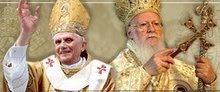
Orthodx prelate: Benedict XVI good; John Paul II bad?! - 'Tis Outrage!


From Rorate Caeli

Another interesting statement from Bishop Hilarion, formerly of Vienna, now of Volokolamsk, successor of the now-Patriarch Kirill as head of the Moscow Patriarchate's Department for External Church Relations. Emphases mine. I have not corrected the grammatical errors, and I am posting this without comment!


This is the latest in the series of statements from the Moscow Patriarchate in support of Pope Benedict's policies. (See this in support of Summorum Pontificum, this one on the lifting of the excommunications of the SSPX bishops, and the latest on Pope Benedict and condoms.)

The Moscow Patriarchate approves of Pope's uncompromising position on ethics


06 April 2009, 12:09


Moscow, April 6, Interfax - Refusal of Pope Benedict XVI to use politically correct language and offer compromise on traditional issues of Christian ethics has gained support of the Russian Orthodox Church.


"The difference of this current Pope from his predecessor is that this Pope never watches for political correctness in his statements. This is the reason why his statements sometimes produce shocking effect on the Western society: people there are not used when the Church's Head voices a traditional standpoint of the Church," Bishop Hilarion of Volokolamsk, a new head of the Moscow Patriarchate Department for External Church Relations said at a live broadcast of National Interest program shown Saturday on Rossiya TV Channel.


That was Bishop's comment of criticisms aimed at the Pope, also by the French Ministry for Foreign Affairs, for his opposition to contraception.


Bishop Hilarion continued that "we view this as a positive shift in the Catholic Church's position, because head of the Church, in particular, head of the largest Christian Church, should not adapt himself to any PC language, he should tell people what his Church teaches him to tell them."


I don't know. Diss the former pontiff who ended, or at least played a huge part, in ending communism? A pope who engaged the modern world in set the stage for the world to receive Pope Benedict? This argument seems silly, though it is good to hear positive comments. The remarks are valid too, only if time exists in vaccum; no continuity from pope to pope and age to age. This is one reason why I have issues with Orthodoxy.

American Papist: 32 bishops now against Obama at UND

Round-up: *32* Bishops have responded to Notre Dame's Obama invitation
I was going to compile this list, but Catherine Harmon at Catholic World Report did it first. Here it is:

Bishops’ statements on Notre Dame’s invitation to Barack Obama (my additions in bold)

1. Bishop John D’Arcy, Fort Wayne-South Bend
2. Cardinal Francis George, Chicago
3. Cardinal Daniel DiNardo, Galveston-Houston
4. Archbishop Timothy Dolan, Milwaukee (--> NYC)
5. Archbishop John Nienstedt, St. Paul-Minneapolis
6. Archbishop Eusebius Beltran, Oklahoma City
7. Bishop Edward Slattery, Tulsa
8. Archbishop John Myers, Newark
9. Archbishop Alfred Hughs, New Orleans
10. Bishop Joseph Martino, Scranton
11. and Auxiliary Bishop John Dougherty, Scranton
12. Bishop Thomas Doran, Rockford, Ill.
13. Bishop Thomas Olmsted, Phoenix
14. Bishop Gregory Aymond, Austin
15. Bishop Robert Lynch, St. Petersburg
16. Bishop R. Walker Nickless, Sioux City
17. (Paul Schenck, on behalf of) Bishop Kevin Rhoades, Harrisburg, Pa.
18. Bishop William E. Lori, Bridgeport, CT
19. Bishop Robert Morlino, Madison WI
20. Bishop George Murry, S.J., Youngstown, OH
21. Bishop William Higi, Lafayette, IN
22. Bishop Anthony Taylor of Little Rock, AR
23. Archbishop Jose Gomez, San Antonio, TX
24. and Auxiliary Bishop Oscar Cantu
25. Bishiop Jerome Listecki, La Crosse, WI
26. Archbishop Edwin O'Brien, Baltimore MD
27. Bishop Alex Sample, Marquette MI
28. Archbishop Daniel Buechlein, Indianapolis
29. Bishop Robert Baker, Birmingham AL
30. Bishop Samuel Aquila, Fargo ND
31. Bishop Gerald Barbarito, Palm Beach FL
32. Archbishop Fabian Brukeswitz, Lincoln NE

Brooks on 'the end of philosophy' or 'the end of humanity'

The End of Philosophy by David Brooks (New York Times)

Socrates talked. The assumption behind his approach to philosophy, and the approaches of millions of people since, is that moral thinking is mostly a matter of reason and deliberation: Think through moral problems. Find a just principle. Apply it.

One problem with this kind of approach to morality, as Michael Gazzaniga writes in his 2008 book, “Human,” is that “it has been hard to find any correlation between moral reasoning and proactive moral behavior, such as helping other people. In fact, in most studies, none has been found.”

Today, many psychologists, cognitive scientists and even philosophers embrace a different view of morality. In this view, moral thinking is more like aesthetics. As we look around the world, we are constantly evaluating what we see. Seeing and evaluating are not two separate processes. They are linked and basically simultaneous.

As Steven Quartz of the California Institute of Technology said during a recent discussion of ethics sponsored by the John Templeton Foundation, “Our brain is computing value at every fraction of a second. Everything that we look at, we form an implicit preference. Some of those make it into our awareness; some of them remain at the level of our unconscious, but ... what our brain is for, what our brain has evolved for, is to find what is of value in our environment.”

Think of what happens when you put a new food into your mouth. You don’t have to decide if it’s disgusting. You just know. You don’t have to decide if a landscape is beautiful. You just know.

Moral judgments are like that. They are rapid intuitive decisions and involve the emotion-processing parts of the brain. Most of us make snap moral judgments about what feels fair or not, or what feels good or not. We start doing this when we are babies, before we have language. And even as adults, we often can’t explain to ourselves why something feels wrong.

In other words, reasoning comes later and is often guided by the emotions that preceded it. Or as Jonathan Haidt of the University of Virginia memorably wrote, “The emotions are, in fact, in charge of the temple of morality, and ... moral reasoning is really just a servant masquerading as a high priest.”

The question then becomes: What shapes moral emotions in the first place? The answer has long been evolution, but in recent years there’s an increasing appreciation that evolution isn’t just about competition. It’s also about cooperation within groups. Like bees, humans have long lived or died based on their ability to divide labor, help each other and stand together in the face of common threats. Many of our moral emotions and intuitions reflect that history. We don’t just care about our individual rights, or even the rights of other individuals. We also care about loyalty, respect, traditions, religions. We are all the descendents of successful cooperators.

Read the rest of this wretched but interesting piece here.


My commentary:
As science comes up with 'explanations' for why humans feel the need to be moral, the moral 'values' that we hold will become useless. This is because, as science will have proven, it's all biologically determined anyway. This sort of reasoning admits a limit on what is reason; reason is strictly limited to the verifiable or empirical. Science hasn't accounted for feelings like "patriotism", but as Brooks asserts, eventually it will. Hence the title: "The Death of Philosophy". How does this not give a person pause? Reason is limited to materialistic determinism? Say 'bye, bye' to philosophy, theology, and reason-based ethics. An "epochal" shift. I think the article should be titled: "The End of Humanity". Brooks doesn't seem to get where this is going.... the topic is "above his pay grade".

The scientists seek to pair human morality with the reigning dogma on evolution/chance. This, of course, is not science but ideology. How are terms of 'value' and 'morality' and 'purpose' scientific? Explain why it is valid for scientists to be theorizing about such topics. Brook's article assumes evolution of random chance is true (so much for God's creative Spirit), and is more interested in taking such a view into the realm of morality with metaphysical underpinnings. The article posits, at least the scientists (it seems to me that Brooks doesn't get it), that reason is the slave of emotions because that's the only account empiricism can make for any 'moral' judgments. It very much appears that the 'science' going on here in Brooks' piece is just what you rail against in the quote above. This is especially seen when Dr. Quartz moves from 'the brain processing info at a vast rate' to 'this is what the brain is for' (assigning purpose... but I thought we were just moving particles at random?) to assigning 'value' to 'this is how we make moral judgments'. Where did the science end and the philosophy begin? I don't know about you, but I find it absurd when humans are compared to bees, moral decisions to tasting food, and that adults are no more qualified to make moral judgments than babies (yes, the article asserts all of those things). Hence, Brooks notes in the conclusion that the proposition of the 'moral scientists' is "an epochal" change; aka kiss religion, reason based morality, and what Lewis calls "the Tao" goodbye. Forget "The End of Philosophy" and enter "The End of Humanity". Which reminds me, you need to read The Abolition of Man if you haven't already; it's a great account of reason based morality that gives a role to emotion that I think you will find interesting.

At this point, the more important discussion is about the Brooks piece, and it gets back to The Metaphysical Club as well as Neuhaus' brilliant summation of Rorty and liberal irony.
One must choose:
a) To be with the materialists asserting that man's reason is slave to the emotions, and morality is simply as pragmatism describes (ready, fire, aim); truth is also always evolving and in-flux and determined by the utility in any given time by 'majority' consensus. Reality is really just what man percieves in his own mind; it does not apply to others. Such claims foundationally are anti-institution, anti-tradition, and anti-religious; usually if not always they favor a radical and unbridled positivism in the academy/polis.
-or-
b) To be with the realists who believe that man ought to and can order his emotions by using right reason and conquer his appetites, striving for the good, true, and beautiful which exist 'out there' and is accessible by our (God-given) reason, and embodied in the eternal Logos (in this account one can still recognize that we often act on emotions without thinking.) Such claims are friendly to religions, traditions, and hierarchical institutions (they are also not 'western' arguments exclusively); positivism has its place, but it is ordered to right reason.

There is no half-way house between the two. It's option 'a' or 'b'. This is the crux of our entire discussion! Again, even Brooks sees it as "an epochal" change - hence the problems of modern education as Deneen, Fish, and many others argue. Neither choice gives any road to a 'third' option; they are diametrically opposed. I'm interested to see what your choice is, and why.

Saturday, April 11, 2009

Metropolitan Jonah on American Orthodoxy - a magnum opus

I haven't read the whole piece yet, but it appears to be quite comprehensive. A nice ecclesiology teaching moment, perhaps.

A Time of Crisis and Opportunity

His Beatitude, Metropolitan Jonah


--The following is a portion of the opening address of His Beatitude, Metropolitan Jonah to the OCA Metropolitan Council at their 2009 Spring Meeting, February 18, 2009


The past years have been a huge struggle and a time of cleansing and purgation, a true crisis in the sense of a time of judgment. The Orthodox Church in America has emerged from this crisis, realizing that much has to be changed and much has to be created anew in its internal structures. This is a time of immense opportunity. Not only did the inadequacies and sins of the past regimes create an impasse for the Church, and present it with horrific choices; but, these revealed the deeper structural flaws in the organization of the OCA that permitted and perhaps created the crisis to begin with. These include, but are not limited to, structures of accountability and delineation of responsibilities, which are not dealt with adequately in our current statute. This was complicated by a lack of appropriate leadership. As a result the central administrative organizations of the Church were thrown into disarray.

Most of the superficial problems have been dealt with, and a new administration is in place, new policies have been implemented to create structures of accountability, and there is new leadership. But the underlying issues of the inadequacies of our statute, and the confusion of responsibilities between the organs of our central organizations, constitute what our essential task is to address in the near future. There are also issues left over that are pressing, and we also need to address and resolve them, so that the Orthodox Church in America can move on and assume the responsibility of its mandate: to be the local indigenous autocephalous Orthodox Church in North America.

During our time of troubles, the national and international reputation of the OCA was severely compromised. Movement towards Orthodox unity in America was severely damaged, and the perception of the OCA as being a viable partner in any movement towards unity, or even a player, was compromised. Various other Churches expected our dissolution. But in the words of Mark Twain, "Rumors of my demise have been greatly exaggerated!"

Coinciding with this slide there has been a descent into deeper and deeper parochialism, and with that, congregationalism. This "hunker down" mentality really constitutes a loss in the catholic breadth of the vision of our Church.

The breadth of vision is the key to our renewal. During the crisis, the leadership of the Church, Episcopal, clerical and lay, became completely consumed with the "next issue" to arise, the next revelation of wrongdoing, the next betrayal or failure of some leader. The vision of the Church was buried in gossip and scandal, people became demoralized and disillusioned, and God and his Providence were forgotten. What is important to remember is that while these things did happen, evil as they were, it is the pastoral effect that must be addressed as well as the issues themselves. It is a tragic thing to see someone in a position of great responsibility fall; it is a worse thing to judge and condemn them, and then fall into resentment towards the institution and community which itself was the victim. It becomes a self-perpetuating vicious circle. What suffered is the Church as Church, as people lost sight of the Church as the Body of Christ, and instead became focused on individual members and their sins and failings. The bishops are not the Church. The Central Administration is not the Church; nor is the MC, the AAC or any other organization.

Rather, we all constitute the Church, together, in Christ by the Spirit. We who are broken and sinful, dishonest and corrupt people. When we lose sight of our own sinfulness, and start blaming and judging others, we have lost our Christianity. If we want vengeance and retribution, we trample on Christ and the Gospel. We cut ourselves off from God and from one another in a great orgy of ego gratification. "Everyone loves a dirty little sex scandal." And scandals over money are not far behind. But does it not occur to us, as incensed as we are with self-righteous indignation, that all this is a distraction and temptation to betray Christ and betray ourselves as Christians? Temptation always presents this question: Will I act as a Christian, or not, in relation to this provocation?

If we have responsibility for the life of the Church, which we as the bishops and the Metropolitan Council as clerical and lay leaders do, we have to know about this stuff (Unfortunately!) in order to correct the problems. But if we allow ourselves to obsess about it, and especially in judgment and condemnation of others, we not only have forgotten our own sins and hypocrisy, but we will be blind to any constructive solution, any solution that is of God. Ultimately, all these problems came and were revealed as God's Providence for us. They revealed weaknesses that needed to be addressed, and an opportunity for us to address them.

We have to return to the vision of Christ, crucified and risen from the dead, present now, and coming again, that is at the very core of our life as the Church. To be an Orthodox Christian is to focus our lives on Jesus Christ, and to continue His ministry of love and reconciliation, the call to repentance and forgiveness. We are called to bear one anothers' burdens--the burden of one another--and so fulfill the Law of Christ. The Lord calls us to patience and longsuffering, always going by the way of humility and love. This vision of Christianity must be at the very heart of all our decisions and all our lives, as Christians, and especially as leaders of the Church.

Revisioning the Orthodox Church in America

We have an enormous opportunity, and responsibility, to re-vision the structure and life of the Orthodox Church in America. While the basic elements are outlined in the Tradition, especially the Canons of the Ecumenical Councils and the Fathers, there are other elements that we incorporate as 21st Century Americans. Those essential elements from the Tradition are the Holy Synod presided over by the Metropolitan, a diocesan structure, and the canonical heritage. Other values critical to us, and partly coming from the Russian Council of 1917, are the participation of lay and clerical members in decision making. The Strategic Planning process on which we are embarking is precisely the process we are using to re-vision the Church.

Ultimately, we need to rewrite the Statute. The structures that were put in place and incorporated in the Statute reflected the life of the Metropolia and its early transition to being the autocephalous Orthodox Church in America. When the Statute was written, the OCA consisted essentially of a single archdiocese, with three or four sub-dioceses, with bishops who were essentially auxiliaries. It was a fairly homogenous social and ethnic community located mainly in the "Rust Belt" between Chicago and New York, north of the Ohio River. Cultural ideas of egalitarianism, democracy and division of powers, as well as identity as a corporation, shaped the initial document. Transparency, accountability and "best practices" had not even entered the national debate.

The OCA has outgrown its previous structures. It has become a huge, diverse community stretching to every corner of the continent. It consists of 13 dioceses, each with its own life. It is largely a convert church, and has no social, ethnic or linguistic homogeneity--and is authentically local and indigenous, rather than an ethnic church. While culturally very North American (in its own diversity), the OCA can no longer be "one of the jurisdictions," but rather has to develop its internal structures to measure up to the challenge of being the Local Autocephalous Church, inclusive of the tremendous diversity of our continent, but also respecting the uniqueness of each community and its needs.

The Statue itself and the organizations it creates have become obsolete. The AAC not only has become huge and unwieldy, and cannot effectively make most decisions; but the real underlying problem is that it compromises the diocesan structure of the Church, treating the whole Church as a single archdiocese with parish representation. The MC was initially the archdiocesan council, advising the one bishop with full authority, the Metropolitan. The central administration performs all the statutory functions of the Metropolitan Council; and then we wonder why there is conflict. The crisis created a power vacuum, which the MC stepped in to fulfill--a power gap previously filled by the Chancellor. But nowhere in the Statute is the MC given any authority as an organ of accountability; BUT neither is anyone one else specifically. Nor does the MC perform the primary role defined in the Statute: as the main fiduciary, to raise the money to support the life and work of the church. Because the leadership was dysfunctional, the Holy Synod abrogated its authority, and retreated into their own dioceses; the central administration grew to immense proportions and power, and both the Holy Synod and the Metropolitan Council rubber stamped the decisions of the CA, and abrogated their responsibility. Et cetera.

And so, my dears," we have a mess. Not to even bring up any corruption.

So where do we start? First, we have to look at basic Orthodox ecclesiology. The Apostles invested the bishops with the leadership of the Church, through sacramental ordination. This is the principle of authority in the Church: sacramental responsibility. This sacramental responsibility is not only over what is "spiritual," but the entire life of the whole Church, in every aspect, because even how we use our money is spiritual and sacramental. There can be no dualism between the spiritual and the material.

The real underlying question is the issue of leadership--primatial, Episcopal and lay. We need to examine the nature of primacy: how the episcopacy relates to the local church, and the interrelationship of the local churches within their province, and hence, the role of the Metropolitan as Primate. Central to this, however, is the nature of that relationship of obedience: of the presbyters to the bishop, and the bishops to the Metropolitan. Primacy is constituted by accountability and authority, in a relationship of obedience. This is Christian leadership. All of this is, ultimately, defined in the ancient Canons, and rooted in the Scriptures.

Obey those who rule over you, and be submissive, for they watch out for your souls, as those who must give account. Let them do so with joy and not with grief, for that would be unprofitable for you. (Hebr. 13:17)

I believe that the starting place to understand all this is to understand authority and obedience as responsibility, rather than as "power." Any reduction to "power" is by definition, corruption. Accountability in relation to responsibility is a core element in obedience. Various areas of responsibility are given to the different offices and organs of the Church by the canons. The question is, how are they invested with responsibility and for what, and to whom they are accountable? Accountability is intimately linked with responsibility; the structures of accountability are built as structures of obedience. Then we have to look at the nature of the support of the whole structure: first, financially, with the flow of money and resources; then, the flow of responsibility and accountability in relation to the organs of advice and consensus.

Bishops and the Metropolitan

34. The bishops of every nation must acknowledge him who is first among them and account to him as their head, and do nothing of consequence without his consent. But each may do those things only which concerns his own parish [diocese] and the country places which belong to it. But neither let him, who is the first, do anything without the consent of all, for so there will be unanimity, and God will be glorified through the Lord in the Holy Spirit. (Apostolic Canon 34)

The basic unit of the Church is the diocese: the bishop surrounded by the presbyters, deacons and faithful. The bishop has responsibility for the whole body, and sacramentally recapitulates it, and all ministries flow from the bishop. This is the literal meaning of "hierarch"--the "source of all priesthood." The presbyters and deacons, in particular, as well as all the faithful, are in a relationship of obedience to the bishop, and accountable to him for their service within the Church. The bishop has a double accountability: to the clergy and laity of his diocese; but also to the Synod which elected him and its head.

The Synod of bishops of a nation is the "Local Church." They bear responsibility for the oversight of all the churches in their care. They have the responsibility to elect and install new bishops where there is a vacancy or need. They are the point of accountability for each other. They elect as president of their Synod the bishop of the metropolis or "mother city," as Metropolitan Archbishop.

The Metropolitan bears the responsibility to maintain unanimity and consensus among the bishops in all matters affecting the life of the Church as a whole, and is the point of accountability for the bishops; while he in turn is accountable to them. This is a relationship of obedience, accountability in mutual love and respect, for the responsibilities given. The Metropolitan has the responsibility to relate his Local Church to the other Local Churches, and maintain unity and communion. This "ecumenical level" is the highest level of accountability, as it is the final court of appeal. The Metropolitan is a diocesan bishop, as are all the others. Thus all the bishops of the Synod bear an equal responsibility, as well as an equal ordination. The one thing that distinguishes the ministry of the Metropolitan is his primacy: his responsibility to be the point of accountability, with the other bishops in a relationship of obedience. There is no "super-bishop" or ordination over that of bishop.

Regional Council of Antioch: 9. The presiding Bishop in a metropolis must be recognized by the Bishops belonging to each province (or eparchy), and undertake the cure of the entire province, because of the fact that all who have any kind of business to attend to are wont to come from all quarters to the metropolis. Hence it has seemed best to let him have precedence in respect of honor, and to let the rest of the Bishops do nothing extraordinary without him, in accordance with the ancient Canon of the Fathers which has been prevailing, or only those things which are imposed upon the parish of each one of them and upon the territories under it. For each Bishop shall have authority over his own parish, to govern in accordance with the reverence imposed upon each, and to make provision regarding all the territory belonging to his city, as also to ordain Presbyters and Deacons, and to dispose of details with judgment, but to attempt nothing further without the concurrence of the Bishop of the Metropolis; nor shall he himself, without the consent and approval of the rest. (p.228)

There is a fundamental difference in primacy between a diocese and a synod. In a diocese there is a distinct difference in responsibility and structure of accountability because the levels of ordained responsibility are unequal. In a diocese, the bishop presides by virtue of his ordination, and all the clergy and people are accountable to him for their stewardship; as well as he to them for his leadership. In the Synod, it is a community of equals, all bishops, though the Metropolitan has primacy.

The Metropolitan's ministry is to hold the bishops to accountability in a structure of obedience that is by its very nature love and respect, unanimity and synergy. The Metropolitan's leadership arises through building consensus, rather than authority over the other bishops. Decisions are communal, by consensus; and the Metropolitan cannot act alone. As a bishop sacramentally recapitulates his diocese, so also does the Metropolitan recapitulates the Synod, personifying it and speaking for it. The Metropolitan cannot intervene in the affairs of another diocese, unless there is a canonical issue; then that intervention is his responsibility on behalf of the Synod. A diocesan bishop is accountable to the Synod for his stewardship of the diocese, because he is given that responsibility by them in election and ordination in a relationship of obedience. That structure of accountability is personified in the relationship of obedience to the Metropolitan.

A bishop's authority comes from his responsibility for his own diocese; the metropolitan's authority is within the Synod. The parishes relate to their own bishop, as their point of accountability in obedience. The bishops relate to one another in the Synod as the structure of accountability in obedience to the Metropolitan. But, the Metropolitan, as metropolitan, has no relationship to either the parishes or the clergy directly, other than those in his own diocese. This is very important, especially in regards to the flow of resources.

The Metropolitan's responsibilities, as primate, are in maintaining unity among the bishops of his Synod, and resolving whatever decisions need to be made on a Synodal level, and whatever issues directly affect the whole Church. The primacy also demands that the Metropolitan relate his Synod to the other Local Churches, maintaining recognition, contact, and communion. This would include, in our contemporary situation, relations with other jurisdictions in America, as well as with the other Autocephalous Churches. Thus, all matters related to the transfer of clergy between Churches, jurisdictional disputes, and so forth, are the purview of the Metropolitan. It is also within his purview to convene the Synod, councils and church-wide conferences; oversee church-wide ministries such as theological education; and oversee economic matters such as tax status, legal matters and insurance which affect the whole Church. The Metropolitan oversees matters dealing with bishops, including election, placement, accusations, investigations, transfers, and canonical actions.

Administration

The bishop is entrusted with responsibility for every aspect of the life of the Church, including full authority over the material goods and finances of the Church.

Apostolic Canon 41. We ordain that the bishop have authority over the goods of the Church, for if he is to be entrusted with the precious souls of men, much more are temporal possessions to be entrusted to him. He is therefore to administer them all of his own authority, and supply those who need, through the presbyters and deacons, in the fear of God, and with all reverence. He may also, if need be, take what is required for his own necessary wants, and for the brethren to whom he has to show hospitality, so that he may not be in any want. For the law of God has ordained, that they who wait at the altar should be maintained at the altar's expense. Neither does any soldier bear arms against an enemy at his own cost.

As this reflects the practice of the 4th Century and before, the later canons bring up the practice of a steward or economos, essentially chancellor or treasurer, to assist in the management of the affairs of the diocese. This is the beginning of diocesan administration other than through cathedral deacons and presbyters.

Chalcedon:26. Since in some churches, as we have been informed, the Bishops are administering the ecclesiastical affairs with the services of a Steward, it has seemed most reasonable and right that each and every church that has a Bishop should also have a Steward selected from its own Clergy to manage the ecclesiastical affairs of that particular church in accordance with the views and ideas of its own Bishop, so as to provide against the administration of the church being unwitnessed, so as to prevent the property of the same church from being wasted as a result of such stewardless administration and to prevent any obloquy from attaching itself to holy orders. (p.84)

In the Orthodox Church, according to the Canons, all responsibility rests ultimately on the bishops: spiritual as well as financial and organizational. They may and should designate people to handle such affairs, both for the sake of ability to administer and to guard the reputation and integrity of the bishop. This is where we can begin to see the foundation of the central and diocesan administrations, as well as the Metropolitan Council.

Vision for Today and the Future

The OCA is the heir of this ancient tradition, and structures its life accordingly. However, over the past decades, this system broke down to some extent because of personalities involved, and to a great extent because it went out of balance. The dioceses, to a great extent, did not take on the full responsibility for their own lives, and the Metropolitan and his staff took on the role of an archdiocese--or rather, continued it according to the existing statute. In the meantime the life of the Church grew and developed, dioceses were formed that assumed responsibility over their own lives--"sovereignty."

What we need now is for the dioceses to develop fully, and each to take on responsibility for itself. Each diocese needs to develop its own programs, funding, and missionary outreach. At the same time, the Metropolitan's Office must focus on the things that are in its purview, and leave the dioceses to handle their own business. Clergy matters, internal OCA transfers, local ministries, youth programs, development of missions, charitable and evangelistic outreach are all the responsibilities of each diocese and its bishop.

The Metropolitan's Office has the responsibility to take care of the administrative tasks that affect the whole church. The Office of the Metropolitan, perhaps a better name than "central administration," is called focus on coordinating diocesan programs for ministries, as well as the intra- and inter-Orthodox relations that are necessary, and develop programs that benefit the whole Church. This requires a staff, as prescribed by the Statute. How large a staff is a different question. Clearly the 37 people on staff, more employees than all the dioceses put together, and a bigger budget than all the dioceses put together, was excessive. How large that staff should be also depends on how much the dioceses are ready to assume their responsibilities. This is not possible until the dioceses are adequately funded.

Another element is the place of the All American Council. The All American Council, as a legislative body per the 1971 Statute, does not work. The AAC does not reflect the diocesan structure of the Church. It treats the whole OCA as a single archdiocese, with one bishop. This is simply not the reality. While the value of lay participation in decision making is almost universally accepted, the scope of the council is too large to allow for meaningful discussion, especially as it effects the life of each particular diocese. The council allows for no contact or discussion, much less constant interaction, of the bishop with the delegates from his diocese. But especially problematic is the fact that the Council treats each parish as belonging to the greater OCA, rather than its own diocese. As a result of this unwieldiness, the Metropolitan Council has taken on the legislative function of the AAC.

The Metropolitan Council is structured like a board of trustees, according to the laws of New York State, where the OCA is incorporated. There are two issues here: the administration in the Metropolitan's Office performs most of the statutory responsibilities of the MC, while others are done by both. Many of these functions, book- and record keeping and coordination, can only be done by a standing administration. The main fiduciary responsibility is in fact given to the Metropolitan Council by the Statute, both for budget as well as for raising funds and supporting the work of the whole Church. Even this was taken over by the Central Administration of old, by a Development Office. The Metropolitan Council needs to turn its attention and considerable talent to the challenge of raising financial support for the Church. There are two elements in this: a development function for donations, trusts, bequests and so forth; and a church-wide rethinking of support, based on the principles of percentage giving or tithing. More later on this.

The second structural issue, however, is more problematic. The laws for religious corporations pertain primarily to parishes, and not to the structure of a synodal Church. On the parish and diocesan levels, the rector and the bishop have full responsibility and accountability for use of resources, and the bishop in particular canonically. In a parish, the Parish Council, led by the priest, has the responsibility to manage the financial and material resources of the parish; in a diocese, the Diocesan Council, led by the bishop. As long as the presiding clergyman is the president of the Council, there is no problem: the Council has the responsibility to assist the priest or bishop in the administration of the material resources as trustees.

The Synod, however, and the Office of the Metropolitan as the organizational recapitulation of the Synod, is different. While the MC started out as an archdiocesan council, with the above function, as the Church has grown into a fully functioning Synodal structure, the structure of the MC has to change. It is the bishops who bear the primary fiduciary responsibility for the Church according to the Canons. The MC shares that responsibility, but on a different level. The Metropolitan and Synod have to approve or can veto decisions of the MC; the Metropolitan cannot veto decisions of the Synod.

This can be resolved in that it must be made clear in the new Statute that the bishops, collectively as the Synod, bear the main responsibility and accountability for the material resources, as well as the spiritual life, of the Church. The MC executes their decisions, and administers the resources of the Church, providing for its maintenance and ministries; but it does not have the same level of accountability as the Synod itself, nor can it make decisions independently of the Synod and/or Metropolitan--which is already clear in the existing statute.

The Conciliar Structures of the Orthodox Church in America

A Time of Crisis and Opportunity: Part II


His Beatitude, Metropolitan Jonah


The Mission of the Autocephalous Orthodox Church in America, as the local Body of Christ (for/on) the North American Continent, is to be faithful in preaching the fullness of the Gospel of the Kingdom to all peoples of North America in fulfillment of the great commission of Jesus Christ to "Go into all the world and make disciples of all nations, baptizing them in the Name of the Father, and of the Son, and of the Holy Spirit, teaching them to observe all [things that He has] commanded": so that all may be saved and come to the knowledge of the truth, that all may become communicants of the Orthodox Church, that Christ's way of sanctification, theosis and eternal life may be revealed to all. --His Eminence, Archbishop Job of Chicago and the Midwest


******


The Calling of the Orthodox Church in America: Go into all the world and make disciples of all nations, baptizing them in the Name of the Father, of the Son and of the Holy Spirit, teaching them to observe all things I have commanded you.

* Mission/Identity: We are the presence of the fullness of the One Holy Catholic and Apostolic Church, incarnate as the Local, Indigenous Territorial Orthodox Church in North America, embracing all Orthodox Christians regardless of any ethnic, linguistic or cultural distinctions. We are essentially a missionary Church, striving to bring the full integrity of the Gospel of Christ to all the people of North America, so that they may come to the unity of the Orthodox Faith and communion of the Holy Spirit, in the One Body of Christ.

* Core Values:
o The Gospel of Jesus Christ
o Missionary
o Diverse & inclusive
o Multi-cultural
o Multi-ethnic
o Multi-lingual
o Non-Colonial
o Non-Diaspora
o Ascetic
o Monastic
o Sanctity


There were a number of issues raised in response to the previous Address to the Metropolitan Council of February, 2009. These include:

1. Fear of exclusion of lay and clergy from decision making, conciliarity
2. This is a "power grab" by the hierarchy
3. What happens when the Metropolitan abrogates his responsibility?
4. The future and role of the Metropolitan Council
5. The future and role of the All American Council.
6. How do we know that anything has really changed? With the OCA in general, and the Holy Synod?

It is clear that we need to change the culture of the OCA. We need not only to change how things are done and attitudes and values. Rather, we need to change the culture and structure of the organization so that the established flow of relationships and information grows and expands. I believe that we need to do this so that we can further develop the life of the whole Church, and facilitate participation by more and more members of the Church in the process of real conciliarity.

There is a very damaging false notion that the lay people are separate from the clergy, and that the clergy are different from the laity. This is not the case! The clergy are simply those laity invested with a particular scope of responsibility by the whole Church, in a structure of accountability. In particular, the presbyters and deacons are accountable to the bishop for their stewardship of the life of the parishes. However, all members share responsibility for the Body, but have differing levels of accountability. The priests and bishops are accountable for each member of the Body by their ordination. Each member is important. Each member has a voice, and must be heard.

There are two related attitudes that constitute baggage from the past, temptations which have afflicted the Church and distorted its life and indeed, its conciliarity. Both stem from an abrogation of responsibility. Clericalism comes from an abrogation of responsibility by the laity for the affairs of the church, with the clergy taking over all functions; even the loss of the traditional ministerial role of the diaconate and pastoral role of the episcopate, with the concentration of all "ministry" in the presbyters, is a kind of clericalism . Trusteeism comes from a refusal of the clergy to accept their responsibility for the more mundane aspects of the life of the Church, which was then seized upon by lay leaders. This resulted in the priests being responsible for what happens in the altar; the parish council for everything else in the church. Both result from a breakdown of conciliarity, in which the integrity of each area of responsibility in a structure of accountability is critical. Conciliarity can be partially defined as shared responsibility with distinct levels of accountability. In both reductions, authority becomes identified with power; there is tremendous resentment and mistrust of the others by the persons disenfranchised. Both the clergy and laity need to recognize their areas of responsibility, and support one another in the exercise of that authority. The rector of a parish, or the bishop of a diocese, has complete responsibility for every aspect of the life of the community under his care, liturgical, spiritually, financial, legal, and administrative. But he cannot do it alone; it has to be done in cooperation with the laity, who are empowered with responsibility for certain areas by delegation.

The image used by St Paul of the body is very valuable in approaching this: the eye is not the foot, which is not the hand; there are parts more or less presentable, more or less private. Yet it takes all the parts working together, doing what they are supposed to be doing, and all have to be united to the Head, to Jesus Christ, the real Leader of the Church.

Conciliarity does not mean democracy. Its Russian root concept, Sobornost, refers to both conciliar structure (councils) and catholicity--wholeness or integrity. That can only happen when each element of the conciliar structure has integrity of its own life and ministry, and each is working in the proper order to build up the whole. Each area of responsibility has to be functioning for it to participate in the whole. Thus the bishops have to take full responsibility and be accountable to one another and to the Metropolitan, as well as to the Body, for their stewardship of their diocese or area of responsibility. The Metropolitan has to accept full responsibility to maintain the unity of the whole, both of his Synod and of the Synod with the other Churches. The Metropolitan has to be accountable to the Synod for his stewardship of the office. Each order or function of the Church, the diocesan councils, Metropolitan Council, and the periodic All American Council, must be accountable to the structures above it in responsibility: the Diocesan Council to their Diocesan Bishop; the Metropolitan Council and Synod to the Metropolitan, and Metropolitan to them.

For some people, "obedience" is a scary word, because it has been much abused. But the word "obedience" is integral to the life of the Church, and to the Gospel. Jesus was exalted above all others because of his obedience (Phil 2:5-11): "Have this mind in you, which was also in Christ Jesus, who emptied himself,... humbled himself... and was obedient unto death, even the death of the cross." The same passage is read for many feasts of the Theotokos, extol her for her obedience. "Be it unto me according to your word" is the ultimate expression of free, voluntary obedience in love. Obedience is not about power and control; it is about communion, synergy, and a voluntary assent to cooperation. If it is about power, coercion and the like, it is distorted. Jesus is the ultimate example of obedience; wives are called to be obedient to their husbands; and we are all called to submit to one another and be obedient in love to those who have to give account for us (Hebr 13). In a diocese, the priests are in a relationship of obedience to the bishop, similar to the monks to the abbot in a monastery. The bishops are in a relationship of obedience, though slightly different, to the Metropolitan. This relationship is the primacy of leadership.

In the Orthodox Church, the bishops were entrusted by the Apostles, by virtue of their ordination, with the greatest degree of responsibility for the whole Church. An individual bishop is accountable for the people and their lives in his diocese. It is a holistic responsibility for every aspect of the life of his communities and for the lives of the members of his diocese. This does not mean power and control, but rather accountability, and the maintenance of a unity of mind and vision throughout the Church. It means that a bishop must know his priests and people, and actively build and maintain consensus with them. This pertains not only to doctrine and practice of the Faith, but the unity of a community gathered in love.

If a national local church (whatever you would call the ecclesiastical province that has autocephaly or autonomy) is a federation of dioceses, each diocese has to be an equal partner in the community. The primate is elected by the other bishops as its leader and particularly as the one who is accountable for the whole, and for its unity. The Metropolitan is accountable to the bishops, and the bishops to the Metropolitan. He is first among equals; but he bears a unique responsibility and accountability to maintain the unity and obedience with his Synod; as well as unity with the rest of the Churches world wide.

In the Orthodox Church in America, the current Statute envisions the Church as a single Archdiocese, with the Metropolitan as the single fully empowered bishop, and the other bishops as glorified auxiliaries. It does not adequately develop its vision of the dioceses. In other words, the existing Statute envisions complete centralization. I and the other bishops believe we need to decentralize, by emphasizing that the real life of the Church is on the diocesan level. The diocesan foundation of the life of the Church is not policy or philosophy: it is the structure that is at the heart of the canons and the apostolic teaching. The greater the decentralization and upbuilding of the life of the various dioceses, the greater will be the opportunity for authentic participation by more laity in the direction and decision-making, as well as ministries, of the Church.

In other words, we are talking about a major shift in the culture of the OCA: from centralized and dependent on "Syosset" for all leadership, to decentralized and looking to the local bishop to empower ministries to serve the particular needs of each region.

The Metropolitan and Metropolitan's Office

This decentralization does not mean weakening the Metropolitan's Office by strengthening the dioceses. Rather, for authentic accountability, we need a strong Metropolitan; but we also need strong dioceses. Does that mean a massive staff and development of all programs in New York? Not at all. Rather, what needs to be strengthened, and what has failed almost completely in the last decades, is that the Metropolitan needs to be the point of accountability for the Diocesan bishops. The Metropolitan is the one leader of the Church, elected both as president of the Synod by the Synod, but also by the whole Church in Council. While not above other bishops, he is elected to be accountable to the rest of the Church for the other bishops as Synod and the life of the whole. He is to represent it internationally and ecumenically, with an overarching ministry of unity. What is the ministry of unity, but to facilitate conciliarity on the various levels of the life of the Church. More on this below.

The dual election of the Metropolitan gives him a unique capacity among the bishops, as he is chosen as the Primate. Primacy means leadership, but also the responsibility of accountability. Primacy, leadership as first among equals, bears the responsibility to maintain canonical order within the Synod, and accountability of the bishops for their stewardship of their office. If a bishop loses the ability to lead through age or illness, or abuses his authority, or is credibly accused or falls into a state of immorality demanding canonical action, or is derelict in his duties, it is the Metropolitan's responsibility to investigate the situation on behalf of the Synod, and to call that bishop to accountability. If the bishop in question is the metropolitan himself, then the next senior bishop of the Synod bears that responsibility. The canons are clear: bishops alone judge bishops. These structures of accountability are essential if the Church is to maintain its integrity. The bishops, in turn, are responsible to maintain canonical order and integrity among their diocesan clergy.

There are certain ministries that can only be effectively accomplished on the level of the Metropolitan's Office: the calling of councils, Synods and church-wide meetings; the oversight and administration of theological education and training for ministries; administrative matters relating to churches and clergy, such as health care, tax status and pension; the facilitation of relations with other churches, both jurisdictional and inter-church ecumenical; and the communications that facilitate the multiple levels of relationship. These ministries require competent professionals to do the work needed to facilitate, empower and coordinate the various ministries within the dioceses. And it is this office that maintains the Orthodox Church in America in relationship with the other Orthodox Churches, the ministry of unity.

Diocesan Ministries

There are common ministries that must exist within each diocese: missions and evangelism, charitable outreach, youth work, religious education, and so forth. The Metropolitan and his office are given the task of encouraging the bishops to develop these active ministries within their dioceses, and to function as the coordinator and resource center for those ministries. However, those ministries have to be done on a local, diocesan level, not from a central office.

In other words, how is some ecclesiastical bureaucrat in Syosset supposed to know how to evangelize and establish a mission in Louisiana or Oregon? Or work with a native village in Alaska? Or renew a dead parish in the Monongahela Valley? Or establish a homeless shelter in Kansas City? Or how to serve a whole native people that converted in Mexico, who don't even speak Spanish, let alone English? These concrete ministries can only be done on a diocesan level: locally. Each diocese needs to develop the kind of outreach ministries necessary to fulfill the particular local needs that it encounters.

This is another aspect of a major culture shift: rather than simply being focused on developing parishes, according to a particular model, we must look at the diocese, to a large extent, as a collection of particular and diverse ministries. The greatest proportion of these will indeed be parishes; but there are a multitude of ways for a parish to exist and minister to its congregations. We have to embrace diversity of ministries and needs, and move beyond the idea of homogeneity of practice and form. Homogeneity is a characteristic of American denominationalism; we don't need it. For example, a parish might focus on Georgian, Mexican or Romanian immigrants, with specific language needs and cultural particularities. Or the ministry might not be a parish at all: a homeless shelter, an OCF chapter, a monastery, a battered women's center or a cohousing community for widows. The bishop is, by virtue of his office, the one who blesses all these ministries, and without his blessing, they cannot call themselves Orthodox. These can only be done on a local level, on a diocesan level. There can be sharing of information and experience between dioceses; but the ministries are going to be particular to their place. Some places will have a succession of different ministries, as one community dies out or moves along, and another moves into its place. Only on the local level can the Church be responsive to the particular needs of its communities.

As the local Church, as the diocese develops its life and programs, the greater the need presents itself for dialog and conciliarity on the diocesan level. As the various ministries grow and develop, then it would be appropriate for them to be represented, somehow, on the Diocesan Councils--which are the most important organs of conciliarity on the diocesan level. As the dioceses become more and more diverse, the task of conciliar dialog and consensus building will be greater and greater. This will demand more of the bishops; but in turn, it will involve more clergy and laity on an ever increasing scale. This already exists in the South, the West, and Canada; as well as to a great degree with the Midwest and the Romanian Episcopate.

Another major culture shift is to open the Synod itself to bishops sent from other Churches, and actualize itself as the basis of unity in North America. Thus, the vision is to "open up" the Synod to representatives of foreign churches who send bishops to North America to care for their nationals and immigrants, and yet, have them sit on the same Synod of the Orthodox Church in America. We already have three non-territorial dioceses; what needs to happen is to provide greater integration and cooperation, both on the local level between individual bishops, and on the Synodal level as a whole. In turn, the foreign bishops can represent the OCA to their mother churches, and their Synods to the OCA. This then becomes a model for Orthodox unity in North America, with a single Synod of Bishops that respects and preserves the diversity in unity of the whole.

To summarize: The major culture shifts needed in the OCA are decentralization and strengthening of local leadership, Episcopal and lay, and hence the upbuilding of the dioceses; a change in the institutional expressions of the conciliarity, the All American and Metropolitan Councils to reflect the Church as a federation of local churches (dioceses), united under one Synod with one Metropolitan. This is simply rooted in basic Orthodox ecclesiology. We must build an accountability structure within the Synod, which has not existed; but also build in an institutional process should that accountability structure fail. We must transcend the sense of homogeneity that has dominated the OCA, and embrace multiple diverse expressions of Orthodoxy within it. Our unity is not in uniformity; our unity is in the One Lord, One Faith, One Baptism, One Bread and Cup, respecting the legitimate diversity of expressions.

The Bishops and the People

Part of the dynamic currently is that the Synod is coming together as a community as never before. This is due to the personalities in the past, which prevented a sense of community. Now that has changed. And within that, there is a new sense of mutual accountability and co-responsibility for the whole Church. It is simply the Orthodox Faith and Tradition that the bishops bear the ultimate responsibility for the life of the Church. But they cannot and do not bear it alone.

There is no such thing as a bishop (or priest) without a flock. Without his flock, a bishop has no authority, because he has no responsibility. Bishops who are auxiliaries, retired or are without a flock are respected, and can serve as bishops; but they have no power to act on their own, but only with the specific request of the diocesan bishop. Only in relation to his own flock, and synod, does the episcopacy of a bishop have meaning. While the ordination of a bishop comes from the grace of the Spirit, it is always in relation to his particular community. A bishop can do nothing in another diocese without permission from the local bishop.

The point of all this is that if the diocese is the primary unit of the Church, the whole life of the Church depends on the relationship of the people of each diocese to their own bishop. St Paul envisions this as a unity of mind and heart, with common service together to those in need, celebrating a common Eucharist, an authentic community gathered in love. This unity of life has a mystical reality: the bishop is the sacramental recapitulation of the community. But, this in turn has to have a basis in experience: the unity of the community comes from the bishop's active ministry, and involvement in the lives of his people, their consensus, and following of the bishop's leadership. In other words, the community is gathered in love around their bishop, who in turn loves them and cares for them. The two movements are both critical: the love of the flock for the bishop--and hence, obedience and cooperation; and the love of the bishop for the flock--seeking to fulfill their needs by empowering ministries within the Body. The two must be absolutely complementary, a synergy.

The bishop's leadership is crucial. It is what holds a diocese together, unifies it into one body, and fulfills it as the Church the Body of Christ. Otherwise, you may have an efficient organization, but it is not the Church. Ultimately, it is the bishop's ministry, and the grace which flows from it, that transforms a community into the Church. The bishop is the criterion of ecclesiality.

There is no leadership if people don't follow. And there is no leadership if there is only domination and subjection of others. Christian leadership is always about building synergy, communion in love. Obedience is an expression of that synergy, communion in love. It flows from responsibility and accountability, and a sense of mutuality.

Hierarchy is primarily about a distribution of responsibility, and is a structure of accountability. The Orthodox Church is a hierarchical church par excellence! It has nothing to do with dominance and subjection; but rather, with shared responsibility in a structure of accountability. The bishop is within the Church, not over it. Hierarchy is about the facilitation of conciliarity. Hierarchy provides the context for people on every level of responsibility for the life of the Church to exercise their ministries together, communally. It brings forth and employs the "diversity of gifts" coming from the one Spirit.

The organs of conciliar leadership that have evolved in the Orthodox Church in America are: parish councils, diocesan councils, the All American Councils, the Metropolitan Council. The ultimate model of conciliarity and conciliar leadership is the synod of bishops. This synodal/conciliar model is reflected up and down, as it were, in the levels of Church organization. Because the diocese is the basic unit of the Church, indeed is the Local Church, Diocesan Councils have an essential role. The Synod of Bishops is the sacramental type of all councils, the recapitulation of all the dioceses in the Synod. All other councils within the Church have to reflect this essential diocesan structure of the Church, and the conciliar structure that constitutes it.

Diocesan Councils

Historically, the presbyters constituted a council around the bishop, a parish or diocesan council. Contemporary Diocesan Councils, with Diocesan Assemblies, are the means whereby the presbyters and lay leaders make the needs within the community known, and where the bishop works to build consensus and empower lay leaders to serve those needs. While the means is partly financial administration, the diocesan councils are the real organ of conciliarity within each local church. The bishop leads and proposes, the Council discusses and comes to consensus, and then cooperates to fulfill the needs of the church. When it works, there is wonderful synergy, and the Church's needs are fulfilled; when it doesn't, the whole diocese grinds to a halt. It takes as much work from the bishop as from everyone else to come together, discern God's will, and implement it through consensus and cooperation.

This diocesan structure is particularly important in the OCA because of the tremendous diversity within each diocese, not to mention the whole Church. The diversity of communities and ministries has the bishop as its point of unity, and works out its daily life in the community represented by the diocesan council. The acceptance and fostering of diversity in the ministries and communities of the Church is essential for its growth.

The All American Council and Metropolitan Council

While it is true that the Canons do not envision councils of clergy and lay representatives meeting with bishops, the experience of the OCA has shown that councils reflecting the whole community of the Church are essential to its life in the contemporary world. The historical foundations of the AAC and MC lie in the Russian theologians who designed the Great Council of 1917. These decisions, while shelved in Russia due to the Communist period, were applied by the Orthodox Church in America in its canonical structure. They resonate with the culture of the Church in America. Indeed, as 21st Century Christians in the West, it is difficult to comprehend the life of the Church without participation by the laity and the clergy in decision making on most levels of the Church's organization.

One of the most glaring problems of the current Statute is how the All American Council is currently constituted: it currently actualizes the Statute's vision of the whole OCA as a single Archdiocese. Similarly, the Metropolitan Council is envisioned as continuing the work of the AAC between sessions, but also reflects the vision of the Church as a single archdiocese. The AAC, in particular, regards each parish as if the Metropolitan were its bishop, and the dioceses are not reflected at all. The MC, as the old Archdiocesan Council of the Metropolia, includes members elected at large at the AAC in addition to specifically diocesan representation, and now generally excludes the hierarchs. Neither body reflects the diocesan character of the Church.

One way to slightly modify the AAC to give it a more diocesan character, and to make it more effective, would be to change the representation from parochial to diocesan. Either a diocese would elect a given number of representatives to the Council; or the diocesan council, with the deans, would be designated as the representatives to the All American Council. Reducing the AAC from 900+ to less than two hundred people would make it much more effective in dealing with administrative issues, and enable representatives to work together to support and share ministries and other resources throughout the Church. It would also focus the work of the All American Council on the business of the Church, and it could be accommodated at far more modest expense. The expenses of the delegates would be paid by their respective dioceses. This type of council would meet every three years. While there would be a social component to it, the main social/educational/fellowship events would be conferences and conventions that do not focus on business.

What would give the new AAC its diocesan character is that it would not only be composed of diocesan representatives, but it could be structured with a double voting structure, so that each diocese would have one vote, as well as each delegate. This would force the discussions to be focused within each diocesan representation, led by their bishop; and thus build the community of the diocese while also building the greater community of the Church. Similarly, this would force a greater sense of accountability of the bishop to his diocese, and of the diocesan representatives to their bishop, in the task of building consensus and community.

A second type of All American Council, a Great Council, would be convoked to elect a new Metropolitan. This would include much broader representation, from each parish, though it would retain the same diocesan structure of the regular AAC. The Russian equivalent, to elect a Patriarch, takes candidates nominated by the Holy Synod, and then it is the Council that elects; the OCA version is just the opposite.

Pastors' Conferences and Clergy-Laity Conventions: Crosscutting Relationships

It is very important, however, that the Church gather together to discuss issues and for the people to get to know one another across diocesan boundaries. This could be done with annual gatherings, alternating pastors' conferences and Clergy-laity conventions, which would be open to all members of the Church, and would focus on education and fellowship, youth events and the sharing of information about ministries. While these Clergy-Laity Conventions would not have a business component, they could also be designed to pay for themselves, and be events that people would look forward to. The Pastors' Conferences in particular could be used for continuing education, and the building up of the relationships of the clergy across diocesan lines. Both types of meetings are valuable to build and maintain a common vision across the whole Orthodox Church in America.

The Metropolitan Council and Metropolitan's Office

The Metropolitan Council, as an advisory board to the Metropolitan, and a Board of Trustees for the corporation of the Orthodox Church in America, is an important element in the life of the Church. Perhaps the main difference that I would suggest is that representatives be strictly diocesan, rather than having a number of delegates at large elected at the AAC. The MC continues the work of the AAC between sessions; but also is the chief administrative support body to the office of the Metropolitan.

The officers of the Church are ex officio members of the MC, but are also extensions of the MC to assist the Metropolitan as the full time administrative staff. The MC are fiduciaries, who accept responsibility for the life and work of the Church, and who themselves work to support the Church in its various tasks. But, given the diocesan focus, the MC would need to keep in mind not only issues affecting the whole Church, but the common ministries and activities between dioceses.

Healing homosexual attractions... a study

Origin and Healing of Homosexual Attractions and Behaviors
Richard Fitzgibbons

In my clinical experience over the past twenty years I have witnessed the resolution of the emotional pain which caused homosexual temptations and behavior in several hundred males and females. Their process of healing occurred, first, through insight-oriented psychotherapy to identify the origins of their conflicts and then through the use of forgiveness and Catholic spirituality.

At the present time most Catholics have little to no understanding of the emotional causes of homosexual attractions and behavior nor of the powerful role that Catholic spirituality can play in the healing of this disorder. The reasons for this state of ignorance are numerous and include the scant literature available on the value of the Catholic Faith and the sacraments in the resolution of homosexual attractions and acts; failure of traditional therapy to resolve homosexual behavior; views within the media and educational, social service, health and political fields. In addition, there are many factions within the Church herself that are opposed to and are attempting to undermine traditional Catholic moral doctrine on this issue.

The failure to understand the actual causes of homosexuality impacts those who counsel teenagers and adults with this disorder. Therapists regularly tell those seeking help that the Church's teaching on homosexuality is insensitive to homosexuals, unscientific, and erroneous. They are advised to accept themselves as being created homosexual by God. Unfortunately, those giving such counsel usually have little awareness of the emotional conflicts leading to homosexual attractions nor of the healing power available with forgiveness and the Catholic spirituality.

In my clinical experience over the past twenty years I have witnessed the resolution of the emotional pain which caused homosexual temptations and behavior in several hundred males and females. Their process of healing occurred, first, through insight-oriented psychotherapy to identify the origins of their conflicts and then through the use of forgiveness and Catholic spirituality. Such a treatment approach is similar in ways to the employment of spirituality in the treatment of substance abuse disorders. In fact, major breakthroughs were made in the management of addictive disorders only after a reliance on God was made the cornerstone of the treatment plan. Prior to that time, traditional psychotherapy alone resulted in minimal improvement. The use of Catholic spirituality in the treatment of homosexuality follows a similar pattern.

Origins

The most common conflicts at different life stages that predispose individuals to homosexual attractions and behavior are loneliness and sadness, profound feelings of inadequacy, mistrust and fear, narcissism, sexual addiction, excessive anger, sexual abuse in childhood and a lack of balance in one's life. During times of stress these inner difficulties are activated. In an attempt to seek relief or to escape from this unconscious emotional pain, strong sexual temptations and behavior can occur. This dynamic of inner emotional suffering leading to homosexual desires and activity rarely can begin during childhood but usually it develops in early adolescence. However, adult life may be the first time for the emergence of this disorder.

Read the rest here.

Forcing students to condone homosexuality - EMU in Michigan

From CNA:

School faces lawsuit for dismissing student who refused to condone homosexuality

Ypsilanti, Mich., Apr 9, 2009 / 03:31 pm (CNA).- A lawsuit was filed against Eastern Michigan University on Thursday after school officials allegedly dismissed a student from the school’s counseling program for not affirming homosexual behavior as morally acceptable. The Alliance Defense Fund Center for Academic Freedom filed the lawsuit with the U.S. District Court for the Eastern District of Michigan on behalf of student Julea Ward.

EMU reportedly requires students in its counseling program to affirm or validate homosexual behavior within the context of a counseling relationship. It also prohibits students from advising clients that they can change their homosexual behavior.

According to the Alliance Defense Fund, Ward has never addressed homosexual behavior in any form during counseling sessions with her clients.

The school initiated a disciplinary process against Ward and reportedly said she could stay in the graduate school counseling program if she agreed to undergo a “remediation” program. According to the ADF, the program’s purpose was to change her belief system as it concerns counseling about homosexual relationships and to conform her beliefs to the university’s views.

Given the choice of voluntarily leaving the program or asking for a formal review hearing, Ward chose the hearing.

During the hearing, EMU faculty reportedly denigrated her Christian views and asked “several inappropriate and intrusive questions about her religious beliefs,” the ADF said.

Read the rest.

Friday, April 10, 2009

Shea & Zmirak on living in exile

Read it here.

Part of Shea:

I don't know how many times I'm going to have to say that I think both parties in our country are, in various ways, deadly to the Church before people believe it and stop making the dumb accusation that I think Bush worse than Obama or the GOP worse than the Dems. Chesterton remarks that "Men do not differ much about what things they will call evils. They differ enormously about what evils they will call excusable."

Anybody with any sense at all knows that I am mortally opposed to the Democrat dogmatic enthusiasm for the sacrament of abortion and their (apparently incurable, though miracles can happen) lust to sacrifice the weakest to money, sex, and power. So it goes without saying that I am implacably opposed to Obama and the Dems current campaign to advance this goal and crush the consciences of those who would oppose them. I've said this repeatedly, as I've said that Obama is behaving like an enemy of the Church. When you support legislation that would effectively destroy the Catholic hospital system, that's called "being an enemy of the Church."

At the same time, in my ongoing quest to urge peopl not to be insane, I have also pointed out that opponents of Obama would acquit themselves much better if they kept their heads and stopped making ludicrous comparisons of the guy to Hitler or some sort of devil worshipper. He is a man. A politician. He has virtues and faults. It is not the case that you will persuade normal people that some of his policies are very bad by screaming that he is evil incarnate, or by insisting that he is completely indistinguishable from a foaming madman filled with a racist, militaristic ideology bent on world conquest, enslavement of inferior peoples, genocide, and the establishment of a thousand year Reich in which every citizen is subject to his absolute and unquestioned will. If you talk this way, people will look at their watch, clear their throats, and say, "I think this is my stop." They will be sure to find a different seat the next time they get on the bus with you.

How do I know this? Because Lefties tried the same thing with Bush. Barking madness it was with them, and barking madness it is with anti-Obama wingnuts.


Part of Zmirak:

As Catholics and Americans, it's clear from recent events that we have just embarked upon a long and dangerous Lent. It's a secular Lent, with no resurrection promised, with tempting spirits aplenty, and no guarantee we will refuse their bread transformed from stones, their angels to cushion our fall, their kingdoms on offer for kneeling before the world. The hungrier we become, the more reckless we will get, more likely to worship would-be "saviors."

The liturgical season itself drags on long enough, and if you take it seriously it can seem to last forever. But it has a definite ending, set down in black and white -- the black vestments of Good Friday, the white dawn of Easter lilies and candles. As hard as we try to recapture the grief of the apostles and Our Lady on Good Friday, to join ourselves to Jesus as He cries, "My God, my God, why have You abandoned Me?," there's always a cushion in the back of our minds: We know the story's ending. As we watch with Christ an hour this Thursday, or meditate upon His seven last words on Friday, at the very lowest point in this bleakest, hostless liturgy. . . we can't quite forget that "death is swallowed up in victory." We have that advantage over the apostles.

Not so in worldly affairs. Societies, even Christian societies, really have collapsed. Catholic missions to pagan empires that came achingly close to mass success -- in Japan, in China -- have failed thanks to human mistakes, to hubris or corruption, and ended in massacres. More tragic than those who died horribly as martyrs are those who succumbed to fear, who traded (as most of us would) the integrity of faith for a few more years of "quantity time.” Catholic nations have lost the Faith, as the English did, under slow, relentless pressure from their governments. Still others have weathered persecution nobly, then greeted the dawn of freedom with a yawn. The faith that sustained my Irish ancestors through the Famine in time of feast seems childish, a bogeyman of the past that adds local color -- like the leprechauns.

As Americans we like to think that we're exceptional, that our nation is some unique, divine experiment, immune to the laws of history. (We're not the first nation to think so, and we're unlikely to be the last.) The events of the past eight years have disproved this charming theory. It turns out we really can't impose modernity and liberalism on a civilization of a billion through either force or farce; neither the Pentagon nor Hollywood seem likely to turn the Dar al-Islam into one more interchangeable piece of a globalized, peaceful McWorld. Nor can we live in prosperity forever without making anything -- trading for cheap imports our cleverness at finagling finances. One needn't think all lending at interest sinful, nor even reject the market economy, to see that the hucksterism that passed for investment wizardry on Wall Street amounted at last to usury. Nor can we count on the order and stability of a society that has undermined its very building block -- the family -- through sexual revolution, incessant contraception, and easy divorce. Anarchy begins at home.

Marriage for all - a homosexual manifesto

This was an excellent post about what is really behind gay 'marriage' amendments from Catholic Culture.

marriage for all Posted Apr. 8, 2009 11:40 AM || by Diogenes || category

In every nation, in every epoch, homosexuals have been free to marry. In every nation, in every epoch, homosexuals been free to marry other homosexuals. Homosexuals have been prohibited, exactly as heterosexuals have been prohibited, from marrying persons of the same sex. There was no question of discrimination on the basis of orientation because the appetites of the consenting parties (as is the case in every contractual obligation) were beside the point. Until now.

Partisans of same-sex marriage pretend that marriage is a good they wish to extend to those it has been arbitrarily denied: hence campaigns named "Marriage for All" or "Marriage Equality." But the publicly dispensable good (the kind a marriage license gives you) has always been available. What they resent is the moral value accorded marriage -- an honor markedly weaker today than in the past, yet still potent enough to cause gnashing of teeth among the innovators. That honor is what they want to abolish.

Imagine that the attitudes of a century ago -- when marriage was accorded the power to ennoble sexual relations -- could be beamed forward into the present. And imagine today's parents of a young man betrothed to another young man, urging him to remain a virgin until his wedding so as to preserve intact his and his fiancé's purity. Or imagine a same-sex couple, piously abstaining from fellatio or rimming during the season of Lent, only to resume it with prayerful joy on Easter morning. Simply to raise these possibilities is to see how grotesque they are. The decision to countenance same-sex unions is not to shift sodomy in one's books from the "immoral" to the "moral" column, it is to dispense with the category of sexual morality full stop. It is to rip up one's passport and renounce one's citizenship in the commonwealth of sexual morality.

Gay activists taunt the rest of us that conventional man-woman marriage is in a shambles today, and they're right. But their proposed innovation, as they really understand and rarely admit, is a choice for moral anarchy. Within their world there is no question of calling one act pure and another act impure, because the notion of purity has to be put to death before their project is embarked on. Chastity cannot be ennobling because to embrace same-sex congress is to debunk nobility. Even the photos from the Pride parades display a kind of sack-dance gloating over the dethronement of the concepts of purity and sexual integrity; it's a burlesque of those values that marriage -- real marriage -- was ordained to uphold.

Same-sex marriage is a war on honor. And it appears to be winning.