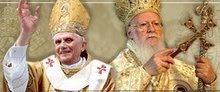
Benedict XVI Tells Alexy II the Times Urge Haste
By Inmaculada Álvarez
VATICAN CITY, OCT. 6, 2008 (Zenit.org).- Benedict XVI sent a personal message to Russian Orthodox Patriarch Alexy II saying that modern times call for a hastening of the journey toward Christian unity.
The Sept. 22 message was hand-delivered to Alexy II by the archbishop of Naples, Cardinal Crescenzio Sepe, on an official visit to Moscow at the invitation of the patriarch. The cardinal gave the message to the patriarch in a meeting that lasted a little more than an hour last Thursday.
"I have a deep affection for all the Orthodox brethren, and I am particularly close to them in these most recent days when conflict has caused significant suffering to peoples so dear to me," the Holy Father said. "I never cease to offer daily prayers for peace, asking the Lord that the appeals of Your Holiness to resolve all hostility for the good of the nations may be heeded."
He added: "Faith in Our Lord Jesus Christ is a bond that unites hearts in a profound way and invites us all to strengthen our commitment to manifest to the world a shared witness of living together respectfully and peacefully.
"Our times, marked so often by conflict and grief, make it even more necessary to hasten the journey toward the full unity of all the disciples of Christ, so that the joyous message of salvation may be spread to all humanity."
Getting closer
Cardinal Sepe told Vatican Radio on the day of his meeting with Alexy II that the Orthodox and Catholic Churches are growing ever closer, "as the patriarch himself emphasized with emotion."
"The impression is that a very important step has been taken to create a climate of closeness and mutual respect, of fraternity and friendship," he added.
Bishop Vincenzo Paglia of Terni, president of the Italian bishops' ecumenism commission, who was also present in the meeting with Alexy II, said that the process of growing closer should proceed with meetings between the various pastors of both Churches.
On the path to unity, the bishop added, "meetings between experts are no longer sufficient." Rather, ecumenism "is a coming together of the Churches."
And, Bishop Paglia affirmed, ecumenism is more and more "a demand of contemporary society."
"The harmony between the Catholic Church and the Orthodox Church is ever more evident," he said, referring to the challenges presented to all Christians in Europe and contemporary society. "Certain limits and challenges can only be faced from a perspective of unity."
============Here is the full letter:To His Holiness Alexy II, Patriarch of Moscow and All Russia
The visit of His Eminence Cardinal Crescenzio Sepe, Archbishop of Naples, offers me the occasion to extend to Your Holiness my cordial and fraternal greetings in the Lord. I have a deep affection for all the Orthodox brethren, and I am particularly close to them in these most recent days when conflict has caused significant suffering to peoples so dear to me. I never cease to offer daily prayers for peace, asking the Lord that the appeals of Your Holiness to resolve all hostility for the good of the nations may be heeded. Faith in our Lord Jesus Christ is a bond that unites hearts in a profound way and invites us all to strengthen our commitment to manifest to the world a shared witness of living together respectfully and peacefully. Our times, marked so often by conflict and grief, make it even more necessary to hasten the journey toward the full unity of all the disciples of Christ, so that the joyous message of salvation may be spread to all humanity.
Invoking upon Your Holiness the maternal protection of Mary, Mother of God, that she may preserve you in full health and assist you in your daily ministry, I renew to you the assurance of my heartfelt fraternal regard.
From the Vatican, 22 September 2008
© Copyright 2008 -- Libreria Editrice Vaticana
Wednesday, October 22, 2008
Pope to Patriarch: We Need Unity Faster
from Zenit.org

Pope's Reflection at Synod on Word of God
"The Foundation of Everything, It Is the True Reality"
VATICAN CITY, OCT. 7, 2008 (Zenit.org).- Here is an unofficial Vatican translation of the reflection Benedict XVI gave Monday at the first general congregation of the world Synod of Bishops on "The Word of God in the Life and Mission of the Church," under way in the Vatican through Oct. 26. The Pope addressed the assembly in Latin.
* * *
Dear Brothers in the Episcopacy,
Dear Brothers and Sisters,
At the beginning of our Synod the Liturgy of the Hours proposes a passage from Psalm 18 on the Word of God: praise for His Word, expression of the joy of Israel in learning it and, in it, to learn about His will and His face. I would like to meditate on a few verses of this Psalm with you.
It begins like this: “In aeternum, Domine, verbum tuum constitutum est in caelo... firmasti terram, et permanet”. This refers to the solidity of the Word. It is solid, it is the true reality on which we must base our life. Let us remember the words of Jesus who continues the words of this Psalm: “Sky and earth will pass away, but my words will never pass away”. Humanly speaking, the word, my human word, is almost nothing in reality, but a breath. As soon as it is pronounced, it disappears. It seems like nothing. But already the human word has incredible force. It is words that create history, it is words that form thoughts, the thoughts that create the word. It is the word that forms history, reality.
Even more, the Word of God is the foundation of everything, it is the true reality. And to be realistic, we must rely upon this reality. We must change our notion that matter, solid things, things we can touch, is the most solid, the most certain reality. At the end of the Sermon on the Mount, the Lord speaks to us about the two possible foundations for building the house of one’s life: sand and rock. He who builds on sand only builds on visible and tangible things, on success, on career, on money. Apparently these are the true realities. But all this one day will vanish. We can see this now with the fall of two large banks: this money disappears, it is nothing. And thus all things, which seem to be the true realities we can count on, are only realities of a secondary order. Who builds his life on these realities, on matter, on success, on appearances, builds upon sand. Only the Word of God is the foundation of all reality, it is as stable as the heavens and more than the heavens, it is reality. Therefore, we must change our concept of realism. The realist is he who recognizes the Word of God, in this apparently weak reality, as the foundation of all things. Realist is he who builds his life on this foundation, which is permanent. Thus the first verses of the Psalm invite us to discover what reality is and how to find the foundation of our life, how to build life.
The following verse says: “Omnia serviunt tibi”. All things come from the Word, they are products of the Word. “In the beginning was the Word”. In the beginning the heavens spoke. And thus reality was born of the Word, it is “creatura Verbi”. All is created from the Word and all is called to serve the Word. This means that all of creation, in the end, is thought to create the meeting place between God and His creature, a place where the history of love between God and His creature can develop. “Omnia serviunt tibi”. The history of salvation is not a small event, on a poor planet, in the immensity of the universe. It is not a minimal thing, which happens by chance on a lost planet. It is the motivation for everything, the motivation for creation. Everything is created so that this story can exist, the encounter between God and His creature. In this sense, the history of salvation, Covenant, precedes creation. During the Hellenistic period, Judaism developed the idea that the Torah would have preceded the creation of the material world. This material world seems to have been created solely to make place for the Torah, for this Word of God that creates the answer and becomes the history of love. The mystery of Christ already is mysteriously revealed here. This is what we are told in the Letter to the Ephesians and to the Colossians: Christ is the prototypos, the first-born of creation, the idea the universe was conceived for. He welcomes all. We enter in the movement of the universe by uniting with Christ. One can say that, while material creation is the condition for the history of salvation, the history of the Covenant is the true cause of the cosmos. We reach the roots of being by reaching the mystery of Christ, His living word that is the aim of all creation. “Omnia serviunt tibi”. In serving the Lord we achieve the goal of the being, the goal of our own existence.
Let us take a leap forward: “Mandata tua exquisivi”. We are always searching for the Word of God. It is not merely present in us. Just reading it does not mean necessarily that we have truly understood the Word of God. The danger is that we only see the human words and do not find the true actor within, the Holy Spirit. We cannot find the Word in the words. Saint Augustine, in this context, recalls the scribes and Pharisees consulted by Herod when the Magi arrived. Herod wants to know where the Savior of the world would be born. They know this, they give the correct answer: in Bethlehem. They are great specialists, who know everything. However they do not see reality, they do not know the Savior. Saint Augustine says: they are signs on the road for the others, but they themselves do not move. This is a great danger as well in our reading of the Scriptures: we stop at the human words, words form the past, history of the past, and we do not discover the present in the past, the Holy Spirit who speaks to us today with the words from the past. This is not how we may enter the internal movement of the Word, which in human words hides and opens the divine words. Therefore, there is always a need for “exquisivi”. We must always look for the Word within words.
Therefore, exegesis, the true reading of the Holy Scripture, is not only a literary phenomenon, not only reading a text. It is the movement of my existence. It is moving towards the Word of God in the human words. Only by conforming to the Mystery of God, to the Lord who is the Word, can we enter within the Word, can we truly find the Word of God in human words. Let us pray to the Lord that He may help us to look for the word, not only with our intellect but also with our entire existence.
At the end: “Omni consummationi vidi finem, latum praeceptum tuum nimis”. All human things, all the things we can invent, create, are finite. Even all human religious experiences are finite, showing one aspect of reality, because our being is finite and can only understand one part, a few elements: “latum praeceptum tuum nimis”. Only God is infinite. And therefore His Word too is universal and knows no boundaries. Coming into communion with the Word of God, we enter a communion of the Church that lives the Word of God. We do not enter into a small group, with the rules of a small group, but we go beyond our limitations. We go towards the depths, in the true grandeur of the only truth, the great truth of God. We are truly a part of what is universal. And thus we go out into the communion of all the brothers and sisters, of all humanity, because the desire for the Word of God, which is one, is hidden in our heart. Therefore even evangelization, the proclamation of the Gospel, the mission are not a type of ecclesial colonialism, where we wish to insert others into our group. It means going beyond the individual culture into the universality that connects all, unites all, makes us all brothers. Let us pray once again that the Lord may help us to truly enter the “vastness” of His Word and thus open the universal horizon to humanity, what unites us despite all the differences.
At the end, we return to a preceding verse: “Tuus sum ego:salvum me fac”. This translates as: “I am yours”. The Word of God is like a stairway that we can go up and, with Christ, even descend into the depths of His love. It is a stairway to reach the Word in the words. “I am yours”. The word has a face, it is a person, Christ. Before we can say “I am yours”, He has already told us “I am yours”. The Letter to the Hebrews, quoting Psalm 39, says: “You gave me a body... Then I said, ‘Here I am, I am coming’”. The Lord prepared a body to come. With His incarnation He said: I am yours. And in baptism He said to me: I am yours. In the Holy Eucharist, He always repeats this: I am yours, so that we may answer: Lord, I am yours. In the path of the Word, entering the mystery of his incarnation, of His being among us, we wish to appropriate His being, expropriate our existence, giving ourselves to Him, He who gave Himself to us.
“I am yours”. Let us pray the Lord that we may learn to say this word with our whole being. That way we will be in the heart of the Word. That way we will be saved.
Literalischtick

by Mark Shea
Bill Maher is on the loose with his new film Religulous. Proving yet again that within the breast of every dime-store atheist beats the heart of a Christian fundamentalist crank, the latest pop paladin of Truly True Scientific Atheist Thought sallies forth to combat the ravages of faithheads like Louis Pasteur who promote irrational superstitious belief in unseen realities like "God" and "germs."
Maher's method for dismissing religion puts me in mind of something that once happened to me while I was in Ireland to do a series of talks about The Da Vinci Code. I was being interviewed by the umpteenth UK journalist and answering, for the umpteenth time, the question, "But seriously. You don't mean to tell me you, a man of the 21st century, take the bible literally, do you?"
I had tried repeatedly to answer that question with long, wordy distinctions and carefully parsed sentences over the course of several interviews with different reporters, only to see one MSM Brit after another glance at their watches in the middle of my nuance-filled replies and abruptly cut me off with something like "Mmmhmm. Look, we're up against the clock. Thanks for talking about your quaint backward religion, which we totally respect. Next up: Posh Spice and Paris Hilton go bar hopping!" Then the firm handshake, the walk to the studio door, and the distinct sound of snickering just before it closed.
This time, however, was different. I was tired from running all over Dublin. It was the end of the day and this was my last interview. So when he asked The Question in that "What a maroon!" tone of voice and looked at me across the table in the radio studio with that "Let's see if the American Howdy Doody wahoo can form a coherent sentence" look, I wearily mumbled, "Which part of the Bible do you mean?"
The sneer slowly melted into a blank look of bewilderment. Through the fog of exhaustion, as I watched him quietly begin to panic, it dawned on me that I'd accidentally been clever. So I pressed him: "Do you mean to ask if I take it literally that David hid from Saul in a cave? Or do you mean to ask if I take it literally when Genesis speaks of talking snakes and the psalmist says his life is poured out like wax?" By this time, he looked pretty shaken and muttered something about how he didn't know anything about the Bible. Now fully awake and suddenly unexhausted by the smell of prey, I suggested to him that he perhaps should stop asking that question if he didn't know what he was talking about. It was a gratifying moment after a week of having reporters talking to me like I'd just fallen off the turnip truck.
And it's something I'd suggest to Maher, too. The dude needs to learn how to read books written for grownups and not just content himself and other illiterate literalists with Beavis and Butthead levels of laughter at Christianity.
Here's the thing: The Bible, while it is a single book authored by God, is also 73 books authored by men writing under inspiration. Those men were not robots zapped by a God Ray and forced to write against their will. They were perfectly free and writing exactly what they wanted to write. This means, among other things, that they were writing a lot of different kinds of literature and were by no means all writing newspaper language. Therefore, the very first step we should take as readers in understanding a biblical (or, for that matter, any) text is to determine what literary form the author is employing. Is the passage poetry? Historical narrative? Philosophical reflection? Pastoral instruction? Apocalyptic? Myth? Scripture is simply crammed with a wide variety of different kinds of writing, and the kind of writing you are reading will greatly influence the way in which it is intended to be read.
For Bill Maher, it is all the National Enquirer. This leaves him ill-equipped to cope with a complex adult document like the Bible, because when he is confronted with the fact that -- mark this -- every biblical text has a literal meaning, he instantly assumes a "literal meaning" is identical with a literalistic meaning.
In theological terms, the "literal" sense of Scripture is, "What the author was saying in the way he tried to say it." But Maher makes the mistake of assuming that an author who uses metaphor, fiction, hyperbole, or various other figures of speech does not have a literal meaning. Thus, for instance, if I say, "My heart is broken," people like Maher mistakenly imagine that I "meant nothing literally." But, of course, I do. I literally mean I am deeply grieved and I am expressing that grief via a metaphor. Likewise, if I say, "The line for Religulous was so short, you could measure it in microns," I am using an exaggeration to communicate another literal meaning: Not many people are going to see Bill Maher's ignorant rant against the Christian faith. Indeed, more often than not, figurative language is exactly the right vehicle for conveying a literal meaning and is far better than nonfigurative language. The shortest distance between two minds is a figure of speech.
That is why Scripture employs dozens of different devices to communicate literal meanings. "I am the vine and you are the branches" employs a metaphor to express the literal meaning of the Christian's complete dependence on Christ. Likewise, the author of Genesis uses various linguistic devices (such as measured Hebrew poetry and the image of six "days" of creation) to convey a literal meaning, but many modern readers mistake the device for the meaning. The literal sense of the author was, "Creation is the orderly act of a loving Creator God." What the modern fundamentalist -- both atheist and Christian -- often hears, however, is, "The universe was made in six 24-hour days." This is as wrong-headed as taking me to mean that my cardiac tissue has been torn in half or that Christ had delusions of being a grape plant. It is necessary therefore to distinguish between the literal meaning of an author and the various literary devices he may employ to communicate that meaning.
Take, for instance, the parables of Christ. Jesus tells us the parable of the prodigal son. In relating this story to us, does Luke intend as his literal sense to tell us a true story about a historical Palestinian domestic dispute? Obviously not. His literal meaning is, "God forgives the repentant sinner." But he has used a particular literary device employed by Christ to get that literal meaning across.
Read the rest here.
A nice piece by Shea.
Patriarch of Constantinople Urges Touching the Word of God
Bartholomew I Explains Use of "Spiritual Senses"
VATICAN CITY, OCT. 17, 2008 (Zenit.org).- Most Christians have heard the Word of God, but have they seen it in art or nature, or realized they were touching it in the Eucharist?
Orthodox Patriarch Bartholomew I of Constantinople spoke Saturday afternoon at the celebration of vespers in the Sistine Chapel of using one's "spiritual senses" to perceive the Word of God.
The event, presided over by Benedict XVI and attended by some 400 cardinals, bishops, religious and laypeople, took place within the context of the world Synod of Bishops on the Word of God, which is under way in the Vatican through Oct. 26.
The first patriarch in history to be invited to address a world Synod of Bishops, Bartholomew I noted that his presence was "an important step toward the restoration of our full communion."
"We regard this as a manifestation of the work of the Holy Spirit leading our Churches to a closer and deeper relationship with each other," he said.
Sitting with Michelangelo's "Final Judgment" behind him, the patriarch discussed the importance of the synod's theme.
"The Church needs [...] to rediscover the Word of God in every generation," he said, "and make it head with a renewed vigor and persuasion also in our contemporary world, which deep in its heart thirsts for God’s message of peace, hope and charity."
He continued: "This duty of evangelization would have been, of course, greatly enhanced and strengthened if all Christians were in a position to perform it with one voice and as a fully united Church.
"It is, therefore, most appropriate, that this synod has opened its doors to ecumenical fraternal delegates so that we may all become aware of our common duty of evangelization as well as of the difficulties and problems of its realization in today’s world."
Scriptural Church
The patriarch, drawing on the Patristic doctrine of the "spiritual senses," then spoke of three "spiritual ways of perceiving" the Word of God: "listening to God’s Word, beholding God’s Word, and touching God’s Word."
He reflected first of all "on hearing and speaking the Word of God through the holy Scriptures."
"The Christian Church is, above all, a scriptural Church," Bartholomew I said. "Although methods of interpretation may have varied [...] Scripture was always received as a living reality and not a dead book."
"In the context of a living faith," he added, "Scripture is the living testimony of a lived history about the relationship of a living God with a living people."
The patriarch said that in this sense that Christians must "provide a unique perspective -- beyond the social, political, or economic -- on the need to eradicate poverty, to provide balance in a global world, to combat fundamentalism or racism, and to develop religious tolerance in a world of conflict."
Art and nature
Bartholomew I affirmed that the Word of God can be seen "in nature and above all in the beauty of the icons": "Nowhere is the invisible rendered more visible than in the beauty of iconography and the wonder of creation."
"Icons are a visible reminder of our heavenly vocation," he explained. "They are invitations to rise beyond our trivial concerns and menial reductions of the world. They encourage us to seek the extraordinary in the very ordinary.
"Icons underline the Church’s fundamental mission to recognize that all people and all things are created and called to be 'good' and 'beautiful.'"
Regarding nature, the patriarch affirmed: "All genuine 'deep ecology' is, therefore, inextricably linked with deep theology."
“Even a stone,” Bartholomew I stated, quoting Basil the Great, “bears the mark of God’s Word. This is true of an ant, a bee and a mosquito, the smallest of creatures. For he spread the wide heavens and laid the immense seas; and He created the tiny hollow shaft of the bee’s sting.”
The patriarch added, "Recalling our minuteness in God’s wide and wonderful creation only underlines our central role in God’s plan for the salvation of the whole world."
Sacraments and saints
Bartholomew I said that the Word of God, which "receives his full embodiment" in the sacrament of the Eucharist, can be touched and shared "in the communion of saints and the sacramental life of the Church."
In the Eucharist, he explained, "the Word becomes flesh and allows us not simply to hear or see him, but to touch him with our own hands."
"Word and sacrament become one reality," the patriarch added. "The word ceases to be 'words' and becomes a Person, embodying in himself all human beings and all creation."
Bartholomew I said the example of saints is "the tangible experience and human expression of God’s Word in our community."
"In the gentle presence of a saint," he explained, "we learn how theology and action coincide. In the compassionate love of the saint, we experience God as 'our father' and God’s mercy as 'steadfastly enduring.'"
"Each of us is called to 'become like fire,' to touch the world with the mystical force of God’s Word," he said, "so that -- as the extended Body of Christ -- the world, too, might say: 'Someone touched me!'"
Healing revolution
"Evil," continued Bartholomew I, "is only eradicated by holiness, not by harshness. And holiness introduces into society a seed that heals and transforms."
"It is like the tectonic plates of the earth’s crust," he explained. "The deepest layers need only shift a few millimeters to shatter the world’s surface.
"Yet for this spiritual revolution to occur, we must experience radical 'metanoia' -- a conversion of attitudes, habits and practices -- for ways that we have misused or abused God’s Word, God’s gifts and God’s creation."
The patriarch added: "The challenge before us is the discernment of God’s Word in the face of evil, the transfiguration of every last detail and speck of this world in the light of Resurrection.
"The victory is already present in the depths of the Church, whenever we experience the grace of reconciliation and communion."
Benedict's address at Synod on Scripture
Benedict XVI's Address to Synod
"Dualism Between Exegesis and Theology Must Be Overcome"
VATICAN CITY, OCT. 19, 2008 (Zenit.org).- Here is the intervention Benedict XVI gave Tuesday during the 14th general congregation of the world Synod of Bishops, which is under way in the Vatican through Oct. 26. The theme of the assembly is on "The Word of God in the Life and Mission of the Church."
* * *
"Dualism Between Exegesis and Theology Must Be Overcome"
VATICAN CITY, OCT. 19, 2008 (Zenit.org).- Here is the intervention Benedict XVI gave Tuesday during the 14th general congregation of the world Synod of Bishops, which is under way in the Vatican through Oct. 26. The theme of the assembly is on "The Word of God in the Life and Mission of the Church."
* * *
Dear Brothers and Sisters, the work for my book on Jesus offers ample occasion to see all the good that can come from modern exegesis, but also to recognize the problems and risks in it. Dei Verbum 12 offers two methodological indications for suitable exegetic work. In the first place, it confirms the need to use the historical-critical method, briefly describing the essential elements. This need is the consequence of the Christian principle formulated in Jn 1:14 "Verbum caro factum est." The historical fact is a constitutive dimension of Christian faith. The history of salvation is not a myth, but a true story and therefore to be studied with the same methods as serious historical research.
However, this history has another dimension, that of divine action. Because of this, "Dei Verbum" mentions a second methodological level necessary for the correct interpretation of the words, which are at the same time human words and divine Word.
The Council says, following a fundamental rule for any interpretation of a literary text, that Scripture must be interpreted in the same spirit in which it was written and thereby indicates three fundamental methodological elements to bear in mind the divine dimension, the pneumatology of the Bible: one must, that is 1) interpret the text bearing in mind the unity of the entire Scripture; today this is called canonical exegesis; at the time of the Council this term had not been created, but the Council says the same thing: one must bear in mind the unity of all of Scripture; 2) one must then bear in mind the living tradition of the whole Church, and finally 3) observe the analogy of faith. Only where the two methodological levels, the historical-critical and the theological one, are observed, can one speak about theological exegesis -- of an exegesis suitable for this Book. While the first level today's academic exegesis works on a very high level and truly gives us help, the same cannot be said about the other level. Often this second level, the level constituted of the three theological elements indicated by Dei Verbum seems to be almost absent. And this has rather serious consequences.
The first consequence of the absence of this second methodological level is that the Bible becomes a book only about the past. Moral consequences can be drawn from it, one can learn about history, but the Book only speaks about the past and its exegesis is no longer truly theological, becoming historiography, the history of literature. This is the first consequence: the Bible remains in the past, speaks only of the past. There is also a second even more serious consequence: where the hermeneutics of faith, indicated by Dei Verbum, disappear, another type of hermeneutics appears of necessity, a secularized, positivistic hermeneutics, whose fundamental key is the certitude that the Divine does not appear in human history. According to this hermeneutic, when there seems to be a divine element, one must explain where it came from and bring it to the human element completely.
Because of this, interpretations that deny the historicity of divine elements emerge. Today, the so-called mainstream of exegesis in Germany denies, for example, that the Lord instituted the Holy Eucharist and says that Jesus' corpse stayed in the tomb. The Resurrection would not be an historical event, but a theological vision. This occurs because the hermeneutic of faith is missing: therefore a profane philosophical hermeneutic is stated, which denies the possibility of entering and of the real presence of the Divine in history. The consequence of the absence of the second methodological level is that a deep chasm was created between scientific exegesis and lectio divina. This, at times, gives rise to a form of perplexity even in the preparation of homilies. Where exegesis is not theology, Scripture cannot be the soul of theology and, vice versa, when theology is not essentially the interpretation of the Scripture in the Church, this theology has no foundation anymore.
Therefore for the life and the mission of the Church, for the future of faith, this dualism between exegesis and theology must be overcome. Biblical theology and systematic theology are two dimensions of the one reality, what we call Theology. Due to this, I would hope that in one of the propositions the need to bear in mind the two methodological levels indicated in Dei Verbum 12 be mentioned, where the need to develop an exegesis not only on the historical level, but also on the theological level is needed. Therefore, widening the formation of future exegetes in this sense is necessary, to truly open the treasures of the Scripture to today's world and to all of us.
Weigel: There Is No Match for Theology of Body
Contrasts It With View of "Sex as Sport"
By Robert F. Conkling
BALTIMORE, Maryland, OCT. 20, 2008 (Zenit.org).- The teachings of John Paul II's theology of the body offer a healing vision of human sexuality that the dominant culture simply can't match, says Catholic thinker and author George Weigel.
Weigel said this during the opening keynote address at the Catholic Medical Association's 77th Annual Education Conference on the applications of Pope John Paul II's theology of the body to the practice of medicine.
Some 306 physicians and 18 medical students gathered Oct. 9-12 in Baltimore, Maryland, to reflect on "Theology of the Body: Modern Challenges to Health, Conscience, and Human Dignity."
The annual conference, held under the patronage of wife, mother and Catholic physician St. Gianna Beretta Molla, opened with a Mass presided over by Cardinal William Keeler, the retired archbishop of Baltimore. Archbishop Edwin O’Brien, who currently leads the see of Baltimore, presided over the closing Mass.
Weigel, author of Pope John Paul II's biography "Witness to Hope," said the 21st century is characterized by the question of being or nothingness: “We are witnessing a new Gnosticism, where the belief exists that the material world, including the human body, is utterly malleable, and changeable.”
He said that this new Gnosticism affirms that “anything that can be changed should be changed," and that this trend is especially noticeable in the realm of human sexuality.
When nothing in the realm of human sexuality is taken as a given, this leads to a “dictatorship of relativism,” the author said, quoting Cardinal Joseph Ratzinger's address to the conclave that led to his election as Benedict XVI.
Truth collision
Whenever "my truth and your truth collide,” stated Weigel, these irreconcilable truths are being resolved through the coercive power of the state.
He contrasted this view of “sexuality turned contact sport” to the teaching of John Paul II in his theology of the body, which the late Pope was already working on during the conclaves that eventually resulted in his election to the papacy.
The Christian response to this new Gnosticism is found in the “theology of the body,” stated Weigel, as it offers an expanded insight into the biblical story found in the Book of Genesis.
He explained that John Paul II looked back to the beginning when God brought into being the first man, then the first woman. John Paul II discovered that before original sin, there was the original solitude of the first man (Adam), the original unity of the man with the woman (Eve), and both with God, and the original nakedness without shame.
Together they discovered God’s love through a free gift of self, and openness to the gift of fertility, the author explained. John Paul II considers that the original unity of Adam with Eve -- and both with God -- was ruptured when Adam and Eve used each other rather than freely giving themselves to each other.
The giving of themselves in holy marriage, fully open to each other's body, is an icon of the love of God, Weigel affirmed.
According to the author, this new teaching that is now available to the entire Catholic Church, from the original writings of John Paul II to publications by other authors, offers the dominant culture that sees sex as sport, a healing vision unmatched by anything the culture itself has to offer.

Pius XII - Servant of God

Pope Pius XII
by Rev. George W. Rutler
10/14/08
In dire days of the last dark world war, one man said after a papal audience: "Pius XII judges everything from a perspective that surpasses human beings, their undertakings and their quarrels. . . . Pious, compassionate, political -- such does this pontiff and sovereign appear to me because of the respect that he inspires in me." That was the assessment of General Charles de Gaulle, who was thrifty in his praise of men. To the outrage of the Vichy government, the pope had received him as head of the new provisional government in June of 1944, even before the liberation of France.
As a child, Eugenio Maria Giuseppe Giovanni Pacelli was moved when an uncle told him of a missionary who been crucified. He said that he wanted to be a martyr but "without the nails." The man the child became learned that there are different kinds of crucifixions and various sorts of nails, and he suffered in untold ways in a tortured world, bearing witness to the words of the Prince of the Apostles:
Always be ready to give an explanation to anyone who asks you for a reason for your hope, but do it with gentleness and reverence, keeping your conscience clear, so that, when you are maligned, those who defame your good conduct in Christ may themselves be put to shame. For it is better to suffer for doing good, if that be the will of God, than for doing evil (1 Pet 3:15-17).
His crucifixion without nails began when the mannerly diplomat met face-to-face with Evil, who has two faces and hides one. Through trials Pacelli learned that the strengths of diplomacy can weaken the apostle, which is why the only one of the Twelve to destroy himself was all diplomat and no apostle. Forged in earnestness by Pius XI, who was no friend to subtlety, Pacelli constantly mortified his aesthetic desire to imagine things that should be as if they were.
He was consecrated a bishop on the day the Mother of God first appeared at Fatima with her prediction of calamities. He knew that optimism as a wish is not hope as a virtue, and that the spiritual combat is not without paradoxes. While his papal coat of arms showed a dove with an olive branch, he instructed the halberded Swiss Guard during the Nazi occupation of Rome to carry machine guns. With bags packed should he be dragged away in a venerable tradition from Maximinus to Napoleon, he marked the line between bravery and bravado and martialed prudence to save lives when impetuousness would have cost more. The Chief Rabbi of Romania said in the exhausted year of 1945: "The Catholic Church saved more Jewish lives during the war than all other churches, religious institutions and rescue organizations put together. Its record stands in startling contrast to the International Red Cross and the Western Democracies . . . ."
The faulty architecture of human history is postwar and prewar at the same time. Pius XII never doubted that, after a hot war, a cold war would be long. Jozsef Cardinal Mindszenty was a symbol of the affliction of a new darkness, and the pope defended him with an uncompromising zeal that sustained the cardinal in later years when he felt bereft. The pope was satisfied that tyrants should die and closely followed attempts on the life of Hitler. As an incarnation of the tradition of immutable natural law, he concisely explained capital punishment: "Even in the case of the death penalty the State does not dispose of the individual's right to life. Rather, public authority limits itself to depriving the offender of the good of life in expiation for his guilt, after he, through his crime, deprived himself of his own right to life." His simultaneous impulse of mercy could be startling, as when he twice pleaded for clemency for the convicted spies Julius and Ethel Rosenberg -- and, in an unprecedented act, published his appeals to President Eisenhower in L'Osservatore Romano.
It is dangerous to play Monday-morning quarterback when taking the measure of a man's soul. In American-Indian lore, you can only know a man if you have walked in his moccasins. With a pope, this means walking in the Shoes of the Fisherman, and only a pope can do that. His was a rare voice in a world of immoral silence. Today that silence is deafening in those same institutions that, in those war years, ignored the progress of evil: the universities, the media, and the courts. No one who lives is subhuman: no baby, however young, and no invalid, however old. To say that in our generation is to indict the academics, journalists, and jurists who stammer when the voice of God calls out, as in Eden: "Where are you?"
Rev. George W. Rutler is the pastor of the Church of our Saviour in New York City. His latest book, Coincidentally: Unserious Reflections on Trivial Connections, is available from Crossroads Publishing.
Sunday, October 19, 2008
No love for Columbus?

Columbus on the Santa Maria.
From Zenit.
Hero: Columbus
Remembering the Truth of His Faith and Courage
By Elizabeth Lev
ROME, OCT. 16, 2008 (Zenit.org).- Even the ancient Romans understood the importance of gratitude. Marcus Tullius Cicero, orator extraordinaire, extolled that "gratitude is not only the greatest of virtues, but the parent of all the others."
Yet in our modern age we seem to have lost this virtue as revisionist history, cinema and popular literature have vilified those whose achievements have shaped the world we live in today.
This came to mind Sunday, Oct. 12, on what was once known as Columbus Day in commemoration of the day Christopher Columbus first sighted the New World.
This event, which opened the age of discovery, has been since renamed "Indigenous People Day" by some U.S. towns, thus casting into obscurity the courageous and visionary undertaking of the explorer and his patrons who equipped the mission.
Columbus himself has been recast as a greedy, social-climbing tyrant, and while his defects have been blown out of all proportion, his admirable qualities have been simply forgotten.
Ironically, Columbus, the first European man to set foot in America, was the first example of what would later be called "the American dream."
Born of poor parents in Genoa, he immigrated to Spain with only his hard-earned knowledge of seamanship, his desire to get ahead and his profound Catholic faith to sustain him.
Like the countless immigrants who would follow him, he had a dream and the drive to work hard and take risks to realize it.
Divine Providence decreed that he would find a sympathetic ear in the king and queen of Spain, and so Columbus fulfilled his life's ambition, did well for himself and paved the way for future generations to be able to excel through hard work and ingenuity.
A deeply devout man, Columbus was always grateful to God and dedicated his mission to the New World to the conversion of pagan peoples; like the apostles, he hoped to bring the Gospel to those who had never heard of Christ. Upon sighting land on Oct. 13, 1492, the entire crew prayed the Salve Regina.
Today, his contributions are masked by words like "exploitation" and "gold-hunger," but all those Americans who descend from families who hoped to live out their ambitions while freely practicing their faith, should be grateful to Christopher Columbus who was not only great navigator on the seas, but in life.
Saturday, October 18, 2008
The Barak Backlash... Buchanan waighs in
As Americans render what Catholics call temporal judgment on George Bush, are they aware of the radical course correction they are about to make?
This center-right country is about to vastly strengthen a liberal Congress whose approval rating is 10 percent and implant in Washington a regime further to the left than any in U.S. history. Consider.
As of today, Speaker Nancy Pelosi, the San Francisco Democrat, anticipates gains of 15-30 seats. Sen. Harry Reid, whose partisanship grates even on many in his own party, may see his caucus expand to a filibuster-proof majority where he can ignore Republican dissent.
Headed for the White House is the most left-wing member of the Senate, according to the National Journal. To the vice president's mansion is headed Joe Biden, third-most liberal as ranked by the National Journal, ahead of No. 4, Vermont Socialist Bernie Sanders.
What will this mean to America? An administration that is either at war with its base or at war with the nation.
America may desperately desire to close the book on the Bush presidency. Yet there is, as of now, no hard evidence it has embraced Obama, his ideology, or agenda. Indeed, his campaign testifies, by its policy shifts, that it is fully aware the nation is still resisting the idea of an Obama presidency.
In the later primaries, even as a panicked media were demanding that Hillary drop out of the race, she consistently routed Obama in Ohio and Pennsylvania and crushed him in West Virginia and Kentucky.
By April and May, the Democratic Party was manifesting all the symptoms of buyer's remorse over how it had voted in January and February.
Obama's convention put him eight points up. But, as soon as America heard Sarah Palin in St. Paul, the Republicans shot up 10 points and seemed headed for victory.
What brought about the Obama-Biden resurgence was nothing Obama and Biden did, but the mid-September crash of Fannie, Freddie, Lehman Brothers, AIG, the stock market, where $4 trillion was wiped out, the $700 billion bailout of Wall Street that enraged Middle America – and John McCain's classically inept handling of the crisis.
In short, Obama has still not closed the sale. Every time America takes a second look at him, it has second thoughts, and backs away.
Even after the media have mocked and pilloried Palin and ceded Obama and Biden victory in all four debates, the nation, according to Gallup, is slowly moving back toward the Republican ticket.
Moreover, Obama knows Middle America harbors deep suspicions of him. Thus, he has jettisoned the rhetoric about the "fierce urgency of now," and "We are the people we've been waiting for," even as he has jettisoned position after position to make himself acceptable.
His "flip-flops" testify most convincingly to the fact that Obama knows that where he comes from is far outside the American mainstream. For what are flip-flops other than concessions that a position is untenable and must be abandoned?
Flip-flopping reveals the prime meridian of presidential politics. If an analyst will collate all the positions to which all the candidates move, he will find himself close to the true center of national politics.
Thus, though he is the nominee of a party that is in thrall to the environmental movement, Obama has signaled conditional support for offshore drilling and pumping out of the Strategic Petroleum Reserve.
While holding to his pledge for a pullout of combat brigades from Iraq in 16 months, he has talked of "refining" his position and of a residual U.S. force to train the Iraqi army and deal with al-Qaida.
On Afghanistan, he has called for 10,000 more troops and U.S. strikes in Pakistan to kill bin Laden, even without prior notice or the permission of the Pakistani government.
Since securing the nomination, Obama has adopted the Scalia position on the death penalty for child rape and the right to keep a handgun in the home. He voted to give the telecoms immunity from prosecution for colluding in Bush wiretaps. This onetime sympathizer of the Palestinians now does a passable imitation of Ariel Sharon.
No Democrat has ever come out of the far left of his party to win the presidency. McGovern, the furthest left, stayed true to his convictions and lost 49 states.
Obama has chosen another course. Though he comes out of the McGovern-Jesse Jackson left, he has shed past positions like support for partial-birth abortion as fast as he has shed past associations, from William Ayers to ACORN, from the Rev. Jeremiah Wright to his fellow parishioners at Trinity United.
One question remains: Will a President Obama, with his party in absolute control of both Houses, revert to the politics and policies of the left that brought him the nomination, or resist his ex-comrades' demands that he seize the hour and impose the agenda ACORN, Ayers, Jesse and Wright have long dreamed of?
Whichever way he decides, he will be at war with them, or at war with us. If Barack wins, a backlash is coming.
Thursday, October 16, 2008
In troubled times, let's remember what's important...

Baby Thomas hours after his very premature birth.

Baby Thomas in a recent photo; keep fighting, little fella!
For instance, this little life. I believe I have posted on him before; his name is Thomas, and he's been fighting for his life since day #1. Check out Thomas' parents' blog for his inspiring story; thousands of people have visited the site. One could say that Thomas has evangelized more people than some of us at this point in our adult lives. Please continue to pray for him.
Monday, October 13, 2008
A lesson in how sin makes you stupid: by Margaret Sanger

You have to link up here. Very wicked and very interesting.
Watch this wicked interview. It's interesting how solid journalism was back in the day. Wallace, can you believe it, just grills her over and over. I wonder what would happen to our modern day politicians if they were dealt with in such a fair, but forthright manner? (actually, I have a pretty good idea)
Sunday, October 12, 2008
A Bible reading marathon... on Italian TV
Cardinal Bertone Closes Bible Marathon
Urges an Opening to Scripture
ROME, OCT. 12, 2008 (Zenit.org).- A Bible-reading marathon on Italian television, which was kicked off by Benedict XVI, drew to a close with his secretary of state reading the final passages of Revelation.
Cardinal Tarcisio Bertone read the last chapter of Revelation on "Bibbia Giorno e Notte" (Bible Day and Night), a program broadcast by RAI where the Bible was read from beginning to end in various languages by nearly 1,200 readers. The Pope called the event "a fitting accompaniment to the synod of bishops on the Word of God."
The marathon began Sunday, Oct. 5, and ended Saturday evening. The site of the reading was the Basilica of Santa Croce in Gerusaleme in Rome
Readers included, among others, 40 participants in the 12th Ordinary General Assembly of the synod of bishops on "The Word of God in the Life and Mission of the Church," underway in Rome through Oct. 26.
.
In a final address, Cardinal Bertone called upon everyone to "open yourselves to the Bible, which will carry you beyond yourselves."
The project was called the longest public television broadcast in history, at 139 hours. Readers came from 64 countries; almost 4 million viewers watched the first hour of reading last Sunday; 122,000 people followed the daily readings in the basilica.
The event was ecumenical and interreligious: Among the readers, 30 were from Protestant communities, 17 were Jewish, six were Muslim, and there were representatives of the Orthodox Churches.
Only two of the readings were pre-recorded: Benedict XVI's from the Vatican and Cardinal Carlo Martini's from Gallarate.
Among the readers were three former presidents of Italy.
Speaking to Vatican Radio, the abbot of the basilica, Cistercian Father Simone Fioraso, spoke about the experience of a "rediscovery" of the Word of God, saying it immersed the basilica in an atmosphere of deep spirituality.
"It was also very beautiful to meet many readers who before or after reading the Word of God asked to go to confession and reconcile with God," he said. "A young Muslim woman came who wanted to read and she had not registered, so there was nothing. [...] And a woman who teaches catechism here told her: ‘We'll read together.'
"And it was wonderful to see how they read the Word together, putting the Word at the center of their life. I believe that from this Word a friendship was born between them, which had its beginnings here. [...]
"Perhaps the Word that divided in times past will today become and remain the Word that, as always, unites all hearts and all men."
The Synod of Bishops & a great idea...
I welcome the cardinal's idea... this is a great comment. I imagine a compendium that covers the Old Testament, with prayers, artwork, scriptural commentary; and a second volume of the same on the New Testament. Oh, it would be great. With comments from the Fathers... dream on, dream on.
Texas Cardinal Suggests Scripture Compendium
Says It Would Help Catholics in Bible Studies
VATICAN CITY, OCT. 12, 2008 (Zenit.org).- A cardinal from the U.S. "Bible Belt" is suggesting a compendium on sacred Scripture that would highlight the methods of the Church for reading and praying the word of God.
Cardinal Daniel DiNardo, archbishop of Galveston-Houston, made this suggestion when he addressed the world Synod of Bishops on Saturday. The synod is underway in Rome through Oct. 26.
According to a summary of his address released by the Vatican, the cardinal recommended "a compendium, similar to other such documents, that would be directed to the faithful. It would be a clear and direct guide that would highlight the rich and useful methods of the Church for reading and sharing sacred Scriptures. Such a compendium would be an immeasurable help for personal Bible reading, for Bible study groups, etc."
The prelate said that such a volume, "totally ecclesial and Catholic" would also be an aid for Catholics who participate in ecumenical Bible studies with members of other Christian congregations.
"It would help retrieve a vivid and excellent sense of the Catholic understanding of the Holy Spirit's inspiration in sacred Scriptures," he affirmed. "The eternal Word emptied himself for our salvation. In an analogous way the Holy Spirit has also given and 'humbled' himself in the inspiration of the holy Scriptures. With great courtesy he has adapted the divine 'language' with thought toward our human nature."
The cardinal said he spoke on behalf of Catholics from the "famous Bible Belt of the Southern United States."
"It is a genuine location, but it is also a frame of mind, diffused through many places in the world," Cardinal DiNardo explained. "There are surely issues and problems with this mindset, but it has kept alive a biblical imagination and vocabulary and a sense of divine agency in the world that is important for us."
Orthodox prelate: "The First Bishop" "the Pope"
From Zenit.
Orthodox Delegate Speaks of Pope as Sign of Unity
Says Tired Society Demands United Christian Voice
VATICAN CITY, OCT. 12, 2008 (Zenit.org).- A representative of the Orthodox Church who addressed the world Synod of Bishops spoke of the Bishop of Rome as a sign of unity among Christians.
Archimandrite Ignatios Sotiriadis, fraternal delegate from the Orthodox Church of Greece, spoke Saturday to the synod, which is focusing on the Word of God in the life and mission of the Church.
His address brought more applause than any other intervention in the first week of the synod.
"Your Holiness," he said, "our society is tired and sick. It seeks but does not find! It drinks but its thirst is not quenched. Our society demands of us Christians -- Catholics, Orthodox, Protestants, Anglicans -- a common witness, a unified voice. Here lies our responsibility as pastors of the Churches in the 21st Century."
"Here," the Orthodox pastor continued, "is the primary mission of the First Bishop of Christianity, of him who presides in charity, and, above all, of a Pope who is Magister Theologiae: to be the visible and paternal sign of unity and to lead under the guidance of the Holy Spirit and according to Sacred Tradition, with wisdom, humility and dynamism, together with all the bishops of the world, fellow successors of the apostles, all humanity to Christ the redeemer."
"This is the profound desire of those who have the painful longing in their heart for the undivided Church, 'Una, Sancta, Catholica et Apostolica,'" he concluded. "But it is also the desire of those who, again today, in a world without Christ, fervently, but also with filial trust and faith, repeat the words of the apostles: 'Lord, to whom shall we go? You have the words of eternal life!'"
Saturday, October 11, 2008
In my email box today....
The Seventh Ecumenical Council Approves the Veneration of Icons
The Seventh Ecumenical Council which opened in Nicea, Bithynia, on September 24, 787, was attended by 350 bishops, and soon joined by 17 other hierarchs, who abjured the Iconoclast heresy. Next to the papal delegates and those sent by the Patriarchs of Antioch and Jerusalem, the monks, who had been relentlessly persecuted under the Iconoclast emperors Leo III the Isaurian (717-741) and Constantine V Copronymus (741-775), were well-represented with a count of 136.
In this last great council recognized by all the Apostolic Churches, the holy fathers proclaimed the eternal memory of the defenders of Orthodoxy: Patriarch Germanus (715-730), Saint John Damascene, George of Cyprus, and all who had been subjected to exile and torture in their defense of Holy Icons.
The council fathers decreed:
The Seventh Ecumenical Council which opened in Nicea, Bithynia, on September 24, 787, was attended by 350 bishops, and soon joined by 17 other hierarchs, who abjured the Iconoclast heresy. Next to the papal delegates and those sent by the Patriarchs of Antioch and Jerusalem, the monks, who had been relentlessly persecuted under the Iconoclast emperors Leo III the Isaurian (717-741) and Constantine V Copronymus (741-775), were well-represented with a count of 136.
In this last great council recognized by all the Apostolic Churches, the holy fathers proclaimed the eternal memory of the defenders of Orthodoxy: Patriarch Germanus (715-730), Saint John Damascene, George of Cyprus, and all who had been subjected to exile and torture in their defense of Holy Icons.
The council fathers decreed:
"We define with all certitude and accuracy that just as the figure of the precious and life-giving Cross, so also the venerable and holy images, as well in painting and mosaic as of other fit materials, should be set forth in the holy churches of God, and on the sacred vessels and on the vestments and on hangings and in pictures both in houses and by the wayside, to wit, the figure of our Lord God and Savior Jesus Christ, of our spotless Lady, the Mother of God, of the honorable Angels, and of all Saints and pious people."
Tuesday, October 7, 2008
Remember: Lepanto
The Victory of Lepanto and the Feast of Our Lady of the Rosary
Today is the anniversary of the Battle of Lepanto, the 1571 grand naval battle that saved Europe from Ottoman Turkish conquest. The victory -- one of the greatest ever in naval warfare -- was credited by Pope Pius V to the intercession of the Virgin Mary, who'd received countless rosaries in petition for the victory of Christian forces and the protection of Christian Europe from Islamic conquest. Today, then, is the feast of Our Lady of the Rosary among Catholic Christians. Europe wouldn't be free of the Turkish threat for good until the Battle of Vienna in 1683.
If you have a glass to lift tonight, raise it in thanksgiving to God, the Virgin and the West's naval commanders, especially Don John of Austria.
Below is G.K. Chesterton's famous poem Lepanto.
Lepanto
White founts falling in the courts of the sun,
And the Soldan of Byzantium is smiling as they run;
There is laughter like the fountains in that face of all men feared,
It stirs the forest darkness, the darkness of his beard,
It curls the blood-red crescent, the crescent of his lips,
For the inmost sea of all the earth is shaken with his ships.
They have dared the white republics up the capes of Italy,
They have dashed the Adriatic round the Lion of the Sea,
And the Pope has cast his arms abroad for agony and loss,
And called the kings of Christendom for swords about the Cross,
The cold queen of England is looking in the glass;
The shadow of the Valois is yawning at the Mass;
From evening isles fantastical rings faint the Spanish gun,
And the Lord upon the Golden Horn is laughing in the sun.
Dim drums throbbing, in the hills half heard,
Where only on a nameless throne a crownless prince has stirred,
Where, risen from a doubtful seat and half-attainted stall,
The last knight of Europe takes weapons from the wall,
The last and lingering troubadour to whom the bird has sung,
That once went singing southward when all the world was young.
In that enormous silence, tiny and unafraid,
Comes up along a winding road the noise of the Crusade.
Strong gongs groaning as the guns boom far,
Don John of Austria is going to the war,
Stiff flags straining in the night-blasts cold
In the gloom black-purple, in the glint old-gold,
Torchlight crimson on the copper kettle-drums,
Then the tuckets, then the trumpets, then the cannon, and he comes.
Don John laughing in the brave beard curled,
Spurning of his stirrups like the thrones of all the world,
Holding his head up for a flag of all the free.
Love-light of Spain - hurrah!
Death-light of Africa!
Don John of Austria
Is riding to the sea.
Mahound is in his paradise above the evening star,
(Don John of Austria is going to the war.)
He moves a mighty turban on the timeless houri's knees,
His turban that is woven of the sunset and the seas.
He shakes the peacock gardens as he rises from his ease,
And he strides among the tree-tops and is taller than the trees,
And his voice through all the garden is a thunder sent to bring
Black Azrael and Ariel and Ammon on the wing.
Giants and the Genii,
Multiplex of wing and eye,
Whose strong obedience broke the sky
When Solomon was king.
They rush in red and purple from the red clouds of the morn,
From temples where the yellow gods shut up their eyes in scorn;
They rise in green robes roaring from the green hells of the sea
Where fallen skies and evil hues and eyeless creatures be;
On them the sea-valves cluster and the grey sea-forests curl,
Splashed with a splendid sickness, the sickness of the pearl;
They swell in sapphire smoke out of the blue cracks of the ground, -
They gather and they wonder and give worship to Mahound.
And he saith, "Break up the mountains where the hermit-folk may hide,
And sift the red and silver sands lest bone of saint abide,
And chase the Giaours flying night and day, not giving rest,
For that which was our trouble comes again out of the west.
We have set the seal of Solomon on all things under sun,
Of knowledge and of sorrow and endurance of things done,
But a noise is in the mountains, in the mountains, and I know
The voice that shook our palaces - four hundred years ago:
It is he that saith not 'Kismet'; it is he that knows not Fate;
It is Richard, it is Raymond, it is Godfrey in the gate!
It is he whose loss is laughter when he counts the wager worth,
Put down your feet upon him, that our peace be on the earth."
For he heard drums groaning and he heard guns jar,
(Don John of Austria is going to the war.)
Sudden and still - hurrah!
Bolt from Iberia!
Don John of Austria
Is gone by Alcalar.
St. Michael's on his Mountain in the sea-roads of the north
(Don John of Austria is girt and going forth.)
Where the grey seas glitter and the sharp tides shift
And the sea-folk labour and the red sails lift.
He shakes his lance of iron and he claps his wings of stone;
The noise is gone through Normandy; the noise is gone alone;
The North is full of tangled things and texts and aching eyes
And dead is all the innocence of anger and surprise,
And Christian killeth Christian in a narrow dusty room,
And Christian dreadeth Christ that bath a newer face of doom,
And Christian hateth Mary that God kissed in Galilee,
But Don John of Austria is riding to the sea.
Don John calling through the blast and the eclipse
Crying with the trumpet, with the trumpet of his lips,
Trumpet that sayeth ha!
Domino gloria!
Don John of Austria
Is shouting to the ships.
King Philip's in his closet with the Fleece about his neck
(Don John of Austria is armed upon the deck.)
The walls are hung with velvet that is black and soft as sin,
And little dwarfs creep out of it and little dwarfs creep in.
He holds a crystal phial that has colours like the moon,
He touches, and it tingles, and he trembles very soon,
And his face is as a fungus of a leprous white and grey
Like plants in the high houses that are shuttered from the day,
And death is in the phial and the end of noble work,
But Don John of Austria has fired upon the Turk.
Don John's hunting, and his hounds have bayed -
Booms away past Italy the rumour of his raid.
Gun upon gun, ha! ha!
Gun upon gun, hurrah!
Don John of Austria
Has loosed the cannonade.
The Pope was in his chapel before day or battle broke,
(Don John of Austria is hidden in the smoke.)
The hidden room in a man's house where God sits all the year,
The secret window whence the world looks small and very dear.
He sees as in a mirror on the monstrous twilight sea
The crescent of his cruel ships whose name is mystery;
They fling great shadows foe-wards, making Cross and Castle dark,
They veil the plumed lions on the galleys of St. Mark;
And above the ships are palaces of brown, black-bearded chiefs,
And below the ships are prisons, where with multitudinous griefs,
Christian captives sick and sunless, all a labouring race repines
Like a race in sunken cities, like a nation in the mines.
They are lost like slaves that swat, and in the skies of morning hung
The stairways of the tallest gods when tyranny was young.
They are countless, voiceless, hopeless as those fallen or fleeing on
Before the high Kings' horses in the granite of Babylon.
And many a one grows witless in his quiet room in hell
Where a yellow face looks inward through the lattice of his cell,
And he finds his God forgotten, and he seeks no more a sign -
(But Don John of Austria has burst the battle-line!)
Don John pounding from the slaughter-painted poop,
Purpling all the ocean like a bloody pirate's sloop,
Scarlet running over on the silvers and the golds,
Breaking of the hatches up and bursting of the holds,
Thronging of the thousands up that labour under sea
White for bliss and blind for sun and stunned for liberty.
Vivat Hispania!
Domino Gloria!
Don John of Austria
Has set his people free!
Cervantes on his galley sets the sword back in the sheath
(Don John of Austria rides homeward with a wreath.)
And he sees across a weary land a straggling road in Spain,
Up which a lean and foolish knight forever rides in vain,
And he smiles, but not as Sultans smile, and settles back the blade. . .
(But Don John of Austria rides home from the Crusade.)
- G.K. Chesterton
In the 15th century, the expanding Ottoman Empire continued to threaten all Christianity in the West. Pope Pius V finally succeeded in uniting the forces of Venice, Spain and the Holy See.
An important fleet was entrusted to Don John of Austria, and the Pope recommended that his commander-in-chief leave behind all soldiers of ill repute, promising victory if he did so. He ordered public prayers, and increased his own supplications to heaven.
The decisive battle took place on October 7, 1571, in the Gulf of Lepanto, off the Strait of Corinth. A good number of the enemy ships were taken over. The Turkish admiral Ali Pasha was decapitated. Fifteen thousand Christian prisoners were released. Less than a third of the Turkish fleet was able to set out again, dealing the Turkish power a blow from which it never recovered.
On the evening of the battle, Pope Pius V went to the window of his office and looking up at the sky, he cried out, "? our great task at present is to thank God for the victory which he has just given the Christian army." It was the 7th of October, a little before 5 PM, but the news of the victory did not reach Rome until 19 days later on October 26th, confirming the sovereign pontiff's revelation.
In memory of this triumph Pope Pius V instituted for the first Sunday of October the Feast of the Rosary, and added to the Litany of Loreto the supplication "Help of Christians." Among the Catholic faithful, the Lepanto victory contributed extensively to the rapid popularity of the devotion of the Rosary.
Today is the anniversary of the Battle of Lepanto, the 1571 grand naval battle that saved Europe from Ottoman Turkish conquest. The victory -- one of the greatest ever in naval warfare -- was credited by Pope Pius V to the intercession of the Virgin Mary, who'd received countless rosaries in petition for the victory of Christian forces and the protection of Christian Europe from Islamic conquest. Today, then, is the feast of Our Lady of the Rosary among Catholic Christians. Europe wouldn't be free of the Turkish threat for good until the Battle of Vienna in 1683.
If you have a glass to lift tonight, raise it in thanksgiving to God, the Virgin and the West's naval commanders, especially Don John of Austria.
Below is G.K. Chesterton's famous poem Lepanto.
Lepanto
White founts falling in the courts of the sun,
And the Soldan of Byzantium is smiling as they run;
There is laughter like the fountains in that face of all men feared,
It stirs the forest darkness, the darkness of his beard,
It curls the blood-red crescent, the crescent of his lips,
For the inmost sea of all the earth is shaken with his ships.
They have dared the white republics up the capes of Italy,
They have dashed the Adriatic round the Lion of the Sea,
And the Pope has cast his arms abroad for agony and loss,
And called the kings of Christendom for swords about the Cross,
The cold queen of England is looking in the glass;
The shadow of the Valois is yawning at the Mass;
From evening isles fantastical rings faint the Spanish gun,
And the Lord upon the Golden Horn is laughing in the sun.
Dim drums throbbing, in the hills half heard,
Where only on a nameless throne a crownless prince has stirred,
Where, risen from a doubtful seat and half-attainted stall,
The last knight of Europe takes weapons from the wall,
The last and lingering troubadour to whom the bird has sung,
That once went singing southward when all the world was young.
In that enormous silence, tiny and unafraid,
Comes up along a winding road the noise of the Crusade.
Strong gongs groaning as the guns boom far,
Don John of Austria is going to the war,
Stiff flags straining in the night-blasts cold
In the gloom black-purple, in the glint old-gold,
Torchlight crimson on the copper kettle-drums,
Then the tuckets, then the trumpets, then the cannon, and he comes.
Don John laughing in the brave beard curled,
Spurning of his stirrups like the thrones of all the world,
Holding his head up for a flag of all the free.
Love-light of Spain - hurrah!
Death-light of Africa!
Don John of Austria
Is riding to the sea.
Mahound is in his paradise above the evening star,
(Don John of Austria is going to the war.)
He moves a mighty turban on the timeless houri's knees,
His turban that is woven of the sunset and the seas.
He shakes the peacock gardens as he rises from his ease,
And he strides among the tree-tops and is taller than the trees,
And his voice through all the garden is a thunder sent to bring
Black Azrael and Ariel and Ammon on the wing.
Giants and the Genii,
Multiplex of wing and eye,
Whose strong obedience broke the sky
When Solomon was king.
They rush in red and purple from the red clouds of the morn,
From temples where the yellow gods shut up their eyes in scorn;
They rise in green robes roaring from the green hells of the sea
Where fallen skies and evil hues and eyeless creatures be;
On them the sea-valves cluster and the grey sea-forests curl,
Splashed with a splendid sickness, the sickness of the pearl;
They swell in sapphire smoke out of the blue cracks of the ground, -
They gather and they wonder and give worship to Mahound.
And he saith, "Break up the mountains where the hermit-folk may hide,
And sift the red and silver sands lest bone of saint abide,
And chase the Giaours flying night and day, not giving rest,
For that which was our trouble comes again out of the west.
We have set the seal of Solomon on all things under sun,
Of knowledge and of sorrow and endurance of things done,
But a noise is in the mountains, in the mountains, and I know
The voice that shook our palaces - four hundred years ago:
It is he that saith not 'Kismet'; it is he that knows not Fate;
It is Richard, it is Raymond, it is Godfrey in the gate!
It is he whose loss is laughter when he counts the wager worth,
Put down your feet upon him, that our peace be on the earth."
For he heard drums groaning and he heard guns jar,
(Don John of Austria is going to the war.)
Sudden and still - hurrah!
Bolt from Iberia!
Don John of Austria
Is gone by Alcalar.
St. Michael's on his Mountain in the sea-roads of the north
(Don John of Austria is girt and going forth.)
Where the grey seas glitter and the sharp tides shift
And the sea-folk labour and the red sails lift.
He shakes his lance of iron and he claps his wings of stone;
The noise is gone through Normandy; the noise is gone alone;
The North is full of tangled things and texts and aching eyes
And dead is all the innocence of anger and surprise,
And Christian killeth Christian in a narrow dusty room,
And Christian dreadeth Christ that bath a newer face of doom,
And Christian hateth Mary that God kissed in Galilee,
But Don John of Austria is riding to the sea.
Don John calling through the blast and the eclipse
Crying with the trumpet, with the trumpet of his lips,
Trumpet that sayeth ha!
Domino gloria!
Don John of Austria
Is shouting to the ships.
King Philip's in his closet with the Fleece about his neck
(Don John of Austria is armed upon the deck.)
The walls are hung with velvet that is black and soft as sin,
And little dwarfs creep out of it and little dwarfs creep in.
He holds a crystal phial that has colours like the moon,
He touches, and it tingles, and he trembles very soon,
And his face is as a fungus of a leprous white and grey
Like plants in the high houses that are shuttered from the day,
And death is in the phial and the end of noble work,
But Don John of Austria has fired upon the Turk.
Don John's hunting, and his hounds have bayed -
Booms away past Italy the rumour of his raid.
Gun upon gun, ha! ha!
Gun upon gun, hurrah!
Don John of Austria
Has loosed the cannonade.
The Pope was in his chapel before day or battle broke,
(Don John of Austria is hidden in the smoke.)
The hidden room in a man's house where God sits all the year,
The secret window whence the world looks small and very dear.
He sees as in a mirror on the monstrous twilight sea
The crescent of his cruel ships whose name is mystery;
They fling great shadows foe-wards, making Cross and Castle dark,
They veil the plumed lions on the galleys of St. Mark;
And above the ships are palaces of brown, black-bearded chiefs,
And below the ships are prisons, where with multitudinous griefs,
Christian captives sick and sunless, all a labouring race repines
Like a race in sunken cities, like a nation in the mines.
They are lost like slaves that swat, and in the skies of morning hung
The stairways of the tallest gods when tyranny was young.
They are countless, voiceless, hopeless as those fallen or fleeing on
Before the high Kings' horses in the granite of Babylon.
And many a one grows witless in his quiet room in hell
Where a yellow face looks inward through the lattice of his cell,
And he finds his God forgotten, and he seeks no more a sign -
(But Don John of Austria has burst the battle-line!)
Don John pounding from the slaughter-painted poop,
Purpling all the ocean like a bloody pirate's sloop,
Scarlet running over on the silvers and the golds,
Breaking of the hatches up and bursting of the holds,
Thronging of the thousands up that labour under sea
White for bliss and blind for sun and stunned for liberty.
Vivat Hispania!
Domino Gloria!
Don John of Austria
Has set his people free!
Cervantes on his galley sets the sword back in the sheath
(Don John of Austria rides homeward with a wreath.)
And he sees across a weary land a straggling road in Spain,
Up which a lean and foolish knight forever rides in vain,
And he smiles, but not as Sultans smile, and settles back the blade. . .
(But Don John of Austria rides home from the Crusade.)
- G.K. Chesterton
Monday, October 6, 2008
Chesterton Academy - getting it right

Counter-cultural education in a one-room school
by Katherine Kersten (Star Tribune)
Remember the old one-room schoolhouse? We've moved far beyond it with our multimillion-dollar school facilities and our high-tech computer labs, right?
If so, why are John DeJak and Dale Ahlquist back in a one-room school, aiming to start an education revolution in St. Louis Park with 11 students?
DeJak, of Richfield, puts it simply: "We realized that our kids are being robbed."
So began Chesterton Academy -- a school that may point the way to an educational renaissance to match the Renaissance man whose name it bears.
The academy, which opened in September, is a private high school that will expand from ninth and 10th to 12th grade in the next two years. It is named after G.K. Chesterton, an English social commentator, theologian and man of letters who was one of the 20th century's greatest minds and most prolific authors.
Chesterton Academy's "countercultural" identity doesn't spring from theories found in the latest education journals. Nor is the school breaking new ground in Chinese immersion pedagogy or robotics.
Instead, this place exemplifies the real avant-garde.
The bright room in Eliot Community Center is hung with icons and medieval art, and lined with such books as Cicero's "Orations" and Chaucer's "Canterbury Tales." Students sit around a table, engrossed in Latin verbs. One wall displays calligraphy exercises, which include this revealing Chesterton quote: "A dead thing goes with the stream, but only a living thing can go against it."
In future years, the kids will study calculus and chemistry, and immerse themselves in great thinkers from Homer to T.S. Eliot. They will also explore once-celebrated arts such as oil painting and Gregorian chant, which few pursue today.
The educational "robbery" that Chesterton Academy is striving to halt has two components, says DeJak, the school's headmaster.
Read the whole story here.
Pope contrasts: Money, career, success... OR the word of God

Rabbi Shear-Yashuv Cohen (R), Chief Rabbi of Haifa, shakes hand with Pope Benedict XVI at the 2008 Synod of Bishops.
Yahoo news gets this story correct...
VATICAN CITY - Pope Benedict XVI says the global financial crisis show the futility of money and ambition.
Benedict says that "now with the collapse of big banks we see that money disappears, is nothing and all these things that appear real are in fact of secondary importance." He urges those who build their lives "only on things that are visible, such as success, career, money" to keep that in mind.
The pontiff was speaking Monday as he opened the works of a meeting of 253 bishops at the Vatican.
Benedict says "the only solid reality is the word of God."