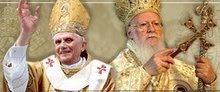
The following is from an excellent blog (now lost) by an Evangelical considering both Catholicism and Orthodoxy. This individual was convinced that both were the origin of the true, historical Church established by Christ and was planning on converting to one or the other after much consideration. This is one of his reflections that is about a very interesting book. Soloviev was a Russian Orthodox who is believed to have converted to Catholicism on his death-bed.
==========================================================================
[from Irenaeus, the blog author and would-be convert of either Orthodoxy/Catholicism]
I thought I might blog more on this book, but I don't know if there is much I want to say. Catholics would like it, and the Orthodox, well, not so much. It presumes a lot of history I don't have down cold. The writing, however, is strong and engaging.
Whether it's finally compelling or not, I found most interesting his discussion of the relationship of Christology to the State, suggesting that the politics of the East were infected by the heresies of the East, with deleterious consequences. Please note, I'm not trying to annoy my Orthodox readers by posting this. I plan on returning to Markides and his positive valuation of Orthodox life shortly:
This "Orthodoxy" of the Byzantines was in fact nothing but ingrown heresy. The true central dogma of Christianity is the intimate and complete union of the divine and human without confusion or division. The logical consequence...is the regeneration of social and political life by the spirit of the gospel, in other words the Christianization of society and the state. Instead of this synthetic and organic union of the divine and the human, the two elements were in turn confused or divided, or one of them was absorbed or suppressed by the other.
To begin with, the divine and the human were confused in the sacred majesty of the emperor. Just as -- in the confused thought of the Arians -- Christ was a hybrid being, more than man and less than God, so caesaropapism, which was simply political Arianism, confused the temporal and spiritual powers without uniting them, and made the autocrat something more than the head of the state without succeeding in making him a true head of the church.
Religious society was separated from secular society, the former being relegated to the monasteries while the forum was abandoned to pagan laws and passions. The dualism of Nestorius, condemned in theology, became the very foundation of Byzantine life. Or again, the religious ideal was reduced to bare contemplation, that is, to the absorption of the human spirit in the Godhead, an obviously Monophysite ideal. The moral life, on the other hand, was robbed of its practical force by the inculcation of the supreme ideal of passive obedience and blind submission to power; that is to say, of an ideal of quietism which was in reality the denial of human will and energy, the heresy of the Monothelites. Finally, an exaggerated asceticism attempted to suppress the bodily nature of man and to shatter the living image of the divine Incarnation -- a logical though unconscious application of the Iconoclastic heresy.
This profound contradiction between professed orthodoxy and practical heresy was the Achilles' heel of the Byzantine Empire. There lay the real cause of its downfall. Indeed it deserved to fall and still more it deserved to fall before Islam. For Islam is simply sincere and logical Byzantinism, free from all its inner contradictions. It is the frank and full reaction of the spirit of the East against Christianity; it is a system in which dogma is closely related to the conditions of life and in which the belief of the individual is in perfect agreement with the social and political order [Catholic Answers abridged edition, pp. 38-40].
[Irenaeus speaking] I'm not sure what I think of this; given how the East has suffered under the Islamic hordes, I winced at that last paragraph. (I think it was CS Lewis, however, who remarked that Islam is simply the greatest Christian heresy.) I also question the criticisms of asceticism; from reading Markides (and others), it seems to me that prayer is a high task that has real results in the real world. I do believe our theological beliefs have concrete effects in the real world, however, of which most people are simply unaware. (It's always interesting doing intellectual history with people and explaining to them the historical roots of what they believe and why they came to believe it.)
The following paragraph I found more compelling:
The two great historic experiments, that of the Middle Ages and that of modern times, seem to demonstrate conclusively that neither the Church -- lacking the assistance of a secular power which is distinct from but responsible to her -- not the secular state -- relying on her own resources -- can succeed in establishing Christian justice and peace on earth. The close alliance and organic union of the two powers without confusion and without division is the indispensable condition of social progress [46-47].
PS: I also think that Western historians of various stripes have consistently misinterpreted and denigrated and neglected the Byzantine Empire...
Tuesday, January 1, 2008

Stem Cells, Then and Now

Check out Cardinal Schoenborn's excellent book.
From First Things blog...
Posted by Joseph Bottum on December 27, 2007, 12:45 PM
In the January issue of Commentary, there’s a fascinating article called “Stem Cells and the President—An Inside Account,” written by Jay Lefkowitz, who was the official “primarily responsible for advising the President” on the issue of stem cells during the debates that produced Bush’s compromise in the summer of 2001.
In “Stem Cells and the President,” Lefkowitz writes, “Now that the debate seems to be over, what can we say about Bush’s policy and the long months it took for him to devise it? I think it is fair to look upon it as a model of how to deal with the complicated scientific and ethical dilemmas that will continue to confront political leaders in the age of biotechnology.”
That’s a large claim, and it requires not only thinking about how recent breakthroughs have changed the debate but also remembering what the situation was like in 2001. There’s a touch of beyondism in the Commentary piece—a bit of the move that suggests “We must have been correct because we were attacked from both the left and the right.” It’s true, for example, that Judie Brown, the president of the American Life League, told the New York Times that after the stem-cell compromise in 2001 President Bush could “no longer describe himself as pro-life.” But if being attacked at some point by the hard-line American Life League is the criterion, few of us would qualify as pro-life.
For that matter, the two sides would gradually change their opinions in opposite directions: Many on the supporters of stem-cell researcher—including, as Lefkowitz notes, the actor Christopher Reeve and Irving Weissman of Stanford—began with mild praise of the decision and moved over the next three years to raging opposition.
Meanwhile, the compromise was generally received with mild disappointment by the pro-life side (including by First Things, which characterized the compromise as “morally defensible in principle but gravely imprudent.”) But the political left increasingly decided the issue was a winning one, and their attacks on President Bush escalated until, at the 2004 Democratic convention in Boston, the phrase stem cells was spoken from the dais dozens of times, in nearly every major speech—while the word abortion was never heard. The effect of all this work by the left was that, across the nation, Bush’s 2001 position was no longer understood as a compromise. The Democrats insisted it was a complete surrender to a pro-life extremism, and the nation, I think, came to believe the Democrats (and voted, one notes, for President Bush over John Kerry anyway—or, perhaps, voted for Bush precisely because of what it perceived as the president’s enduring pro-life stand).
Still, Lefkowitz is basically right about the reaction to the president’s address on August 9, 2001: It pleased no one particularly at the time. He attributes the president’s position to Bush’s courage in 2001, but, the man’s courage may have been better displayed by the fact that Bush stuck to his compromise even as the Democrats and the mainstream media ginned the issue up into one of the major themes of the elections of 2004, 2006, and 2008. Or, rather, what was going to be one of the major issues of the 2008 election, until this year’s breakthroughs suddenly changed the entire landscape of the debate—and gave an enormous victory to the pro-life side.
Let’s think for a moment, however, about the 2001 compromise. We tend to forget that confusion and disorganization in the first days of the Bush administration helped produce the original political crisis over stem cells: An executive order, issued in the first flurry of such orders as the new administration took office, might well have passed without comment for some time.
Once the issue was on the table, however, Bush was forced to act in the full glare of publicity. It’s easy to accept Lefkowitz’s claim that the 2001 compromise seemed the clearest solution at the time. But Lefkowitz makes too easy an elision to move from there to the claim that the recent breakthroughs are a vindication of Bush’s 2001 position—for that would require showing that the new results would not have happened, or would have happened slower, if Bush had instead refused to fund even previously created stem-cell lines.
Meanwhile, it’s not as though Bush’s compromise bought him much respite from attacks by the pro-research world or the political left. And though his speech on August 9, 2001, was a brilliant one, he missed—as he has often missed during his presidency—the chance to educate the public on the deeper pro-life position.
And yet, along the way, the public did get educated. The political left’s endless attacks on the 2001 compromise made it seem less of a compromise and more of an entirely pro-life stand. And then the new breakthroughs suddenly stranded the attackers in odd and unsustainable positions. Lefkowitz is surely right that all this marks a great triumph for President Bush. But it is one with many twists and turns between 2001 and 2007.
Saving Ecumenism from Itself
Saving Ecumenism from Itself
by Avery Cardinal Dulles
Copyright (c) 2007 First Things (December 2007).
The Oberlin conference on The Nature of the Unity We Seek, which met fifty years ago, in September 1957, marked an important stage in the ecumenical movement. For the first time, the churches in North America in large numbers committed themselves to the quest for Christian unity. The composition of the conference was diverse, including delegates from several Orthodox churches and the Protestant Episcopal Church, as well as Lutherans, Reformed, Methodists, Baptists, Disciples of Christ, Adventists, and others.
The delegates heard thoughtful addresses by a brilliant array of theologians from North America, Europe, and Asia, including a sermon by the secretary-general of the World Council of Churches, Willem A. Visser ’t Hooft. After some days of discussion, the delegates came up with a “Message to the Churches,” which recommended steps toward a greater visible manifestation of the unity of the Church.
Although I had to leave the United States in June 1957 for a three-year sojourn in Europe, I can recall the interest that the scheduled Oberlin Conference aroused in the Catholic Church even before I left. My own professor and mentor in ecumenism, Fr. Gustave Weigel, S.J., took part in the conference as one of the two Catholic observers. The other was my good friend the Paulist editor of Catholic World, John B. Sheerin.
At the time, H.P. Van Dusen judged that the Oberlin Conference “cast virtually no light on the theme which the gathering was summoned to examine,” which remains theologically defensible. But, in my estimation, the conference achieved all that could reasonably have been expected of it. Large multilateral conferences of this type, gathering for the first time, cannot be expected to come up with profound new consensus statements. The delegates were effectively exposed to the complexities of the problem in the areas of faith, liturgy, and the Christian life. They became conscious of the length of the road ahead but at the same time were eager to bring their respective churches, with God’s help, as far as they could along that road.
The ecumenical movement, which had been going on for a generation in Europe, was formally launched in the United States. Oberlin stands near the beginning of a half century of thriving ecumenical activity. The impetus toward unity was strengthened, four years later, by the General Assembly of the World Council of Churches at New Delhi and then, in 1963, by the Fourth World Conference on Faith and Order at Montreal. The full and official entry of the Catholic Church into the ecumenical movement came with the Second Vatican Council (1962-1965).
In those early days, Catholic ecumenists, like their Orthodox colleagues, were conscious that their participation in the ecumenical movement was in some ways problematic because of the claims of their own Church to possess all the means of salvation entrusted by the Lord to his Church. The Central Committee of the World Council of Churches in its Toronto statement of 1950 indicated that such claims to exclusivity were not an obstacle to membership in the World Council of Churches, provided that the churches in question were at least able to recognize “vestiges” or “elements” of the true Church in communities other than their own.
Without concealing or minimizing the specific claims of the Catholic Church, the Second Vatican Council found ways of showing how that Church could and should pursue ecumenism. Four important insights, all expressed by Vatican II, undergirded the commitment of Catholics to this new apostolate.
First of all, the scandal of Christian division posed difficulties for the Catholic Church’s own missionary work. It was a stumbling block that impeded what the council called “the most holy cause of proclaiming the gospel to every creature.” Non-Christians often reacted to missionary efforts with the feeling that, before asking them to convert, the missionaries ought to agree among themselves about what Christianity is. Why should the past quarrels among European or American Christians, some asked, be visited upon young churches from other parts of the world? Did it make any sense for an African, for example, to join the Swedish Lutheran Church or to become a Southern Baptist?
In the second place, the Catholic Church recognized that the divisions among Christians impoverished her catholicity. She lacked the natural and cultural endowments that other Christians could have contributed if they were united with her. Catholicity required that all the riches of the nations should be gathered into the one Church and harvested for the glory of God.
Third, the fullness of Christianity in Catholicism did not imply that all other churches were devoid of truth and grace. For all their differences, they shared considerable commonalities in faith, worship, and ministerial order. The council taught, in fact, that non-Catholic churches and communions were “by no means deprived of significance and importance for the mystery of salvation” because the Holy Spirit could use them as instruments of grace. Vatican II, therefore, represents a sharp turn away from the purely negative evaluation of non-Catholic Christianity that was characteristic of the previous three centuries.
And fourth, the Catholic Church, insofar as she was made up of human members and administered by them, was always in need of purification and reform. Through ecumenical contacts, other Christian communities could help her to correct what was amiss, to supply what was lacking, and to update what was obsolete.
Regarding the ecclesial status of non-Catholic Christians, Pius XII had taught as late as 1943 that they could not be true members of the Church because the Body of Christ was identical with the Catholic Church. Such Christians could not belong to the body except by virtue of some implicit desire, which would give them a relation that fell short of true incorporation. From a different point of view, Vatican II taught that every valid baptism incorporates the recipient into the crucified and glorified Christ, and that all baptized Christians were to some extent in communion with the Catholic Church. Their status, therefore, was quite different from that of non-Christians, although these, too, could be related by desire or orientation to the People of God.
Relying on the new ecclesiology of communion, Catholic ecumenists now perceived their task as a movement from lesser to greater degrees of communion. All who believed in Christ and were baptized in his name already possessed a certain imperfect communion, which could be recognized, celebrated, and deepened. The ecumenical movement aspired to the full restoration of the impaired communion among separated churches and communities. Paul VI felt authorized to declare that the communion between the Catholic and Orthodox churches was “almost complete.”
Following the example set by John XXIII, the next few popes cultivated cordial relationships with prominent leaders of other churches. Paul VI enjoyed relations of deep affection and respect with Patriarch Athenagoras I of Constantinople and Archbishop Michael Ramsey of Canterbury. John Paul II continued this tradition and in his encyclical Ut Unum Sint (1995) reaffirmed the Catholic Church’s commitment to ecumenism as a permanent priority. Benedict XVI in his inaugural homily as pope, on April 24, 2005, renewed this commitment. His meetings with Patriarch Bartholomew of Constantinople and with Archbishop Rowan Williams of Canterbury have been major landmarks in his pontificate.
The principal instrument of ecumenism over the past half century has been a series of theological conversations between separated churches. Proceeding on the basis of what they held in common, the partners tried to show that their shared patrimony contained the seeds of much closer agreement than had yet been recognized. Rereading their confessional documents in light of Scripture and early creeds as shared authorities, they produced remarkable convergence statements on traditionally divisive subjects such as justification, Mariology, Scripture and tradition, the Eucharist, and the ordained ministry. The achievements of the Anglican-Roman Catholic International Commission (ARCIC), the Groupe des Dombes, and the World Commission on Faith and Order in its Lima paper on baptism, Eucharist, and ministry deserve our admiration. I personally stand by the ecumenical statements that I have signed, including those of the Lutheran-Catholic Dialogue and of Evangelicals and Catholics Together.
And yet, valuable though it was, the convergence method was not without limitations. Each new round of dialogue raised expectations for the future. The next dialogue, at the price of failure, was under pressure to come up with new agreements. The process would at some point reach a stage at which it had delivered about as much as it could. It would eventually run up against hard differences that resisted elimination by this method of convergence.
When the dialogues attempted to go beyond convergence and achieve full reconciliation on divisive issues, they sometimes overreached themselves. Although not all would agree, I think the much vaunted Lutheran-Catholic Joint Declaration on Justification by Faith, signed in 1999, exaggerated the agreements. After stating quite correctly that the Lutheran and Catholic dialogues of previous decades had come to a basic consensus on the doctrine of justification by grace through faith, the Joint Declaration goes on to assert, more dubiously, that the remaining disagreements could now be written off as “differences of language, theological elaboration, and emphasis,” and therefore as not warranting condemnation from either side. It even described these differences as “acceptable.”
In my judgment, some of the unresolved differences are more correctly classified as matters of doctrine. Is the justified person always and inevitably a sinner worthy of condemnation in the sight of God? Are human beings able, with the help of grace, to dispose themselves to receive sanctifying grace? Can they merit an increase of grace and heavenly glory with the help of the grace they already have? Do sinners, after receiving forgiveness, still have an obligation to make satisfaction for their misdeeds? On questions such as these, Lutherans and Catholics seem to give incompatible answers. Nothing in the Joint Declaration persuades me that such differences are mere matters of theological speculation or linguistic formulation.
Bilateral conversations have been particularly useful for churches with a firm and ample doctrinal tradition, such as the Orthodox, the Lutheran, the Anglican, and the Catholic. They have dispelled past prejudices, identified real but unsuspected agreements, and enabled the parties to say more together than they previously deemed possible. But to the extent that churches rely on different normative sources or different exegetical methods, the dialogues have been less fruitful.
Many of the twentieth-century dialogues have opted to take Scripture, interpreted by the historical-critical method, as their primary norm. This method has worked reasonably well for mainline Protestant churches and for the Catholic Church since Vatican II. But many Christians do not rely on the critical approach to Scripture as normative. Catholics themselves, without rejecting the historical-critical method, profess many doctrines that enjoy little support from Scripture, interpreted in this manner. They draw on allegorical or spiritual exegesis, authenticated by the sense of the faithful and long-standing theological tradition. As a consequence, certain Catholic doctrines, such as papal primacy, the Immaculate Conception, the Assumption, and purgatory, have been banished to the sidelines. Unable to cope with doctrines such as these, the dialogues have treated them as an ecumenical embarrassment.
Dialogues conducted according to the dominant methods of the past century have tended to be reductive, and many doctrinally conservative Christians, strongly wedded to their beliefs, have abstained from ecumenical involvements for fear of doctrinal compromise. Indeed, since the 1980s, some of the churches heavily committed to ecumenical dialogue have shown anxiety about maintaining their own identity. Some observers speak of a reconfessionalization in the ecumenical landscape.
The negative criticisms of the Joint Declaration from both the Protestant and the Catholic sides are illustrative of this new tendency. Without wanting a return to the polemics of the past, some critics fear that a vague spirit of civility is being allowed to replace the theological candor and rigor of earlier centuries.
This reaction against immoderate irenicism may be found in some recent official teaching of the Catholic Church. A new concern for orthodoxy, as Walter Kasper has noted, lies behind the “Letter on Some Aspects of the Church Considered as Communio” issued by the Congregation for the Doctrine of the Faith in 1992. The same is true of the declaration Dominus Iesus issued by the same congregation in 2000 and of the “Note on the Expression ‘Sister Churches’” issued at the same time.
Dominus Iesus, in particular, goes further in the direction of Catholic exclusivity than does Vatican II, as the council has generally been understood. Reacting against ecclesial relativism, it vigorously denies that the Church exists today in a fragmented form, in which no one body could claim identity with the Church of Christ. This declaration contains no suggestion that the Body of Christ is broader than the Catholic Church or that one may be incorporated in the former without being a member of the latter. Instead it asserts that in holding that the Church of Christ “subsists” in the Roman Catholic communion, the council intended to say that the Church of Christ, his Body and Bride, is identical with the Catholic Church, outside of which there are only elements or fragments of the true Church.
The teaching of Dominus Iesus is repeated in substance in the “Responses to Some Questions Regarding Certain Aspects of the Doctrine of the Church” made public by the Congregation for the Doctrine of the Faith on July 10, 2007. One minor difference is that where Dominus Iesus had asserted that the Church of Christ is “present and operative” in all churches that have preserved the apostolic succession and a valid Eucharist, the Responses state that the same may be true of ecclesial communities that have not preserved these structural elements.
Some would regard the recent trend toward reconfessionalization as a defeat for ecumenism. This judgment would be true if it meant a retreat of the confessions into their own shells and a refusal to encounter others. But reconfessionalization need not mean what Cardinal Kasper calls “an apprehensive, self-absorbed, defensive attitude.” It may be an opening to a new kind of dialogue, in which the partners are eager to express their own distinctive heritage so that they may be able to share it with others.
John Paul II consistently opposed styles of ecumenism that seemed to aim at settling for a least common denominator. In an address to the Roman Curia on June 28, 1980, he laid down the principle that “the unity of Christians cannot be sought in a ‘compromise’ between the various theological positions, but only in a common meeting in the most ample and mature fullness of Christian truth.” In his encyclical Ut Unum Sint he proposed a better alternative. After stating that “the unity willed by God can be attained only by the adherence of all to the content of revealed truth in its entirety,” he went on to say that dialogue is not merely an exchange of ideas but also, in some way, “an exchange of gifts.” Later, in the same encyclical, he wrote: “Communion is made fruitful by the exchange of gifts between the churches insofar as they complement each other.” In these words he called for a new chapter in the history of ecumenism.
For some years now, I have felt that the method of convergence, which seeks to harmonize the doctrines of each ecclesial tradition on the basis of shared sources and methods, has nearly exhausted its potential. It has served well in the past and may still be useful, especially among groups that have hitherto been isolated from the conversation. But to surmount the remaining barriers we need a different method, one that invites a deeper conversion on the part of the churches themselves. I have therefore been urging an ecumenism of mutual enrichment by means of testimony. This proposal corresponds closely, I believe, with John Paul II’s idea of seeking the fullness of truth by means of an “exchange of gifts.”
There are not many examples of the kind of ecumenical encounter I am envisaging, but one comes to my mind. In January 2006, the theology department at Durham University hosted at Ushaw College, a neighboring Catholic seminary, an international conference of Catholics in conversation with Orthodox, Anglicans, and Methodists. Conducting an experiment in what the conference called “receptive ecumenism,” the speakers were asked to discuss what they could find in their own traditions that might be acceptable to the Catholic Church without detriment to its identity. The Catholic participants, including Cardinal Kasper, were asked to evaluate the suggestions and judge their practical feasibility. The discussion, I am told, was informal and did not lead to any set of agreed conclusions.
Unlike some recent models of dialogue, ecumenism of this style leaves the participants free to draw on their own normative sources and does not constrain them to bracket or minimize what is specific to themselves. Far from being embarrassed by their own distinctive doctrines and practices, each partner should feel privileged to be able to contribute something positive that the others still lack.
This does not mean, of course, that the churches should be uncritical of themselves or others. Where they express, or hear others expressing, singular beliefs, they should carefully examine the grounds for such views. But that is different from abdicating or suppressing their special convictions as a matter of principle.
With this mentality, Catholics would want to hear from the churches of the Reformation the reasons they have for speaking as they do of Christ alone, Scripture alone, grace alone, and faith alone, while Catholics tend to speak of Christ and the Church, Scripture and tradition, grace and cooperation, faith and works. We would want to learn from them how to make better use of the laity as sharers in the priesthood of the whole People of God. We would want to hear from evangelicals about their experience of conversion and from Pentecostals about perceiving the free action of the Holy Spirit in their lives. The Orthodox would have much to tell about liturgical piety, holy tradition, sacred images, and synodical styles of polity. We would not want any of these distinctive endowments of other ecclesial families to be muted or shunted aside for the sake of having shared premises or an agreed method.
Conversely, Catholics would not hesitate to go into the dialogue with the full panoply of beliefs, sustained by our own methods of certifying the truth of revelation. We are not ashamed of our reliance on tradition, the liturgy, the sense of the faithful, and our confidence in the judgment of the Magisterium.
One of the doctrines most distinctive to the Catholic Church is surely the primacy of the pope as the successor of Peter—a primacy that the First Vatican Council set forth in clear, uncompromising language. Because Catholics cherish this doctrine, we should not be content to keep it to ourselves. The successor of Peter, we believe, is intended by Christ to be the visible head of all Christians. Without accepting his ministry, Christians will never attain the kind of universal concord that God wills the Church to have as a sign and sacrament of unity. They will inevitably fall into conflict with one another regarding doctrine, discipline, and ways of worship. No church can simply institute for itself an office that has authority to pronounce finally on disputed doctrines. If it exists at all, this office must have been instituted by Christ and must enjoy the assistance of the Holy Spirit. The Petrine office is a precious gift that the Lord has given us not only for our own consolation but as something to be held in trust for the entire oikoumene.
John Paul II in Ut Unum Sint expressed a desire to work with leaders and theologians of other churches in seeking ways for the Petrine office to be exercised such that it could be beneficial to them as well as to Catholics. These other churches and communities will have to consider the ways in which they could receive the primatial ministry of the bishop of Rome. A dialogue on this subject is already underway. For some communities, perhaps, the papacy will be the final piece by which to complete the jigsaw puzzle of Christian unity.
Each party will engage in ecumenical dialogue with its own presuppositions and convictions. As a Roman Catholic, I would make use of the methods by which my church derives its distinctive doctrines. I would also expect that any reunion to which Catholics can be a party would have to include as part of the settlement the Catholic dogmas, perhaps reinterpreted in ways that we do not now foresee. Other churches and ecclesial communities will have their own expectations. But all must be open to possible conversion. We must rely on the Holy Spirit to lead us, as Vatican II recommended, “without obstructing the ways of divine Providence and without prejudging the future inspiration of the Holy Spirit.”
How then can Christian unity be envisaged? That is the question asked at Oberlin five decades ago. The first condition, I believe, is that the various Christian communities be ready to speak and listen to one another. Some will perhaps receive the grace to accept what they hear credibly attested as an insight from other communities. The witnesses and their hearers need not insist on rigorous proof, because very little of our faith can be demonstrated by deductive methods. Testimony operates by a different logic. We speak of what has been graciously manifested to us and what we have found to be of value for our relationship with God. If others accept what we proclaim, it is because our words evoke an echo in them and carry the hallmark of truth.
The process of growth through mutual attestation will probably never reach its final consummation within historical time, but it can bring palpable results. It can lead the churches to emerge progressively from their present isolation into something more like a harmonious chorus. Enriched by the gifts of others, they can hope to raise their voices together in a single hymn to the glory of the triune God. The result to be sought is unity in diversity.
True progress in ecumenism requires obedience to the Holy Spirit. Vatican II rightly identified spiritual ecumenism as the soul of the ecumenical movement. It defined spiritual ecumenism as a change of heart and holiness of life, together with public and private prayer for the unity of Christians. We must pray to God to overcome our deafness and open our ears to what the Spirit is saying to the churches, including our own. No mutual rapprochement can be of any value unless it is also a closer approach to Christ the Lord of the Church. We must ask for the grace to say only what the Spirit bids us say and to hear all that he is telling us through the other.
Then we may hope that, by accommodating what other communities are trying to tell us, we may be enriched with new and precious gifts. By accepting the full riches of Christ we lose nothing except our errors and defects. What we gain is the greatest gift of all: a deeper share in the truth of Christ, who said of himself, “I am the way, and the truth, and the life.”
Avery Cardinal Dulles, S.J., holds the Laurence J. McGinley Chair in Religion and Society at Fordham University. This essay is adapted from a lecture delivered at the National Council of Churches’ Faith and Order Conference at Oberlin, Ohio.
by Avery Cardinal Dulles
Copyright (c) 2007 First Things (December 2007).
The Oberlin conference on The Nature of the Unity We Seek, which met fifty years ago, in September 1957, marked an important stage in the ecumenical movement. For the first time, the churches in North America in large numbers committed themselves to the quest for Christian unity. The composition of the conference was diverse, including delegates from several Orthodox churches and the Protestant Episcopal Church, as well as Lutherans, Reformed, Methodists, Baptists, Disciples of Christ, Adventists, and others.
The delegates heard thoughtful addresses by a brilliant array of theologians from North America, Europe, and Asia, including a sermon by the secretary-general of the World Council of Churches, Willem A. Visser ’t Hooft. After some days of discussion, the delegates came up with a “Message to the Churches,” which recommended steps toward a greater visible manifestation of the unity of the Church.
Although I had to leave the United States in June 1957 for a three-year sojourn in Europe, I can recall the interest that the scheduled Oberlin Conference aroused in the Catholic Church even before I left. My own professor and mentor in ecumenism, Fr. Gustave Weigel, S.J., took part in the conference as one of the two Catholic observers. The other was my good friend the Paulist editor of Catholic World, John B. Sheerin.
At the time, H.P. Van Dusen judged that the Oberlin Conference “cast virtually no light on the theme which the gathering was summoned to examine,” which remains theologically defensible. But, in my estimation, the conference achieved all that could reasonably have been expected of it. Large multilateral conferences of this type, gathering for the first time, cannot be expected to come up with profound new consensus statements. The delegates were effectively exposed to the complexities of the problem in the areas of faith, liturgy, and the Christian life. They became conscious of the length of the road ahead but at the same time were eager to bring their respective churches, with God’s help, as far as they could along that road.
The ecumenical movement, which had been going on for a generation in Europe, was formally launched in the United States. Oberlin stands near the beginning of a half century of thriving ecumenical activity. The impetus toward unity was strengthened, four years later, by the General Assembly of the World Council of Churches at New Delhi and then, in 1963, by the Fourth World Conference on Faith and Order at Montreal. The full and official entry of the Catholic Church into the ecumenical movement came with the Second Vatican Council (1962-1965).
In those early days, Catholic ecumenists, like their Orthodox colleagues, were conscious that their participation in the ecumenical movement was in some ways problematic because of the claims of their own Church to possess all the means of salvation entrusted by the Lord to his Church. The Central Committee of the World Council of Churches in its Toronto statement of 1950 indicated that such claims to exclusivity were not an obstacle to membership in the World Council of Churches, provided that the churches in question were at least able to recognize “vestiges” or “elements” of the true Church in communities other than their own.
Without concealing or minimizing the specific claims of the Catholic Church, the Second Vatican Council found ways of showing how that Church could and should pursue ecumenism. Four important insights, all expressed by Vatican II, undergirded the commitment of Catholics to this new apostolate.
First of all, the scandal of Christian division posed difficulties for the Catholic Church’s own missionary work. It was a stumbling block that impeded what the council called “the most holy cause of proclaiming the gospel to every creature.” Non-Christians often reacted to missionary efforts with the feeling that, before asking them to convert, the missionaries ought to agree among themselves about what Christianity is. Why should the past quarrels among European or American Christians, some asked, be visited upon young churches from other parts of the world? Did it make any sense for an African, for example, to join the Swedish Lutheran Church or to become a Southern Baptist?
In the second place, the Catholic Church recognized that the divisions among Christians impoverished her catholicity. She lacked the natural and cultural endowments that other Christians could have contributed if they were united with her. Catholicity required that all the riches of the nations should be gathered into the one Church and harvested for the glory of God.
Third, the fullness of Christianity in Catholicism did not imply that all other churches were devoid of truth and grace. For all their differences, they shared considerable commonalities in faith, worship, and ministerial order. The council taught, in fact, that non-Catholic churches and communions were “by no means deprived of significance and importance for the mystery of salvation” because the Holy Spirit could use them as instruments of grace. Vatican II, therefore, represents a sharp turn away from the purely negative evaluation of non-Catholic Christianity that was characteristic of the previous three centuries.
And fourth, the Catholic Church, insofar as she was made up of human members and administered by them, was always in need of purification and reform. Through ecumenical contacts, other Christian communities could help her to correct what was amiss, to supply what was lacking, and to update what was obsolete.
Regarding the ecclesial status of non-Catholic Christians, Pius XII had taught as late as 1943 that they could not be true members of the Church because the Body of Christ was identical with the Catholic Church. Such Christians could not belong to the body except by virtue of some implicit desire, which would give them a relation that fell short of true incorporation. From a different point of view, Vatican II taught that every valid baptism incorporates the recipient into the crucified and glorified Christ, and that all baptized Christians were to some extent in communion with the Catholic Church. Their status, therefore, was quite different from that of non-Christians, although these, too, could be related by desire or orientation to the People of God.
Relying on the new ecclesiology of communion, Catholic ecumenists now perceived their task as a movement from lesser to greater degrees of communion. All who believed in Christ and were baptized in his name already possessed a certain imperfect communion, which could be recognized, celebrated, and deepened. The ecumenical movement aspired to the full restoration of the impaired communion among separated churches and communities. Paul VI felt authorized to declare that the communion between the Catholic and Orthodox churches was “almost complete.”
Following the example set by John XXIII, the next few popes cultivated cordial relationships with prominent leaders of other churches. Paul VI enjoyed relations of deep affection and respect with Patriarch Athenagoras I of Constantinople and Archbishop Michael Ramsey of Canterbury. John Paul II continued this tradition and in his encyclical Ut Unum Sint (1995) reaffirmed the Catholic Church’s commitment to ecumenism as a permanent priority. Benedict XVI in his inaugural homily as pope, on April 24, 2005, renewed this commitment. His meetings with Patriarch Bartholomew of Constantinople and with Archbishop Rowan Williams of Canterbury have been major landmarks in his pontificate.
The principal instrument of ecumenism over the past half century has been a series of theological conversations between separated churches. Proceeding on the basis of what they held in common, the partners tried to show that their shared patrimony contained the seeds of much closer agreement than had yet been recognized. Rereading their confessional documents in light of Scripture and early creeds as shared authorities, they produced remarkable convergence statements on traditionally divisive subjects such as justification, Mariology, Scripture and tradition, the Eucharist, and the ordained ministry. The achievements of the Anglican-Roman Catholic International Commission (ARCIC), the Groupe des Dombes, and the World Commission on Faith and Order in its Lima paper on baptism, Eucharist, and ministry deserve our admiration. I personally stand by the ecumenical statements that I have signed, including those of the Lutheran-Catholic Dialogue and of Evangelicals and Catholics Together.
And yet, valuable though it was, the convergence method was not without limitations. Each new round of dialogue raised expectations for the future. The next dialogue, at the price of failure, was under pressure to come up with new agreements. The process would at some point reach a stage at which it had delivered about as much as it could. It would eventually run up against hard differences that resisted elimination by this method of convergence.
When the dialogues attempted to go beyond convergence and achieve full reconciliation on divisive issues, they sometimes overreached themselves. Although not all would agree, I think the much vaunted Lutheran-Catholic Joint Declaration on Justification by Faith, signed in 1999, exaggerated the agreements. After stating quite correctly that the Lutheran and Catholic dialogues of previous decades had come to a basic consensus on the doctrine of justification by grace through faith, the Joint Declaration goes on to assert, more dubiously, that the remaining disagreements could now be written off as “differences of language, theological elaboration, and emphasis,” and therefore as not warranting condemnation from either side. It even described these differences as “acceptable.”
In my judgment, some of the unresolved differences are more correctly classified as matters of doctrine. Is the justified person always and inevitably a sinner worthy of condemnation in the sight of God? Are human beings able, with the help of grace, to dispose themselves to receive sanctifying grace? Can they merit an increase of grace and heavenly glory with the help of the grace they already have? Do sinners, after receiving forgiveness, still have an obligation to make satisfaction for their misdeeds? On questions such as these, Lutherans and Catholics seem to give incompatible answers. Nothing in the Joint Declaration persuades me that such differences are mere matters of theological speculation or linguistic formulation.
Bilateral conversations have been particularly useful for churches with a firm and ample doctrinal tradition, such as the Orthodox, the Lutheran, the Anglican, and the Catholic. They have dispelled past prejudices, identified real but unsuspected agreements, and enabled the parties to say more together than they previously deemed possible. But to the extent that churches rely on different normative sources or different exegetical methods, the dialogues have been less fruitful.
Many of the twentieth-century dialogues have opted to take Scripture, interpreted by the historical-critical method, as their primary norm. This method has worked reasonably well for mainline Protestant churches and for the Catholic Church since Vatican II. But many Christians do not rely on the critical approach to Scripture as normative. Catholics themselves, without rejecting the historical-critical method, profess many doctrines that enjoy little support from Scripture, interpreted in this manner. They draw on allegorical or spiritual exegesis, authenticated by the sense of the faithful and long-standing theological tradition. As a consequence, certain Catholic doctrines, such as papal primacy, the Immaculate Conception, the Assumption, and purgatory, have been banished to the sidelines. Unable to cope with doctrines such as these, the dialogues have treated them as an ecumenical embarrassment.
Dialogues conducted according to the dominant methods of the past century have tended to be reductive, and many doctrinally conservative Christians, strongly wedded to their beliefs, have abstained from ecumenical involvements for fear of doctrinal compromise. Indeed, since the 1980s, some of the churches heavily committed to ecumenical dialogue have shown anxiety about maintaining their own identity. Some observers speak of a reconfessionalization in the ecumenical landscape.
The negative criticisms of the Joint Declaration from both the Protestant and the Catholic sides are illustrative of this new tendency. Without wanting a return to the polemics of the past, some critics fear that a vague spirit of civility is being allowed to replace the theological candor and rigor of earlier centuries.
This reaction against immoderate irenicism may be found in some recent official teaching of the Catholic Church. A new concern for orthodoxy, as Walter Kasper has noted, lies behind the “Letter on Some Aspects of the Church Considered as Communio” issued by the Congregation for the Doctrine of the Faith in 1992. The same is true of the declaration Dominus Iesus issued by the same congregation in 2000 and of the “Note on the Expression ‘Sister Churches’” issued at the same time.
Dominus Iesus, in particular, goes further in the direction of Catholic exclusivity than does Vatican II, as the council has generally been understood. Reacting against ecclesial relativism, it vigorously denies that the Church exists today in a fragmented form, in which no one body could claim identity with the Church of Christ. This declaration contains no suggestion that the Body of Christ is broader than the Catholic Church or that one may be incorporated in the former without being a member of the latter. Instead it asserts that in holding that the Church of Christ “subsists” in the Roman Catholic communion, the council intended to say that the Church of Christ, his Body and Bride, is identical with the Catholic Church, outside of which there are only elements or fragments of the true Church.
The teaching of Dominus Iesus is repeated in substance in the “Responses to Some Questions Regarding Certain Aspects of the Doctrine of the Church” made public by the Congregation for the Doctrine of the Faith on July 10, 2007. One minor difference is that where Dominus Iesus had asserted that the Church of Christ is “present and operative” in all churches that have preserved the apostolic succession and a valid Eucharist, the Responses state that the same may be true of ecclesial communities that have not preserved these structural elements.
Some would regard the recent trend toward reconfessionalization as a defeat for ecumenism. This judgment would be true if it meant a retreat of the confessions into their own shells and a refusal to encounter others. But reconfessionalization need not mean what Cardinal Kasper calls “an apprehensive, self-absorbed, defensive attitude.” It may be an opening to a new kind of dialogue, in which the partners are eager to express their own distinctive heritage so that they may be able to share it with others.
John Paul II consistently opposed styles of ecumenism that seemed to aim at settling for a least common denominator. In an address to the Roman Curia on June 28, 1980, he laid down the principle that “the unity of Christians cannot be sought in a ‘compromise’ between the various theological positions, but only in a common meeting in the most ample and mature fullness of Christian truth.” In his encyclical Ut Unum Sint he proposed a better alternative. After stating that “the unity willed by God can be attained only by the adherence of all to the content of revealed truth in its entirety,” he went on to say that dialogue is not merely an exchange of ideas but also, in some way, “an exchange of gifts.” Later, in the same encyclical, he wrote: “Communion is made fruitful by the exchange of gifts between the churches insofar as they complement each other.” In these words he called for a new chapter in the history of ecumenism.
For some years now, I have felt that the method of convergence, which seeks to harmonize the doctrines of each ecclesial tradition on the basis of shared sources and methods, has nearly exhausted its potential. It has served well in the past and may still be useful, especially among groups that have hitherto been isolated from the conversation. But to surmount the remaining barriers we need a different method, one that invites a deeper conversion on the part of the churches themselves. I have therefore been urging an ecumenism of mutual enrichment by means of testimony. This proposal corresponds closely, I believe, with John Paul II’s idea of seeking the fullness of truth by means of an “exchange of gifts.”
There are not many examples of the kind of ecumenical encounter I am envisaging, but one comes to my mind. In January 2006, the theology department at Durham University hosted at Ushaw College, a neighboring Catholic seminary, an international conference of Catholics in conversation with Orthodox, Anglicans, and Methodists. Conducting an experiment in what the conference called “receptive ecumenism,” the speakers were asked to discuss what they could find in their own traditions that might be acceptable to the Catholic Church without detriment to its identity. The Catholic participants, including Cardinal Kasper, were asked to evaluate the suggestions and judge their practical feasibility. The discussion, I am told, was informal and did not lead to any set of agreed conclusions.
Unlike some recent models of dialogue, ecumenism of this style leaves the participants free to draw on their own normative sources and does not constrain them to bracket or minimize what is specific to themselves. Far from being embarrassed by their own distinctive doctrines and practices, each partner should feel privileged to be able to contribute something positive that the others still lack.
This does not mean, of course, that the churches should be uncritical of themselves or others. Where they express, or hear others expressing, singular beliefs, they should carefully examine the grounds for such views. But that is different from abdicating or suppressing their special convictions as a matter of principle.
With this mentality, Catholics would want to hear from the churches of the Reformation the reasons they have for speaking as they do of Christ alone, Scripture alone, grace alone, and faith alone, while Catholics tend to speak of Christ and the Church, Scripture and tradition, grace and cooperation, faith and works. We would want to learn from them how to make better use of the laity as sharers in the priesthood of the whole People of God. We would want to hear from evangelicals about their experience of conversion and from Pentecostals about perceiving the free action of the Holy Spirit in their lives. The Orthodox would have much to tell about liturgical piety, holy tradition, sacred images, and synodical styles of polity. We would not want any of these distinctive endowments of other ecclesial families to be muted or shunted aside for the sake of having shared premises or an agreed method.
Conversely, Catholics would not hesitate to go into the dialogue with the full panoply of beliefs, sustained by our own methods of certifying the truth of revelation. We are not ashamed of our reliance on tradition, the liturgy, the sense of the faithful, and our confidence in the judgment of the Magisterium.
One of the doctrines most distinctive to the Catholic Church is surely the primacy of the pope as the successor of Peter—a primacy that the First Vatican Council set forth in clear, uncompromising language. Because Catholics cherish this doctrine, we should not be content to keep it to ourselves. The successor of Peter, we believe, is intended by Christ to be the visible head of all Christians. Without accepting his ministry, Christians will never attain the kind of universal concord that God wills the Church to have as a sign and sacrament of unity. They will inevitably fall into conflict with one another regarding doctrine, discipline, and ways of worship. No church can simply institute for itself an office that has authority to pronounce finally on disputed doctrines. If it exists at all, this office must have been instituted by Christ and must enjoy the assistance of the Holy Spirit. The Petrine office is a precious gift that the Lord has given us not only for our own consolation but as something to be held in trust for the entire oikoumene.
John Paul II in Ut Unum Sint expressed a desire to work with leaders and theologians of other churches in seeking ways for the Petrine office to be exercised such that it could be beneficial to them as well as to Catholics. These other churches and communities will have to consider the ways in which they could receive the primatial ministry of the bishop of Rome. A dialogue on this subject is already underway. For some communities, perhaps, the papacy will be the final piece by which to complete the jigsaw puzzle of Christian unity.
Each party will engage in ecumenical dialogue with its own presuppositions and convictions. As a Roman Catholic, I would make use of the methods by which my church derives its distinctive doctrines. I would also expect that any reunion to which Catholics can be a party would have to include as part of the settlement the Catholic dogmas, perhaps reinterpreted in ways that we do not now foresee. Other churches and ecclesial communities will have their own expectations. But all must be open to possible conversion. We must rely on the Holy Spirit to lead us, as Vatican II recommended, “without obstructing the ways of divine Providence and without prejudging the future inspiration of the Holy Spirit.”
How then can Christian unity be envisaged? That is the question asked at Oberlin five decades ago. The first condition, I believe, is that the various Christian communities be ready to speak and listen to one another. Some will perhaps receive the grace to accept what they hear credibly attested as an insight from other communities. The witnesses and their hearers need not insist on rigorous proof, because very little of our faith can be demonstrated by deductive methods. Testimony operates by a different logic. We speak of what has been graciously manifested to us and what we have found to be of value for our relationship with God. If others accept what we proclaim, it is because our words evoke an echo in them and carry the hallmark of truth.
The process of growth through mutual attestation will probably never reach its final consummation within historical time, but it can bring palpable results. It can lead the churches to emerge progressively from their present isolation into something more like a harmonious chorus. Enriched by the gifts of others, they can hope to raise their voices together in a single hymn to the glory of the triune God. The result to be sought is unity in diversity.
True progress in ecumenism requires obedience to the Holy Spirit. Vatican II rightly identified spiritual ecumenism as the soul of the ecumenical movement. It defined spiritual ecumenism as a change of heart and holiness of life, together with public and private prayer for the unity of Christians. We must pray to God to overcome our deafness and open our ears to what the Spirit is saying to the churches, including our own. No mutual rapprochement can be of any value unless it is also a closer approach to Christ the Lord of the Church. We must ask for the grace to say only what the Spirit bids us say and to hear all that he is telling us through the other.
Then we may hope that, by accommodating what other communities are trying to tell us, we may be enriched with new and precious gifts. By accepting the full riches of Christ we lose nothing except our errors and defects. What we gain is the greatest gift of all: a deeper share in the truth of Christ, who said of himself, “I am the way, and the truth, and the life.”
Avery Cardinal Dulles, S.J., holds the Laurence J. McGinley Chair in Religion and Society at Fordham University. This essay is adapted from a lecture delivered at the National Council of Churches’ Faith and Order Conference at Oberlin, Ohio.
Global Warming: man-made doomsday, or simply a natural cycle?

U.S. Senate Report: Over 400 Prominent Scientists Disputed Man-Made Global Warming Claims in 2007
Posted By Marc Morano - Marc_Morano@EPW.Senate.Gov - 9:47 AM ET
originally posted on this link:
http://epw.senate.gov/public/index.cfm?FuseAction=Minority.Blogs&
ContentRecord_id=f80a6386-802a-23ad-40c8-3c63dc2d02cb
Senate Report Debunks "Consensus"
Complete U.S. Senate Report Now Available:
INTRODUCTION:
Over 400 prominent scientists from more than two dozen countries recently voiced significant objections to major aspects of the so-called "consensus" on man-made global warming. These scientists, many of whom are current and former participants in the UN IPCC (Intergovernmental Panel on Climate Change), criticized the climate claims made by the UN IPCC and former Vice President Al Gore.
The new report issued by the Senate Environment and Public Works Committee’s office of the GOP Ranking Member details the views of the scientists, the overwhelming majority of whom spoke out in 2007.
Even some in the establishment media now appear to be taking notice of the growing number of skeptical scientists. In October, the Washington Post Staff Writer Juliet Eilperin conceded the obvious, writing that climate skeptics "appear to be expanding rather than shrinking." Many scientists from around the world have dubbed 2007 as the year man-made global warming fears “bite the dust.” (LINK) In addition, many scientists who are also progressive environmentalists believe climate fear promotion has "co-opted" the green movement. (LINK)
This blockbuster Senate report lists the scientists by name, country of residence, and academic/institutional affiliation. It also features their own words, biographies, and weblinks to their peer reviewed studies and original source materials as gathered from public statements, various news outlets, and websites in 2007. This new “consensus busters” report is poised to redefine the debate.
Many of the scientists featured in this report consistently stated that numerous colleagues shared their views, but they will not speak out publicly for fear of retribution. Atmospheric scientist Dr. Nathan Paldor, Professor of Dynamical Meteorology and Physical Oceanography at the Hebrew University of Jerusalem, author of almost 70 peer-reviewed studies, explains how many of his fellow scientists have been intimidated.
“Many of my colleagues with whom I spoke share these views and report on their inability to publish their skepticism in the scientific or public media,” Paldor wrote. [Note: See also July 2007 Senate report detailing how skeptical scientists have faced threats and intimidation - LINK ]
Scientists from Around the World Dissent
This new report details how teams of international scientists are dissenting from the UN IPCC’s view of climate science. In such nations as Germany, Brazil, the Netherlands, Russia, New Zealand and France, nations, scientists banded together in 2007 to oppose climate alarmism. In addition, over 100 prominent international scientists sent an open letter in December 2007 to the UN stating attempts to control climate were “futile.” (LINK)
Paleoclimatologist Dr. Tim Patterson, professor in the department of Earth Sciences at Carleton University in Ottawa, recently converted from a believer in man-made climate change to a skeptic. Patterson noted that the notion of a “consensus” of scientists aligned with the UN IPCC or former Vice President Al Gore is false. “I was at the Geological Society of America meeting in Philadelphia in the fall and I would say that people with my opinion were probably in the majority.”
This new committee report, a first of its kind, comes after the UN IPCC chairman Rajendra Pachauri implied that there were only “about a dozen" skeptical scientists left in the world. (LINK) Former Vice President Gore has claimed that scientists skeptical of climate change are akin to “flat Earth society members” and similar in number to those who “believe the moon landing was actually staged in a movie lot in Arizona.”
The distinguished scientists featured in this new report are experts in diverse fields, including: climatology; geology; biology; glaciology; biogeography; meteorology; oceanography; economics; chemistry; mathematics; environmental sciences; engineering; physics and paleoclimatology. Some of those profiled have won Nobel Prizes for their outstanding contribution to their field of expertise and many shared a portion of the UN IPCC Nobel Peace Prize with Vice President Gore.
Additionally, these scientists hail from prestigious institutions worldwide, including: Harvard University; NASA; National Oceanic and Atmospheric Administration (NOAA) and the National Center for Atmospheric Research (NCAR); Massachusetts Institute of Technology; the UN IPCC; the Danish National Space Center; U.S. Department of Energy; Princeton University; the Environmental Protection Agency; University of Pennsylvania; Hebrew University of Jerusalem; the International Arctic Research Centre; the Pasteur Institute in Paris; the Belgian Weather Institute; Royal Netherlands Meteorological Institute; the University of Helsinki; the National Academy of Sciences of the U.S., France, and Russia; the University of Pretoria; University of Notre Dame; Stockholm University; University of Melbourne; Columbia University; the World Federation of Scientists; and the University of London.
The voices of many of these hundreds of scientists serve as a direct challenge to the often media-hyped “consensus” that the debate is “settled.”
A May 2007 Senate report detailed scientists who had recently converted from believers in man-made global warming to skepticism. [See May 15, 2007 report: Climate Momentum Shifting: Prominent Scientists Reverse Belief in Man-made Global Warming - Now Skeptics: Growing Number of Scientists Convert to Skeptics After Reviewing New Research – (LINK) - In addition, an August 2007 report detailed how proponents of man-made global warming fears enjoy a monumental funding advantage over skeptical scientists.
This report counters the claims made by the promoters of man-made global warming fears that the number of skeptical scientists is dwindling.
Examples of “consensus” claims made by promoters of man-made climate fears:
Former Vice President Al Gore (November 5, 2007): “There are still people who believe that the Earth is flat.” (LINK) Gore also compared global warming skeptics to people who "believe the moon landing was actually staged in a movie lot in Arizona." (June 20, 2006 - LINK)
CNN’s Miles O’Brien (July 23, 2007): "The scientific debate is over," O'Brien said. “We're done." O’Brien also declared on CNN on February 9, 2006 that scientific skeptics of man-made catastrophic global warming “are bought and paid for by the fossil fuel industry, usually.” (LINK)
On July 27, 2006, Associated Press reporter Seth Borenstein described a scientist as “one of the few remaining scientists skeptical of the global warming harm caused by industries that burn fossil fuels.” (LINK)
Dr. Rajendra Pachauri, Chairman of the IPCC view on the number of skeptical scientists as quoted on Feb. 20, 2003: “About 300 years ago, a Flat Earth Society was founded by those who did not believe the world was round. That society still exists; it probably has about a dozen members.” (LINK)
Agence France-Press (AFP Press) article (December 4, 2007): The article noted that a prominent skeptic “finds himself increasingly alone in his claim that climate change poses no imminent threat to the planet.”
Andrew Dessler in the eco-publication Grist Magazine (November 21, 2007): “While some people claim there are lots of skeptical climate scientists out there, if you actually try to find one, you keep turning up the same two dozen or so (e.g., Singer, Lindzen, Michaels, Christy, etc., etc.). These skeptics are endlessly recycled by the denial machine, so someone not paying close attention might think there are lots of them out there -- but that's not the case." (LINK)
The Washington Post asserted on May 23, 2006 that there were only “a handful of skeptics” of man-made climate fears. (LINK)
UN special climate envoy Dr. Gro Harlem Brundtland on May 10, 2007 declared the climate debate "over" and added “it's completely immoral, even, to question” the UN’s scientific “consensus." (LINK)
ABC News Global Warming Reporter Bill Blakemore reported on August 30, 2006: “After extensive searches, ABC News has found no such [scientific] debate” on global warming. (LINK)
Brief highlights of the report featuring over 400 international scientists:
Israel: Dr. Nathan Paldor, Professor of Dynamical Meteorology and Physical Oceanography at the Hebrew University of Jerusalem has authored almost 70 peer-reviewed studies and won several awards. “First, temperature changes, as well as rates of temperature changes (both increase and decrease) of magnitudes similar to that reported by IPCC to have occurred since the Industrial revolution (about 0.8C in 150 years or even 0.4C in the last 35 years) have occurred in Earth's climatic history. There's nothing special about the recent rise!”
Russia: Russian scientist Dr. Oleg Sorochtin of the Institute of Oceanology at the Russian Academy of Sciences has authored more than 300 studies, nine books, and a 2006 paper titled “The Evolution and the Prediction of Global Climate Changes on Earth.” “Even if the concentration of ‘greenhouse gases’ double man would not perceive the temperature impact,” Sorochtin wrote.
Spain: Anton Uriarte, a professor of Physical Geography at the University of the Basque Country in Spain and author of a book on the paleoclimate, rejected man-made climate fears in 2007. “There's no need to be worried. It's very interesting to study [climate change], but there's no need to be worried,” Uriate wrote.
Netherlands: Atmospheric scientist Dr. Hendrik Tennekes, a scientific pioneer in the development of numerical weather prediction and former director of research at The Netherlands' Royal National Meteorological Institute, and an internationally recognized expert in atmospheric boundary layer processes, “I find the Doomsday picture Al Gore is painting – a six-meter sea level rise, fifteen times the IPCC number – entirely without merit,” Tennekes wrote. “I protest vigorously the idea that the climate reacts like a home heating system to a changed setting of the thermostat: just turn the dial, and the desired temperature will soon be reached."
Brazil: Chief Meteorologist Eugenio Hackbart of the MetSul Meteorologia Weather Center in Sao Leopoldo – Rio Grande do Sul, Brazil declared himself a skeptic. “The media is promoting an unprecedented hyping related to global warming. The media and many scientists are ignoring very important facts that point to a natural variation in the climate system as the cause of the recent global warming,” Hackbart wrote on May 30, 2007.
France: Climatologist Dr. Marcel Leroux, former professor at Université Jean Moulin and director of the Laboratory of Climatology, Risks, and Environment in Lyon, is a climate skeptic. Leroux wrote a 2005 book titled Global Warming – Myth or Reality? - The Erring Ways of Climatology. “Day after day, the same mantra - that ‘the Earth is warming up’ - is churned out in all its forms. As ‘the ice melts’ and ‘sea level rises,’ the Apocalypse looms ever nearer! Without realizing it, or perhaps without wishing to, the average citizen in bamboozled, lobotomized, lulled into mindless acceptance. ... Non-believers in the greenhouse scenario are in the position of those long ago who doubted the existence of God ... fortunately for them, the Inquisition is no longer with us!”
Norway: Geologist/Geochemist Dr. Tom V. Segalstad, a professor and head of the Geological Museum at the University of Oslo and formerly an expert reviewer with the UN IPCC: “It is a search for a mythical CO2 sink to explain an immeasurable CO2 lifetime to fit a hypothetical CO2 computer model that purports to show that an impossible amount of fossil fuel burning is heating the atmosphere. It is all a fiction.”
Finland: Dr. Boris Winterhalter, retired Senior Marine Researcher of the Geological Survey of Finland and former professor of marine geology at University of Helsinki, criticized the media for what he considered its alarming climate coverage. “The effect of solar winds on cosmic radiation has just recently been established and, furthermore, there seems to be a good correlation between cloudiness and variations in the intensity of cosmic radiation. Here we have a mechanism which is a far better explanation to variations in global climate than the attempts by IPCC to blame it all on anthropogenic input of greenhouse gases."
Germany: Paleoclimate expert Augusto Mangini of the University of Heidelberg in Germany, criticized the UN IPCC summary. “I consider the part of the IPCC report, which I can really judge as an expert, i.e. the reconstruction of the paleoclimate, wrong,” Mangini noted in an April 5, 2007 article. He added: “The earth will not die.”
Canada: IPCC 2007 Expert Reviewer Madhav Khandekar, a Ph.D meteorologist, a scientist with the Natural Resources Stewardship Project who has over 45 years experience in climatology, meteorology and oceanography, and who has published nearly 100 papers, reports, book reviews and a book on Ocean Wave Analysis and Modeling: “To my dismay, IPCC authors ignored all my comments and suggestions for major changes in the FOD (First Order Draft) and sent me the SOD (Second Order Draft) with essentially the same text as the FOD. None of the authors of the chapter bothered to directly communicate with me (or with other expert reviewers with whom I communicate on a regular basis) on many issues that were raised in my review. This is not an acceptable scientific review process.”
Czech Republic: Czech-born U.S. climatologist Dr. George Kukla, a research scientist with the Lamont-Doherty Earth Observatory at Columbia University, expressed climate skepticism in 2007. “The only thing to worry about is the damage that can be done by worrying. Why are some scientists worried? Perhaps because they feel that to stop worrying may mean to stop being paid,” Kukla told Gelf Magazine on April 24, 2007.
India: One of India's leading geologists, B.P. Radhakrishna, President of the Geological Society of India, expressed climate skepticism in 2007. “We appear to be overplaying this global warming issue as global warming is nothing new. It has happened in the past, not once but several times, giving rise to glacial-interglacial cycles.”
USA: Climatologist Robert Durrenberger, past president of the American Association of State Climatologists, and one of the climatologists who gathered at Woods Hole to review the National Climate Program Plan in July, 1979: “Al Gore brought me back to the battle and prompted me to do renewed research in the field of climatology. And because of all the misinformation that Gore and his army have been spreading about climate change I have decided that ‘real’ climatologists should try to help the public understand the nature of the problem.”
Italy: Internationally renowned scientist Dr. Antonio Zichichi, president of the World Federation of Scientists and a retired Professor of Advanced Physics at the University of Bologna in Italy, who has published over 800 scientific papers: “Significant new peer-reviewed research has cast even more doubt on the hypothesis of dangerous human-caused global warming."
New Zealand: IPCC reviewer and climate researcher and scientist Dr. Vincent Gray, an expert reviewer on every single draft of the IPCC reports going back to 1990 and author of The Greenhouse Delusion: A Critique of "Climate Change 2001: “The [IPCC] ‘Summary for Policymakers’ might get a few readers, but the main purpose of the report is to provide a spurious scientific backup for the absurd claims of the worldwide environmentalist lobby that it has been established scientifically that increases in carbon dioxide are harmful to the climate. It just does not matter that this ain't so.”
South Africa: Dr. Kelvin Kemm, formerly a scientist at South Africa’s Atomic Energy Corporation who holds degrees in nuclear physics and mathematics: “The global-warming mania continues with more and more hype and less and less thinking. With religious zeal, people look for issues or events to blame on global warming.”
Poland: Physicist Dr. Zbigniew Jaworowski, Chairman of the Central Laboratory for the United Nations Scientific Committee on the Effects of Radiological Protection in Warsaw: “We thus find ourselves in the situation that the entire theory of man-made global warming—with its repercussions in science, and its important consequences for politics and the global economy—is based on ice core studies that provided a false picture of the atmospheric CO2 levels.”
Australia: Prize-wining Geologist Dr. Ian Plimer, a professor of Earth and Environmental Sciences at the University of Adelaide in Australia: "There is new work emerging even in the last few weeks that shows we can have a very close correlation between the temperatures of the Earth and supernova and solar radiation.”
Britain: Dr. Richard Courtney, a UN IPCC expert reviewer and a UK-based climate and atmospheric science consultant: “To date, no convincing evidence for AGW (anthropogenic global warming) has been discovered. And recent global climate behavior is not consistent with AGW model predictions.”
China: Chinese Scientists Say C02 Impact on Warming May Be ‘Excessively Exaggerated’ – Scientists Lin Zhen-Shan’s and Sun Xian’s 2007 study published in the peer-reviewed journal Meteorology and Atmospheric Physics: "Although the CO2 greenhouse effect on global climate change is unsuspicious, it could have been excessively exaggerated." Their study asserted that "it is high time to reconsider the trend of global climate change.”
Denmark: Space physicist Dr. Eigil Friis-Christensen is the director of the Danish National Space Centre, a member of the space research advisory committee of the Swedish National Space Board, a member of a NASA working group, and a member of the European Space Agency who has authored or co-authored around 100 peer-reviewed papers and chairs the Institute of Space Physics: “The sun is the source of the energy that causes the motion of the atmosphere and thereby controls weather and climate. Any change in the energy from the sun received at the Earth’s surface will therefore affect climate.”
Belgium: Climate scientist Luc Debontridder of the Belgium Weather Institute’s Royal Meteorological Institute (RMI) co-authored a study in August 2007 which dismissed a decisive role of CO2 in global warming: "CO2 is not the big bogeyman of climate change and global warming. “Not CO2, but water vapor is the most important greenhouse gas. It is responsible for at least 75 % of the greenhouse effect. This is a simple scientific fact, but Al Gore's movie has hyped CO2 so much that nobody seems to take note of it.”
Sweden: Geologist Dr. Wibjorn Karlen, professor emeritus of the Department of Physical Geography and Quaternary Geology at Stockholm University, critiqued the Associated Press for hyping promoting climate fears in 2007. “Another of these hysterical views of our climate. Newspapers should think about the damage they are doing to many persons, particularly young kids, by spreading the exaggerated views of a human impact on climate.”
USA: Dr. David Wojick is a UN IPCC expert reviewer, who earned his PhD in Philosophy of Science and co-founded the Department of Engineering and Public Policy at Carnegie-Mellon University: “In point of fact, the hypothesis that solar variability and not human activity is warming the oceans goes a long way to explain the puzzling idea that the Earth's surface may be warming while the atmosphere is not. The GHG (greenhouse gas) hypothesis does not do this.” Wojick added: “The public is not well served by this constant drumbeat of false alarms fed by computer models manipulated by advocates.”
Background: Only 52 Scientists Participated in UN IPCC Summary
The over 400 skeptical scientists featured in this new report outnumber by nearly eight times the number of scientists who participated in the 2007 UN IPCC Summary for Policymakers. The notion of “hundreds” or “thousands” of UN scientists agreeing to a scientific statement does not hold up to scrutiny. (See report debunking “consensus” LINK) Recent research by Australian climate data analyst John McLean revealed that the IPCC’s peer-review process for the Summary for Policymakers leaves much to be desired.
Proponents of man-made global warming like to note how the National Academy of Sciences (NAS) and the American Meteorological Society (AMS) have issued statements endorsing the so-called "consensus" view that man is driving global warming. But both the NAS and AMS never allowed member scientists to directly vote on these climate statements. Essentially, only two dozen or so members on the governing boards of these institutions produced the "consensus" statements. This report gives a voice to the rank-and-file scientists who were shut out of the process. (LINK)
The most recent attempt to imply there was an overwhelming scientific “consensus” in favor of man-made global warming fears came in December 2007 during the UN climate conference in Bali. A letter signed by only 215 scientists urged the UN to mandate deep cuts in carbon dioxide emissions by 2050. But absent from the letter were the signatures of these alleged “thousands” of scientists. (See AP article: - LINK )
UN IPCC chairman Rajendra Pachauri urged the world at the December 2007 UN climate conference in Bali, Indonesia to "Please listen to the voice of science.”
The science has continued to grow loud and clear in 2007. In addition to the growing number of scientists expressing skepticism, an abundance of recent peer-reviewed studies have cast considerable doubt about man-made global warming fears. A November 3, 2007 peer-reviewed study found that “solar changes significantly alter climate.” (LINK) A December 2007 peer-reviewed study recalculated and halved the global average surface temperature trend between 1980 – 2002. (LINK) Another new study found the Medieval Warm Period “0.3C warmer than 20th century” (LINK)
A peer-reviewed study by a team of scientists found that "warming is naturally caused and shows no human influence." (LINK) – Another November 2007 peer-reviewed study in the journal Physical Geography found “Long-term climate change is driven by solar insolation changes.” (LINK ) These recent studies were in addition to the abundance of peer-reviewed studies earlier in 2007. - See "New Peer-Reviewed Scientific Studies Chill Global Warming Fears"
With this new report of profiling 400 skeptical scientists, the world can finally hear the voices of the “silent majority” of scientists.
Monday, December 31, 2007
How NOT to discern your vocation
I thought this was somewhat amusing...
(thanks to the Hermeneutic of Continuity blog)
(thanks to the Hermeneutic of Continuity blog)
The U.N. coddling Islam...

The United Nations General Assembly in session.
The resolution shows a worrying acceptance of Islamic ideology.
Don't criticise Islam, says UN
Posted by Damian Thompson on 31 Dec 2007 at 14:02
Tags: Islam, United Nations, Religion, terrorism, Ideology, UN resolution
It didn’t attract much notice, but the General Assembly of the United Nations ended the year by passing a disgusting resolution protecting Islam from criticism of its human rights violations.
Lots of non-Muslims voted for it – a sign that more and more corrupt Third World governments are identifying with the ideology of Islam, even if they don't accept its doctrines.
The resolution goes under the innocuous title "Combating defamation of religions" – but the text singles out "Islam and Muslims in particular". It expresses "deep concern that Islam is frequently and wrongly associated with human rights violations and terrorism".
Wrongly associated? As of today, terrorists have carried out 10,277 separate attacks since September 11, 2001. They all belong to the same religion, and it ain’t Methodism.
The resolution (which of course makes no mention of the vicious persecution of Christians) was pushed through by the 57-nation Organisation of the Islamic Conference (OIC), which has been agitating for it for years. Naturally every Muslim country was among the 108 supporters, but it’s interesting to note how other countries lined up.
Cuba, China, North Korea and Zimbabwe all voted the same way. I’ll give you one guess.
Sunday, December 30, 2007
'Tis outrage!


Limerick Church to become spa and leisure centre
(from the English Catholic blog "The Hermeneutic of Continuity")
It has often struck me that places such as Bluewater shopping centre and Gym-spa-health clubs are rather like modern pagan temples. Sad then, to see plans for a real Church to become a temple to the new religion.
The Irish Times reports on the sale of the Sacred Heart Church, Limerick, to developer John O'Dolan for 4 million euros. (Roman baths: new plan for former Jesuit church). An application for purchase was also lodged by a tradionalist group who wished to use the Church as a centre for the Traditional Latin Mass.
The article outlines Architect John Kennedy's plans for the Church. They will involve "very little alteration to the church" and "virtually all of the fabric of the existing structure" will be retained, including all five altars. The nave of the Church will become a swimming pool surrounded by a glass wall so that people can still see the High Altar. also at ground level will be a restaurant and juice bar. The gym itself will be on a new floor, five metres above ground level. Here is a photo of the interior of the Church so that you can picture it all in your mind's eye:
O'Dolan apparently thought that it would be a nice idea to ask the Latin Mass Society of Ireland (LMSI) to come and say Mass from time to time. Their press release in response to the plans for the Church is headed Limerick group condemns grotesque O'Dolan plan Vicky Nestor, Chair of the LMSI, said "It's grotesque to think that we could fit the most sacred ceremonies of our religion around a swimming pool."
Gillibrand has a brief parish history with a detailed description of the Church (Grotesque decision by Jesuits turns Church into swimming pool). It is heartbreaking to read it.
O'Dolan may be sincere in his desire to retain the altars but this is wrong because they contain relics of the saints and have been the resting place of the Sacred Body and Blood of the Lord. The altars, statues and other sacred artefacts from the Church should be removed and given to people who will be glad to take proper care of them.
The Irish Jesuit weekly newsletter, AMDG Express, has a two DVD set for sale. The first DVD has the "Closing Mass" and the second has memories of the Church from Jesuits and local people.
Saturday, December 29, 2007
Cassocks and Christmas charity...

The Rev. Benedict J. Groeschel with Desire Matos, 2, and her mother, Joanna Brown, at the St. Francis Center in the South Bronx. An aid effort grew from an idea he had in 1962.
A Circle of Faith Grows in Unexpected Ways
By PETER APPLEBOME
Published: December 23, 2007 New York Times Religion Section
LARCHMONT, N.Y.
Forty-five years ago, the Rev. Benedict J. Groeschel had a small idea.
Then the chaplain at the Children’s Village for troubled youths in Dobbs Ferry in Westchester County, he decided in December 1962 to take Christmas dinner, other food and a smattering of presents to the impoverished families of five children from the South Bronx and Harlem whom he worked with.
Those families mentioned others — nephews, cousins, friends who were also in need. He thought: Why not? So next year the circle widened a bit. Word spread in the neighborhood. A building superintendent or neighbor would mention other names. Each December the list continued to grow.
Before long, he realized he had begun something that couldn’t be stopped, a Christmas tradition with a regular cast of characters, a past as well as a present, one of those reminders that the more noble notions of Christmas can sometimes creep in amid the seasonal clutter of commerce, bustle and noise.
Pick your religion, the essence of the season is the enormous things that can flow from small ones — a birth among the poor in a humble stable, a day’s worth of oil that somehow burns for eight.
And so, when Father Groeschel and his crew of helpers went to the South Bronx for the 45th year on Saturday, this time with around 700 boxes of food and thousands of presents, the message was not just about the importance of service to the poor. It was also about the huge things that can come from tiny ones.
“As a psychologist, I have to say I have a Santa Claus complex,” Father Groeschel said on Friday, the calm day between the loading and delivering of the food and toys and their distribution. “But I never, ever anticipated that this would become anything like this.”
Actually, there’s a second reason why this Christmas is so special. It’s a miracle he has lived to see it. Father Groeschel, an author of religious books and a fixture on the Roman Catholic EWTN television network, was crossing a street in Orlando, Fla., on Jan. 11, 2004, when he was hit by a car. He was near death three times in the next month, particularly on the night of the accident when he had no blood pressure, heartbeat or pulse for about 20 minutes. A few days later, he almost died from toxins that were overloading his system, then later from heart failure while on a respirator.
The accident left him without much use of his right arm and trouble walking, but he recovered to a degree almost no one expected.
“They said I would never live. I lived,” he said. “They said I would never think. I think. They said I would never walk. I walked. They said I would never dance, but I never danced anyway.”
Father Groeschel, a Franciscan friar who is the director of the Roman Catholic Archdiocese of New York’s office of spiritual development, which assists priests, now presides over an ad-hoc partnership of the faithful for the Christmas operation.
In addition to hundreds of donors, it includes Teresa Catullo, a local woman who spends the entire year buying up hundreds of off-price toys and gifts, which clutter her house until packed and shipped off; Cathy Hickey, who has worked with him since 1986; Jim Hogg, who runs a homeless shelter in Bethlehem, Pa., but comes in every year to help load trucks and deliver the food and toys; and two women, Doris Reeves and Anne Duffy, who for the second year flew in from California to help out as needed.
“If we believe what we say we do, then we should put our words into action,” Mr. Hogg said. “The Bible says, ‘If you do this unto these, the least of my brethren, you have done it for me.’”
Father Groeschel, who is 74, with a long white beard that’s more Merlin than Santa, is considered liberal on social justice issues like poverty and immigration, and extremely orthodox on church issues like abortion and homosexuality.
He figures Christmas has long been in a struggle between the sacred and the temporal, between charity and marketing, tensions that are particularly out of whack now. But then that’s true in our society overall, where the notion of service to the poor that is the focus of the order he helped start seems as quaint as friars in cassocks.
“I’m the only person in Larchmont who wishes he lived in the South Bronx,” Father Groeschel said, in his home and office in what used to be a garage at the archdiocese’s Trinity Retreat House, overlooking a bay off Long Island Sound.
Still, there are consolations. On a frigid Friday, it feels astoundingly peaceful. There’s no television with the overheated cavalcade of daily astonishments in the news and the commercials for luxury cars with bows on top. Priests and fellows and helpers of various stripes pad quietly to and fro. For a moment, in this quiet corner of Westchester all is calm, all is bright.
Friday, December 28, 2007
EURHYTHMIA - mystical music: "continuity with tradition"

The interior of a sweet Catholic church in New York.
Mysterious Encounters
Benedict XVI resurrects the aesthetics of the Mass.
By Michael Knox Beran
In a recent address to the bishops and priests of St. Peter’s, Pope Benedict called for a greater “continuity with tradition” in the music of the Church, and spoke of the value of the Church’s older musical traditions, among them the baroque sacred music of the 17th and 18th centuries and Gregorian Chant. The address followed the pope’s issuance, in July, of an Apostolic Letter (accompanying letter in English here) in which he permitted broader use of the Latin Mass, the “Tridentine” rite authorized by the Council of Trent in the sixteenth century and promulgated most recently by John XXIII in 1962.
The pope’s pronouncements were received with skepticism by those who regard his views on sacred music, like his sympathy for the Latin Mass, as so much reactionary old-fogeyism. But neither the pope’s critics nor even many of his supporters appear to have grasped what His Holiness is up to.
The pope adheres to old Greek belief that words and sounds — and the rhythmic patterns in which they are bound together in music and poetry — have a unique power to awaken the mind. [Yes! This author understands.] He has spoken frequently of the power of rhythm to prepare the soul to receive truths that would otherwise remain unintelligible. In 2002 he described the experience of listening to music as an “encounter with the beautiful,” one that becomes “the wound of the arrow that strikes the heart and in this way opens our eyes.” He went on to say,
For me, an unforgettable experience was the Bach concert that Leonard Bernstein conducted in Munich after the sudden death [in 1981] of Karl Richter. I was sitting next to the Lutheran Bishop Hanselmann. When the last note of one of the great Thomas-Kantor-Cantatas faded away, we looked at each spontaneously and right then we said, ‘Anyone who has heard this, knows that the faith is true.’ The music had such an extraordinary force of reality that we realized, no longer by deduction, but by the impact on our hearts, that it could not have originated from nothingness, but could only have come to be through the power of the Truth that became real in the composer’s inspiration.
For Benedict, the music and poetry of the liturgy are not merely ornamental; they are essential to the education to the soul. “How often,” the pope exclaimed, in October, to members of the Pontifical Institute for Sacred Music, “does the rich biblical and patristic tradition stress the effectiveness of song and sacred music in moving and uplifting hearts to penetrate, so to speak, the intimate depths of God’s life itself!”
It is this conception of the educational power of rhythm that underlies the pope’s defense of the Latin Mass and of the baroque and Gregorian traditions. It is a fair assumption that, in liberating these forms from liturgical purgatory, [What a great image!] His Holiness hopes that their rhythmic virtues will serve as a bulwark against the bad rhythm (kakometros) that today permeates the West.
Those who dismiss the pope’s efforts as an exercise in retrograde pomposity are oddly tone-deaf. They fail to grasp the power of the traditional Mass’s auditory as well as its visual music, its intricate interplay of harmonious sound and harmonious movement. Andrew Sullivan rejects the Tridentine Mass as “a relic.” Fr. James Martin, S.J., was quoted in Time as saying that the revival of the Latin Mass “would make it much more difficult for people to engage in full conscious and active participation” in the liturgy. Fr. Martin’s critique echoed that of Lord Macaulay, who argued that the “service, being in a dead language, is intelligible only to the learned; and the great majority of the congregation may be said to assist as spectators rather than as auditors.”
Introibo ad altare Dei . . . Sursum corda . . . Agnus Dei, qui tollis peccata mundi, misere nobis . . . Critics of the Tridentine rite who contend that the Latin is a barrier to what the pope calls an “encounter with the Mystery of the Most Holy Eucharist” overlook the fact that the words of the liturgy, beautiful and mysterious as they are, are but approximations of the Word (et Deus erat Verbum) that, according to the Gospels, was born in Bethlehem, died on the cross, and ascended into heaven — the logos which, St. Paul says in first Corinthians, we perceive now only as an αινιγμα, a dark saying, a riddle, an enigma. The music of the Mass does as much to illuminate this mystery as the words.
In his essay on Dante, T. S. Eliot observed that the poetic intensity of a work of art or of the spirit often lies concealed in the music of its rhythm. “I was passionately fond,” Eliot wrote, “of certain French poetry long before I could have translated two verses of it correctly. With Dante the discrepancy between enjoyment and discrepancy was still wider. . . . The enjoyment of the Divine Comedy is a continuous process. If you get nothing out of it at first, you probably never will; [This is a very good point.] but if from your first deciphering of it there comes now and then some direct shock of poetic intensity, nothing but laziness can deaden the desire for fuller and fuller knowledge.”
So it is with the Latin Mass. Nor is it only in the rhythms of its language that the poetic intensity of the Mass is made manifest. Its rhythms of motion have their own peculiar power. Eliot described the Mass as “one of the highest forms of dancing” he knew. It was this interplay of sound and movement that led him to say that “the consummation of the drama, the perfect and ideal drama, is to be found in the ceremony of the Mass.”
Oscar Wilde, who also knew a thing or two about drama, was no less beguiled by the dramatic rhythms of the Latin Mass. It “is always a source of pleasure and awe to me,” he wrote in De Profundis, “to remember that the ultimate survival of the Greek chorus, lost elsewhere to art, is to be found in the servitor answering the priest at Mass.”
In vindicating the music of the Latin Mass and the baroque and Gregorian traditions, Pope Benedict is attempting to restore a rhythmic balance that has been lost in art, in popular culture, and in the Church itself. “The writings of Plato and Aristotle on music,” he wrote in his book The Spirit of the Liturgy,
show that the Greek world in their time was faced with a choice between two kinds of worship, two different images of God and man. Now what this choice came down to concretely was a choice between two fundamental types of music. On the one hand, there is the music that Plato ascribes, in line with mythology, to Apollo, the god of light and reason. . . . But then there is the music that Plato ascribes to Marsyas, which we might describe, in terms of cultic history, as “Dionysian.” It drags man into the intoxication of the senses, crushes rationality, and subjects the spirit to the senses.
The Greeks cherished an Apollonian idea of order. Yet, such was their wisdom, they did not repudiate Apollo’s rival, Dionysus; they took his yelps and howls and made them into music. The dithyramb and the tragic chorus preserved the uncanny power of Dionysus while they at the same time restrained his savagery with the civilizing influences of rhythm. Thus the pope writes of “music that draws senses into spirit and so brings man to wholeness.” Such music “does not abolish the senses, but inserts them into the unity of this creature that is man. It elevates the spirit precisely by wedding it to the senses, and it elevates the senses by uniting them with the spirit.”
The pope’s critique of the “cultic character” of certain kinds of rock music — music which, he argues, converts the self into a “prison” and leaves the soul in thrall to the “elemental passions,” to “the ecstasy of having” its “defenses torn down” — is not old-fogeyism: it is a persuasive account of a civilization that is losing its sense of what Plato called eurhythmia, order, proportion, and gracefulness.
Of course the eurhythmia which the pope extols does not invariably lead people towards the good and the true. The music of Tristan und Isolde went deep into the soul of Adolf Hitler; he expressed the wish that, at the moment of his own annihilation, he should hear the Liebestod in the bunker. The beauty of Wagner’s music did not save Hitler from damnation, and may indeed have strengthened his longing for a murderous apocalypse. But if good music does not always save the soul, bad music never does. When the electric guitar sounds during the Sacrifice of the Mass, the cherubim weep. [This is one of the best things I have read in a very long time. I have contended for years, with others, that the true reform of Church music will come to fruition when the last guitar is busted over the head of the last uneeded lay minister of Holy Communion.]
The pope’s attempts to revive the musical glories of a Church that inspired Mozart’s Requiem and Beethoven’s Missa Solemnis represent a cultural event of primary importance. If Benedict is successful, the Church, in becoming once again the patron and protector of eurhythmia, will be better able to carry out its historic mission as an educator of the spirit.
—Michael Knox Beran is a contributing editor of City Journal. His book, Forge of Empires 1861-1871: Three Revolutionary Statesmen and the World They Made, has just been published by Free Press.
==============
Father Z's commentary:
The last point deserves an additional bump.
Holy Church has always been the great expert on humanity there has evern been. As a result, for various motives, she was always the greatest patroness of the arts. As expert and patroness, but with a divine mission and filled with the Holy Spirit, the Church has bequeathed two mighty treasure to all of humanity:
art and saints.
In art we see God’s beauty truth made manifest in matter, in images of beauty. In saints we see His beauty and truth manifest in living images.
Thursday, December 27, 2007
Priests fight over 'orthodox' cleaning of Jesus' manger...

Let's be clear here: I'm all about orthodoxy, being an orthodox Catholic as well as loving and respecting the Orthodox churches; but the following story is one example of why I have problems with Orthodoxy as a church. Is there an 'orthodox' way to clean the site of Jesus' birth? This is going a little too far...
Priests brawl at Bethlehem birthplace of Jesus
Dec 27 08:34 AM US/Eastern
Seven people were injured on Thursday when Greek Orthodox and Armenian priests came to blows in a dispute over how to clean the Church of the Nativity in Bethlehem.
Following the Christmas celebrations, Greek Orthodox priests set up ladders to clean the walls and ceilings of their part of the church, which is built over the site where Jesus Christ is believed to have been born.
But the ladders encroached on space controlled by Armenian priests, according to photographers who said angry words ensued and blows quickly followed.
For a quarter of an hour bearded and robed priests laid into each other with fists, brooms and iron rods while the photographers who had come to take pictures of the annual cleaning ceremony recorded the whole event.
A dozen unarmed Palestinian policemen were sent to try to separate the priests, but two of them were also injured in the unholy melee.
"As usual the cleaning of the church afer Christmas is a cause of problems," Bethlehem Mayor Victor Batarseh told AFP, adding that he has offered to help ease tensions.
"For the two years that I have been here everything went more or less calmly," he said. "It's all finished now."
The Church of the Nativity, like the Church of the Holy Sepulchre in Jerusalem's Old City, is shared by various branches of Christianity, each of which controls and jealously guards a part of the holy site.
The Church of the Nativity is built on the site where Christians believe Jesus was born in a stable more than 2,000 years ago after Mary and Joseph were turned away by an inn.
Wednesday, December 26, 2007

"The God In The Cave" | From The Everlasting Man
This sketch of the human story began in a cave; the cave which popular science associates with the cave-man and in which practical discovery has really found archaic drawings of animals. The second half of human history, which was like a new creation of the world, also begins in a cave. There is even a shadow of such a fancy in the fact that animals were again present; for it was a cave used as a stable by the mountaineers of the uplands about Bethlehem; who still drive their cattle into such holes and caverns at night. It was here that a homeless couple had crept underground with the cattle when the doors of the crowded caravanserai had been shut in their faces; and it was here beneath the very feet of the passersby, in a cellar under the very floor of the world, that Jesus Christ was born But in that second creation there was indeed something symbolical in the roots of the primeval rock or the horns of the prehistoric herd. God also was a CaveMan, and, had also traced strange shapes of creatures, curiously colored upon the wall of the world ; but the pictures that he made had come to life.
A mass of legend and literature, which increases and will never end has repeated and rung the changes on that single paradox; that the hands that had made the sun and stars were too small to reach the huge heads of the cattle. Upon this paradox, we might almost say upon this jest, all the literature of our faith is founded. It is at least like a jest in this; that it is something which the scientific critic cannot see. He laboriously explains the difficulty which we have always defiantly and almost derisively exaggerated; and mildly condemns as improbable something that we have almost madly exalted as incredible; as something that would be much too good to be true, except that it is true. When that contrast between the cosmic creation and the little local infancy has been repeated, reiterated, underlined, emphasized, exulted in, sung, shouted, roared, not to say howled, in a hundred thousand hymns, carols, rhymes, rituals pictures, poems, and popular sermons, it may be suggested that we hardly need a higher critic to draw our attention to something a little odd about it; especially one of the sort that seems to take a long time to see a joke, even his own joke. But about this contrast and combination of ideas one thing may be said here, because it is relevant to the whole thesis of this book. The sort of modern critic of whom I speak is generally much impressed with the importance of education in life and the importance of psychology in education. That sort of man is never tired of telling us that first impressions fix character by the law of causation; and he will become quite nervous if a child's visual sense is poisoned by the wrong colors on a golliwog or his nervous system prematurely shaken by a cacophonous rattle. Yet he will think us very narrow-minded, if we say that this is exactly why there really is a difference between being brought up as a Christian and being brought up as a Jew or a Moslem or an atheist. T he difference is that every Catholic child has learned from pictures, and even every Protestant child from stones, this incredible combination of contrasted ideas as one of the very first impressions on his mind. It is not merely a theological difference. It is a psychological difference which can outlast any theologies It really is, as that sort of scientist loves to say about anything, incurable. Any agnostic or atheist whose childhood has known a real Christmas has ever afterwards, whether be likes it or not, an association in his mind between two ideas that most of mankind must regard as remote from each other; the idea of a baby and the idea of unknown strength that sustains the stars. His instincts and imagination can still connect them, when his reason can no longer see the need of the connection; for him there will always be some savor of religion about the mere picture of a mother and a baby; some hint of mercy and softening about the mere mention of the dreadful name of God. But the two ideas are not naturally or necessarily combined. They would not be necessarily combined for an ancient Greek or a Chinaman, even for Aristotle or Confucius. It is no more inevitable to connect God with an infant than to connect gravitation with a kitten. It has been created in our minds by Christmas because we are Christians; because we are psychological Christians even when we are not theological ones. In other words, this combination of ideas has emphatically, in the much disputed phrase, altered human nature. There is really a difference between the man who knows it and the man who does not. It may not be a difference of moral worth, for the Moslem or the Jew might be worthier according to his lights; but it is a plain fact about the crossing of two particular lights, the conjunction of two stars in our particular horoscope. Omnipotence and impotence, or divinity and infancy, do definitely make a sort of epigram which a million repetitions cannot turn into a platitude. It is not unreasonable to call it unique.
Bethlehem is emphatically a place where extremes meet. Here begins, it is needless to say, another mighty influence for the humanization of Christendom. If the world wanted what is called a non-controversial aspect of Christianity, it would probably select Christmas. Yet it is obviously bound up with what is supposed to be a controversial aspect (I could never at any stage of my opinions imagine why); the respect paid to the Blessed Virgin. When I was a boy a more Puritan generation objected to a statue upon my parish church representing the Virgin and Child. After much controversy, they compromised by taking away the Child. One would think that this was even more corrupted with Mariolatry, unless the mother was counted less dangerous when deprived of a sort of weapon. But the practical difficulty is also a parable. You cannot chip away the statue of a mother from all round that of a newborn child. You cannot suspend the new-born child in mid-air; indeed you cannot really have a statue of a newborn child at all. Similarly, you cannot suspend the idea of a newborn child in the void or think of him without thinking of his mother. You cannot visit the child without visiting the mother, you cannot in common human life approach the child except through the mother. If we are to think of Christ in this aspect at all, the other idea follows I as it is followed in history. We must either leave Christ out of Christmas, or Christmas out of Christ, or we must admit, if only as we admit it in an old picture, that those holy heads are too near together for the haloes not to mingle and cross.
It might be suggested, in a somewhat violent image, that nothing had happened in that fold or crack in the great gray hills except that the whole universe had been turned inside out. I mean that all the eyes of wonder and worship which had been turned outwards to the largest thing were now. turned inward to the smallest. The very image will suggest all that multitudinous marvel of converging eyes that makes so much of the colored Catholic imagery like a peacock's tail., But it is true in a sense that God who had been only a circumference was seen as a centre; and a centre is infinitely small. It is true that the spiritual spiral henceforward works inwards instead of outwards, and in that sense is centripetal and not centrifugal. The faith becomes, in more ways than one, a religion of little things. But its traditions in art and' literature and popular fable have quite sufficiently attested, as has been said, this particular paradox of the divine being in the cradle Perhaps they have not so clearly emphasized the significance o f the divine being in the cave. Curiously enough, indeed, tradition has not very clearly emphasized the cave. It is a familiar fact that the Bethlehem scene has been represented in every possible setting of time and country, of landscape and architecture; and it is a wholly happy and admirable fact that men have conceived it as quite different according to their different individual traditions and tastes. But while all have realized that it was a stable, not so many have realized that it was a cave. Some critics have even been so silly as to suppose that there was some contradiction between the stable and the cave; in which case they cannot know much about caves or stables in Palestine. As they see differences that are not there, it is needless to add that they do not see differences that are there. When a well-known critic says, for instance, that Christ being born in a rocky cavern is like Mithras having sprung alive out of a rock, it sounds like a parody upon comparative religion. There is such a thing as the point of a story, even if it is a story in the sense of a lie. And the notion of a hero appearing, like Pallas from the brain of Zeus, mature and without a mother, is obviously the very opposite of the idea of a god being born like an ordinary baby and entirely dependent on a mother. Whichever ideal we might prefer, we should surely see that they are contrary ideals. It is as stupid to connect them because they both contain a substance called stone as to identify the punishment of the Deluge with the baptism in the Jordan because they both contain a substance called water. Whether as a myth or a mystery, Christ was obviously conceived as born in a hole in the rocks primarily because it marked the position of one outcast and homeless. Nevertheless it is true, as I have said, that the cave has not been so commonly or so clearly used as a symbol as the other realities that surrounded the first Christmas.
And the reason for this also refers to the very nature of that new world. It was in a sense the difficulty of a new dimension. Christ was not only born on the level of the world, but even lower than the world. The first act of the divine drama was enacted, not only on no stage set up above the sightseer, but on a dark and curtained stage sunken out of sight; and that is an idea very difficult to express in most modes of artistic expression. It is the idea of simultaneous happenings on different levels of life. Something like it might have been attempted in the more archaic and decorative medieval art. But the more the artists learned of realism and perspective, the less they could depict at once the angels in the heavens and the shepherds on the hills, and the glory in the darkness that was under the hills. Perhaps it could have been best conveyed by the characteristic expedient of some of the medieval guilds, when they wheeled about the streets a theater with three stages one above the other, with heaven above the earth and hell under the earth. But in the riddle of Bethlehem it was heaven that was under the earth.
There is in that alone the touch of a revolution, as of the world turned upside down. It would be vain to attempt to say anything adequate, or anything new, about the change which this conception of a deity born like an outcast or even an outlaw had upon the whole conception of law and its duties to the poor and outcast. It is profoundly true to say that after that moment there could be no slaves. There could be and were people bearing that legal title, until the Church was strong enough to weed them out, but there could be no more of the pagan repose in the mere advantage to the state of keeping it a servile state. Individuals became important, in a sense in which no instruments can be important. A man could not be a means to an end, at any rate to any other man's end. All this popular and fraternal element in the story has been rightly attached by tradition to the episode of the Shepherds; the hinds who found themselves talking face to face with the princes of heaven. But there is another aspect of the popular element as represented by the shepherds which has not perhaps been so fully developed; and which is more directly relevant here.
Men of the people, like the shepherds, men of the popular tradition, had everywhere been the makers of the mythologies. It was they who had felt most directly, with least check or chill from philosophy or the corrupt cults of civilization, the need we have already considered; the images that were adventures of the imagination; the mythology that was a sort of search the tempting and tantalizing hints of something half human in nature; the dumb significance of seasons and special places. They had best understood that the soul of a landscape is a story and the soul of a story is a personality. But rationalism had already begun to rot away these really irrational though imaginative treasures of the peasant; even as systematic slavery had eaten the peasant out of house and home. Upon all such peasantries everywhere there was descending a dusk and twilight of disappointment, in the hour when these few men discovered what they sought. Everywhere else Arcadia was fading from the forest. Pan was dead and the shepherds were scattered like sheep. And though no man knew it, the hour was near which was to end and to fulfill all things; and though no man heard it, there was one far-off cry in an unknown tongue upon the heaving wilderness of the mountains. The shepherds had found their Shepherd.
And the thing they found was of a kind with the things they sought. The populace had been wrong in many things; but they had not been wrong in believing that holy things could have a habitation and that divinity need not disdain the limits of time and space. And the barbarian who conceived the crudest fancy about the sun being stolen and hidden in a box, or the wildest myth about the god being rescued and his enemy deceived with a stone, was nearer to the secret of the cave and knew more about the crisis of the world, than all those in the circle of cities round the Mediterranean who had become content with cold abstractions or cosmopolitan generalizations; than all those who were spinning thinner and thinner threads of thought out of the transcendentalism of Plato or the orientalism of Pythagoras. The place that the shepherds found was not an academy or an abstract republic; it was not a place of myths allegorized or dissected or explained or explained away. It was a place of dreams come true. Since that hour no mythologies have been made in the world. Mythology is a search.
Read part II of The God in the Cave:
http://www.ignatiusinsight.com/features/chesterton_godinthecave2.asp