Tuesday, December 25, 2007

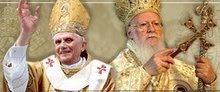
Merry Christmas from Pope Benedict...


Benedict XVI's Midnight Mass Homily
"God Finds a Space, Even If It Means Entering Through the Stable"

VATICAN CITY, DEC. 24, 2007 (Zenit.org).- Here is a Vatican translation of Benedict XVI's homily today at Christmas Midnight Mass in St. Peter's Basilica.

* * *

Dear Brothers and Sisters,

"The time came for Mary to be delivered. And she gave birth to her first-born son and wrapped him in swaddling clothes, and laid him in a manger, because there was no room for them in the inn" (Lk 2:6f.). These words touch our hearts every time we hear them. This was the moment that the angel had foretold at Nazareth: "you will bear a son, and you shall call his name Jesus. He will be great, and will be called the Son of the Most High" (Lk 1:31). This was the moment that Israel had been awaiting for centuries, through many dark hours - the moment that all mankind was somehow awaiting, in terms as yet ill-defined: when God would take care of us, when he would step outside his concealment, when the world would be saved and God would renew all things. We can imagine the kind of interior preparation, the kind of love with which Mary approached that hour. The brief phrase: "She wrapped him in swaddling clothes" allows us to glimpse something of the holy joy and the silent zeal of that preparation. The swaddling clothes were ready, so that the child could be given a fitting welcome. Yet there is no room at the inn. In some way, mankind is awaiting God, waiting for him to draw near. But when the moment comes, there is no room for him. Man is so preoccupied with himself, he has such urgent need of all the space and all the time for his own things, that nothing remains for others - for his neighbour, for the poor, for God. And the richer men become, the more they fill up all the space by themselves. And the less room there is for others.

Saint John, in his Gospel, went to the heart of the matter, giving added depth to Saint Luke's brief account of the situation in Bethlehem: "He came to his own home, and his own people received him not" (Jn 1:11). This refers first and foremost to Bethlehem: the Son of David comes to his own city, but has to be born in a stable, because there is no room for him at the inn. Then it refers to Israel: the one who is sent comes among his own, but they do not want him. And truly, it refers to all mankind: he through whom the world was made, the primordial Creator-Word, enters into the world, but he is not listened to, he is not received.

These words refer ultimately to us, to each individual and to society as a whole. Do we have time for our neighbour who is in need of a word from us, from me, or in need of my affection? For the sufferer who is in need of help? For the fugitive or the refugee who is seeking asylum? Do we have time and space for God? Can he enter into our lives? Does he find room in us, or have we occupied all the available space in our thoughts, our actions, our lives for ourselves?

Thank God, this negative detail is not the only one, nor the last one that we find in the Gospel. Just as in Luke we encounter the maternal love of Mary and the fidelity of Saint Joseph, the vigilance of the shepherds and their great joy, just as in Matthew we encounter the visit of the wise men, come from afar, so too John says to us: "To all who received him, he gave power to become children of God" (Jn 1:12). There are those who receive him, and thus, beginning with the stable, with the outside, there grows silently the new house, the new city, the new world. The message of Christmas makes us recognize the darkness of a closed world, and thereby no doubt illustrates a reality that we see daily. Yet it also tells us that God does not allow himself to be shut out. He finds a space, even if it means entering through the stable; there are people who see his light and pass it on. Through the word of the Gospel, the angel also speaks to us, and in the sacred liturgy the light of the Redeemer enters our lives. Whether we are shepherds or "wise men" - the light and its message call us to set out, to leave the narrow circle of our desires and interests, to go out to meet the Lord and worship him. We worship him by opening the world to truth, to good, to Christ, to the service of those who are marginalized and in whom he awaits us.

In some Christmas scenes from the late Middle Ages and the early modern period, the stable is depicted as a crumbling palace. It is still possible to recognize its former splendour, but now it has become a ruin, the walls are falling down - in fact, it has become a stable. Although it lacks any historical basis, this metaphorical interpretation nevertheless expresses something of the truth that is hidden in the mystery of Christmas. David's throne, which had been promised to last for ever, stands empty. Others rule over the Holy Land. Joseph, the descendant of David, is a simple artisan; the palace, in fact, has become a hovel. David himself had begun life as a shepherd. When Samuel sought him out in order to anoint him, it seemed impossible and absurd that a shepherd-boy such as he could become the bearer of the promise of Israel. In the stable of Bethlehem, the very town where it had all begun, the Davidic kingship started again in a new way - in that child wrapped in swaddling clothes and laid in a manger. The new throne from which this David will draw the world to himself is the Cross. The new throne - the Cross - corresponds to the new beginning in the stable. Yet this is exactly how the true Davidic palace, the true kingship is being built. This new palace is so different from what people imagine a palace and royal power ought to be like. It is the community of those who allow themselves to be drawn by Christ's love and so become one body with him, a new humanity. The power that comes from the Cross, the power of self-giving goodness - this is the true kingship. The stable becomes a palace - and setting out from this starting-point, Jesus builds the great new community, whose key-word the angels sing at the hour of his birth: "Glory to God in the highest, and peace on earth to those whom he loves" - those who place their will in his, in this way becoming men of God, new men, a new world.

Gregory of Nyssa, in his Christmas homilies, developed the same vision setting out from the Christmas message in the Gospel of John: "He pitched his tent among us" (Jn 1:14). Gregory applies this passage about the tent to the tent of our body, which has become worn out and weak, exposed everywhere to pain and suffering. And he applies it to the whole universe, torn and disfigured by sin. What would he say if he could see the state of the world today, through the abuse of energy and its selfish and reckless exploitation? Anselm of Canterbury, in an almost prophetic way, once described a vision of what we witness today in a polluted world whose future is at risk: "Everything was as if dead, and had lost its dignity, having been made for the service of those who praise God. The elements of the world were oppressed, they had lost their splendour because of the abuse of those who enslaved them for their idols, for whom they had not been created" (PL 158, 955f.). Thus, according to Gregory's vision, the stable in the Christmas message represents the ill-treated world. What Christ rebuilds is no ordinary palace. He came to restore beauty and dignity to creation, to the universe: this is what began at Christmas and makes the angels rejoice. The Earth is restored to good order by virtue of the fact that it is opened up to God, it obtains its true light anew, and in the harmony between human will and divine will, in the unification of height and depth, it regains its beauty and dignity. Thus Christmas is a feast of restored creation. It is in this context that the Fathers interpret the song of the angels on that holy night: it is an expression of joy over the fact that the height and the depth, Heaven and Earth, are once more united; that man is again united to God. According to the Fathers, part of the angels' Christmas song is the fact that now angels and men can sing together and in this way the beauty of the universe is expressed in the beauty of the song of praise. Liturgical song - still according to the Fathers - possesses its own peculiar dignity through the fact that it is sung together with the celestial choirs. It is the encounter with Jesus Christ that makes us capable of hearing the song of the angels, thus creating the real music that fades away when we lose this singing-with and hearing-with.

In the stable at Bethlehem, Heaven and Earth meet. Heaven has come down to Earth. For this reason, a light shines from the stable for all times; for this reason joy is enkindled there; for this reason song is born there. At the end of our Christmas meditation I should like to quote a remarkable passage from Saint Augustine. Interpreting the invocation in the Lord's Prayer: "Our Father who art in Heaven", he asks: what is this - Heaven? And where is Heaven? Then comes a surprising response: "... who art in Heaven - that means: in the saints and in the just. Yes, the heavens are the highest bodies in the universe, but they are still bodies, which cannot exist except in a given location. Yet if we believe that God is located in the heavens, meaning in the highest parts of the world, then the birds would be more fortunate than we, since they would live closer to God. Yet it is not written: 'The Lord is close to those who dwell on the heights or on the mountains', but rather: 'the Lord is close to the brokenhearted' (Ps 34:18[33:19]), an expression which refers to humility. Just as the sinner is called 'Earth', so by contrast the just man can be called 'Heaven'" (Sermo in monte II 5, 17). Heaven does not belong to the geography of space, but to the geography of the heart. And the heart of God, during the Holy Night, stooped down to the stable: the humility of God is Heaven. And if we approach this humility, then we touch Heaven. Then the Earth too is made new. With the humility of the shepherds, let us set out, during this Holy Night, towards the Child in the stable! Let us touch God's humility, God's heart! Then his joy will touch us and will make the world more radiant. Amen.

[Original text: Italian]

© Copyright 2007 -- Libreria Editrice Vaticana

Friday, December 21, 2007

AGNUS DEI, MISERERE NOBIS (Lamb of God, have mercy on us)

Read this absolutely ridiculous article by a female Episcopalian 'priest'. First, endure my introductory rant...
Case in point about why the priesthood is only for men; as soon as being a priest turns into being innovative or clever, is about gender or sexuality, or that one's personality is important - then the whole thing turns into a disaster for the office and the faithful. Priests (male or female) begin treating their office as if it had something to do with what 'they' can contribute, but the simple fact is that they simply need to be faithful to the office and to Tradition, not imposing their views onto the faith. Priesthood is about fidelity and obedience, just like marriage. It is difficult for us humans to bear- that God did not ordain the priesthood for women, but neither did God ordain the primordial 'sacrament' of motherhood, bearing a child in the womb for 9th months, to man. We, man and woman, are complimentary and have different roles in the mystical Body of Christ. It is little noted that the only perfect human being to have lived (besides the God-man Christ, of course) was Mary, the Blessed Mother of God; but then again, Catholicism represses women... right.

The Earthly Father: What if Mary wasn't a virgin?
By Chloe Breyer
Posted Thursday, Dec. 22, 2005, at 7:07 AM ET

At Christmas, Christians celebrate the birth of God's only son. Some believers, however, wonder if Jesus Christ is God's son only. The ancient "illegitimacy tradition" and its modern proponents propose that Jesus may have had a human father. That idea upsets one of the central mysteries of the Christian faith—the virgin conception. But it's entirely in keeping with more essential tenets: Jesus' role as the Messiah, and God's love for the poor and downtrodden. What's more, the illegitimacy tradition responds to many strange utterances about Jesus' birth in the Scriptures themselves.

Christians agree that Jesus was not conceived by Mary and Joseph while they were married. He was born so soon after Joseph took Mary into his home that it was clear she had conceived during her betrothal to Joseph. Beginning in the second century, most Christians explained the scandalously timed birth as evidence of the virgin conception. Christian leaders were still figuring out Jesus' identity at the time, and the virgin conception offered evidence of the Messiah's exceptionalism. It also made sense that if Jesus was both fully human and fully God, he should have one human parent and one divine one.

The illegitimacy tradition, by contrast, holds that the Holy Spirit supplemented, rather than replaced, Jesus' human paternity. Justin Martyr, a second-century Christian theologian, wrote of early Christians born as Jews who believed that Jesus was the natural son of Mary and Joseph. Origen, another early church father, referred to two branches of first-century Jewish Christians, collectively called the Ebionites, "the one confessing as we do that Jesus was born of a virgin, the other holding that he was not born in this way but like other men." The Gnostic Gospel of Thomas includes an enigmatic saying that may well refer to Jesus: "He who knows the father and the mother will be called the son of a harlot."

But by the fourth century, the author of Thomas and the other doubters of the virgin conception had been labeled heretics. The illegitimacy tradition was particularly unpopular with church leaders because non-Christians took the lead in articulating it—not just early rabbis, but pagan philosophers as well. (Click here for an example from True Doctrine, a pagan anti-Christian polemic written in 178.)

For centuries, the illegitimacy tradition was forgotten. But recently it has been resurrected, and not only by miracle-bashers. Its proponents include establishment theologians like Raymond Brown, author of the massive Birth of the Messiah and the commentary on John's Gospel in the Anchor Bible Series, and feminist theologians like Rosemary Radford Ruether and Jane Schaberg. To be sure, the idea isn't mainstream. In 1987, Schaberg, a biblical studies professor at the University of Detroit Mercy, published The Illegitimacy of Jesus. Her central argument was that Matthew and Luke's Gospels originally told of an illegitimate conception rather than a miraculous virgin one. University of Detroit Mercy, which is Catholic, publicly distanced itself from Schaberg's positions. She got hundreds of angry letters and a few death threats and one night awoke to discover that her car was in flames on the street outside her apartment.

Should Schaberg and other scholars who question the virgin birth be hurled into the outer darkness? The problem with dismissing them, as the fourth-century church authorities dismissed their forerunners, begins with Scripture. The biblical sources for the virgin conception are a few short passages in two of the four Gospels. In Matthew, an angel appears to Joseph, who is perplexed about his fiancee's pregnancy. Should he divorce Mary or have her stoned her to death, as the law of Deuteronomy requires? "Joseph, Son of David," says the angel, "Do not be afraid to take Mary as your wife, for the child conceived in her is from the Holy Spirit. She will bear a son and you are to name him Jesus." The angel then goes on to quote the Hebrew prophet Isaiah. "Look, the virgin shall conceive and bear a son, and they shall name him Emmanuel." (In fact, "virgin" comes from Matthew's use of a Greek mistranslation; the Hebrew in Isaiah reads "young girl.") The version in Luke is similar.

So far, the Scripture sounds pretty clear. But the infancy narratives from Matthew and Luke must be squared with some startling silences, alternative Greek translations, and a couple of snide comments from Jesus' hometown critics. Paul never mentions the virgin conception and in Galatians describes Christ as "born of a woman." John's Gospel says nothing on the subject of Jesus' conception. And Mark describes the shocked response of the synagogue-goers of Jesus' hometown of Nazareth when Jesus as an adult returns to preach and teach as God's chosen one. The Nazareth Jews presumably would have known better than anyone about the irregular timing of Jesus' birth. "Is not this the carpenter, the son of Mary?" his parents' neighbors ask one another. Since Jewish men of the time were identified in relationship to their father, Schaberg and other scholars take this remark as an insinuation about Jesus' parentage—one that was so offensive that the later Evangelists Luke, Matthew, and John changed it.

And there's more. When Mary responds to the angel's good tidings in Luke, one translation of her speech is, "How can this be, I do not know a man?" But in the Greek, the word for man is anthropos, which also means "husband." Schaberg suggests that if this is the meaning Luke intended, the text could imply that Jesus had a human father who was not Joseph. Finally, in the Magnificat, Mary's song of praise and thanksgiving to God, she says, "God has lifted up his humble maidservant." The Greek word for "humble" is the same one that the Septuagint (the old Greek version of the Hebrew Bible) uses to describe the rape of Dinah in Genesis and other incidents of sexual violation. From this, Schaberg discerns the possibility that Mary's "humility" could be "humiliation" from a sexual assault.

Admittedly, Schaberg's conjecture that the Gospel writers were obliquely conveying an illegitimacy tradition—one in which Mary was the victim of rape or seduction—is just that: conjecture. It lacks positive corroboration within the Gospels or other Christian writings. Schaberg acknowledges that she cannot prove that early Christians read the infancy narratives in the way she proposes. Still, if the Gospel writers did assume that their readers knew of an illegitimacy tradition, their words could support a figurative, rather than literal, reading of the angel's annunciation. It seems rash to rule out that historical possibility when theologically it works so well.

Can a loyal Christian believe that Christ was not born of a biological virgin? Perhaps it's worth posing a different question: Why is church authority so intent upon Mary's virginity as a historical fact? Would Jesus be any less God's son if he had an earthly father? The central message of the Gospel is that God raised up and redeemed his servant from death by crucifixion—the Roman style of execution reserved for the lowest of the low. Why couldn't God have sent the same message of divine solidarity with the world's outcasts by making a Messiah out of a man whose conception was also taboo?

Some church leaders feel the pull of the illegitimacy tradition but fear its impact. "Undoubtedly, some sophisticated Christians could live with the alternative … [but] for many less sophisticated believers, illegitimacy would be an offense that would challenge the plausibility of the Christian Mystery," Brown writes. However well-intended, that fear may be misdirected. When she published her book, Schaberg got seven grateful or supportive letters for every angry one she received. More than a century ago, Elizabeth Cady Stanton wrote, "If a heavenly father, why not a heavenly mother? And if an earthly mother, why not an earthly father?" She continued, "I think the doctrine of the Virgin Birth as something sweeter, higher, nobler than ordinary motherhood, is a slur on all the natural motherhood of the world." An unveiled illegitimacy tradition offers this Christmas gift: the restoration of natural motherhood to its rightful place in the miraculous.

Thursday, December 20, 2007

U.S. News & World Report: The Return to Tradition


Some of the article below...

A Return to Tradition:
A new interest in old ways takes root in Catholicism and many other faiths

By Jay Tolson
Posted December 13, 2007

Worshipers come to St. Mary, Mother of God in downtown Washington, D.C., for various reasons, but many say that a big draw is the Tridentine Latin mass that is said here every Sunday. Soon, St. Mary may be less well known for that distinctive liturgical offering than for the number of big-name government and media types that occupy its pews. Now that Pope Benedict XVI has loosened the restrictions on churches that want to observe the pre-Vatican II rite, more parishes are availing themselves of the option. Call it part of a larger conservative shift within the church—one that includes a renewed emphasis on such practices as personal confession and reciting the rosary as well as a resurgent interest in traditional monastic and religious orders.

...

Something curious is happening in the wide world of faith, something that defies easy explanation or quantification. More substantial than a trend but less organized than a movement, it has to do more with how people practice their religion than with what they believe, though people caught up in this change often find that their beliefs are influenced, if not subtly altered, by the changes in their practice.

Put simply, the development is a return to tradition and orthodoxy, to past practices, observances, and customary ways of worshiping. But it is not simply a return to the past—at least not in all cases. Even while drawing on deep traditional resources, many participants are creating something new within the old forms. They are engaging in what Penn State sociologist of religion Roger Finke calls "innovative returns to tradition."

Ahhhhhh. I love being Catholic!


Cardinal Ratzinger, now Pope Benedict XVI, is enjoying a nice, fat stein of German brew. Any Church whose clergy are seen in habit - draining a 32 oz hefeweizen - is a friend of mine. See, we're not so bad!

"Integrity"

by Rod Dreher (http://blog.beliefnet.com/crunchycon/)

The other night, I spoke to my friend (and godfather) Vladimir Grigorenko, the iconographer at St. Seraphim Orthodox Cathedral here in Dallas. He told me in passing that an editor at Time magazine had contacted him some weeks back and asked him if he would create an icon for them. The subject was not Jesus Christ, nor the Virgin Mary, nor any saint.

The subject was Vladimir Putin.

Our Vladimir told them no, it was out of the question. Putin, in the place of Christ or a saint? That would be a travesty. His objection was not political, but theological. Vladimir told me the editor then asked for a recommendation of an iconographer who would be willing to take the commission. "I told him I would not recommend anybody take such a commission," Vladimir told me.

"Vladimir," I said, "do you understand what you've done? Time is probably going to name Putin their Person of the Year. If you took that commission, you would become world-famous. Your work would have been seen everywhere. You might have made a lot of money out of it."

"What is that?" he said, dismissively. It wouldn't be right to do such a thing, he continued, so there was never any question of fame or riches. Putin deserves to be the Person of the Year, he went on, because of his impact on Russia and the world, but Putin should not be depicted in anything resembling an icon.

I've been thinking since our conversation about the religious and artistic integrity in the stance he took. To talk to Vladimir about it is to realize that for him it wasn't any real temptation. The things of God are reserved for God. Period. Full stop. The end.

Well, I just found out that Time has indeed named Putin its Person of the Year. And they used on the cover a photograph of Putin. Time obviously abandoned its plan to render Putin as an Orthodox icon, and I hope it was because they could find no iconographer willing to go along with it. Still, think for a minute about the witness Vladimir Grigorenko gives by his refusal of fame and fortune for the sake of honoring God and sacred tradition. Could you do that? If you were an artist -- and not a wealthy one -- and were given the opportunity to draw the cover of the most important issue of one of the most important magazines in the world, would you be able to turn it down as instantly and as definitively as Vladimir did?

I hope and pray that I would have done so, but I know myself, and my own weaknesses, too well to say for sure. I think I would have reached the same conclusion he did, and that it wouldn't have taken very long to have done so, but I don't know that for sure. The world can be so alluring, the temptation to compromise comes in all kinds of ways, and the ability of we frail humans to rationalize is enormous.

And then a guy, an ordinary guy, a guy you go to church with, and goof around with, comes along and does something like that, and bam!, you realize what integrity really is. He makes it look easy. But see, this doesn't come from nowhere. Vladimir, who is 43, was raised in the Soviet Union by parents who were party members and atheists. After the fall of the USSR, he discovered Orthodox Christianity, and converted. He became an iconographer (my Dallas Morning News colleague Jeff Weiss profiled him seven years ago). Now he and his wife and kids live in Dallas, where he has spent the past few years creating the iconography for the inside of St. Seraphim Cathedral (click that link to see his work, or come by for evening vespers or Sunday morning liturgy; you really have to see the glory of God shining forth from these images in person). The Grigorenkos are deeply faithful to the church, in a steady, unobtrusive, humble way. Here's Vladimir's website, where you can see more of his iconography.

The thing I realized thinking this week on Vladimir's decision was that to get to the point where you can take a stand like that for God, at serious professional sacrifice to yourself, you have to die to yourself in countless little ways, every single day. If any of us are to find the strength and the courage to stand up for our beliefs in ways that cost us, we have to live the Christian life in a faithful, disciplined way, every day of the year.

Last night at dinner, Vladimir and I were discussing the challenge of raising faithful Christian children in our culture, and he said, "Listen, you can't just tell your children what to believe. You have to show them. You can't force them to believe what you believe, or hit them over the head with the faith. You have to live it out. In our family, the church is our life. You show that to your children, and leave the rest up to God."

This week, Vladimir showed his children what it means to be a Christian. And not only his children.

If the Archbishop of Canterbury doesn't believe in them, who will?


Read below... seriously, I'm not making this stuff up about Williams!

Posted by Damian Thompson on 20 Dec 2007 at 12:13

Does Rowan Williams EVER think before opening his mouth? He waits until the week before Christmas before describing the nativity as a “legend” and condemning the poor wise men, asses and oxen to the realms of fantasy.

Yes, it’s true that most biblical scholars agree with him. But really – has the Archbishop of Canterbury got nothing better to do than dismantle the Christmas story on Radio Five Live, for God’s sake? Can you imagine Pope Benedict XVI going on Simon Mayo’s show to chip away at the naïve beliefs of millions of Christians?

Rowan Williams is not like the former Bishop of Durham, David Jenkins, who really didn’t believe in lots of major Christian doctrines. (“I’m not sure about this eternal life thing,” I once heard him say at a conference.) The Archbishop firmly believes in the Virgin birth, for example; there’s not even a hint of agnosticism in his liberal theology.

But where Dr Jenkins used to drop his publicity-seeking bombshells deliberately, just in time for Christmas or Easter headlines, Dr Williams blunders aimlessly into these controversies. Also just in time for Christmas.

Thursday, December 13, 2007

Will Rowan Williams prove to be the end of Anglicanism?

Archbishop 'confused' about radical Islam

By Damian Thompson Last Updated: 1:44am GMT 26/11/2007

Commentary

One wonders what the millions of Christians persecuted by Islamist terrorists and governments will make of the Archbishop of Canterbury's interview with a Muslim lifestyle magazine. If they are looking for a condemnation of Islamic violence, they will be disappointed.

Dr Rowan Williams is "surprised" by the way Pakistani Muslims perceive local Christians as "deeply threatening". He feels that the Muslim world should be ready to acknowledge that "their present political solutions aren't always very impressive" and that they should consider learning from "classical liberal democracy". And that's it.

The rest of the interview is given over to attacking the United States and "Christian Zionists" - hardly a bold stance in a Muslim magazine.

Dr Williams has a history of anti-Americanism dating back to his student days; he is a self-described "hairy Lefty" who, now that Tony Blair is out of the way, feels comfortable reverting to his default position. And, up to a point, that is fair enough.

If the Archbishop feels that America has lost the moral high ground since September 11, then he is entitled to say so; many churchgoers will agree, and warmly endorse his suggestion that the United States should recover that ground by launching "a generous and intelligent programme of aid".

How will American Anglicans react to his words? To be sure, most of them despise President Bush - but they may not enjoy being lectured on imperialism by a Primate who is pulling the colonial strings of the Anglican Communion to draw them into submission to his policies.

By choosing this moment to compare the American "empire" unfavourably to the British one, Dr Williams is confirming that he lacks the political skills to host what will surely be the last Lambeth Conference.

What this interview also displays, however, is a much more worrying confusion about the nature of radical Islam.

Christians in Indonesia, Africa and the Middle East are being beaten, imprisoned, tortured and killed in the name of Allah. Moderate Muslims in Britain desperately need to be made aware of this situation.

And what has the Archbishop of Canterbury given them? Yet another sermon on the evils of Yankee imperialism.

=========================AND=====================================
The return of George Leonard Carey
Posted by Damian Thompson on 12 Dec 2007 at 19:59

How fascinating that George Carey, not the current Archbishop of Canterbury, has been chosen as an intermediary to appeal for the safe release of five British hostages held in Iraq. I wonder what Rowan Williams makes of that. Hmm. I think I can guess.

Former Archbishop of Canterbury Lord Carey

And did you know that Lord Carey of Clifton now has his own website http://www.glcarey.co.uk/, complete with speeches and press releases? How shrewd. My old mate George obviously realises that, in a post-Lambeth world in which the office of Archbishop of Canterbury is almost irrelevant, he can still present himself as a major Anglican leader.

When Rowan was nominated to succeed him, George expressed “deep joy”. Likewise, I’m sure he’s experiencing “deep sorrow” at Rowan’s current problems.

Here is the key to George, in my opinion. There are lots of subjects on which he has nothing to say, because he’s a man of very narrow horizons. He’s also a natural authoritarian who demands respect. So when he was faced with difficult questions from stroppy journalists, he would waffle angrily.

But there are subjects on which George has absolutely clear views, and now that he is out of office he can devote himself to them. Unfortunately for Rowan, two of Carey’s hobby horses are a) the wonders of conservative African Christianity and b) the wickedness of pro-gay American liberalism.

Combine the two, and what have you got? Millions – literally millions – of African evangelicals and their rich American allies who regard “our George” as the real Archbishop of Canterbury because of his principled stance on gays. “This would never have happened under George,” they say, surveying the current mess – which just happens to be true.

Wednesday, December 12, 2007

A glimpse of the early Church's martyrs... via an Iraqi convert

Catholic Navy chaplain shares story of Iraqi conversion
Muslim woman asks—“Do you give up so easily on Jesus?”


Baghdad, Dec 4, 2007 / 04:48 pm (CNA).- Recently, CNA had the opportunity to send a writer to the Anbar Province of Iraq to cover the experiences of a Catholic chaplain working in the trenches. What follows is his recounting of the amazing encounter he had with this apostle in the desert.

Father Bautista: Apostle in the Desert
Joe Burns, War Stringer

A few weeks ago, I returned to the U.S. after spending a week with Army troops in Iraq. More specifically, I spent six and a half days with my son’s outfit, the 63rd Ordnance Company stationed at Al Taqaddum. Al Taqaddum is a former Iraqi airbase, nicknamed TQ, and lies about 50 miles west of Baghdad in the Anbar Province near Ramadi. My son Mike and I spent the first three days in Baghdad while I was processed for my press pass and then waited for a helicopter to become available to take us to TQ.

Al Taqaddum is covered in dust. In some areas where vehicles had repeatedly driven, the earth was ground down to a fine powder several inches deep (I was tempted to look for Neil Armstrong’s footprints!). The dust in this part of Iraq is so prevalent that it hangs in the air at all times of the day and night, clinging to clothing, nostrils and eyes.

On the second day at Al Taqaddum, I was privileged to attend Mass said by Fr. Jose A. Bautista-Rojas, a Navy chaplain who ministers to the Marines and soldiers at TQ and in the Ramadi area. It was a hot, dry, windy and desolate day.

In the 30 minutes prior to Mass, Fr. Bautista discussed recent events of the day with the three of us: my son Mike, his commander Captain Tom Heilman, and myself.

The setting for our conversation was a makeshift wooden chapel, sparsely furnished with the plastic chairs we sat on and a small white table for an altar. Being inside this simple chapel was like finding an oasis in the desert. What made this oasis most refreshing was the time we spent with Fr. Bautista, a man of irrepressible good humor, joy and generosity.

The events of that morning for Fr. Bautista included a Mass he had just conducted in Ramadi at a Marine detachment. What made the Mass unique, was that his “congregation” consisted of one lonely Catholic Marine. When Father Bautista arrived in Ramadi along with his personal bodyguard, a strong young, well-armed Marine, he visited a detachment of eight men, only one of whom was Catholic. Undeterred, he told the Marine he would be happy to say Mass for him.

The young Marine confided to him, “You know Father, back in the States, I didn’t go to Mass that often, but out here I find myself longing to go to Mass again. But I’ve been here for seven months and you’re the first Catholic chaplain I’ve seen.” Fr. Bautista spent some time listening to his story and asking questions about his family. Then he said Mass for this single Marine, in the presence of countless angels and saints who rejoiced with them.

As Fr. Bautista continued speaking with us, he described the fascinating story of a young Muslim woman who was entering the Church under his guidance through the RCIA process. Her story was moving. While working with Americans, this woman, who must remain anonymous, was touched deeply when she realized that the U.S. medical personnel not only treated wounded Americans and Iraqi civilians, but also treated wounded enemy combatants, including one who was known for having killed U.S. Marines. As she put it, “This cannot happen with us.”

This dramatic extension of mercy even to enemy soldiers caused her to take the next cautious step. She asked Father Bautista to “tell me more about Jesus.” As Father described Jesus and his life in the Gospels, one thing stood out among the rest for the Muslim woman he called “Fatima” (not her real name) and that was how kindly Jesus had related to, as she put it, “the two Mary’s.” Fatima was moved to see how Jesus deeply loved Mary, his mother, who was sinless, but also how Jesus deeply loved Mary Magdalene, who was “a great sinner.” As these discussions continued, Fatima reached a point where she said to Father Bautista, “I want to become a Christian.”

Since Father Bautista sees himself as a chaplain for all troops, not just Catholics, he decided to introduce Fatima to other chaplains from Protestant and Orthodox backgrounds. After some time had passed, Fatima returned to Father Bautista and said, “I want to become a Catholic like you.” When Father asked her the reason for her decision, she said, “You were the only one who told me about the other Christians, so you left me free to decide for myself. That’s how I knew this was the right decision.”

As their catechetical lessons developed over time, Fatima’s family discovered her plan and was warned sternly by her father that if she continued on this path, she would be disowned by the entire family and would never have contact with them again. At this point, Father Bautista became concerned for Fatima’s well-being and cautioned her to look carefully at the consequences of her decision and to think seriously before continuing her path into the Church.

Fatima paused for a moment and then looking intently at Father Bautista asked, “Do you give up so easily on Jesus?” [Fantastic. This is a raw glimpse of the spirit of the martyrs of the early Church.] The question took Father aback for a moment, but then he thought, “This is incredible; this Muslim woman is already bearing witness to me about how important my own faith is!”

As he related it, this woman’s question had caused him to give greater thanks for his faith and for the great privilege of sharing Christ with others. Fatima is currently continuing the RCIA process with great courage and joy.

In a wonderful irony, the first words she will hear spoken during the Liturgy of the Word in the Rite of Acceptance will be those spoken to her great ancestor, Abraham: “Leave your country (and your kindred and your father’s house), and come into the land I will show you” (Gen 12:1).

After sharing this moving testimony, Father Bautista excused himself to prepare to celebrate Mass for us. Moments later, as he led us in the prayers of Mass, I was struck by how blessed I was to be present in this moment, in the ancient dusty land of Abraham, who so willingly offered his only son to God. Now, together with Abraham and his son, Isaac, with all the angels and saints, with our own brave son and his commander, we returned to this same land and heard these magnificent words:

“Look with favor on these offerings and accept them as you once accepted the gifts of your servant Abel, the sacrifice of Abraham, our father in faith, the bread and wine offered by your servant Melchisedech …”

Here, in the same treeless, windy, dusty desert from which God had called Abraham, Christ had returned. Now, through the hands of his servant priest, Father Bautista, a perfect offering was made to fulfill the offering attempted by Abraham. And through this same priest, the Good News that was foretold to Abraham now returned to his homeland to bear witness to a courageous Muslim woman; a woman who was willing to sacrifice everything to know this Jesus who forgives even his enemies and who loves even the sinful Mary.

Putin kisses an icon... of himself!


Russian sect prays to Putin icons, claims he is the chosen one
RIA Novosti, Russia
Dec. 11, 2007

MOSCOW, December 11 (RIA Novosti) - Vladimir Putin may be popular in Russia for saving the nation from the chaos of the 1990s, but a sect in the country has taken its devotion a step further by praying to ‘presidential icons.’

The Bolshaya Elnya village in the Nizhny Novgorod Region is home to the “Rus’ Resurrecting” sect, a group of local residents who believe that President Putin was both the Apostle Paul and King Solomon in previous lives.

Rus’ is the term used for the medieval East Slavic nation that gave its name to modern Russia.

“We didn’t choose Putin,” Mother Fontinya told the Moskovsky Komsomolets paper, expounding on the first time she laid eyes on the “holy one.”

“It was when Yeltsin was naming him as his successor [during a live New Year’s Eve TV broadcast in 1999]. My soul exploded with joy! ‘An ubermensch! God himself has chosen him!’” I cried.

“Yeltsin was the destroyer, and God replaced him with his creation,” claimed Fontinya.

The sect possesses a President Putin icon that Fontinya claims miraculously appeared one day.

“He has given us everything,” she said, pointing to the sky.

A special newspaper published by the sect - ‘The Temple of Light’ - features interviews with long-dead religious figures, including the Apostle Paul. The sect members are also convinced that President Putin knows about and supports the actions of their ‘Mother Superior.’

Russian Christian sects have long been known for their unusual choices of icons, some of them praying to portraits of such well-known ‘holy men’ as Stalin and Ivan the Terrible.

Another Russian sect is currently holed up in an underground shelter in the country’s central Penza Region and has threatened to commit mass suicide if any attempt is made to bring them to the surface.

Religion was tightly controlled in the U.S.S.R. and the collapse of the Soviet Union saw an explosion in sects and cults, as well as interest in New Age philosophies and beliefs. The back pages of many Russian tabloid newspapers are full of advertisements for ‘healers’ and ‘magicians’ who promise to bring happiness in love, success in business, as well as a range of other services.

One of the most well-known sects in Russia has its base near the southern Siberian town of Abakan, where thousands of people, both Russian and foreign, worship a former provincial traffic policeman, Sergei Torop, as the second coming of Christ.

There are currently believed to be around 500-700 such sects in Russia, containing some 600,000-800,000 people.

Technorati Tags: Rus Resurrecting, Russia, Vladimir Putin, Putin

Historian: First English Bible Fueled First Fundamentalists


This story from:
http://news.yahoo.com/s/livescience/20071211/sc_livescience/historianfirstenglishbiblefueledfirstfundamentalists
Tue Dec 11, 8:55 AM ET

The translation of the Bible into English marked the birth of religious fundamentalism in medieval times, as well as the persecution that often comes with radical adherence in any era, according to a new book.
ADVERTISEMENT


The 16th-century English Reformation, the historic period during which the Scriptures first became widely available in a common tongue, is often hailed by scholars as a moment of liberation for the general public, as it no longer needed to rely solely on the clergy to interpret the verses.

But being able to read the sometimes frightening set of moral codes spelled out in the Bible scared many literate Englishmen into following it to the letter, said James Simpson, a professor of English at Harvard University.

"Reading became a tightrope of terror across an abyss of predestination," said Simpson, author of "Burning to Read: English Fundamentalism and its Reformation Opponents" (Harvard University Press, 2007).

"It was destructive for [Protestants], because it did not invite freedom but rather fear of misinterpretation and damnation," Simpson said.

It was Protestant reformer William Tyndale who first translated the Bible into colloquial English in 1525, when the movement away from Catholicism began to sweep through England during the reign of Henry VIII. The first printings of Tyndale's Bible were considered heretical before England's official break from the Roman Church, yet still became very popular among commoners interested in the new Protestant faith, Simpson said.

"Very few people could actually read," said Simpson, who has seen estimates as low as 2 percent, "but the Bible of William Tyndale sold very well—as many as 30,000 copies before 1539 in the plausible estimate of a modern scholar; that's remarkable, since all were bought illegally."

When Catholicism slowly became the minority in the 1540s and 50s, many who hadn't yet accepted Protestantism were berated for not reading the Bible in the same way, Simpson said.

"Scholarly consensus over the last decade or so is that most people did not convert to [Protestantism]. They had it forced upon them," Simpson told LiveScience.

Persecution and paranoia became the norm, Simpson said, as the new Protestants feared damnation if they didn't interpret the book properly. Prologues in Tyndale's Bible warned readers what lay ahead if they did not follow the verses strictly.

"If you fail to read it properly, then you begin your just damnation. If you are unresponsive … God will scourge you, and everything will fail you until you are at utter defiance with your flesh," the passage reads.

Without the clergy guiding them, and with religion still a very important factor in the average person's life, their fate rested in their own hands, Simpson said.

The rise of fundamentalist interpretations during the English Reformation can be used to understand the global political situation today and the growth of Islamic extremism, Simpson said as an example.

"Very definitely, we see the same phenomenon: newly literate people claiming that the sacred text speaks for itself, and legitimates violence and repression," Simpson said, "and the same is also true of Christian fundamentalists."

"Killed for not wearing a hijab"


This article is from Rod Dreher (the Crunchy-Con).
He has a pretty pithy blog.
Some of you will like him even more because he was Catholic and converted to Orthodoxy.

http://blog.beliefnet.com/crunchycon/2007/12/killed-for-not-wearing-a-hijab.html

This happened not in Iran, not in Palestine, not in Saudi Arabia or Iraq or Pakistan. This happened in Canada. Where journalist Mark Steyn and Maclean's magazine are facing federal human rights charges for a 2006 article Steyn wrote in which he engaged in a critical discussion of Muslim demographics. Here's Stanley Kurtz's must-read backgrounder on l'affaire Steyn, in which Muslims are using the state's human rights laws in an attempt to silence free speech. Steyn points out a certain glaring hypocrisy in his chief Muslim critic's stance here.

I'm sure if we look hard enough, we can find Christian fathers murdering their daughters for not wearing hijabs. Or something to blame the rest of us for this alleged crime (see the question from the Canadian TV station in that item). Manning's Corollary, you know.

Tuesday, December 4, 2007

More news to make you sigh....


Here's the story...


'Green Hanukkia' campaign sparks ire

In a campaign that has spread like wildfire across the Internet, a group of Israeli environmentalists is encouraging Jews around the world to light at least one less candle this Hanukka to help the environment.

The founders of the Green Hanukkia campaign found that every candle that burns completely produces 15 grams of carbon dioxide. If an estimated one million Israeli households light for eight days, they said, it would do significant damage to the atmosphere.

Read the rest of this great story here:
http://www.jpost.com/servlet/Satellite?cid=1195546797524&pagename=JPost/JPArticle/ShowFull

Sunday, December 2, 2007

Gag me with a spoon. . .


A new book...
titled.... (drumroll)
The Two Marys: The Hidden History of the Mother and Wife of Jesus

Are you kidding me?!

Here's what Amazon says... unbelievable how stupid people are; even more unbelievable how stupid Amazon thinks Christians are.

Editorial Reviews

"Ms. Browne is as close as publishing gets to a sure thing." [yeah, shameless...]
-The Wall Street Journal

Book Description
Many controversies have remained unanswered in Christianity for centuries [uhhh, yeah like "was Jesus married?" I know that was the first question I had after reading the Gospels. Guffaw.]. Some of these controversies have recently drawn increased attention due to new discoveries in archaeology [B and S] as well as bestsellers and movies such as The Jesus Tomb and The Da Vinci Code. With the unique perspective only Sylvia Browne could bring, The Two Marys focuses on one of the greatest unknowns: the lives of the two most important women in the life of Jesus.

Jesus' mother had an enormous influence on him, which has mostly been marginalized by the Christian churches [Yeah, for instance in Catholicism...]. Contrary to the beliefs of all the Christian religions, Jesus did marry Mary Magdalene [notice the editorial trump card- "What??? You didn't know that FACT, you must be a stupid Christian." Thanks, Amazon.], and she too influenced his teaching. In The Two Marys, New York Times bestselling author Sylvia Browne uncovers the hidden history of these two women in a remarkable book that will be the perfect gift this Christmas season.

Saturday, December 1, 2007

SPE SALVI: "In hope we were saved"

ROMA, November 30, 2007 – The encyclical on hope "Spe Salvi," which Benedict XVI signed and published today, the feast of Saint Andrew and just two days before the beginning of Advent, was motivated by these factors described in paragraph 22:

"A self-critique of modernity is needed in dialogue with Christianity and its concept of hope.

"In this dialogue Christians too, in the context of their knowledge and experience, must learn anew in what their hope truly consists, what they have to offer to the world and what they cannot offer.

"Flowing into this self-critique of the modern age there also has to be a self-critique of modern Christianity, which must constantly renew its self-understanding setting out from its roots."

In this twofold "self-criticism" of modern culture and Christianity, the pope continues, "reason and faith need one another in order to fulfil their true nature and their mission."

These few lines clearly show how strongly the encyclical is marked by Joseph Ratzinger as philosopher, theologian, and pope.
But it would be a mistake to expect to read in it nothing more than an erudite lecture. The style is vibrant, the exposition rich with imagery, and the narrative enlivened by a wide cast of characters.
The entire story of the world passes before the eyes of the reader, from its beginning to end. The final pages on Christ as judge, on hell, on purgatory, on paradise, are stunning for their mere presentation – having disappeared almost completely from the preaching in the churches – and even more for the way in which they are developed.
The text is required reading from start to finish, as is always the case for the writings of Benedict XVI, which never have just one key page or the easily isolated central passage.

*Read the entire encyclical on Christian hope here:
http://www.vatican.va/phome_en.htm

"Christian roots aren't European"


Church's Roots Aren't European, Says Pope
Comments on Syriac Poet-Theologian

VATICAN CITY, NOV. 28, 2007 (Zenit.org).- Christianity didn't originate in Europe, but rather has its roots in the Middle Eastern world of the Old Testament, says Benedict XVI.
The Pope said this today during the general audience in Paul VI Hall, which he dedicated to the figure of St. Ephrem the Syrian, a fourth-century theologian, poet and musician.
He said the reflection continued along the lines of his commentary last week on the fourth-century Syriac Christian Aphraates, which also showed the cultural diversity of the early Christians.
"According to general opinion," said the Pontiff, "Christianity is a European religion that has exported the culture of this Continent to other countries. The reality, though, is a lot more complex, as the root of the Christian religion is found in the Old Testament, and therefore in Jerusalem and the Semitic world."
The Holy Father continued: "Its expansion during the first centuries was both westward -- toward the Greek-Latin world, where it then inspired the European culture -- and eastward to Persia and India, thus contributing to stimulate a specific culture, in Semitic languages, with its own identity."
St. Ephrem, said Benedict XIV, "was the most important representative of Syriac Christianity, and succeeded in a unique way to reconcile the vocation of the theologian with that of the poet."

Read Benedict's whole teaching on St. Ephrem here:
http://www.zenit.org/article-21138?l=english

An interesting new book


The following link has a nice excerpt from this new book offered by an exceptional publisher, Ignatius Press.

http://www.ignatiusinsight.com/features2007/areid_frwdgrkfathers_nov07.asp

Enjoy!

Wednesday, November 28, 2007

Christian dialogue with Islam...


Below are links to some really interesting articles by Sandro Magister, the author of a website out of Italy called "Chisea" (The Church). Article #3 is the most interesting, assuming you have some knowledge of the situation as a whole.

*You will have to copy and paste... sorry, I don't know how to work all this stuff yet!
#1: http://chiesa.espresso.repubblica.it/articolo/171166?eng=y
#2: http://chiesa.espresso.repubblica.it/articolo/173961?eng=y
#3: http://chiesa.espresso.repubblica.it/articolo/178461?eng=y

These articles are the most sensible dissection of what is going on in the dialogue between Christianity and Islam.

Remember that recently 138 Moslem (or Muslim, if you prefer) scholars sent a letter to leaders of Christian churches; this was primarily a response to the speech delivered at Regensburg University in Germany by Pope Benedict. This speech challenged both the modern, secular west and the radical east ('radical' Islam) to deal with the issue of faith and reason: can the two be compatible, and are they in fact essential for each others' existence? Benedict argues the latter, citing that God himself is Logos- the Word.

What Magister discusses is whether the latest ecumenical response from Christians to this letter is on topic: namely, faith and reason.

Monday, November 26, 2007

Pope Benedict's address on St. John Chrysostom


The Holy Father’s Letter on the occasion of the 16th Centenary of the death of St. John Chrysostom

The Holy Father Benedict XVI addressed bishops and all the faithful with a letter on the occasion of the 16th Centenary of the death of St. John Chrysostom, bishop and doctor of the Church. The Letter was released for the opening of the International Conference on St. John Chrysostom 1600th anniversary of his death, which took place at the Patristic Institute “Augustinianum” in Rome, from 8-10 November 2007.

Here's the entire text:
http://www.zenit.org/article-20599?l=english

Catholic - Orthodox dialogue snails along...


Here's the latest...

Catholic-Orthodox Dialogue Takes Important Step

Commission Recognizes Primacy of Bishop of Rome

VATICAN CITY, NOV. 18, 2007, (Zenit.org).- The Catholic-Orthodox theological commission's recognition of the primacy of the Bishop of Rome is an "important first step," says the director of the Vatican press office.

Jesuit Father Federico Lombardi said this in the latest edition of the weekly Vatican Television program "Octava Dies." He commented on the concluding document of the Oct. 8-14 plenary assembly of the Joint International Commission for Theological Dialogue Between the Catholic Church and the Orthodox Church, held in Ravenna, Italy.

The statement, titled "Ecclesiological and Canonical Consequences of the Sacramental Nature of the Church: Ecclesial Communion, Conciliarity and Authority," was published Nov. 15.

While the Vatican spokesman pointed out that the document also stipulated the need to study and understand the functions of the Bishop of Rome, how his primacy is to be exercised, and the scriptural and theological foundations of it, he added that this could be "an historical turn for the dialogue between Catholics and Orthodox."

"They delved into fundamental questions about the nature of the Church and they agreed that on every level -- local, regional and universal -- there is conciliarity, but also authority," said Father Lombardi.

He said that "the primacy at a universal level from ancient times of the Bishop of Rome was recognized. But there was no agreement on what his prerogatives are and on what theological and biblical bases these are founded."

Father Lombardi added that when the commission meets again in two years, it will study the theme of the primacy of the Bishop of Rome in the first millennium, "then there will be a need to study the second millennium and the councils that were held after the division between the Churches [...] to see what consensus can be reached."

Right direction

"It is a long and arduous road," said the spokesman, "but it is a road that is finally going in the direction that John Paul II wanted in 1995 with the encyclical 'Ut Unum Sint,' when he invited the separated brethren to dialogue on the theme of the Bishop of Rome's service to the universal Church."

"The historical problems of the division between the Catholics and the Orthodox have not been resolved," he added, "but a first step -- small but important -- in the right direction" has been taken.

Father Lombardi noted that, unfortunately, the representatives of the Patriarchate of Moscow were not present at the conclusion of the meeting, a reflection of old tensions between Moscow and Constantinople.

He said: "The road toward union does not regard only Catholics and Orthodox but also -- and sometimes more so -- it regards Orthodox and Orthodox, Catholics and Catholics.

"For all the pole of common attraction must be Jesus Christ, his mandate of love and his prayer 'that all be on.' Only if we all look first at Christ, can we hope that the long road will reach its goal."

Our latest selection...


Hey, fellas.

Our latest selection is proving to be very captivating read. It is interesting to see how similar Cyprian's criticisms of the Roman Empire are to what orthodox/traditional Christians would condemn in our own modern culture.

I have yet to read anything about the Church though... I guess I will have to keep reading.

Nota Bene: REMEMBER WE ARE ONLY READING UP TO PAGE 95. We will finish the book in December.

blessings,
Mike